Feeds:
Posts
Comments

Archive for July, 2009

The Urban Oasis Project is an all-volunteer organization dedicated to building food gardens in the city. Think fruits and vegetables growing in a garden in your backyard. Bananas, okra, melons, herbs, mmmm. Urban Oasis Project is the brainchild of CSA member Melissa Contreras, who together with Art Friedrich, host monthly meetings and potlucks. The next one is right around the corner, this Saturday August 1 at 4 pm in North Dade.

Art emailed details: Yvrose Valdez, has offered to host the next garden potluck at her house!  She is a Master Gardener, and I think she’s growing more than all of the community gardens combined on her modest house-lot! You don’t want to miss it!

We will begin to gather around 4PM on Aug 1st, with garden tours at 4:30 and 5PM.

At 5:30 we’ll have a quick more formal meeting to talk about the future of Urban Oasis Project, formalize some by-laws, vote in officers, and sign papers for incorporation, and officially birth the Urban Oasis Project (in the eyes of the state).

Around 6:15 we’ll kick off the potluck and feast upon the delicious wonders. Please bring a dish of some sort, or a dessert. If it’s homegrown, that’s great, but it doesn’t have to be – we know many of you are beginners and that this is a more sparse time in the harvest season for all of us.

Everyone is welcome to bring seeds and plants to trade or share with each as well!

Yvrose lives near 108th St. and NE 2nd Ave., so this will be more convenient for all of you living north of Miami.  You must RSVP for the actual address!

Send your RSVP to Art theedibleyardmiami(at)gmail.com or Melissa admin(at)urbanoasisproject.org .

Read Full Post »

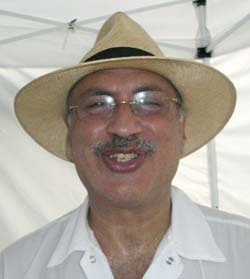
Hani Khouri says "Cheese!"

Hani Khouri says "Cheese!"

Hani Khouri, owner of Redland Mediterranean Organics (and the latest grower to join Redland Organics), makes cheese and ice cream from goat milk. Wait a minute… what’s that… goat milk ice cream? Um, how does it taste? Like really, really good ice cream. And when was the last time that you experienced a flavor like papaya-wild orchid or mango-wild orchid, fruity and sweet with a perfume-y finish. No goat flavors in the ice cream, no worries. How Hani does it is a secret, he says, and I’ve tried to find out.

The ice cream flavors run towards the tropical. There’s jakfruit, mamey, and plain mango, from fruits sourced locally in Redland and subject to availability. For traditionalists there’s vanilla bean, chocolate (to die for), peach, raspberry and strawberry. All flavors are sweetened with agave.

Hani also makes two kinds of cheeses. One is a firm cheese with texture like feta but less salt and no goat-y flavor. It’s

Labneh with olive oil

Labneh with olive oil

one of my favorites. I’ve put it in sandwiches and salads, goes great with arugula. Last Saturday I sampled Hani’s latest offering — labneh, a soft cheese with the spreadability of cream cheese, and with the familiar tang of goat (but not too much). Labneh, Hani explained to me, begins as goat milk yoghurt that is drained and salted. No fan of typical goat cheese, I hesitated before sampling the it with olive oil on whole wheat pita — and was pleasantly surprised by its flavor — a mild goat presence, but not too overwhelming — nice!

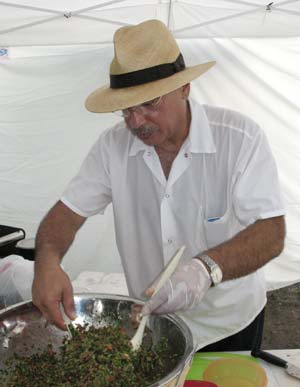
Also on the Redland Mediterranean Organics menu is hummus, tabouli, falafel and baba ganoush. They’re all super fresh. When I dropped by Hani’s tent last on a rainy Saturday afternoon at the Coconut Grove Organic Farmers Market, he was finely chopping organic mint to stir into the tabouli. (The mint was picked at Bee Heaven Farm just the day before, and so were the scallions.) The invigorating aroma of mint floated into the air and drew people to the tent. “What’s that you’re making,” they asked, and hung around waiting for him to finish.

Stirring mint into fresh tabouli

Stirring mint into fresh tabouli

“So what is local food?” Hani asked as he chopped and stirred. “How far do you go to get locally produced food?” The boundaries of a local food area could be set at 100 miles. Or it could be 400 miles. Hani quoted the Farm Bureau as saying local for Miami is anywhere from Florida. Or it could be 7 hours by truck or plane — now wait a minute, that’s pushing it! But where does local food come from — a warehouse, or the field or orchard? And how does it get to the market — airplane, truck, goat cart or walking? Hani asked again, “How far can local food travel and stay local?” I replied, “Redland Organics CSA sources food from 150 miles or less.” Hani gets his goat milk even closer than that — about 50 feet from his kitchen door to the Nubian goats that he raises. He laughed and said proudly, “I’m a local producer who’s also a chef.” He also sells what he makes, and eats what he sells.

Hungry yet? Find Hani Khouri and goodies from Redland Mediterranean Organics at the Saturday farmer’s market in Coconut Grove on Grand Ave. and Margaret St. (just west of 32 Ave.), or at the new greenmarket by The Alamo at the Jackson Memorial complex on Thursdays around lunchtime. Enjoy!

Read Full Post »
State 1, Lowes 0

What happens here in Miami-Dade County could set precedents for other counties regarding sprawl. Why don’t developers reconsider urban infill?

Florida Cabinet thwarts plan to alter Miami-Dade development boundary
The state Cabinet overruled Miami-Dade County and stopped an attempt to move the county’s western development line.
http://www.miamiherald.com/news/southflorida/story/1161697.html

Read Full Post »

Urban sprawl and farms

Urban sprawl is a hot button issue is South Miami-Dade County. Depending on whom you speak to, they’re either strongly for it or against it. The UDB, or Urban Development Boundary, is a line drawn in Miami-Dade’s master plan that separates agriculture from suburbia. Periodically and frequently, developers petition the county and state to move the line to accommodate new development. Sometimes the line moves, sometimes it doesn’t. This dance has been going on for years. Why is the UDB important? Because it allows space for agriculture, and provides a buffer between the city and the Everglades, an important source of our drinking water. Look at Broward County. They don’t have a UDB — and count how many farms, groves and ranches remain.

Recent editorial in The Miami Herald (7/24/09):
Hold the line on development

http://www.miamiherald.com/opinion/editorials/story/1155156.html

Recent related article in the Miami Herald (6/29/09):
Infill development will help hold line

http://www.miamiherald.com/business/story/1116072.html

Read Full Post »

Florida Small Farms Conference

Today is the last day to register at the regular attendee fee for the UF/IFAS Florida Small Farms Alternative Enterprises Conference in Kissimmee on August 1 and 2. You can still register after today, but you’ll pay a little more.

If you want to meet growers from Redland Organics, several of them will be presenting and/or participating on panels. On Saturday, Nick Pikarsky (Bee Heaven Farm) will give a talk on “Farm Solar Energy Applications.” On Sunday morning, Margie Pikarsky (Bee Heaven Farm) will be on the panel “Farm Enterprises to Increase Cash Flow.” Later on Sunday, Chris and Eva Worden (Worden Farm) will be on the panel “I’ll Buy from You Because…” RO members Hani Khouri of Redland Mediterranean Organics, and Gabriele Marewski of Paradise Farms will also be in attendance. Keep your eyes open for Donna Reno of Slow Food Miami, and Marty Mesh of Florida Organic Growers and Consumers Inc. (FOG).

According to the conference web site, “all Florida small farmers are faced with similar challenges of (economics: land, gas, inputs) increasing regulatory pressures, challenges of marketing, etc. so that by coming together as a diverse group, solutions can be identified.” There are six different tracks, ranging from business and marketing to horticulture to policy and regulations. If you are interested in taking your farm (or garden) to the next level, this conference will have plenty to offer.

Read Full Post »

Older Posts »