Feeds:
Posts
Comments

Archive for October, 2009

Redland Raised, Fresh From FloridaRedland Raised launch event:
Thursday Oct. 29th, 10- 11 am
Publix at Tropicaire Shopping Center
7805 SW 40th Street, Miami

Starting this week, you won’t have to go too far to find locally grown produce. Redland Raised branded green beans, yellow squash, zucchini, boniato, okra and avocados will be available at all 1000 Publix stores in the state, during the local growing season which runs from November through April.

Miami-Dade County, Publix and the Florida Department of Agriculture and Consumer Services Fresh From Florida program teamed up to promote a “buy local” program throughout the county and state.

Charles LaPradd, Miami-Dade’s agriculture manager, was quoted as saying, “We were looking for a way to just make our local produce down here known a little bit better,” LaPradd said. “When you go local, you go green.”

Needless to say, larger local growers are delighted with this huge new market for their produce. Publix says the Redland Raised will help them keep transportation costs down, which should result in lower prices for customers, and a smaller carbon footprint.

Miami-Dade County’s agriculture industry is number two in the state (after Palm Beach County) and 18th in the country, generating an estimated $2.7 billion for the local economy.

On the Miami-Dade County web site, on the Office of the County Mayor’s page:

Buy Local, Redland Raised available at Publix

For South Floridians who want to buy local… the shopping experience is about to get even better. Thanks to a partnership with Publix Super Markets, more than 1,000 Publix stores will soon feature locally-grown fresh produce. The produce will be dubbed Redland Raised.

Along with ”organic”, ”buy-one-get-one-free”, and ”on sale” – Redland Raised can be the new buzz word in grocery store shopping. While Publix has always supported our local agriculture industry – shoppers who walk the produce aisle can now look for special labeling and displays that show when green beans, zucchini, avocados and more come from our very own backyard.

Redland Raised is a way to educate and encourage our residents to invest in local produce and in turn, stimulate our local economy. Miami-Dade County’s agriculture industry is number 2 in the state and number 18 in the country, generating an estimated $2.7 billion for our local economy.

I would like to thank Publix Super Markets for making it possible to promote our local brand, and for their continued investment in our community.

Enjoy Redland Raised!

Sincerely,
Mayor Carlos Alvarez

Read Full Post »

Arazá! What a wonderful name! Too bad the fruit is so tart…. But Farmer Margie told me that Hani Khouri of Redland Mediterranean Organics was going to make ice cream with it. Robert Barnum confirmed he had sold some fruit. Hot on the trail, I spoke with Hani and he promised that arazá ice cream would be available at the Edible Garden Festival at Fairchild Tropical Botanic Garden.

Arazá ice cream

Arazá ice cream

So I braved sporadic rain showers on Saturday, sidled up to Hani’s tent and asked, “Got arazá?” Yes, he said, and his son Jad handed me a container from the cooler. The only ingredients are arazá, agave nectar, and fresh goat milk. The ice cream is pale yellow in color, sweet and tart at the same time, with a “yogurt-like flavor in the back as a finish,” as Hani described. From the first spoonful I was in a swoon, lost in the blend of sweet-tart-tangy flavors and the smooth, creamy texture. Almost forgot to photograph it, that’s why there’s some missing in the picture. It’s now my new favorite flavor. Sorry, mango-orchid. Sorry, papaya.

Hani started heating organic safflower oil in the big fry pan to make falafel, and I realized that a) I hadn’t had lunch and b) I hadn’t eaten his falafel in ages. Time to remedy that.

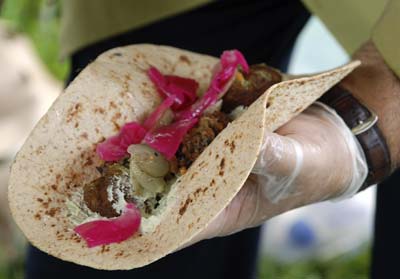
First came the flatbread, smeared with a dab of tahini sauce green with mint. Then three golden nuggets of falafel were topped with amba, fermented pickled green mango flavored with fenugreek and mustard seeds. “It’s spicy,” Hani warned, adding a small amount. (He claims that Farmers Margie and Gabriele are addicted to his amba.) I like how it added an exotic bite. Then came pickled turnips (bright pink from beets), thinly sliced cucumber and chopped tomato. Uniquely flavorful, this style of falafel is lighter than what I’ve tried elsewhere, and was told those particular toppings are quite popular in Israel.

Making falafel

Assembling falafel with pickled turnips

Redland Mediterranean Organics has teamed up with Sous Chef 2 Go and is sharing a tent at the Jackson Memorial Hospital farmers market. It happens on Thursdays in front of the Alamo building. Go look for their tent at lunchtime. The arazá ice cream is waiting to meet your taste buds. Also new on the menu is chicken roll — chicken seasoned with sumac (which gives it a cinnamon-like taste), rolled in dough and baked. And don’t forget the goat cheese!

[Note: Hani Khouri called me on Nov. 11 to tell me that he’s no longer selling at this market due to a sharp increase in vendor fees. He and Sous Chef 2 Go are partnering in a new lunch menu at the shop in Kendall. Look for my review coming soon.]

The Jackson Memorial Foundation Green Market @ Alamo Park
1611 NW 12th Ave., Miami
Inside the JMH Campus
Open Thursdays from 9 a.m. to 4 p.m.

Read Full Post »

Arazá the "Amazonian pear"

Arazá the "Amazonian pear"

A box of arazá (eugenia spititouta stipitata) showed up in Farmer Margie’s barn last week. Robert Barnum had dropped it off. The fruit is round and yellow, with soft velvety skin like a peach but smoother — “smooth as a baby’s behind,” as Robert described. Arazá is very soft when ripe, smells sweet and perfumey but tastes incredibly tart.

Farmer Gabriele stopped by and tried to eat a whole fruit but failed at the attempt. “It got me in the glands in my neck,” she said as she pointed to the sides of her throat. Each fruit has twice as much vitamin C as one orange, so it is said on the Internet.

Because of the fruit’s tartness, you don’t eat it fresh out of hand, Robert cautioned, and suggested that it might be better used to make a bebida (drink), daiquiris or ice cream. Here’s a recipe from The Cantankerous Chef himself:

Arazá Bebida

Cut up fruit, removing seeds and calyx. The skin is thin and can remain. Put fruit in blender and puree. You can freeze some in ice cube trays if you aren’t going to use it all at once. Add banana (to thicken it), sugar (or honey or agave) to taste, ice, and water and blend thoroughly.

For sorbet, leave out the banana and freeze the mixture. For daiquiris, add rum. For ice cream, add heavy cream and freeze.

Robert has been growing arazá at Possum Trot Nursery for the last 30-40 years. He learned about it on a trip to Costa Rica visiting friends who have a grove and run the Tiskita Lodge. (The fruit originally comes from the Ecuadorean rainforest.) Robert brought back seeds and planted them among the avocados in his grove, where the shrubby understory trees tolerate partial shade. They bear three or four crops a year. The trees are blooming now and will bear fruit again in about four months. If you want to buy arazá fruit, you can give Robert a call at 305-235-1768.

Read Full Post »

Go make your beds

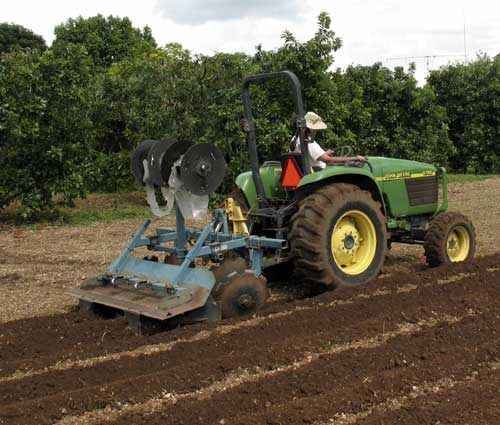
A lot of behind the scenes prep work goes on at Bee Heaven Farm before the first seeds are planted. The cover crop, which fixes nitrogen and other nutrients, has been mowed and tilled under to also add organic matter to the soil. The next step is to create rows of raised beds, where the vegetables will get planted.

Making beds

Making beds

The bedding attachment behind the tractor cuts into the soil and shapes it into a bed with channels on either side (where tractor tires pass). Native soil is not very deep in Redland. It averages about 1/4 inch over limestone rock. At Bee Heaven Farm — after rock-plowing, years of building up organic matter, and mounding up the beds — soil is maybe 4-6 inches deep, and very rocky. That’s it! That’s what your food grows in! The beds then need to be shaped and leveled by hand with a hoe. Rows of plants will then get planted by hand or with a seeder in each bed, either as transplanted starts or directly seeded. Tomatoes are planted in one row, beets in 4 rows, greens in 8 rows, or anything in between.

Bedding attachment

Bedding attachment in action

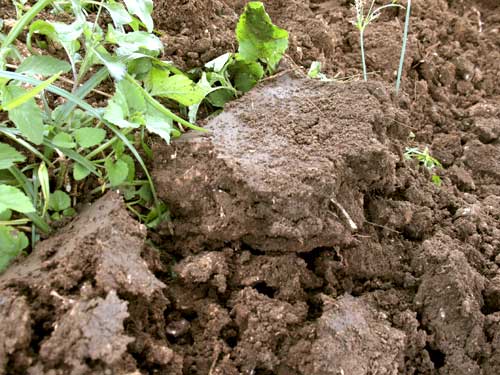
This past Saturday when I arrived, Farmer Margie was driving the tractor with the bedding attachment on the back, making passes up and down the main planting area. The bedding process wasn’t going very well. I saw one row wasn’t straight, kind of tapered into the next row. As she climbed down from the tractor, Margie explained that was where the tractor had actually slipped in the ground. The soil was wet from scattered rain showers blowing through because of a cold front. The wet soil was also getting compacting into clay-ey clumps, losing aeration and fluffiness that had been created by tilling. (For a detailed explanation of soil compaction and air spaces, read Margie’s post on tilth at Bee Heaven Farm’s Blog.)

Wet soil clumps

Wet soil clumps

Margie grumbled that she would have to wait until the weather cleared and the soil dried out, then till all over again to erase the curving beds of compacted soil, and attempt bedding again. Clearly every step of the growing process is affected by weather, in ways both subtle and obvious. Too much rain, not enough rain, too hot, too cold, too windy — the farmer is almost always at the mercy of the weather.

Read Full Post »

The Miami-Dade County Cooperative Extension staff, in an expression of our appreciation for our supporters and friends in our recent budget resurrection, would like to invite the community to a “Thank You” reception on Tuesday, October 27th from 3 to 6 PM. As this is an informal gathering we do not expect to have a program or an agenda. No speeches or presentations, just light refreshments, snacks, and fellowship.

Please come by for afternoon break or stay the while! We all would enjoy having some time to individually thank each member of the community that worked behind the scenes, communicated with the County Commission, and/or took the time to speak at one or numerous public meetings on our behalf .

Hope to see you all.

Best regards,

Don Pybas

UF/IFAS Extension Office
18710 SW 288 St.
Homestead, FL 33030-2309
Phone  (305) 248-3311

Read Full Post »

Older Posts »