Feeds:
Posts
Comments

Archive for July, 2010

Avocado bliss

Seen at the the Pinecrest Whole Foods on Friday.

The time has come to pick avocados. Last week Farmer Margie mustered her crew of mostly volunteers and they went through the grove to gather the first of the season. Thirty bushels of certified organic Donnie avocados went straight to the area Whole Foods warehouse, and I’m told that the fruit just flew out of the stores. This week Margie’s crew picked again, and she took 30 more bushels to the WF warehouse on Thursday. I found her Donnie avocados at the Pinecrest Market on Friday afternoon. They are selling for $3.49 each, ouch! But even at that price, there may not be many left today.

But all is not lost. I’ve learned about Number Two fruit. Those are avocados that have scuff marks on their skins, superficial blemishes that that are bigger than a certain allowed size.  The fruit rubbed against a branch while it was maturing and it made for a dark mark. Stores don’t like blemished fruit, but they are just as good.

Last week I bought a half bushel of Number Twos to re-sell to friends and co-workers for $2.50 each. Like their pristine brethren that went to WF, these avocados sold very fast. This week I sprang for a full bushel of Twos. People wanted more, or saw they missed out and were calling me with orders.

This dramatic scuff mark is cosmetic, doesn't affect the flesh inside. Whole Foods doesn't want this fruit, but I do!

Local fruit makes people happy! Case in point, I took a half bushel of avocados to my doctor’s office. She is a holistic practitioner, and she and her hard working staff and patients know that avocados are good for you. I staggered in with the heavy box of fruit, set it on the floor, and everybody pounced. My doctor did the most interesting thing — she cradled a large green avocado to herself, stroked it with her hand, and giggled with delight. Other staffers were smiling as they sorted through the box. One woman picked out a fruit, then another, then went off with three avocados clutched to her chest. Altogether a dozen avocados found new homes so quickly I felt almost giddy.

I saw that grin, heard that giggle, and watched people pet and stroke the smooth, green shiny skinned avocados over and over on Thursday and Friday as I made my deliveries. And once you’ve actually eaten a Donnie from Bee Heaven, that’s it, you’re hooked on the creamy, nutty flavor. Last week a friend got one avocado, then ask me for four more this week. “Are you sure,” I asked. “Oh yes,” was her answer, said with a smile and sigh of bliss. “I want them. They’re buttery.”

Another thing I heard often is, “I’m going to eat the whole avocado for lunch.” Easy to say now, when the fruit is only about a pound and a half in size. Wait a few weeks when they have increased to three pounds — or more. Last summer a friend claimed that he could eat a whole three pound avocado by himself in one sitting. “That’s a pretty big avocado. I can only eat half or less at one time,” I cautioned. My friend boasted, “I’m a big guy, and I have a big stomach. I can eat it.” He took the avocado home and that was the last I heard of it. It’s quite possible that a three pound avocado defeated a 200 pound man.

So, I get a little crazed this time of year, phoning people — “Hey, I got some green crack*, let me know how many you want” — and driving around town with a bushel of avocados in my car. I do it because Margie’s fruit makes people happy, and I’m glad I can bring them a bit of joy. That’s the power of local food. Once you’ve tasted it, you know.

*That’s a Margie joke.

Nutrition facts and analysis for Florida avocados

Read Full Post »

Melon run

Farmer Margie, winter melons, and Mike Counts.

Last month I rode up with Farmer Margie to C&B Farms up near Clewiston to load up with fruit for the summer fruit sales. We came back packed to the rafters with melons. Loaded in the back were three boxes of cantaloupes (the last of the season this far south), and six big heavy boxes of some of the cutest round watermelons I ever saw. They are called “personal size” and it’s easy to see how one person could very easily gobble one up. And at the other end of the size scale, we snagged several ginormous winter melons that had originally been destined for Asian communities up north. Each one of the winter melons was about 20 pounds, but that is just a guesstimate.

The CSA got a lot of food from C&B Farms through the regular season. A quick look at the newsletters (you read and kept yours, didn’t you?) shows that we ate zucchini, celery, rosemary, strawberries, yellow squash, green beans and mint — to name a few things — grown there. Margie kept telling me that I ought to go up and visit C&B, so when she called me the other day about making the melon run, I jumped at the chance.

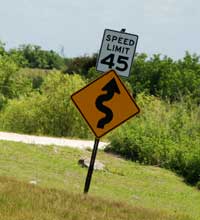
Snake Road wiggles like a snake.

We rode up up I-75 and headed west on a bright sunny morning with big puffy clouds in the sky. Margie spotted all kinds of things — an occasional bird perched in a dead maleleuca tree, big green shrubs studded with pale pink wild hibiscus native to the Everglades, and a golden brown snake rippling across the road. About an hour into the journey, we turned onto Snake Road (but didn’t see any snakes there). Swamp lilies grew in the canals on either side of the road as it turned and twisted past cow pastures dotted with cabbage palms and cypress domes. Swallow-tailed kites soared above. The sawgrass was in bloom, sending up long feathery clusters of small, reddish flowers. We passed through the bustling Big Cypress Seminole Indian Reservation, took a turn and found ourselves in the Devil’s Garden agricultural area.

C&B Farms in Clewiston

C&B Farms is sandwiched between Clewiston and the edge of the Everglades. According to owner Chuck Obern, the farm is 2500 acres in size, with 1500 acres that are tillable. Of that, 1000 acres are planted  conventionally and 500 acres are in organic production. Chuck offered us a quick tour of his farm, so Margie and I hopped into his truck and headed down a sandy road into the heart of the farm. One side of the farm is organic, and the other side is conventionally farmed. The two sides are separated by a large ditch and a row of of trees. Each side has separate farming equipment and packing lines, where the produce is rinsed and boxed, and there’s a separate organic section in the enormous cooler.

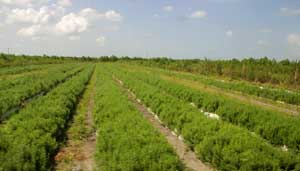
A 2-acre block of rosemary.

Mid-June is pretty much the end of the season and there wasn’t that much growing at C&B. It’s already too hot. We passed by two-acre blocks or fields of herbs — dill that had already bolted, marjoram, knee high sage, bushy rosemary, tarragon, oregano, spearmint, and parsley. We passed by long brown piles of compost, which is used mostly for water and nutrient retention, or as a soil conditioner. The soil is light gray and sandy, very sandy, and it’s amazing they can get so much to grow in it. We passed by blocks of cantaloupe, personal sized watermelons, and butternut squash.

Pumping station for drip irrigation. Barrels hold liquid fertilizer.

Crops are irrigated two different ways. There’s an automated double drip irrigation system (double meaning two lines of drip tape per planting row). Water is pumped from a ditch or a well, and liquid fertilizer is mixed in. A computerized system controls how much water is sent where and when. There’s also the seep irrigation system in which water is pumped into or out of the ditches to raise or lower the water table under the fields. The water seeps into the soil from underneath, rather than drip down from the top. Seep irrigation water is reused or recirculated several times before it is sent to a retention area. Excess water is treated to remove phosphorus before it is released back into a canal bordering the Everglades ecosystem.

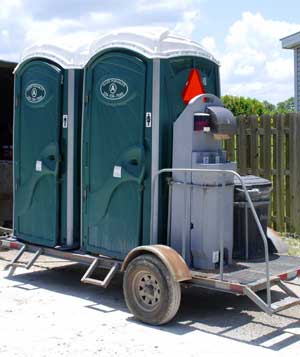
During peak season, 500 workers are in the fields picking and packing. But at the end of the season, with a lot less growing, there are only about 100 workers. Fields were dotted with trailer-mounted portapotties complete with a handwashing and sanitizing station, as required by recent federal food safety laws. These regulations also require that workers can’t wear jewelry or bring outside food or drink into the fields.

The federal food safety act is actually many sets of guidelines that came about after the e. coli incident with contaminated jalapenos from Mexico a few years ago. Since then, domestic growers have to comply with stricter standards of produce handling cleanliness. To check compliance, a major food safety certifier comes once a year to check procedures, equipment, and records over a period of three days.

Mobile portapotties, with handwashing station, that are taken out to the fields.

Surprisingly, Central and South American growers do not have to comply with the same strict federal food safety laws as domestic growers. The vast majority of imported produce is not inspected. At most only one to two per cent (maybe even less) of the food coming in is checked for the same standards of cleanliness and safety, and pesticide residues. “There’s no traceability, no accountability,” Chuck complained. “And no guidelines. It’s not a level playing field.” Imported or “offshore” produce is priced less than domestically grown produce, and American farmers find it hard to compete. Their costs have gone up due to extra work and expenses meeting the new guidelines.

So what should a conscientious food shopper do? “Vote with your dollars,” said Mike Counts, the C&B sales manager. “Your dollar ultimately makes the statement. If enough people do it, they will change.” That said, we finished loading up and headed back out on the highway. One hundred miles later we were back at Bee Heaven, unloading fresh melons that had been picked just a few days before. Maybe it costs a little more to buy local and organic, but as you sink your teeth into those juicy fruits, you’ll have the satisfaction of knowing that you’re keeping a couple of local farmers in business.

Read Full Post »

Cover crops growing at Little River Market Garden.

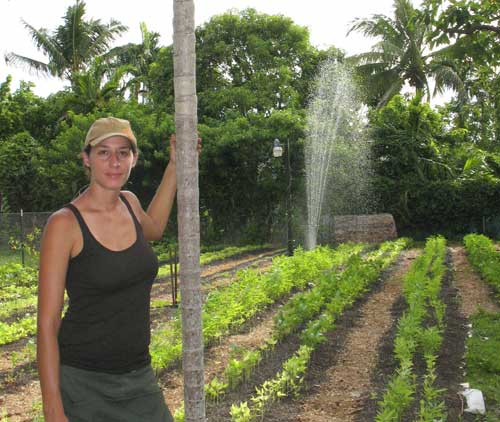
Tucked away in an obscure corner of northeast Miami, a new vegetable garden is starting to take shape in what was an empty city lot. Long straight rows of cover crops — Sunn hemp, cow peas and velvet bean — raise their young leaves to the late afternoon sun. In between rows of cover crop, peanuts are just starting to show pretty little yellow flowers. Loofa vines race to the top of the chain link fence at the front of the property, and a row of cassava flourishes alongside a stepping stone path. Over on one side is a trellis for a muscadine grapevine already forming a miniature cluster of fruit, and sweet potatoes grow beneath. Sage and other herbs are planted in a well-mulched S-shaped bed edged by palm tree logs. In the shade of an ancient mango tree loaded with fruit, a teepee shaped chicken coop holds several brown hens.

Welcome to the Little River Market Garden. This is the handiwork of Muriel Olivares, last year’s farm manager at Bee Heaven Farm. She created this garden from scratch a mere six weeks ago, planting on land leased from friends. Only grass and several trees were growing in what was once part of a citrus grove many decades ago. Now, weathered cardboard peeks out from the edges of some vegetable rows, and Muriel explained that it was set down right over the grass, with compost piled on top. The cardboard is already breaking down, and vegetable roots will easily push through it. In between planted rows, mulch neatly covers grass. The cover crops will get cut down and as they decompose, will add more nutrients to the compost.

This technique of piling on compost and mulch is called no-till because the soil is not tilled or disturbed by a tractor. Tilth builds up naturally without getting disrupted by tilling, and weeds are less likely to grow because they are smothered by compost and mulch. “No-till improves the soil by building soil structure and adding nutrients with compost,” Muriel explained. “It’s a very old technique. No matter the scale of farming, the concept is the same — never disturb the soil and always keep it covered.”

Muriel Olivares

The Garden will provide food for 11 people who have already signed up for CSA shares and flower shares. She says she might be able to squeeze in a couple more members, so if you’re interested, let her know. Her season runs for 21 weeks from November to April. Muriel wants to sell extra veggies and cut flowers at farmers markets, and is already inquiring about getting in to a few in the area. Check out her blog, Little River Market Garden, for news about the garden and updates about markets (once the season starts).

Muriel is confident that her crops and market garden will flourish. She took what she learned working as an intern for a season at a no-till organic farm in upstate New York, and combined that with skills learned at Bee Heaven helping run the CSA and selling at farmers market. Now she is is gambling that she can make a living as a market gardener. “This is my full time job, eight hours a day.” She doesn’t have a “day job” to tide her over. This is it!

So why do this crazy, risky thing? “I really like to be outdoors,” Muriel explained, “and to do what I want to do.” She paused and thought for a moment. “It sounds really weird but I have this connection to plants. I’m absorbed by them. I’m interested in them. Working with plants gives me mental energy.” She chose the urban location because she likes the city and found Redland too isolated. “This is a nice, happy medium. It’s very peaceful, but you’re in the city.” Here she is close to home, her friends, and her customers. When market season starts in winter, look for Little River and say hi to Muriel, the new generation of urban farmer.

Little River Market Garden
8290 NE 4th Ave.
Miami, FL 33138

mail@littlerivercsa.com

Read Full Post »

The Miami Herald has a nice long article about farmer Margie Pikarsky and the Redland Organics CSA. You can find it in today’s Tropical Life section.

Bee Heaven owner: Organic farming is good for the foodie — and the land

BY ANA VECIANA-SUAREZ
aveciana@MiamiHerald.com

On a muggy summer day, as bruised clouds gather overhead, Margie Pikarsky wends her way through her five-acre farm pointing proudly at strips of cultivated land and a growing compost pile. A blue jay swoops across the field, then another. In the distance a cardinal trills.

“I feel very connected to nature,” Pikarsky, 57, says, and then adds with a wry laugh. “I have this Mother Earth thing going.”

Indeed. Pikarsky has been running Bee Heaven, an organic farm in South Dade’s Redland area, since 1995, when pesticide-free farming was more a boutique niche than thriving business. She harvests honey, collects organic eggs and grows familiar fruits and vegetables as well as exotics — mostly Asian greens — that do well in South Florida soil.

She sells them at farmer’s markets and through Redland Organics, a community-supported agriculture (CSA) initiative that allows people to buy “shares” upfront in return for weekly selections of organic produce during the growing season.

Read more: http://www.miamiherald.com/2010/07/22/1740121/mother-earth.html

Read Full Post »

July 24, 2010
8 pm to 1 am

Come hang out in the laid back tropical atmosphere of the Everglades Hostel’s back yard. Event organizer and artist Kristin Jayd will be applying henna/mehndi designs. The gazebo will be set up as a hookah lounge, with carpets and cushions to recline on. A DJ will be playing laid back, ambient Mediterranean-flavored music. And Hani Khouri will reprise his role as chef, with an endless buffet of delicious goodies.

On the menu: hummus, fool muddamas (fava and garbanzo beans), lentils, okra, maybe a fish dish, tabbouleh, shish kabob, chicken rolls with sumac, falafel, and nammourah (semolina tea cake flavored with rose water), among other things.

A cover charge of $5 gets you in the door, rain or shine. Everything else is a la carte. Check out the package deal which includes all three for $35.

Details and tickets available at Kristin Jayd Unlimited or call/text 305-342-5844
Facebook: Henna Hookah & Hani

Location:

Everglades Hostel
20 SW 2nd Ave.
Florida City, Florida 33034
305.248.1122

Read Full Post »

Older Posts »