Feeds:
Posts
Comments

Archive for October, 2009

Heirloom tomato starts

Heirloom tomato starts

The Edible Garden Festival is coming up this weekend Oct. 24-25 at Fairchild Garden. Farmer Margie and her crew will be there, selling starts of heirloom tomatoes, basil, arugula, garlic chives, lemongrass and chard so you can plant them in your garden. (She promises to have an even bigger selection at Ramble next month.)

Heirloom varieties available for this month’s event are mostly small and plum-fruited types. The larger, beefsteak types won’t be ready for another three weeks. I’ve met heirloom tomato fans who explain they buy starts year after year from Redland Organics because there are certain varieties (like black tomatoes, such a deep dark red it looks almost black) that only Margie sells.

You can also get fruits that are in season now: avocados, carambolas, perhaps bananas, cas guava, and antidesma (bignay). Also available are the usual offerings of organic eggs in lovely shades of browns — and even light green ones from auracana hens — and wildflower honey from hives kept on the farm.

====================================

Events presented by growers or members of Redland Organics CSA:

LECTURES
Saturday, October 24
12:00 p.m. Growing Organic Heirloom Tomatoes, Margie Pikarsky
1:00 p.m. Edible Landscaping in Paradise, Gabriele Marewski

Sunday, October 25
4:00 p.m. Extreme Edible Landscaping: Urban Homesteading!, Melissa Contreras

GARDENING DEMONSTRATIONS

Sunday, October 25
10:00 a.m. Slow Food School Gardens, Hunter Reno
1:30 p.m. Square Foot Gardening with Kids, Hunter Reno

Read Full Post »

Why people join or leave the CSA

People sign up because:

  • They want to get really fresh food straight from the farms, not food that’s been in warehouses, distribution centers and back storage (like buying clubs and co-ops get).
  • They want organic/pesticide-free food.
  • They want to support local farmers.
  • They eat a lot of veggies.
  • Their doctor told them to.
  • They want a ‘greener’ footprint.
  • They’ve been in CSAs in other parts of the country (this category increasing).
  • They were in a buying club or a co-op and realized all they’re getting there is the same exact stuff they can get at the grocery store.

People leave because:

  • They find out they really DON’T eat as many veggies as they thought.
  • They move away.
  • They are uncomfortable with surprises, because they don’t know in advance what they are going to get.
  • They want more of what they call ‘traditional veggies’ — meaning the basic 10 things they buy at the grocery store, some of which don’t grow here, or only during a limited time (in season), and they can’t understand why they can’t get, for example, onions or tomatoes or potatoes at the start of the season (and all season long!).
  • They’re stuck in the grocery store ‘pretty food’ paradigm (ooh, it has a bad spot, throw it out!) and can’t accept ‘real food’ complete with buggies (extra protein, anyone?), and soil (vegetables grow in dirt? can’t we get rid of it?).

Thanks to Farmer Margie for sending me her rant!

Read Full Post »

If you’re new to this area, you might be thinking ah, fall, time for harvest. Not! The growing seasons are upside down this far south. During the long, hot summer, most growers take a break. They start preparing the soil and planting in September and October. This time of year is their “spring.” The first crops are harvested around November, maybe earlier, depending on what you’re planting. So if you’ve had a garden when you lived in northern latitudes, and you want to have one here, you have to adjust for the location and climate and soil.

Farmer Margie was interviewed for a recently published article in the Fort Lauderdale Sun-Sentinel called How to plant a fall vegetable garden in South Florida. In it she discusses all-important soil preparation and how to grow heirloom tomatoes (one of her specialties). You can read the article online. (Hopefully they will keep it in the online archives for a while!)

Read Full Post »

Several months ago, I blogged about Jaideep Hardikar, a journalist from India who was here in the States on a fellowship. He wrote the article The Farmers Among Us that was published in the Sun-Sentinel. The original article profiled several growers who belong to Redland Organics, but is no longer available online. A shortened version was published on the front page of the Business section of the Miami Herald on Tuesday Oct. 13th. You can read it here.

According to the article,

Across the United States, consumers are increasingly buying directly from local farms through a model started decades ago in Switzerland and Japan now known as Community Supported Agriculture.

Nationwide, sales from farms directly to consumers — including CSA and farmers markets — jumped 49 percent from $812 million in 2002 to $1.2 billion in 2007, according to the most recent Department of Agriculture census. That’s twice as many sales as a decade earlier, the federal agency said.

Estimates of active CSA programs vary, but the 2007 U.S. census found more than 12,500 farms selling directly to consumers in every state. The National Center for Appropriate Technology, an agriculture think tank, estimates CSA programs supplied food to more than 270,000 households last year.

Farmer Margie told me that last season she had 440 CSA members, and has 465 members this season. She started Redland Organics CSA in 2002 with only 25 members. There are at least 100 on the waiting list. Turnover varies, maybe about 35%. Margie also mentioned that in January there will probably be a very limited number of trial shares available, and only to those folks already asking about them. She is pretty much at full capacity already. If you’re not a CSA member, but still want to get the same food, you can shop at the South Florida Farmers Market in Pinecrest.

Read Full Post »

Thyme for tilapia and lime

Sleeps wit' da fishes

Sleeps wit' da fishes

The other Saturday I rambled down to Bee Heaven to pick up a tilapia and some callaloo for dinner. If you’ve never done that, you’re missing out on some good eating. The fish are ridiculously fresh. They were swimming early that same morning just before getting put on ice. You won’t eat anything fresher unless you catch it yourself. When you order a tilapia, you get the whole fish. It’s your job to scale, gut and clean it before cooking, but that isn’t too difficult to do. The average weight per fish is about 1.5 pounds, maybe a bit more.

The tilapia is farm raised by Wayne and Carmen of American Viking Aqua Farms, a mom-n-pop operation right around the corner from Bee Heaven. Although the fish is a bit more expensive than what you can get at at the grocery store, it has been raised without chemicals. Technically they are not organic because the fish food isn’t, though Wayne and Carmen want to move in that direction. They also use a biofilter to clean their water, and have a natural filtration system which lets them use the nutrients to grow native mangroves for use in bioremediation projects.

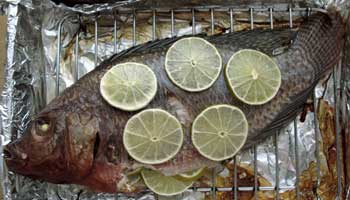
Plans for Mr. Fish were to roast it whole. It was scaled, gutted and cleaned, then its cavity stuffed with slices of lime and branches of fresh thyme, and more lime slices on top. Was baked it in the oven at 350 for about 20 minutes (more or less), until the flesh flaked when stuck with a knife.

Mr. Fish meets his demise

Mr. Fish meets his demise

Mmmmmm good eating! The flesh was tender, moist and delicate. Limes on top kept it moist, and the flavors of lime and thyme permeated. Well, maybe a bit too much lime… will try with lemon next time, and use a bit less, and add garlic or onion. I don’t pretend to be a chef, or even a halfway good cook, but I have my moments and this was one of them. Your meal is only as good as the ingredients!

If you got a tilapia how did you prepare it? Feel free to share your recipe in the comments section below!

Read Full Post »

« Newer Posts - Older Posts »