Feeds:
Posts
Comments

Archive for October, 2011

Let them eat pie! The heart shaped strawberry tart took first place.

For the second year in a row, Slow Food Miami held its pie baking contest. This year there were a few changes. The event moved to the historic Barnacle House in Coconut Grove, and your ticket also got you a fried chicken dinner prepared by Sustain restaurant, with sides from Whole Foods. But the heart of the event stayed the same — to choose the best homemade pie made with local (Florida) or home grown ingredients.
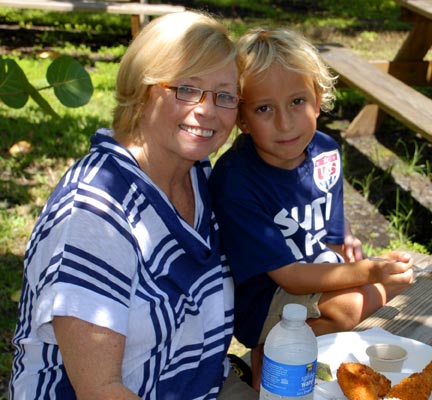
Jan Anderson Treese and her grandson baked the blueberry-lemon curd-cookie crust pie.

Sixteen contestants rose to the challenge and brought unique, delicious pies filled with avocado, guava, and muscadine grape, to name a few. Jan Anderson Treese and her grandson made the lemon curd-blueberry-cookie-crust pie. “I used local eggs and lemons and butter,” she said, and sourced Florida grown blueberries. “My biggest thing is local food and fresh food. I’m a chef and I’ve preached that all my life.”

Even the judges were local. Food celebrities Lee Brian Schrager (founder of South Beach Wine & Food Festival), Hedy Goldsmith (executive pastry chef, Michael’s Genuine Food & Drink), and Ariana Kumpis (president, Les Dames d’Escoffier Miami) had the really tough job of grading pies on appearance, filling, crust, and overall creativity. And of course, judges had to keep entries to the rule of using “a main ingredient that grows in Florida.”
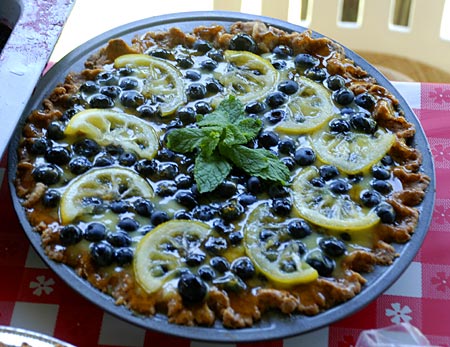
Blueberry-lemon curd-cookie crust pie!

In last year’s competition, some entries had used non-local main ingredients (chocolate and apple don’t grow here), and there had been some grumbling as to why those pies weren’t disqualified. This year the pendulum swung in the other direction. There was a moment of controversy about the rhubarb pie, whether the filling was local or not, and should it be disqualified. But that contestant claimed she did manage to grow rhubarb in her garden. (Who knew that rhubarb can grow this far south?)

Controversy aside, two of the the three finalists used the ever beloved mango. Third place was mango ginger, and second was mango crumb. The winner was a strawberry tart with a heart shaped crust — definitely scoring points for appearance and creativity!
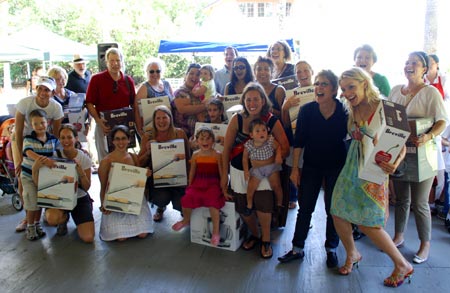
All the contestants posed for a group picture with their prizes.

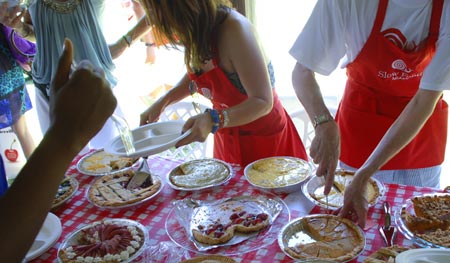
Each contestant received a Breville pie maker, and the three top finalists won additional kitchen appliances. After the prizes were awarded, pies were sliced up so guests could get a taste. This is always the best part of the event, to sample pies and make your own decisions on which were best. Slices and slivers of the winning strawberry pie just flew, and by the time I ambled up for a taste, it was all gone, just crumbs left in the pan.

Avocado pie (foreground) and scorecards.

Slow Food Miami did a good job with this year’s competition, which is maturing and evolving. Including lunch was smart. It kept hungry guests from mobbing the pies. The raffle was also new this year. If you bought extra tickets, you got chances to win a food basket from Whole Foods, or one of several pie makers.

And to complete the circle of eating local, two local growers and one vendor — Bee Heaven Farm, G.R.O.W. and Seriously Organic — brought fruits and veggies, sprouts, eggs and honey.

Slow Food members did a lot of work to make this event better, and it showed. Looking forward to next year!
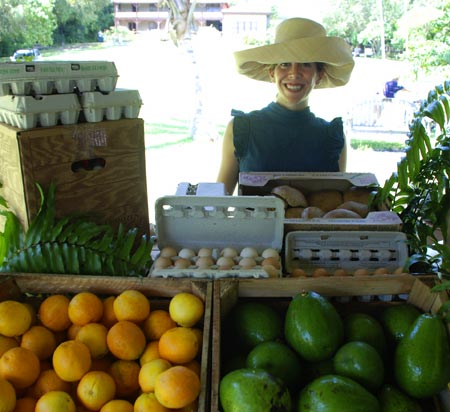
Elke Zabinski of Seriously Organic
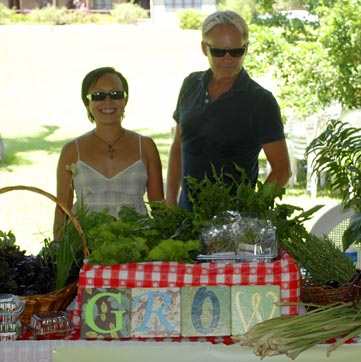
Thi and Bill Squire of G.R.O.W.
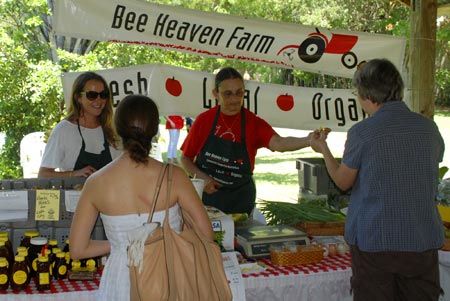
Sampling monstera fruit at the Bee Heaven Farm Tent, with Sara Willoughby and Margie Pikarsky.

Read Full Post »

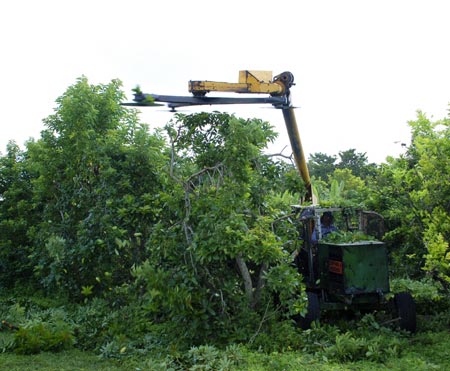
Avocado grove getting trimmed.

The avocado season is over at Bee Heaven Farm. The last of the big, plump Donnie avocados got picked weeks ago. The lull between picking fruit and and blooming season (usually around January) brings off-season maintenance. Almost every year the tree trimmer comes to cut back all the avocado trees. Call it their summertime haircut, with a little off the sides and top.

Trimming happens for practical reasons. Farmer Margie Pikarsky explained, “You don’t need a tall tree to produce fruit, and you don’t get a proportionally greater harvest just because it’s tall. Harvesting a tall tree is way more labor-intensive and requires special equipment — at minimum a tall ladder, at best a cherry picker.” Avocados are picked by hand, and Margie’s pickers either climb the tree or go up an orchard ladder, which has a tripod-like leg to keep it standing up by itself. Margie added that “a shorter tree (about 15 feet) is MUCH more hurricane resistant.”

A little off the sides.

When you have a grove of 90-some trees, you need to bring in some serious cutting power. The man who trims trees showed up early one morning with a very impressive machine. Imagine a bobcat whose operator not only drives the machine but also controls an articulated arm mounted at the top. This arm can reach up or down, swing around from side to side, or turn from horizontal to vertical. At the business end of this arm is a revolving metal piece, and three spinning circular saw blades are attached to it. Those revolving blades cut through branches smoothly and easily. The whole rig looks like something Freddy Scissorhands dreamed up.

And a little off the top.

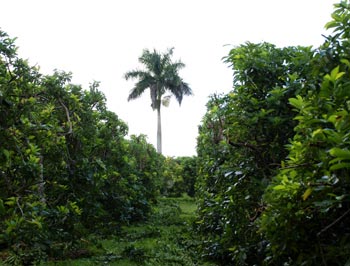
The tree trimmer drove his cutting machine up and down the shaggy rows of the avocado grove. He maneuvered the arm to first trim the sides of the rows, and then made a final pass to level the tops. Branches fell onto the safety cage of the bobcat and onto the ground. Scraggly trees transformed into huge boxy hedges, like something you might find in a giant’s formal garden.

Sadie (under tree) and Pedro (with pitchfork) gather cut branches.

Once the tree trimmer was done, there was a mess to clean up. Pedro used a pitchfork to grab and pull out cut branches that had snagged in trees. Sadie went after branches lying underneath. They were tossed on the grass in between the rows. Then Margie came with the bush hog to chew up fallen branches and turn them into coarse mulch. (A bush hog is a tractor attachment that looks and works like a large, heavy duty mower.) Margie made a few passes up and down each row, and gestured for me to step aside, but I stood my ground, taking pictures. I quickly realized that it wasn’t a good idea for me to stand off to the side as the bush hog went by. Twice I got hit by bits of flying branches, once on the foot and once on the arm. No blood lost, just a moment of surprise. (I think Margie was trying to warn me not to lose a camera — or an eye.) Lesson learned: don’t stand too close to a working brush hog!

Margie mulches branches with the brush hog.

What looks like a severe trimming is not bad for the tree. In fact, trimming keeps trees healthy and vigorous. They will grow new branches and look less and less boxy as the months go by. “Avocados flower and fruit on new growth, so trimming after harvest is finished gives them time for a couple of new growth flushes before blooming begins, thus increasing chances of a good yield next season,” Margie explained. More new growth means more fruit and more deliciousness in summer!

After the trim.

Read Full Post »

« Newer Posts