Feeds:
Posts
Comments

Archive for the ‘csa’ Category

Cover crops growing at Little River Market Garden.

Tucked away in an obscure corner of northeast Miami, a new vegetable garden is starting to take shape in what was an empty city lot. Long straight rows of cover crops — Sunn hemp, cow peas and velvet bean — raise their young leaves to the late afternoon sun. In between rows of cover crop, peanuts are just starting to show pretty little yellow flowers. Loofa vines race to the top of the chain link fence at the front of the property, and a row of cassava flourishes alongside a stepping stone path. Over on one side is a trellis for a muscadine grapevine already forming a miniature cluster of fruit, and sweet potatoes grow beneath. Sage and other herbs are planted in a well-mulched S-shaped bed edged by palm tree logs. In the shade of an ancient mango tree loaded with fruit, a teepee shaped chicken coop holds several brown hens.

Welcome to the Little River Market Garden. This is the handiwork of Muriel Olivares, last year’s farm manager at Bee Heaven Farm. She created this garden from scratch a mere six weeks ago, planting on land leased from friends. Only grass and several trees were growing in what was once part of a citrus grove many decades ago. Now, weathered cardboard peeks out from the edges of some vegetable rows, and Muriel explained that it was set down right over the grass, with compost piled on top. The cardboard is already breaking down, and vegetable roots will easily push through it. In between planted rows, mulch neatly covers grass. The cover crops will get cut down and as they decompose, will add more nutrients to the compost.

This technique of piling on compost and mulch is called no-till because the soil is not tilled or disturbed by a tractor. Tilth builds up naturally without getting disrupted by tilling, and weeds are less likely to grow because they are smothered by compost and mulch. “No-till improves the soil by building soil structure and adding nutrients with compost,” Muriel explained. “It’s a very old technique. No matter the scale of farming, the concept is the same — never disturb the soil and always keep it covered.”
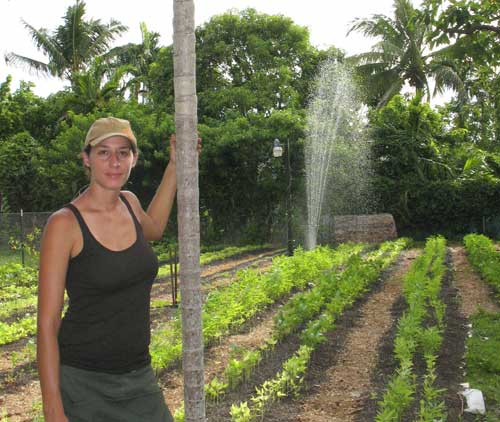
Muriel Olivares

The Garden will provide food for 11 people who have already signed up for CSA shares and flower shares. She says she might be able to squeeze in a couple more members, so if you’re interested, let her know. Her season runs for 21 weeks from November to April. Muriel wants to sell extra veggies and cut flowers at farmers markets, and is already inquiring about getting in to a few in the area. Check out her blog, Little River Market Garden, for news about the garden and updates about markets (once the season starts).

Muriel is confident that her crops and market garden will flourish. She took what she learned working as an intern for a season at a no-till organic farm in upstate New York, and combined that with skills learned at Bee Heaven helping run the CSA and selling at farmers market. Now she is is gambling that she can make a living as a market gardener. “This is my full time job, eight hours a day.” She doesn’t have a “day job” to tide her over. This is it!

So why do this crazy, risky thing? “I really like to be outdoors,” Muriel explained, “and to do what I want to do.” She paused and thought for a moment. “It sounds really weird but I have this connection to plants. I’m absorbed by them. I’m interested in them. Working with plants gives me mental energy.” She chose the urban location because she likes the city and found Redland too isolated. “This is a nice, happy medium. It’s very peaceful, but you’re in the city.” Here she is close to home, her friends, and her customers. When market season starts in winter, look for Little River and say hi to Muriel, the new generation of urban farmer.

Little River Market Garden
8290 NE 4th Ave.
Miami, FL 33138

mail@littlerivercsa.com

Read Full Post »

CSA share: week 20

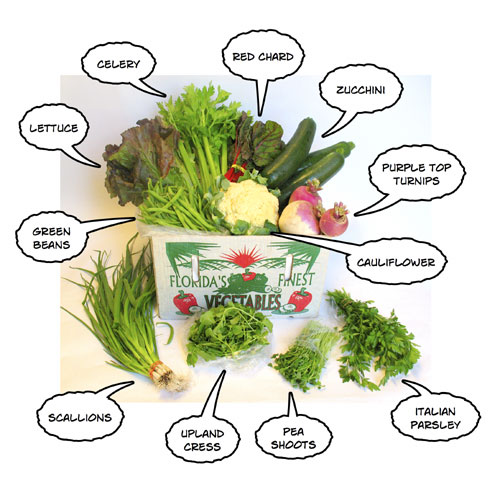
CSA share: week 20. The final share of the season!

This is it, kids, the final share of the season! I can’t believe that 20 weeks have flown by already. I’m going to miss visiting the farm every Friday and finding out what’s new, and taking this picture. My friends will miss hearing me complain that I can’t close my refrigerator door, and can they please help me out by taking some veggies off my hands. Geez, now I’ll have to go back to Whole Paycheck for organic produce. (But it’s not the same.)

What did you like in the share, and what did you not like? I’m going to go against the flow and say that I loved all the greens this season. It’s hard to find a variety of fresh greens in the stores, and I’ve really enjoyed them. The turnips, meh. The heirloom tomatoes were worth the trip to the farmers market. Wish I had signed up for an egg share, because organic eggs from the grocery are just not the same.

This blog was the first season that I documented the shares and the ebb and flow of events on Bee Heaven Farm and in Redland. I wanted to do a lot more than I managed to find time and energy for. During the off-season lull, I hope to get caught up on some blog posts I’ve been working on. What do you want more news about, and what do you want less of? Do you want farm news, area news, farmer/intern interviews, politics, recipes, information about different foods, what’s available at market, various related events, rants and rambles, or …?

Your responses are very interesting to me, and based on what I hear, may help shape the direction of the blog (as long as it doesn’t stray too far from original mission of writing about Redland Organics growers, CSA members, the issues that affect them, and the farm area). Would love to hear your thoughts! Let’s get a conversation going! I know you’re out there…

Read Full Post »

When cabbages fly

Last week, Farmer Margie told me that she was short-handed and needed volunteers to help pack shares. I offered to help, and rounded up my new buddy Nathan (who wants to be a tractor mechanic when he grows up), and he brought along his mother Tunie. Farm manager Muriel invited Christina, and we four volunteers joined the packing line in the barn at eight last Friday morning.

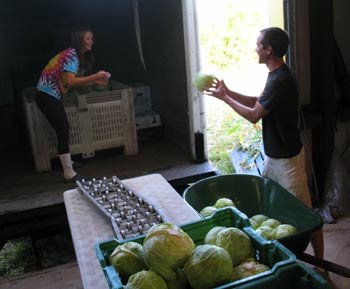
Kenna and Nathan make cabbages fly.

Before we could start packing the actual shares, the reefer truck had to be unloaded. It was full of vegetables from Worden Farm. The first challenge was a large bin full of cabbages, too heavy to lift fully loaded. Intern Kenna and Muriel climbed aboard and tossed cabbages fast and furious to Nathan and me. We caught and stacked them into wheelbarrows, which went to the head of the packing line.

Muriel determined which veggies went in which order on the line. The heaviest items get packed first and go in the bottom of the share box. The lightest things go on top, where they won’t get crushed. The actual packing went fast and easy. Margie and Christina packed cabbage and beets. Tunie added green beans and spring onions. I was next on the line. With my left hand, I reached for the box coming down the rollers and put in a bunch of kale. If the cabbage was big (and some were monstrously huge), I packed a smaller head of lettuce. If the cabbage was small, I put a bigger head. Then I pushed the box to Jesus on my right, who added mushrooms, closed the boxes and stacked them. Nathan loaded the boxes into the truck. Kenna was the runner, replenishing supplies of veggies and empty boxes.

Packing had a steady rhythm. Pull, pack, push. Pull, pack, push. When the full shares were done, the half shares were next. It seemed to go more slowly, but I think that’s because there are more half shares than full shares. Still, we were done by noon, and the truck was loaded with share boxes. Christina described the process as, “This is the place where the farm connects with the table, putting the vegetables in the box. Goodbye, vegetables! Hope you don’t wilt in the frig!”

Thanks to volunteers Nathan, Tunie and Christina for their hard work!

Read Full Post »

CSA share: week 19

CSA share: week 19

Read Full Post »

CSA share: week 18

CSA share: week 18

Read Full Post »

« Newer Posts - Older Posts »