Feeds:
Posts
Comments

Archive for the ‘farm’ Category

Gabriele Marewski is an Innovative Farmer.

Local organic farmer Gabriele Marewski was recognized with the Florida Innovative Farmer Award at the 2012 Small Farm and Alternative Enterprise Conference this summer. (She joins Eva and Chris Worden of Worden Farm, organic growers in Punta Gorda, who were given the same award in 2010.)

Gabriele owns and operates Paradise Farms Organic, which is known for the Dinner in Paradise fine dining series every winter/spring. A portion of the proceeds from each dinner series is donated to small local non-profits. This season, Urban Greenworks and Slow Food Miami will receive donations. (Events are the main way that the community can visit the farm, which is otherwise not open to the public.)

In addition to dinners, Sunday morning brunches and occasional farm tours, Paradise Farms has branched out to other ventures, and recently started offering a venue for “sustainable, organic weddings” on the farm. Several cabins are available for B&B overnight stays.

The farm is also venturing into the realm of value-added foods. “We have a large 3’x3’ 24 shelf dehydrator where we are making teas from our edible flowers,” Gabriele said. In addition,”We have received a Value Added Producer Grant from the USDA to dehydrate our oyster mushrooms into a delicious healthy snack for school vending machines.” (The mushroom snacks are still in the focus group tasting stage.) And of course, Gabriele has made a name for herself growing microgreens and edible flowers for high-end restaurants.

Paradise is innovative in that it’s not only an organic farm, but also strictly vegetarian. Meat and meat products are not allowed on the property, whether they be dinner ingredients or farm nutrients. Gabriele is determined to keep it that way. “Vegetarianism is the single most important act to save our planet as it take lots of resources to produce commercial meat and is the biggest single pollutant of our waterways.”

The Innovative Farmer Award is a joint venture by the University of Florida and Florida A&M University to assist the state’s small farms, which are defined as having sales of less than $250,00 a year, and represent more than 90 per cent of all farms in Florida.

Read Full Post »

Jackfruit tree

Some of the strangest tropical fruits are available during the summer. One of the biggest and most unusual looking is jackfruit. It is as large as a melon or bigger, mostly oval in shape, and has knobby or spiny green skin. The typical size at market is 20 pounds, but they can get as big as 60 to 80 pounds. It’s commonly sold cut in chunks.

Grower Robert Barnum has about 200 jackfruit trees at his Possum Trot Tropical Fruit Nursery, interplanted with other trees on his 40 acre property. We strolled through a section of a dozen tall trees, all loaded with large fruit which varied in shape and size, some smaller and rounder, others more elongated. You can tell when a fruit is ripe because it sounds like a drum when you thump on it. Another clue is that its spines flatten out as it ripens, although that isn’t the best indicator, because some varieties have flatter spines than others. But the best way to tell ripeness is by smell. Ripe jackfruit has a strong aroma and gives off a lot of ethylene gas. If you put a whole ripe fruit in a refrigerator, it will keep ripening, and the whole interior will smell like it.

Opening up a such a large fruit is not a casual undertaking. It requires stamina and patience, and a large sharp knife well coated with vegetable oil. The fruit’s thick rind releases a latex sap when you cut into it, and can gum things up. The edible part of the fruit is the aril, or thick sac of chewy yellow flesh that has an oval, shiny brown seed inside. The grayish-colored connective membranes called rags are generally not edible and need to be removed. Cleaning the fruit involves taking out the arils, and separating the seeds. Rags and rind are thrown away. Depending on the size, the job can take a good hour or more. Cleaned fruit will keep 2-3 weeks in a zipper bag in the refrigerator, or 6 months in the freezer.

An open jackfruit.

Jackfruit vary in the texture of their flesh. Some kinds are soft and wet, suited for making drinks, and others are more firm and dry. Those kinds are more desirable because they can be eaten ripe or unripe. Robert says the ripe fruit tastes like pineapple-banana with hints of vanilla, but I can smell and taste a musky overtone. (Others have told me the flavor reminds them of Juicy Fruit gum.) Unripe fruit is has a chewy texture, and is usually cooked and used as a meat substitute. Jackfruit curry is a popular dish made with unripe fruit, as is fake pulled pork seasoned with BBQ sauce. Seeds are also edible. Robert recommends blanching seeds in boiling salt water three times to remove the astringent flavor, then roasting in the oven. They taste a lot like chestnuts. You can save seeds to grow your own tree, but you’ll have to be patient. It takes anywhere from four to 15 years, depending on the variety, before a jackfruit tree starts to bear fruit.

You can find whole and cut jackfruit from Possum Trot at the Upper Eastside Farmers Market, Verde Gardens Farmers Market, and at Bee Heaven Farm’s online store.

Robert Barnum and jackfruit tree.

Read Full Post »

Prolific pineapples

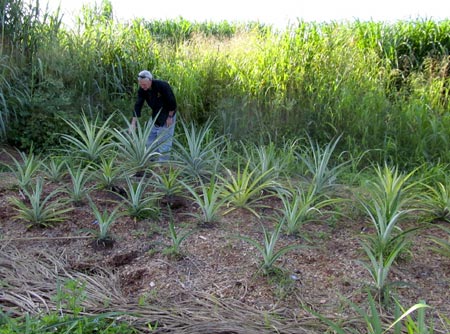
Tim Rowan tending to his newest pineapple patch.

Since my last visit, farmer Tim Rowan has added another raised bed of pineapple tops and hapas (pups). Dozens more were potted up and waiting to get planted. His goal is to have over 100 plants in the ground, and maybe, just maybe start selling fruit next year. Right now he’s giving fruit away to family, friends and co-workers. (Sly man, that’s how he gets people hooked!)

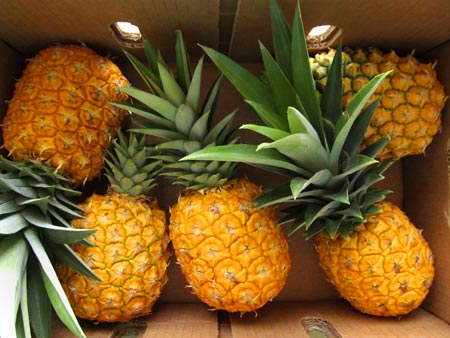
Tim gave me some pineapple to try. These were a different variety, smaller and more square-shaped than the 9 pound monster from before. They looked more like what one would find at a grocery, but that’s where the comparison ends. Tim’s pineapples are allowed to ripen naturally and are aromatic, sweet, juicy and bursting with flavor. Nothing like home grown!

Recently Tim’s pineapple plantation was featured in a one-page article in the latest issue of Edible South Florida. You can find the magazine for free at Whole Foods, among other places. Or download a pdf of the article here pineapple (file size 668 kb).

The aroma coming from this box was mouthwatering.

Read Full Post »

Freshly harvested macadamia nuts.

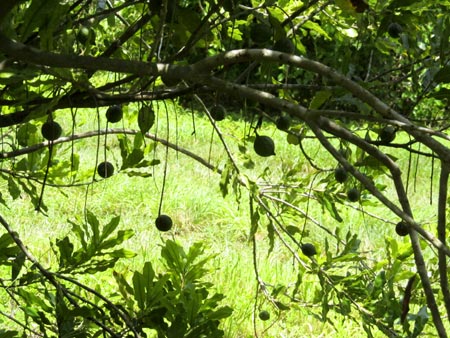
Fresh pesticide-free macadamia nuts have been available at several farmers markets the last few weeks. Yes, they are locally grown! The green-husked nuts come from Possum Trot Tropical Fruit Nursery, where grower Robert Barnum has about a dozen trees. This summer, Robert managed to harvest about 45 pounds this summer, and fresh nuts should be available for about two more weeks.

Husk splits open by itself when the nut is ripe.

Fresh macadamias don’t look like a nut. They have a green rind or husk that needs to be cut and peeled off. It will split by itself when the nut is ripe. Robert suggests leaving fresh nuts out on the counter for a few days to dry out a bit. When the husk is slightly dry, it is easier to remove. If you have a dehydrator, you can speed up the process. Dry them for a few hours on low heat until the husks split. Use a sharp knife to pare them off.

Underneath the husk is a smooth, dark brown shell that is tough to crack. Dry the husked nuts in the dehydrator again, for two to three days at 100 degrees F. This will dry the nut meat a bit and cause it to pull away from the shell, making it easier to crack. If they crack cleanly, they’re ready.

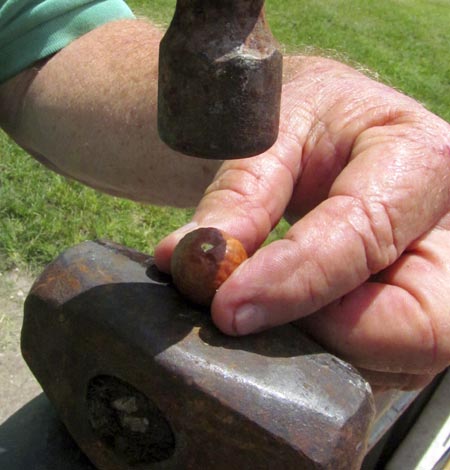
Tap the hammer lightly to crack the shell.

Robert’s cracking technique is very DIY. He carefully holds the nut in place on the side of a sledgehammer, and taps it with a claw hammer. If you don’t have two hammers (or don’t want to risk smashing your fingers), you can try a concrete slab or sidewalk and tap at the shells until they crack. (Whatever you do, do NOT do this on a granite counter top or the stone will crack. Don’t say I didn’t warn you!) Nutcrackers don’t apply enough force to crack the shell.

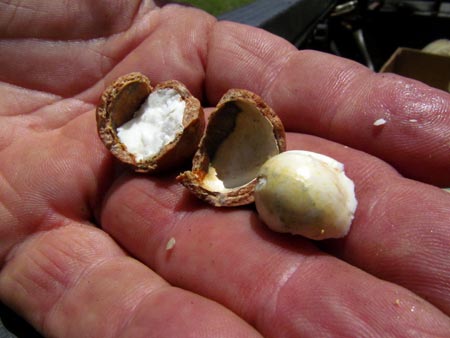
Shelled raw macadamia. It tastes like coconut.

Once the shell is cracked, you have to pry it open. Robert used a pocketknife. Inside is the white, mild flavored nut. You can eat it raw, or lightly toast and salt it. Cracking nuts and getting the meat out is labor intensive, but somehow squirrels are able to open nuts without any tools.

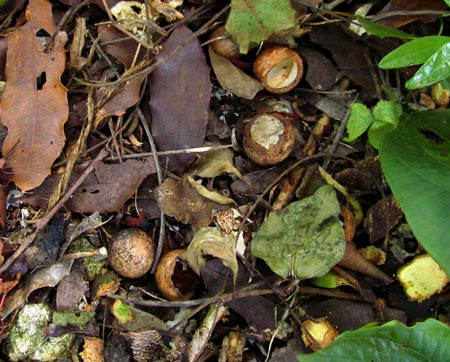
What squirrels leave behind.

The macadamia trees have been bearing well in past summers, but those harvests were much smaller because of The Squirrel Problem. Sounds like a well-worn cliche, but Robert has been battling squirrels for years, trying to keep them out of the nut trees. The little animals have a powerful attraction for macadamias, but waste a lot. They’ll eat part of the nut, cracking it open with their powerful jaws, and let the rest of it fall to the ground.

On a recent visit to the macadamias, two mutts that accompanied Robert and me went racing ahead, barking excitedly. A brown hound ran up to a tree, clambered up its lower branches, barking vigorously. It had spotted something. As Robert and I approached, the dog climbed down. I peered up at higher branches but saw nothing. “Squirrel,” Robert said. “The little critter is hard to spot. It will hide on the opposite side of a branch, and all you’ll see is the tip of its tail, or an eye peeking out.” I did see plenty of half-eaten nuts in the leaf litter below, a sign that squirrels had been munching there for some time.

Feast like a squirrel! Fresh pesticide-free macadamia nuts are available at the Upper East Side Farmers Market, Verde Gardens Farmers Market, and through Bee Heaven Farm’s online store for a limited time.

Waiting to be picked.

Read Full Post »

It’s media week for Redland’s organic farmers! See Gabriele Marewski and her luscious summer fruit from Paradise Farms featured on Deco Drive on Tuesday. The produce is the star at Elemis Spa, where they use it in various concoctions to make your skin and body glowing and beautiful. Watch (and read) here:

http://www.wsvn.com/decodrive/articles/deco_features/MI95690/

You will need the latest version of Flash Player to watch the video.

Read Full Post »

« Newer Posts - Older Posts »