Feeds:
Posts
Comments

Archive for the ‘farmer/grower’ Category

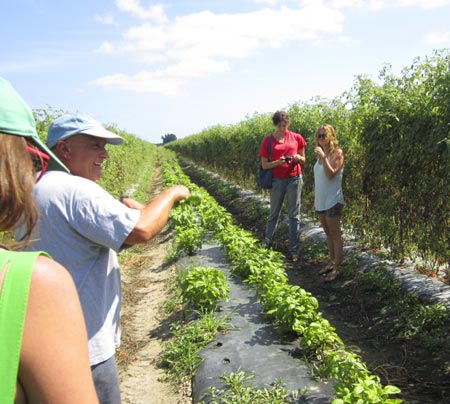
Arturo Gonzalez (wearing blue hat) points out a double row of Italian basil and sage growing among rows of tomatoes.

Good local food abounds in Redland, but you have to know where to look for it. One place is Margarita’s farm stand located on Krome Avenue. Earlier in the growing season, brother and sister owners Arturo and Maggie Gonzalez invited farmer Margie and her hard working crew for a tour of Sunshine Organic Farm, located right behind the stand, and for a completely locavore lunch.

The farm is certified organic, and Arturo has been growing heirloom tomatoes and other vegetables for several years. He was selling his vegetables at the stand, along with other locally grown produce and herbs.

Before we lunched, Arturo gave us a brief tour of his five acre field. Long rows of grape tomatoes, hanging in heavy clusters, stretched endlessly toward the back of his property. “All the tomatoes came in at the same time and ripened overnight,” Arturo complained. The vines produced more than he could sell, and a heap of rotten fruit lay on the ground. Abundance, thy name is tomato!

Farm intern Erinn kicked off her sandals and stomped around on the mess of overripe grape tomatoes. Squish squish!

Several rows of shaggy vines were loaded down heavily with colorful heirloom tomatoes — green zebra, yellow taxi, gold nugget, black cherry, and yellow cherry, to name varieties I recognized. In between rows of tomatoes grew double rows of basil and sage, both blooming with the sweetest aroma. Nearby were sweet long peppers, and those outrageous globular lavender and white eggplant with the romantic name of Rosa Bianca.
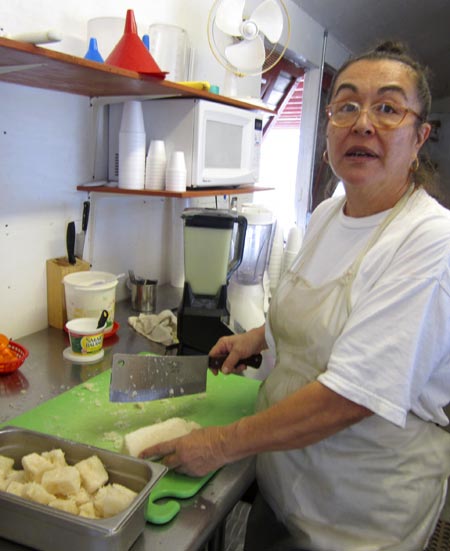
Madeleine chopped up frozen guanabana to make drinks for the guests.

After the tour, we gathered under a breezy overhang at the back of the farm stand. Madeleine, who works at the stand making batidos (fruits shakes) and juices, pulled out frozen chunks of guanabana (soursop), and made a thick white fruit drink in the blender with some added sugar and water. It was my first sip of guanabana (and I have no excuse why I waited so long to try it). It tasted a bit like banana, definitely not sour, certainly delicious.

Marinated fried tilapia waiting to get eaten. They didn’t have too wait long.

Nearby, a deep fryer full of vegetable oil heated up. On a table beside it was a large steel pan heaped with cleaned whole tilapia, which Arturo had marinated overnight with pepper and other spices. He gently eased fish one at a time into bubbling hot oil where they would swim until they turned a golden brown. He had sourced the fish from an aquaculture farm he discovered near Okeechobee.
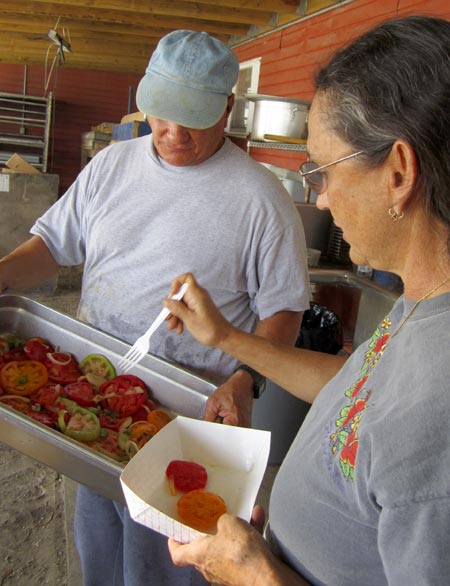
Arturo offered Margie his heirloom tomato salad.

As the fish cooked, Arturo tossed fresh mild watercress grown by “the old Cuban guy down the road” with spring onion slices for a simple salad dressed lightly with olive oil, white vinegar and salt. “When I eat fried fish I gotta have a salad,” he said, making another one. He cut up a variety of different colored tomatoes picked at the peak of ripeness from the field just steps away. They were also dressed with just the right amount of oil, vinegar and salt. In the farm stand kitchen, Maggie made twice-cooked crispy tostones, fried patties made from locally grown plantains and brought them out piping hot, crispy on the outside and soft on the inside.

Erinn enjoyed the tilapia.

Farm intern Marsha dug in to the tostones.

As Arturo and Maggie cooked, we rounded up a collection of mismatched plastic outdoor chairs, and gathered in a semi-circle near the fryer. This was rustic dining at its best. We ate from paper boats on our laps, using fingers to pick at the fish, stabbed at salads with plastic forks. The fish was cooked to perfection, its white sweet flesh moist and tender, fried skin and fins golden brown and crispy crunchy. Dessert was thick slices of queso blanco (farmer’s cheese) topped with slabs of guava paste, maybe the only two things that weren’t local, but we quickly forgave that. The meal was fresh, simply and quickly prepared, and the most delicious thing I had eaten in a long time.

Margarita brought out a simple dessert made with cheese and guava.

Who needed overpriced craziness of SoBe dining when we had a fresh, delicious meal at our own locavore “pop up cafe” located near a busy country road, deep in the heart of where food comes from. As cool spring breezes whispered of new growth and possibilities, Arturo shared a dream of putting in water tanks and growing tilapia and watercress. Selling fried fish meals could come soon after that, permitted under a county ordinance passed last year. Hopefully by next winter’s growing season, locavores could drive down to the farm stand to buy heirloom tomatoes, and stay for a batido or a bite of fresh tilapia, relaxing at a shaded picnic bench. “Eat local and keep a family farmer in business,” somebody in our group said. Arturo laughed with delight. Yes, it’s really that simple.

Margarita’s Fruits & Vegetables
15585 SW 177th Ave. (Krome Ave.)
Redland FL 33187
305-233-7793
Open 7 days a week, 9 am to 6 pm. Open all year. 

Margie crunched down on fried fish fins.
Read Full Post »

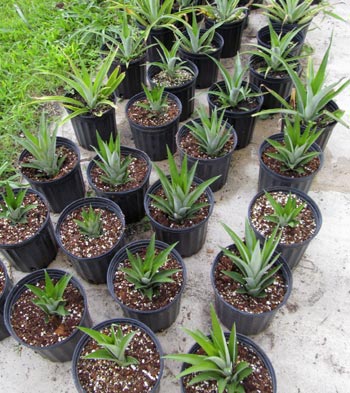
One year old plants which started from hapas.

Recently, farmer Margie and I were invited over to The Lettuce Farm to pick some pineapples. Really! Farmer Tim Rowan has all kinds of fruit growing during the summer, when it’s too hot for lettuce and cabbage.

Whenever you visit a farm for the first time, the farmer will take you on a tour of all the significant plants and features of his or her place. Tim pointed out Tommy Atkins mango trees loaded with blushing round-shouldered fruit, ribbon-like dragon fruit cactus vines ready to bloom and complete with an abandoned bird’s nest, passion fruit vines thick on a trellis, and quite possibly the area’s largest compost pile running the length of his property. The field where he grows lettuces and cabbages in winter was covered densely with elephant grass as tall as our heads, and home to twittering birds.

Farmer Margie learns the fine art of picking pineapple.

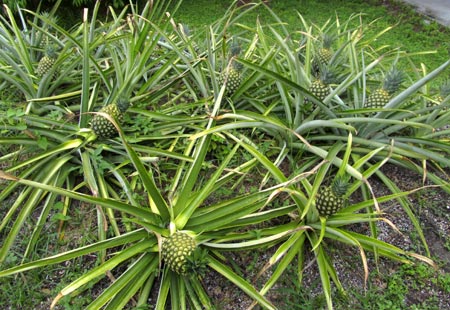
But what drew our attention and curiosity were the large raised beds, loaded with pineapple plants, which ring his modest house. In the west bed, all the plants were two years old, fully grown from green tops cut off pineapples, and they were loaded with fruit. Each plant produces only one fruit, which grows on a stalk at the center of the plant. The fruit were very large, and the ripest ones were peeking out golden through long leaves. In the east bed were plants bearing slightly smaller pineapples, which looked like they would be ready in about a month or so. Those plants were a year old, originally hapas (or slips) that sprouted from the bases of the older plants. Last summer Tim had snapped off hapas and planted them in their own patch. Each mature plant sprouted one or two hapas. Plants grown from hapas bear fruit in one year, but plants grown from tops bear in two.

More hapas potted up. These will be transplanted to a raised bed.

Tim let us pick our own fruit. He pointed out the ripest ones, and told us what to do. Picking a pineapple is fairly simple. Grasp it firmly with both hands, give the fruit a snap to one side and a small twist, and it easily breaks off the stalk. I was once again surprised by how heavy and substantial it was. After picking, Tim aimed a hose at the base of the fruit and washed off a bunch of ants. They are attracted to sugar in the fruit, which start to ripen from the bottom.

Hosing off the ants.

The pineapples we picked were amazingly heavy. Out came the scale to check weight. One was eight and a half pounds and the other was nine. (I haven’t weighed the ones you can get at the store, but they’re about half the size and weight.) Must be the special soil mix and organic fertilizer that Tim feeds his plants! The ripest fruit was ready to eat, and its sweet aroma tantalized us on light breeze, as we chatted on the back patio. Tim’s feisty Chihuahua jumped from his lap onto the table and sniffed at the fruit, which easily dwarfed her. It can truly be said that on that small farm located at the edge of the Everglades, pineapples grow as big as a dog.

Tim’s chihuahua is dwarfed by a giant pineapple.

Read Full Post »

*** Part Two of two ***

McArthur “genius prize” winner Will Allen spoke about his work in urban farming on a recent book tour. Here is part two, about his influence on a local non-profit.

Will Allen spoke at a recent tour of his new book, The Good Food Revolution.

In the audience were a number of people deeply involved in our fledgling local food movement. Among them were Melissa Contreras and Art Friedrich of Urban Oasis Project, a non-profit that plants food gardens and runs farmers markets. Their mission is clear and simple: “We believe that good, clean, healthy food should be accessible and affordable to all.”

Project founder Melissa was thrilled to hear Will Allen speak again. His message “energized me to keep moving forward with Urban Oasis Project after its first nine months” when it was just her and Art trying to get others involved. She attended a community food systems workshop at Growing Power in 2009 to learn more. “The work he was doing was so similar to what we were trying to achieve: teach people to grow some of their own food, and increase access to fresh, local produce to be eaten with a day or so after harvest,” she said.

Her commitment to Growing Power’s training didn’t stop after the workshop was over. Melissa explained, “I signed a pledge that I would come back to my community and teach others what I learned there. We have been doing that, but some of it is on hold until we have a place to call our own.”

Market manager Art said their non-profit drew from Will Allen’s work, especially in terms of food justice. Art explained, “He’s the inspiration why we started planting gardens, to create the future leaders of the local food movement, especially in neighborhoods where it’s hard to have access to fresh food. First grow community, then soil, then plants.”

And Miss Shirley, a volunteer who helps at Urban Oasis markets, was thrilled to meet Will. “He’s giving back to his people, he’s giving his time. I learned what soil was made of and how to take care of the earth. And to be grateful for what you have.”

Read Full Post »

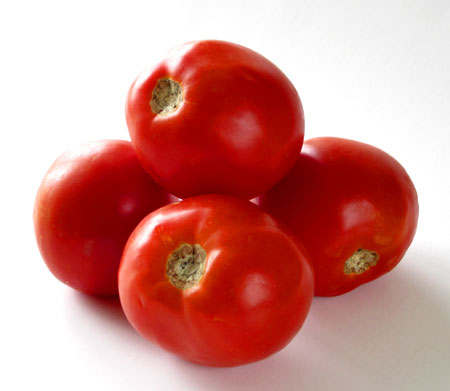
Locally grown round red slicers.

Round and red, and kind of ordinary looking, the slicing tomatoes in your CSA share box a few weeks ago didn’t seem very special, did they? But they are, and what made this year’s crop different is the way it was grown — in pots of soil, not directly in the ground. (The variety itself, Florida 47, is a commercial hybrid that’s been around for a long time, and is known as a good producing plant.)

Dan’s field of tomatoes in pots.

Farmer Dan raised the Florida 47s one plant per container, dozens of rows marching across a field blanketed with shiny black landscaping cloth, hundreds of staked tomatoes filling up three and a half acres. Why grow in pots? Because the land Dan had to use for growing, across from the Keys Gate Market Garden, was former swampland filled in with rock and even chunks of concrete, thin soil supporting only weeds. “Seven, eight, ten feet of fill instead of soil, and it was absolutely impossible to grow anything there,” Dan explained. Thus hundreds of pots, growing plant nursery style — a quick solution to the no-soil problem. (Plus, it was also the quickest way to get the operation certified organic.)

Read the fine print. This tomato came from Mexico. And people bought it because it’s cheap.

The tomatoes were delicious and beautiful, but financially the crop was a disaster. Startup costs were much higher than if he had planted directly into a fertile field. The potted plants required a lot of input — fertilizer and insect control sprays — plus you have to take into account the cost of soil, pots, landscaping cloth, irrigation and labor. “It cost me seventeen thousand dollars gross to set up, and my net was damn near nothing,” Dan grumbled.

Just as Dan was starting to harvest a few weeks ago, round red organic tomatoes from Mexico flooded the local market. (You might have seen them at area stores.) Thanks to NAFTA, the dollar-peso exchange rate, and low labor costs, organic tomatoes from Mexico were wholesaling for a lot less than what Dan was asking for.

No way he could make a profit. And he was stuck with bushels of tomatoes he had to unload. So he sold them at cost to farmer Margie of Bee Heaven Farm, and everybody in her CSA, large and small shares alike, got round red tomatoes. And, there’s Florida 47s to be had at the Keys Gate Farmer’s Market on Saturdays, and Pinecrest Gardens Farmers Market on Sundays, while they last.

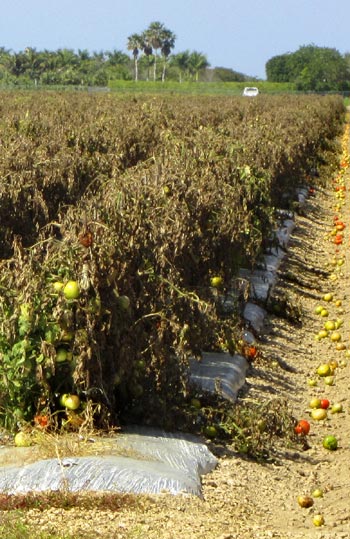
Tomatoes left to rot.

It’s not just organic growers who gambled and lost hard this season. I saw a field off Krome Ave. and SW 168 St. where the grower didn’t even bother harvesting his tomatoes. He left his crop to rot on the vines. Half the field was brown and dead, like it went through the worst freeze — and in the absence of recent cold weather, a sign it had been doused with herbicide. Why bother to spend more for labor to pick the crop when he was already in the hole raising it? (Food activists may want to chime in about holding off on chemicals, and allowing people to come glean fields to salvage food.)

Mexican produce aside, growing organic tomatoes in pots was an interesting experiment, but not one Dan cares to repeat any time soon. “It’s not sustainable,” he said. He is sticking with growing slightly more profitable green beans grown in a field of real dirt. It’s a gamble he knows how to win a bit better, providing there’s no hard winter freezes. “You want to know how to make a little money in farming?” Dan asked. “Start with a LOT of money.” And he laughed long and hard at his familiar joke.

Read Full Post »

Friday January 6, 2012
TIME: 3:00 p.m.
HOST FARMER: Hani Khouri, Hani’s Mediterranean Organics
GUEST CHEF: Alejandro Pinero, Sustain
PRICE: $190.00 SOLD OUT! Seats still available as of Dec 28.

Outstanding in the Field is hosting a farm dinner at Hani’s goat farm next week. The event is only one of two Florida stops on their North American Tour of dinners. (The next stop is at Lake Meadow Naturals farm in Ocoee outside of Orlando.) The organization’s mission is “to re-connect diners to the land and the origins of their food, and to honor the local farmers and food artisans who cultivate it.” Since 1999, the group has hosted diners all over the world, in all kinds of exotic settings. This coming week, guests will be dining near gentle Nubian goats safely contained in their pen.

Enough tables and chairs to accommodate 100 guests will be set up in the front yard, in a grove of oak trees with a view of the goat pen. Guests will be able to interact with the goats, and feed them roasted peanuts. (Goats are browsers, not grazers, and eat all kinds of things. Peanuts are one of their favorites.) “My farm is unique,” Hani said. “Where else will you find goats? And I’m the only cheesemaker, too.”

Hani will provide a variety of cheeses, and help source other local ingredients. Chef Alex from Sustain restaurant in Midtown Miami is creating the menu using fresh and local ingredients. “Sustain has been buying cheese from me for a long time,” Hani said. “I delivered extra cheese for them, 18 pounds of different kinds, mostly hallumi, on an emergency basis during Art Basel.” Chef Alex is also the one coordinating the event with Outstanding in the Field.

Outstanding in the Field is committed to honoring local farmers and food artisans. “Wherever the location, the consistent theme of each dinner is to honor the people whose good work brings nourishment to the table.” Several organic farmers — Margie Pikarsky at Bee Heaven Farm, Gabriele Marewski at Paradise Farms, and Robert Barnum at Possum Trot Tropical Fruit Nursery — have been hosting popular farm dinners and similar events (whether elegant affairs or humble events) for a number of years. Hopefully through this event, the local growers and Redland historic farming district will get a much-needed boost in agritourism.

Read Full Post »

« Newer Posts - Older Posts »