Feeds:
Posts
Comments

Archive for the ‘food’ Category

Sunday April 29, 2012
Cocktail reception at 6:00 pm
Dinner at 7:00 pm

Chefs:
Sergio Sigalia (Cecconi’s)
Paula DaSilva (1500˚ at Eden Roc)
Thorsten Leighty (Eden Roc)

Enjoy the last Dinner in Paradise of the season!  Paradise Farms hosts a five course meal prepared by local celebrity chefs in the same beautiful natural setting where the fresh ingredients are grown, for a truly unique artisanal dining experience in a lush tropical setting.

Tickets are $165 + tax and processing per person. Online reservations are required, no later than Saturday 12 noon. Dress is upscale casual.

For more information email Info@paradisefarms.net or call 305.248.4181

Read Full Post »

Sunday April 22, 2012
Registration: 8:30 am
Tour: 9 am – 1 pm

Slow Food Miami and Bee Heaven Farm have collaborated to organize the Farm Bike Tour, a fun locavore family event in observance of Earth Day. Start by registering at Bee Heaven Farm, then follow a 12-mile route that takes you on a tasting tour of three other local farms. Show up at the various stops and get a bite and something to drink (better than trick or treating, and you don’t have to dress up). You’ll also get to see a pretty part of farm country and visit various farms that you might not ordinarily get to see.

Begin at Bee Heaven Farm, where farmer Margie Pikarsky will start you on your way with fresh berries, black sapote muffins and herbal iced teas. Next stop is Paradise Farms, where farmer Gabriele Marewski will offer mango smoothies and small bites. Then cruise over to Teena’s Pride, a family owned 500 acre farm known for its heirloom tomatoes, where you can take part in a tomato tasting. Next stop is Fancy Koi 2, an aquaculture farm where they grow not only koi and other ornamental fish, but also the very tasty tilapia, which you will get to sample. Then, finish the tour and come back to Bee Heaven to cool off with Gaby’s Farm ice cream and sorbets, made with local tropical fruits, and frozen lychees (Mother Nature’s own popsicles) from LNB Farms.

Tickets:
Adults: $30 – Children under 12 free
Buy online at https://www.brownpapertickets.com/event/237345
More info: Renée 888-580-4480

Read Full Post »

Les Dames d’Escoffier Miami
4th Annual Tropical Brunch in the Redland

Sunday April 15, 2012
11 am to 2 pm

The Miami chapter of Les Dames d’Escoffier is holding their Fourth Annual Fundraising Brunch deep in the heart of Redland. Come for the delicious tropical food and drink, and stay to bid on lavish auction lots. It’s all for a good cause. This year’s Tropical Brunch will help fund nutrition and cooking education for local kids, and underwrite school vegetable gardens.

The feast is a locavore’s delight, presenting locally grown fruits and vegetables, farm-fresh eggs, fruit breads and pastries, and various ethnic specialties. Paradise Farms is providing greens for the salad bar and edible flowers. Teena’s Pride, famous for its ginormous, flavorful heirloom tomatoes is providing tomatoes and cucumbers for the gazpacho. And there will be microgreens from Swank Farms, just to name a few of the local growers involved. Schnebly Redland’s Winery & Brewery will pour their tropical fruit wines, along with their newest craft beers.

The menu draws its inspiration from MMMMiami: Tempting Tropical Tastes for Home Cooks Everywhere, authored by Dame Carole Kotkin and Miami Herald food editor Kathy Martin. (The book is out of print but there’s still a few copies to be had on Amazon.)

Soup
Orange-Tomato Gazpacho

Salads & Cheese Board
Shrimp Citrus Ceviche, Calypso Chicken Salad, Tropical Couscous Salad
Redland-Raised and Fresh from Florida field-ripened vegetables and greens
Aged Cheddar, Bonne Bouche, Cacciotta Brinatta, Manchego and Tetilla
Assorted breads, crackers, fruit and tapenades

Meats
Finger-lick’n Spare Ribs with Guava Barbecue Sauce and Mixed Cabbage Slaw
All-American Sliders with Caramelized Onions and Pickle
Arroz Campesino Paella of Chicken, Pork & Sausage with Corn and Roasted Red Peppers

Omelet
Cooked-to-order with a choice of ingredients, including:
Mushroom, Onion, Scallion, Spinach, Tomato Cheddar Cheese, Cream Cheese, Ham

Pancakes
Cooked-to-order Sweet Potato Pancakes with Chantilly Cream
Silver Dollar Pancakes with Florida Strawberries

Dessert
Roasted Plantain Cake with Toasted Coconut, Mango Ice Cream
Piña Colada Cheese Cake, Orange Bundt Cake, Key Lime Pie
Guava Linzer Torte, Triple-Chocolate Brownies, Lemon Biscotti
Florida Strawberries with Whipped Cream

Beverages
Schnebly Redland’s Winery & Brewery signature wines, sparkling wine and craft beers
Coffee, fresh Florida orange and grapefruit juices

(Gluten-Free dishes available upon request)

Les Dames president Ariana Kumpis will also give a cooking demonstration. Guests will dine al fresco at shaded picnic tables by the waterfall, and live easy listening music by Jukebox Joe Tunon will set the mood.

The best part is a Silent Auction with something for everyone. Some of the items to bid on: brunch at Paradise Farms, Sustain restaurant gift certificate, Monkey Jungle family passes, food baskets, wine lots, gourmet coffees, and a Breville espresso maker.

Location:
Schnebly Redland’s Winery
30205 SW 217 Ave
Homestead FL 33030

Tickets:
Adults: $45 advance / $50 at the door
Children (5-12 years): $15 advance / $20 at the door
Buy tickets online: http://www.brownpapertickets.com/event/235515
or call 305-531-0038

Specially priced winery and brewery tours, tasting and commemorative glass at day of event. Payment at door only: $12 pp.

Read Full Post »

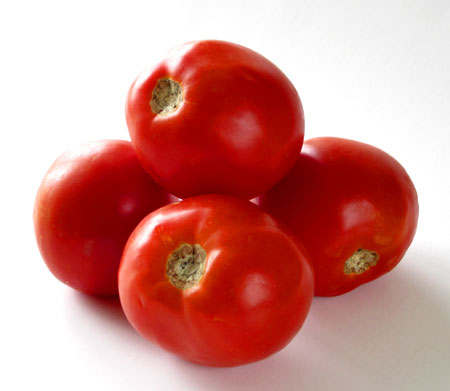
Locally grown round red slicers.

Round and red, and kind of ordinary looking, the slicing tomatoes in your CSA share box a few weeks ago didn’t seem very special, did they? But they are, and what made this year’s crop different is the way it was grown — in pots of soil, not directly in the ground. (The variety itself, Florida 47, is a commercial hybrid that’s been around for a long time, and is known as a good producing plant.)

Dan’s field of tomatoes in pots.

Farmer Dan raised the Florida 47s one plant per container, dozens of rows marching across a field blanketed with shiny black landscaping cloth, hundreds of staked tomatoes filling up three and a half acres. Why grow in pots? Because the land Dan had to use for growing, across from the Keys Gate Market Garden, was former swampland filled in with rock and even chunks of concrete, thin soil supporting only weeds. “Seven, eight, ten feet of fill instead of soil, and it was absolutely impossible to grow anything there,” Dan explained. Thus hundreds of pots, growing plant nursery style — a quick solution to the no-soil problem. (Plus, it was also the quickest way to get the operation certified organic.)

Read the fine print. This tomato came from Mexico. And people bought it because it’s cheap.

The tomatoes were delicious and beautiful, but financially the crop was a disaster. Startup costs were much higher than if he had planted directly into a fertile field. The potted plants required a lot of input — fertilizer and insect control sprays — plus you have to take into account the cost of soil, pots, landscaping cloth, irrigation and labor. “It cost me seventeen thousand dollars gross to set up, and my net was damn near nothing,” Dan grumbled.

Just as Dan was starting to harvest a few weeks ago, round red organic tomatoes from Mexico flooded the local market. (You might have seen them at area stores.) Thanks to NAFTA, the dollar-peso exchange rate, and low labor costs, organic tomatoes from Mexico were wholesaling for a lot less than what Dan was asking for.

No way he could make a profit. And he was stuck with bushels of tomatoes he had to unload. So he sold them at cost to farmer Margie of Bee Heaven Farm, and everybody in her CSA, large and small shares alike, got round red tomatoes. And, there’s Florida 47s to be had at the Keys Gate Farmer’s Market on Saturdays, and Pinecrest Gardens Farmers Market on Sundays, while they last.

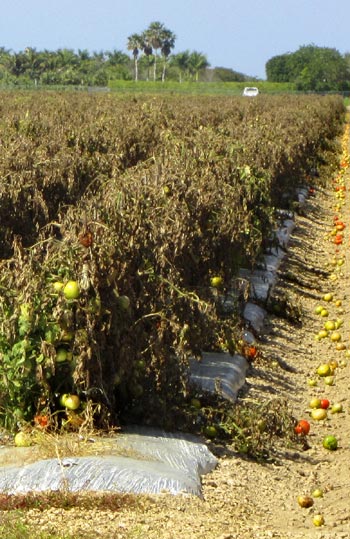
Tomatoes left to rot.

It’s not just organic growers who gambled and lost hard this season. I saw a field off Krome Ave. and SW 168 St. where the grower didn’t even bother harvesting his tomatoes. He left his crop to rot on the vines. Half the field was brown and dead, like it went through the worst freeze — and in the absence of recent cold weather, a sign it had been doused with herbicide. Why bother to spend more for labor to pick the crop when he was already in the hole raising it? (Food activists may want to chime in about holding off on chemicals, and allowing people to come glean fields to salvage food.)

Mexican produce aside, growing organic tomatoes in pots was an interesting experiment, but not one Dan cares to repeat any time soon. “It’s not sustainable,” he said. He is sticking with growing slightly more profitable green beans grown in a field of real dirt. It’s a gamble he knows how to win a bit better, providing there’s no hard winter freezes. “You want to know how to make a little money in farming?” Dan asked. “Start with a LOT of money.” And he laughed long and hard at his familiar joke.

Read Full Post »

A hen lays an egg every day.
True. Hens generally lay around the same time of day, usually in the morning. To get more technical, it takes about 25 hours for an egg to form and travel through the oviduct, causing the hen to lay her egg a little later each day. As the cycle progresses, she will skip a day (hens don’t lay eggs in the evening) and start a new cycle. A group of eggs laid during one cycle is called a “clutch.”

A hen will lay eggs all its life.
Maybe. A young hen, called a pullet, will start laying eggs at 6 months until its first moult. It will then resume laying eggs in the second year at 80% of its previous rate, then 60% of that year’s rate in the year after that. After 3 years, laying drops off. But a hen can keep laying eggs for several years after, just not every day. Older hens usually stop laying eggs, but some might keep laying an occasional egg.

A very big hen lays the big double yolk eggs.
False. A pullet, or young hen, that doesn’t have a regular laying cycle can occasionally lay double yolk eggs. That happens when ovulation happens inconsistently, and one yolk joins the next as the egg develops. (Some breeds will regularly lay double yolk eggs.) Of course, a double yolk egg is much larger than a normal sized egg. Sound painful? Not really. The egg comes out soft and its shell hardens in contact with air.

An old egg will float in water, but a fresh egg will sink.
True! A fresh egg will sink in a bowl of water, but as it gets older, it will start to stand up. A very old egg will float. Don’t eat that one! Inside the egg is a small air pocket at the blunt end. Eggshell is porous to air, and as the egg ages, more air will slowly seep in, and make the air pocket bigger.

The best place to store eggs in the refrigerator is on the door.
False! Keeping eggs in the refrigerator door is bad, because every time you open the door it changes temperature — hot, cold, hot, cold. Always store eggs in the carton with the pointy end down. To keep eggs fresh longer, find a spot for them on the shelf where the temperature is cool and consistent.

Read Full Post »

« Newer Posts - Older Posts »