Feeds:
Posts
Comments

Archive for the ‘photo’ Category

The tents of Upper Eastside Farmers Market, at Biscayne and 66th.

Used to be that local farmers markets closed down in summer, or brought produce in from elsewhere. Isn’t anything growing, I’ve heard. Too hot. But that isn’t necessarily so! Quite an abundance of local and seasonal produce (and other local foods) has been available at the Upper Eastside Farmers Market, which has stayed open through a second summer and is still going strong.

Look, they have mamey! And dragonfruit!

You can count on lots of fruit during the summer. In the last several months I’ve seen lychees, canistel, dragon fruit, mamey, longans, white sapote, Thai guava, jackfruit, starfruit, monstera, mango, avocado, mamoncillo, red guava, sugar apples (anon), bananas and plantains as they come in (and go out) of season. The market also offers eggs, callaloo, collards, both sweet and hot peppers, herbs, french sorrel, potatoes, carrots, eggplant, tomatoes, okra, squash, boniato, calabaza, snake gourd, allspice berries, katuk, honey, Art’s pickles and whatever else is available. You won’t go hungry in the summer!

Market manager Art Friendrich (or his assistant Olga Gomez) makes rounds of dozens of small local farmers and gardens every week, gathering produce for the market. Everything is fresh, and some picked to order. And everything is labeled clearly if it is organic or pesticide free, sustainably or conventionally grown, and which farm it came from. Upper Eastside is one of three markets run by Urban Oasis Project, a non-profit dedicated to bringing fresh and local food to underserved neighborhoods. “UEFM is our only year-round market, and in peak season we run or sell at other community based markets,” Art said. All markets run by Urban Oasis Project accept EBT (food stamps) and doubles dollars — $10 of EBT funds will buy $20 worth of food.

Serving the Community

Art and Olga employ Youth L.E.A.D. apprentices and train them in sales, service and the details of local produce. “They are placed for 6 month periods, and we have had about 6 different apprentices over the last 12 months,” Art said. Judith Fucien has been working at the market for about eight months and enjoys it. “I like meeting new people and exposing them to fruits and vegetables,” she said. Since she started, she has gained experience about food and people. “I learned that all fruits and vegetables are not from here, that not all people are the same, they’re very different in many ways, and there’s lots of friendly dogs.” Judith comes in the morning to set up tents and tables, stays all day helping customers, and at closing helps pack everything up. Market volunteer Miss Shirley sang Judith’s praises. “I admire her because she’s very faithful, very committed to her job,” she repeated.
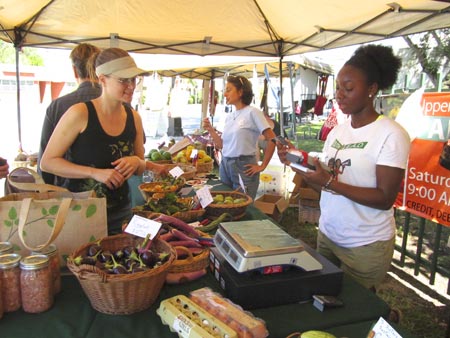
Youth L.E.A.D. apprentice Judith Fucien (right) rings up a sale.

Customers can close the food loop by bringing back their raw fruit and vegetable scraps for composting. Right now, the scraps are going to Art’s compost heap, but that wasn’t always the case. Recent Youth L.E.A.D. graduate Terry Perman would take a full bin of scraps for composting to the nearby Earth N Us urban farm. But grant money ran out and Terry moved on. Founder Erin Healy has applied for grant money from the Health Foundation to resume this project. She wants to buy an adult tricycle (with a big basket to haul a compost collection bin) and pay a monthly stipend to the compost gatherer. Composting is just one of many programs and events run by the non-profit. According to Erin, “Youth L.E.A.D. is an emerging food justice organization that educates, empowers, and employs underserved youth to eat healthy, local diets while increasing access to healthy, local foods in their communities.”

Visit With the Vendors

Every time I chat with Yorkys of Bodhi’s Garden Delights I learn something new. She grows herbs in raised beds in her back yard and at Wynwood on the Green, then pots them up to sell at market. This past weekend, she offered Cuban oregano, aloe, culantro, thyme, rue and papalo, along with less typical varieties of basil. Each plant comes with a little card indicating what it’s good for and how to prepare it. Ask her a question, and Yorkys will share her knowledge of cooking and self-care. She also sells cooked vegetarian food, seasoned with her herbs.
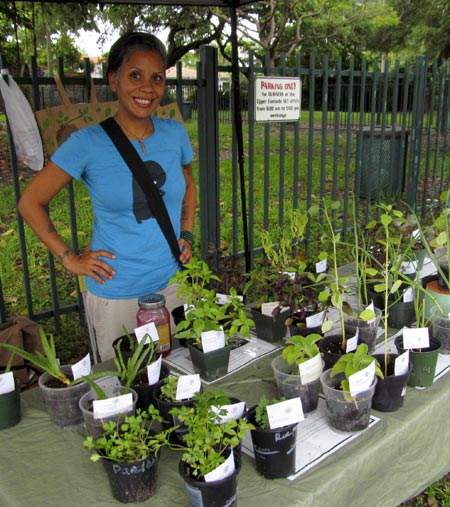
Yorkys sells herbs from her garden to yours.

At Novae Gourmet Jerky you’ll meet lively and talkative Helen Cole, the artisan who makes small batches of jerky with Angus beef and chicken. She sources clean meats that are hormone and antibiotic free, and seasons them with her own blends of spices and herbs. Beef comes in teriyaki, BBQ, honey coryaki (sweet or hot) and penang chili (hot) flavors. Chicken jerky comes in teryaki and now penang chili flavors, and is incredibly popular. Some varieties are sliced thick and chewy, and others are thin and crispy like chips. Helen calls her customers “jerky junkies” and for good reason. Try one piece and you want another. Next thing you know the package is empty, and it’s time to get more.
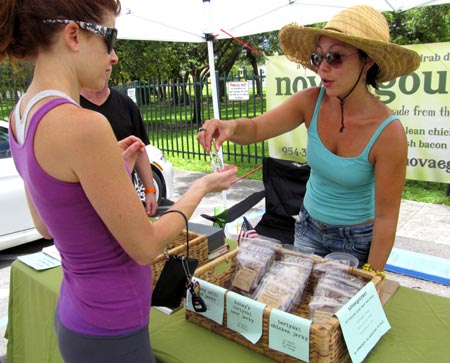
Helen Cole dishes out a taste of jerky.

A sunny day at market can be wicked hot and requires a stop for refreshment at Nature Boyz where Clive makes fresh juices. You’ll find him in constant motion behind his bamboo stand — feeding stalks of sugar cane into a large boxy juicer that presses sweet cane juice (guarapo) into a container, or cutting up fruits and loading the swirling blender, or pouring and serving drinks to thirsty customers. Every drink starts with a base of sugarcane and you can choose pineapple, mango, passion fruit or carrot, or design your own blend. If you need a pick me up, ask for extra ginger. Other choices are fresh coconut water straight from the nut, or a shot of fresh-squeezed wheatgrass. Clive also offers a small assortment of tropical fruit, which he sources from growers in Homestead.

Some of the other vendors at the market are Proper Sausages, Copperpot’s Jams, Hadaya Spices, Crackerman, Asha’s Orchids, Massud’s Roasted Corn, and Akete’s Jamaican Fritters.

Market manager Art Friedrich weighs mushrooms for a customer.

The market is open on Saturdays from 9:00 am to 2:00 pm. It located next to the NET office on Biscayne and 66th St. (They moved in March from their old location on a windy, noisy corner of Biscayne and 79th St.) Parking is very tight, as people jostle for a handful of spaces. Almost every weekend there’s a close call (and sometimes a fender bender) in that cramped little lot. Best to turn from Biscayne onto 64th St., go east one block, turn left, go one short block and leave your car in the Legion Memorial Park lot. The walk through the park to the market is safe, pleasantly breezy, and not very long. If you pass by early enough, there’s a free yoga class of about 20 students that meets every Saturday morning at 10 am in the shade of live oak trees.

Read Full Post »

Gabriele Marewski is an Innovative Farmer.

Local organic farmer Gabriele Marewski was recognized with the Florida Innovative Farmer Award at the 2012 Small Farm and Alternative Enterprise Conference this summer. (She joins Eva and Chris Worden of Worden Farm, organic growers in Punta Gorda, who were given the same award in 2010.)

Gabriele owns and operates Paradise Farms Organic, which is known for the Dinner in Paradise fine dining series every winter/spring. A portion of the proceeds from each dinner series is donated to small local non-profits. This season, Urban Greenworks and Slow Food Miami will receive donations. (Events are the main way that the community can visit the farm, which is otherwise not open to the public.)

In addition to dinners, Sunday morning brunches and occasional farm tours, Paradise Farms has branched out to other ventures, and recently started offering a venue for “sustainable, organic weddings” on the farm. Several cabins are available for B&B overnight stays.

The farm is also venturing into the realm of value-added foods. “We have a large 3’x3’ 24 shelf dehydrator where we are making teas from our edible flowers,” Gabriele said. In addition,”We have received a Value Added Producer Grant from the USDA to dehydrate our oyster mushrooms into a delicious healthy snack for school vending machines.” (The mushroom snacks are still in the focus group tasting stage.) And of course, Gabriele has made a name for herself growing microgreens and edible flowers for high-end restaurants.

Paradise is innovative in that it’s not only an organic farm, but also strictly vegetarian. Meat and meat products are not allowed on the property, whether they be dinner ingredients or farm nutrients. Gabriele is determined to keep it that way. “Vegetarianism is the single most important act to save our planet as it take lots of resources to produce commercial meat and is the biggest single pollutant of our waterways.”

The Innovative Farmer Award is a joint venture by the University of Florida and Florida A&M University to assist the state’s small farms, which are defined as having sales of less than $250,00 a year, and represent more than 90 per cent of all farms in Florida.

Read Full Post »

Jackfruit tree

Some of the strangest tropical fruits are available during the summer. One of the biggest and most unusual looking is jackfruit. It is as large as a melon or bigger, mostly oval in shape, and has knobby or spiny green skin. The typical size at market is 20 pounds, but they can get as big as 60 to 80 pounds. It’s commonly sold cut in chunks.

Grower Robert Barnum has about 200 jackfruit trees at his Possum Trot Tropical Fruit Nursery, interplanted with other trees on his 40 acre property. We strolled through a section of a dozen tall trees, all loaded with large fruit which varied in shape and size, some smaller and rounder, others more elongated. You can tell when a fruit is ripe because it sounds like a drum when you thump on it. Another clue is that its spines flatten out as it ripens, although that isn’t the best indicator, because some varieties have flatter spines than others. But the best way to tell ripeness is by smell. Ripe jackfruit has a strong aroma and gives off a lot of ethylene gas. If you put a whole ripe fruit in a refrigerator, it will keep ripening, and the whole interior will smell like it.

Opening up a such a large fruit is not a casual undertaking. It requires stamina and patience, and a large sharp knife well coated with vegetable oil. The fruit’s thick rind releases a latex sap when you cut into it, and can gum things up. The edible part of the fruit is the aril, or thick sac of chewy yellow flesh that has an oval, shiny brown seed inside. The grayish-colored connective membranes called rags are generally not edible and need to be removed. Cleaning the fruit involves taking out the arils, and separating the seeds. Rags and rind are thrown away. Depending on the size, the job can take a good hour or more. Cleaned fruit will keep 2-3 weeks in a zipper bag in the refrigerator, or 6 months in the freezer.

An open jackfruit.

Jackfruit vary in the texture of their flesh. Some kinds are soft and wet, suited for making drinks, and others are more firm and dry. Those kinds are more desirable because they can be eaten ripe or unripe. Robert says the ripe fruit tastes like pineapple-banana with hints of vanilla, but I can smell and taste a musky overtone. (Others have told me the flavor reminds them of Juicy Fruit gum.) Unripe fruit is has a chewy texture, and is usually cooked and used as a meat substitute. Jackfruit curry is a popular dish made with unripe fruit, as is fake pulled pork seasoned with BBQ sauce. Seeds are also edible. Robert recommends blanching seeds in boiling salt water three times to remove the astringent flavor, then roasting in the oven. They taste a lot like chestnuts. You can save seeds to grow your own tree, but you’ll have to be patient. It takes anywhere from four to 15 years, depending on the variety, before a jackfruit tree starts to bear fruit.

You can find whole and cut jackfruit from Possum Trot at the Upper Eastside Farmers Market, Verde Gardens Farmers Market, and at Bee Heaven Farm’s online store.

Robert Barnum and jackfruit tree.

Read Full Post »

Prolific pineapples

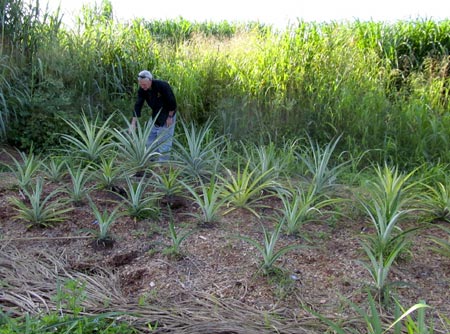
Tim Rowan tending to his newest pineapple patch.

Since my last visit, farmer Tim Rowan has added another raised bed of pineapple tops and hapas (pups). Dozens more were potted up and waiting to get planted. His goal is to have over 100 plants in the ground, and maybe, just maybe start selling fruit next year. Right now he’s giving fruit away to family, friends and co-workers. (Sly man, that’s how he gets people hooked!)

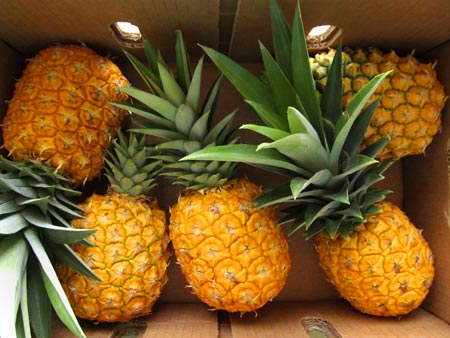
Tim gave me some pineapple to try. These were a different variety, smaller and more square-shaped than the 9 pound monster from before. They looked more like what one would find at a grocery, but that’s where the comparison ends. Tim’s pineapples are allowed to ripen naturally and are aromatic, sweet, juicy and bursting with flavor. Nothing like home grown!

Recently Tim’s pineapple plantation was featured in a one-page article in the latest issue of Edible South Florida. You can find the magazine for free at Whole Foods, among other places. Or download a pdf of the article here pineapple (file size 668 kb).

The aroma coming from this box was mouthwatering.

Read Full Post »

Freshly harvested macadamia nuts.

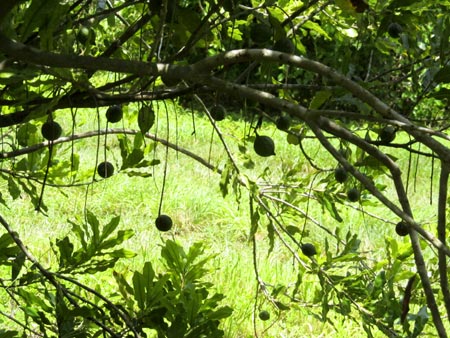
Fresh pesticide-free macadamia nuts have been available at several farmers markets the last few weeks. Yes, they are locally grown! The green-husked nuts come from Possum Trot Tropical Fruit Nursery, where grower Robert Barnum has about a dozen trees. This summer, Robert managed to harvest about 45 pounds this summer, and fresh nuts should be available for about two more weeks.

Husk splits open by itself when the nut is ripe.

Fresh macadamias don’t look like a nut. They have a green rind or husk that needs to be cut and peeled off. It will split by itself when the nut is ripe. Robert suggests leaving fresh nuts out on the counter for a few days to dry out a bit. When the husk is slightly dry, it is easier to remove. If you have a dehydrator, you can speed up the process. Dry them for a few hours on low heat until the husks split. Use a sharp knife to pare them off.

Underneath the husk is a smooth, dark brown shell that is tough to crack. Dry the husked nuts in the dehydrator again, for two to three days at 100 degrees F. This will dry the nut meat a bit and cause it to pull away from the shell, making it easier to crack. If they crack cleanly, they’re ready.

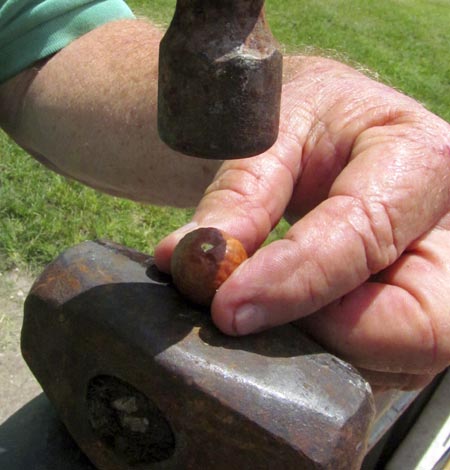
Tap the hammer lightly to crack the shell.

Robert’s cracking technique is very DIY. He carefully holds the nut in place on the side of a sledgehammer, and taps it with a claw hammer. If you don’t have two hammers (or don’t want to risk smashing your fingers), you can try a concrete slab or sidewalk and tap at the shells until they crack. (Whatever you do, do NOT do this on a granite counter top or the stone will crack. Don’t say I didn’t warn you!) Nutcrackers don’t apply enough force to crack the shell.

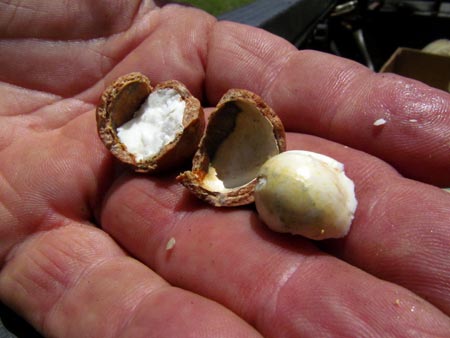
Shelled raw macadamia. It tastes like coconut.

Once the shell is cracked, you have to pry it open. Robert used a pocketknife. Inside is the white, mild flavored nut. You can eat it raw, or lightly toast and salt it. Cracking nuts and getting the meat out is labor intensive, but somehow squirrels are able to open nuts without any tools.

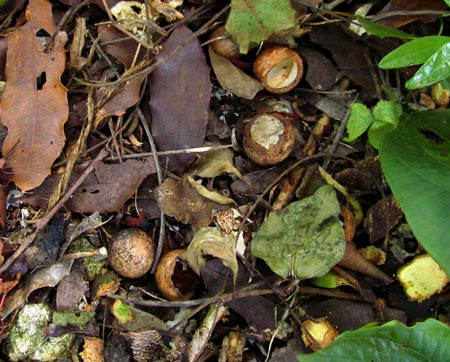
What squirrels leave behind.

The macadamia trees have been bearing well in past summers, but those harvests were much smaller because of The Squirrel Problem. Sounds like a well-worn cliche, but Robert has been battling squirrels for years, trying to keep them out of the nut trees. The little animals have a powerful attraction for macadamias, but waste a lot. They’ll eat part of the nut, cracking it open with their powerful jaws, and let the rest of it fall to the ground.

On a recent visit to the macadamias, two mutts that accompanied Robert and me went racing ahead, barking excitedly. A brown hound ran up to a tree, clambered up its lower branches, barking vigorously. It had spotted something. As Robert and I approached, the dog climbed down. I peered up at higher branches but saw nothing. “Squirrel,” Robert said. “The little critter is hard to spot. It will hide on the opposite side of a branch, and all you’ll see is the tip of its tail, or an eye peeking out.” I did see plenty of half-eaten nuts in the leaf litter below, a sign that squirrels had been munching there for some time.

Feast like a squirrel! Fresh pesticide-free macadamia nuts are available at the Upper East Side Farmers Market, Verde Gardens Farmers Market, and through Bee Heaven Farm’s online store for a limited time.

Waiting to be picked.

Read Full Post »

« Newer Posts - Older Posts »