Feeds:
Posts
Comments

Archive for the ‘photo’ Category

Dances with rebar


Sadie working rebar out of the ground.

After Bee Heaven Farm’s CSA season ended in May, work shifted to cleaning up planting beds and putting things away. Irrigation hoses and tapes that watered plants at ground level were rolled up. Bamboo poles that supported colorful heirloom beans were pulled up and stacked in the barn. And the toughest job of all was to take down the tomato trellising.

Giving a good tug to see if rebar will come loose.

Heirloom tomatoes are indeterminate, meaning their vines just grow and grow. Their limit is determined by the height of trellising. At Bee Heaven Farm, the support is about 6 feet. Rebar — just like what you’d find on a construction site — is set into the ground several feet apart along each row. Wire mesh is run along the rebars from one end of the row to the other, and this is what supports tomato vines. But when the growing season is over, the mesh needs to be rolled back up and rebar pulled out and put away in the barn for the summer.

Triumphant Sadie takes rebar back to the barn.

Farm interns Mike and Sadie had the tough job of removing trellising, including all the rebar. How hard could it be to pull a piece of metal out of the ground? Pretty hard, I discovered. The soil is dry and holds the steel like cement. You have to wiggle the rebar around, widen its hole, pour some water in to soften the soil, push and pull and twist the rebar around, add more water, maybe catch your breath, and do it again until finally, finally it loosens up and you can tug it out of the ground. (It’s quite a workout for the arms!)

Sadie had her own rebar dance going. She swayed back and forth using her arms and body weight to move the rebar, and worked around in a big circle. Occasionally she stopped to pour a bit of water into the hole she was making.

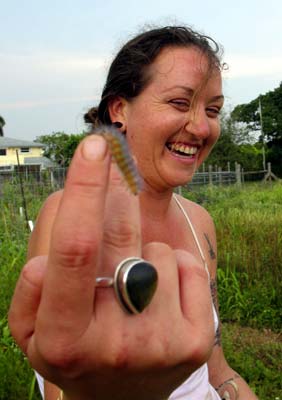
Ginormous wooly bear caterpillar rescued from a hole in the ground.

There was a moment of life and death drama when a wooly bear caterpillar fell into the water-filled hole. Sadie rushed to rescue it. This is quite a magnificent wooly bear! Not sure what kind of butterfly it grew up to be — any ideas?

Sadie and the wooly bear.

Read Full Post »

Hani’s cute kids


The baby goats and their mothers nibble on a royal palm frond. Goats are browsers and will eat all kinds of vegetation.

Hani Khouri makes ice cream and several varieties of cheese using milk from his own herd of Nubian goats. He keeps them on his farm in Redland. It’s always fun to visit and take pictures of cute and friendly goats. They, in turn, like to nibble on my shirt and fingers if I’m not paying attention.

The new kids on the farm hanging out underneath the milking stand. The white one still has his umbilical cord. They are about a week old in this picture.

Back in March, Hani’s herd grew to 17 with the arrival of two new kids. They’re both male, which is a problem, because two grown bucks are already in the herd. Hani prefers to keep only one buck with his female goats.

Marylee Khouri holds one of the new kids.

When I went to see the kids, they were only a few weeks old and in that awwww how cuuuute stage. Now they are four months old, bigger but still cute, and Hani is looking to sell them — but only to the right buyer. “Not to eat, and no santeria!” he said. He’d like to see them go to a herd where they can grow up and live out their lives.

If you are interested please contact Hani at www.hanisorganics.com If you are located in Miami-Dade or Broward counties and are interested in purchasing goat cheese, goat milk ice cream, or Mediterranean food, you may do so through his web site.

Read Full Post »

So ugly and so big

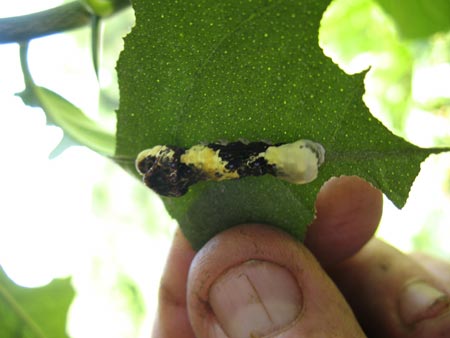
The caterpillar of the swallowtail butterfly, with evidence of its enormous appetite.

Last month I stopped by Possum Trot Tropical Fruit Nursery, and as usual, brought my camera. I look forward to those visits, because there’s always something new happening. Walking around with Robert Barnum looking at trees and plants never gets old. Robert pointed out something that looked like a massive bird dropping on a leaf, a blotchy browish-black and white blob, and said it was actually the caterpillar of the giant swallowtail butterfly. It was the biggest, ugliest caterpillar I had ever seen. And it had been quite busy, was chewing up large chunks of a Ponderosa lemon seedling’s leaves. In fact, they like eating citrus leaves very much, which could be a problem. Citrus greening is killing local citrus trees, so there goes its food supply.

Touching the caterpillar triggers a defense response.

The caterpillar’s ugly looks were actually its main defense from getting eaten. A bird would look at that and wouldn’t think it’s food. The caterpillar also had another way of defending itself, Robert said as he touched its back. It immediately arched up a bit and something that looked like a red forked tongue came out of one end. It’s called an osmeterium and it gives off a noxious odor to repel its predator. Robert asked if I wanted to smell that finger, but I shied away, no thanks, take your word on it.

That was in May, and by now the caterpillar and its buddies have most likely decimated the lemon sapling and any others nearby, gone through their chrysalis stage (which lasts about 10-12 days) and are most likely now transformed into the giant swallowtail butterfly. The adult butterfly has a wingspan of 4 to 6 inches, and it’s breathtaking to see a butterfly that big in flight.

A stressed swallowtail caterpillar displaying its osmeterium.

Read Full Post »

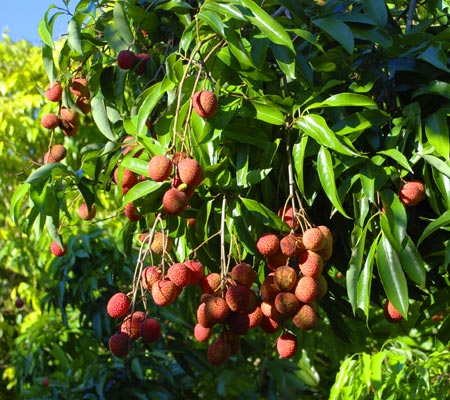
Organic lychees ripening in the morning sun.

The lychees in this week’s summer fruit offering come from Green Groves, not too far from Bee Heaven Farm. Steven Green, the grower, invited me to see how lychees get picked. He had an order from Whole Foods, and hired a picking crew to help. If you were in Whole Foods last weekend or this weekend and saw pint containers of organic lychees for sale, those were the ones!

Up in the cherry picker, Gonzalo picks lychees.

Picking work starts early. Golden morning sunlight was just breaking over the tops of trees from the grove across the road. The air was cool and full of sounds of birds. Dew was still clinging to weeds under the lychee trees. Ripening fruit hung in heavy clusters on the trees. At 7 am, the crew was already getting started. They had dropped off their cherry picker the day before. It was a simple contraption — an engine on three wheels, with a boom arm and bucket. Gonzalo, one of the workers, stood in the bucket and manipulated the controls to raise the boom and drive the picker to a different spot. When I arrived, he was already at tree top level gathering fruit.

Gonzalo held a pair of heavy duty clippers in one hand, and reached with his other hand to grab clusters of lychees called panicles. He snipped the panicle and placed it into one of the bins fastened to the sides of the bucket. He started with the first tree by the gate, and worked from top down. Then he moved to the other side of the tree, gracefully maneuvering the picker, and again clipped fruit from the top down. “Usually the whole tree ripens at the same time. The lower branches ripen before the upper. And the top gets eaten by grackles,” Steven said with a laugh. “I have enough to share.” He has 125 trees planted on two acres, and has been growing lychees since 1992, and avocados for 15 years before then.
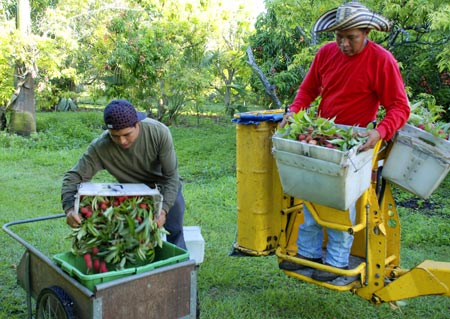
Hidalgo loads fruit that Gonzalo gathered.

The rising morning sun shone on Gonzalo’s face as he worked silently and quickly. Bins filled up with lychees. The picker’s gasoline engine clattered, and grackles screeched from a nearby tree. He lowered the bucket and Hidalgo came with a gardener’s cart and dumped lychees into it. When the cart was full, he walked back with the cart to the improvised packing house. A long table had been set in the carport of Steven’s house. Hidalgo dumped lychees onto the table. It had a raised lip along the edges, to keep precious fruit from rolling away.
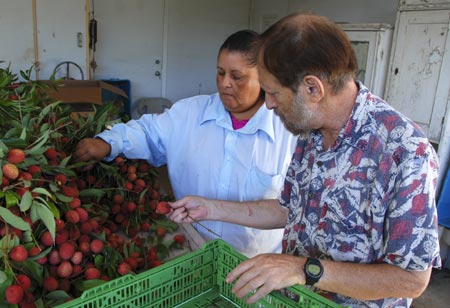
Steven shows Leticia the acceptabe size for coffee spots.

Leticia, the owner of the picking company, stood at the table and checked each individual fruit. She has been packing fruit for 25 years and has a keen eye for the perfect ones. “This crew knows ripeness,” Steven said. They have worked for him for many years. Steven reviewed with Leticia how he preferred to grade the fruit. The perfect ones went into a green bin. The less than perfect ones, called number twos, were tossed into a box. A number two lychee was one that had a brown blemish called a coffee spot. Steven explained the coffee spots were harmless and didn’t affect flavor or quality of the fruit. Spots the size of a pencil eraser were ok, but bigger ones were not. Spotted number twos are still good to eat, but in this case would get sold to make wine or ice cream. Steven pointed out, “Buyers of number twos are price sensitive and understand that the blemishes have no effect on fruit quality except for appearance.”

The sweet perfume of ripe lychees filled the air. Steven showed me the difference between a perfectly ripe lychee and one that wasn’t quite there. The not as ripe fruit’s skin had little spines or bumps. A ripe fruit’s bumps flattened out. Steven explained that as it ripened, the lychee grew more plump and rounded, which stretched its skin and flattened out the bumps.
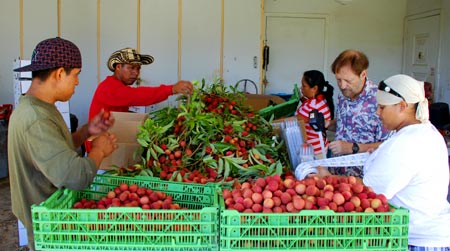
Hidalgo, Gonzalo, Betty, Steven and Shelly grading and packing fruit.

Picking is all a matter of timing. Pick too early and the lychees are a little sour. (I happened to eat some of those a couple weeks ago.) Wait a little for the fruit to ripen more and it gets sweeter and tastes like lychee. “If you wait too long to pick, overripe fruit tastes like sugar water and you lose the lychee flavor,” Steven explained. Picking also has to do with market timing and getting a good price. The first local lychees to hit the local market got top dollar, getting $46 for 10 pounds wholesale. When Mexican lychees came in last Monday, May 30th, the prices crashed down to $25 and are now tumbling even lower. (These are prices for conventionally grown fruit. Organic lychees can fetch considerably more.)

Steven grumbled that NAFTA is the reason for the drop. “In Mexico, growing is much less expensive, and the quality is less, not anywhere as good as locally grown. They pick earlier because they need the extra time in shipping.” NAFTA gives offshore fruit — as growers call imports — another unfair advantage. “Mexican lychees may have prohibited pesticide residues, or have been treated with sulfites to preserve their color. USDA doesn’t have the manpower or resource to inspect all the fruit coming in. Also the retailer is supposed to mark COOL (Country of Origin Label) but there’s almost no enforcement against retailers that don’t. For organic fruit, that’s no problem, because origin is part of the certification.”
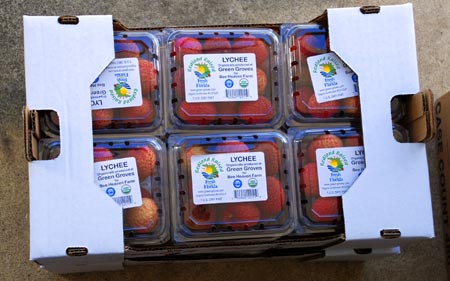
A case of organic lychees destined for Whole Foods.

Steven showed me the label that went on each pint clamshell and cardboard case. Among other information, the label had the “Redland Raised Fresh From Florida” logo and the grove’s organic certification number. Shelly stuck labels onto pint sized plastic clamshell containers, then filled one container at a time with number one lychees, and packed 12 to a case. Steven put labels on the cases. The crew would pick and pack fruit for a few more hours. A driver was coming later that afternoon to pick up their order of 40 cases. Steve’s lychees would be in local stores for the weekend selling for $6.99 a pint.

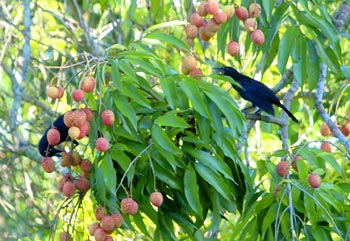
Look carefully and you’ll see a pair of common grackles feasting on fruit.

On my way back into town, I passed by a woman selling lychees by the side of Krome Avenue. It was completely the opposite of a supermarket — a tent, a bin full of lychees, and an ancient looking scale. Three cars had pulled to the side of the road and people were handing her cash for pounds of sweet fruit. Hand lettered signs nearby said LEECHEES $2.00. For that price, most likely the lychees were grown locally and were not organic. I was reminded of something I heard a farmer once tell me: “Growers are price takers, not price makers.” On that sunny Thursday morning deep in the heart of Redland, two kinds of lychees were being sold, and two kinds of prices were being made.

Read Full Post »

Jeepers, peepers!

Three day old baby chicks pecking at food.

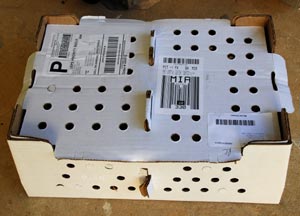
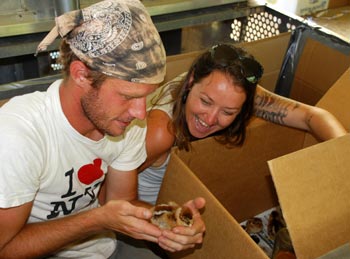
A new batch of baby chicks arrived at Bee Heaven Farm this week. The little peepers  hatched last Monday and arrived in the mail on Thursday. Yes, baby chickens travel by mail! The post office called Farmer Margie at 6:30 in the morning to come pick them up. They were packed tightly in a cardboard box with lots of air holes. They kept each other warm with their own body heat while traveling. So far it looks like all survived the trip.

How baby chicks travel through the mail.

Farm interns Sadie and Mike immediately started holding and cuddling the baby chicks. There’s something about handling the little birds, or just watching them peep and run around, that’s mesmerizing. What’s not to love? They’re so cute and fluffy! The chicks will have no problem getting socialized with all the attention they’re getting.

Mike and Sadie playing with chicks.

Margie got two heritage breeds. The black chicks are cuckoo maran and the brown chipmunk-looking ones are welsummers. When they grow up to be 4 to 6 months old, the hens will lay chocolate (dark brown, that is) eggs. This week 25 chicks arrived, and next week 25 more are coming. Farmer Margie is getting that many birds to replace those killed by feral dogs this past season.

Read Full Post »

« Newer Posts - Older Posts »