Feeds:
Posts
Comments

Chilling out

I’m starting to get overwhelmed by my CSA share. Opened the refrigerator door and all I saw is a sea of green in plastic zipper bags. What was I thinking when I signed on to eat a full share all by myself?? (In full disclosure, I eat what I shoot. The share I photograph goes home with me as compensation.)

Every other week I make “clean out the frig” soup. Last weekend it was a good way to use up the bunch of Greenwise organic celery bought at Publix only three days before the share. (Really, what was I thinking? During season, Publix is best for non-veg staples.) Chopped up that whole bunch to make celery soup, threw in a few stray potatoes and carrots, and chopped up an onion, too. Simmered it in homemade vegetable stock. Was pretty good topped with chopped tofu, cilantro and a drizzle of sesame oil and a dash of hot sauce.

Don’t laugh! Gourmet chef I’m not, nor pretend to be. Just trying to keep ahead of things wilting or going bad. When they do, and it’s happened a few times already, I can hear Margie’s voice or Eva Worden’s voice scolding me about how hard they worked to grow that food for me. (No, I don’t usually hear voices. That’s some leftover Catholic guilt rattling around.)

Made room in the freezer next to leftover soup, and am starting to fill it with plastic zipper bags of blanched veggies. Found information on the UF IFAS Extension website, including a chart of detailed instructions on how to handle various vegetables. First you blanch (or cook briefly in boiling water), chill, then pack and label and store in the freezer. (If you have a garden, or have been a serious cook for a long time, you already know how to do this.) Doesn’t take that long, either. As my dad would say, waste not want not. I think I’m ready for the next share!

CSA share: week 9

CSA share: week 9

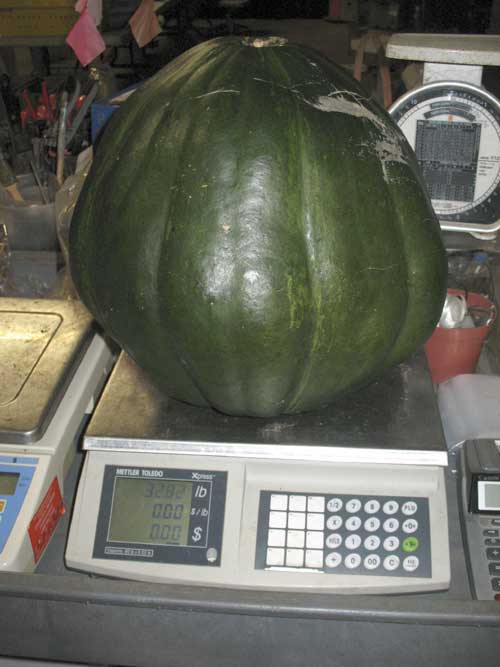
28 pound calabaza

Last week Cliff Middleton brought over two giant calabazas. They were huge! One could fit inside a full share box, maybe. Grabbed a squash and waddled across the barn to weight it — 28 pounds! Weighed the other one — 32 pounds! What kind of organic goodness is Cliff doing over at Three Sisters Farm to get things to grow like that?? Or maybe it’s just the nature of the squash — they want to rule the world.

32 pound calabaza

Margie cut up and sold both at market last Sunday, and farm intern Emily took a picture of one of them cut open and posted it on her blog Crooked Row. Just one squash could have fed a family of four four a week. Hmmm, wondering what kinds of goodies are waiting in the barn to be photographed this week…

Magic mushrooms

Oyster mushrooms have been a welcome addition to the CSA shares so far twice this season. They are grown at Paradise Farm, and are for sale on Saturdays at the Paradise tent at the Coral Gables Farmers Market, and also on Sundays at the Redland Organics tent at the Pinecrest Gardens Farmers Market. The following article was published in the Miami Herald on Thursday. Nancy Ancrum did a great job, couldn’t do better myself. Enjoy!

Homestead farmer, African scientist realize mushroom dreams

BY NANCY ANCRUM
nancrum@MiamiHerald.com

It was an e-mail that just screamed to be spiked. It came from an African country; it mentioned something about a “lottery;” it hinted that there was a wonderful, enriching opportunity to be had.But Homestead farmer Gabriele Marewski didn’t delete the message. She read it. It wasn’t a scam; it was the world working in mysterious ways.

“Those scam e-mails go right into the spam box. But this one had that first sentence that was intriguing,” Marewski says. “It said, ‘I won the lottery to come to the United States.’ The other ones say, ‘You won the lottery, give us an account number.’ ”

She went from intrigued to hooked when she got to this line: “I can show you how to grow oyster mushrooms.”

“This was too bizarre; so bizarre I had to respond.”

Read the rest of the article here:
http://www.miamiherald.com/living/top-stories/story/1448132.html

Mystery of the bees

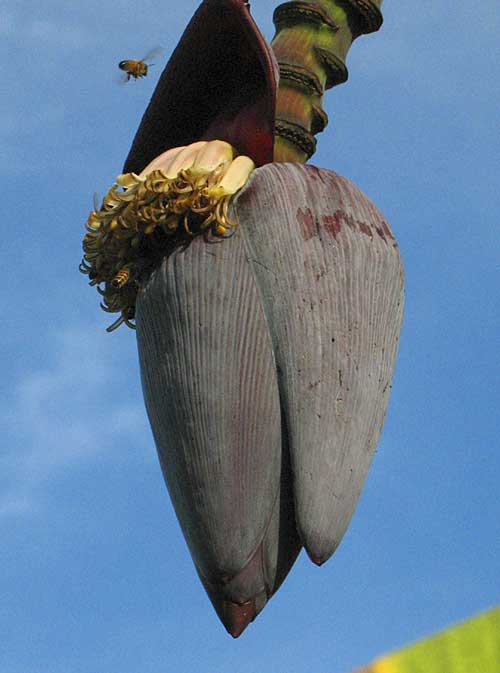
Bees like bananas. Taken in happier times a couple months ago.

About half the honey bees are dead at Bee Heaven Farm, according to Miguel Bode, the beekeeper. He checked his hives after the last freeze and again this past weekend. The bottom of the hives had a layer about an inch thick of dead bees, and there were plenty more dead bees outside the hive entrances. And hives he keeps down the road at Paradise Farms also suffered casualties, but not quite as many, and bees there were more active.

Without a doubt, Miguel suspects pesticide spraying [in the mass casualties in one hive]. No telling where it occurred, because a bee can range as far as a mile from the hive in its search for food. When a bee brings back contaminated pollen to the hive, it will get distributed to the other bees, which will also sicken and die.

Miguel was surprised by the huge quantity of deaths because the hives were in decent shape before the cold weather rolled in. The bulk of his hives, which he keeps in the suburbs, remain in good condition.

It’s not likely that it was the cold that caused the mass die off. Miguel pointed out that bees which live Up North make it through much harsher winters than ours without significant problems. Bees can survive cold weather. When the temperatures drop, the bees inside the hive cluster into a ball, and vibrate the muscles of their wings to generate heat to stay warm. The temperature inside the cluster is about 90 degrees. The bees rotate from the warm inside of the cluster to the cooler outside, so that all can get warm. [But on the other hand, if the bees didn’t have enough food to make it though the abnormally long cold spell, they could have very well been affected by the cold, Miguel told me on Jan 30th.]

So, because the bees have been diminished, it doesn’t look like there will be much avocado honey this next season. The trees are putting out buds and will start blooming in a couple weeks. By the time the next generation of bees is old enough to go out and forage (about six weeks from now), the blooming season might be past its peak. There’s also a chance there may not be as many avocados this summer. [All of this is might and maybe, because mother nature doesn’t work on an exact schedule. A lot of variables are involved.]

This incident is all the more reason why Miguel is searching for that special yard somewhere in the suburbs where he can move his bees. (There isn’t as much mass spraying of pesticides there.) If you have a big yard and love bees and honey, contact him at beemyhoneymiami(at)yahoo.com for the details of the deal.