Feeds:
Posts
Comments

Lovin in the garden

Valentine’s Day, February 14th features LOVIN IN THE GARDEN

Join us for dining, music and dancing under the stars

Come join us once again for the most romantic day of the year by spending an enchanted evening in paradise! LOVIN IN THE GARDEN will tempt you and your lover’s senses throughout the evening as you stroll in the beautiful tropical gardens; recline together under the stars with a glass of delicious wine; indulge in our aphrodisiac-inspired menu kissed with organic herbs; paired with equally sensual wines selected by Sommelier Shari Gherman.

Private chefs and brother/sister team Christopher Siragusa and Mary Siragusa will delight you with their farm fresh tropical cuisine with a specialty in edible flowers. Love songs fill the air to inspire passion and excitement, it will stir your senses, encourage you and your lover’s desire to be close… you’ll be dancing in the moonlight. LOVIN IN THE GARDEN is the sure way to make this Valentine’s Day the one you will always remember.

Please visit www.paradisefarms.net to make reservations.

Surviving the freeze

Have you thawed out yet? We had two weeks of record-breaking cold temperatures this month. It seemed each night a new low was recorded, and the cold went on for the longest stretch anyone could remember. “I’ve been down here for 40 years and I’ve never seen a cold snap like this,” marveled Cliff Middleton of Three Sisters Farm. And this long cold spell did break yet another record. Beginning January 2nd, we had 12 days in a row of temps dropping below 50 degrees, and came one day short of breaking the record of 13 days straight, set in Miami in Jan/Feb 1940, according to the National Weather Service.

The weekend of Saturday January 9th brought historic lows that were well below freezing. And by the wee hours of Monday January 11, hopes of any chance of crops escaping harm died as the temperature dropped into the high to mid 20s and stayed there for several hours. That was long enough to destroy cold-sensitive plants.

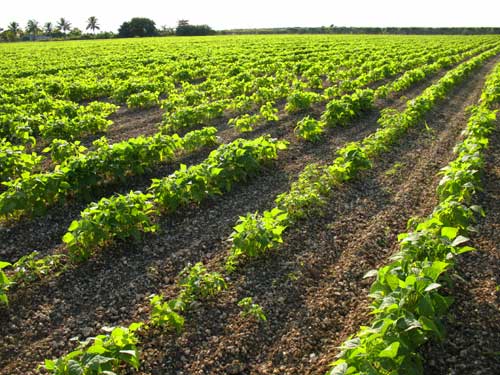
Green bean field, Homestead Organics. Taken on Friday Jan. 8, before the last freeze.

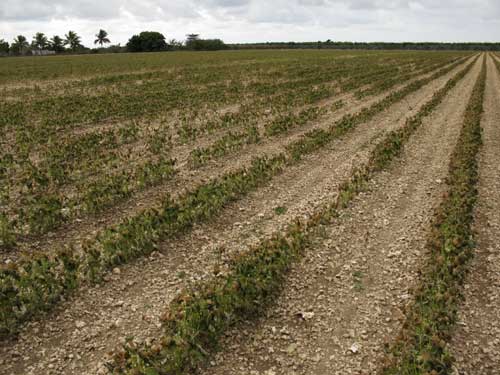
Same green bean field, Homestead Organics. Taken on Friday Jan. 15, after the freeze.

The growers of Redland Organics got hit hard by the freeze this past week. Dan Howard of Homestead Organics had five fields planted with green beans. He watered the crops for days to protect them from the cold. But early Monday Jan. 11th, the temperature fell as low as 28 degrees on his front porch, with the coldest temps around 4 – 5 a.m., and it stayed below freezing until dawn.There was no fighting it. All 22 acres of green beans were damaged.

“Farmers gamble with the weather and are risk takers,” Dan said. Sometimes they gamble and lose. Because of the freeze, Dan says he lost $100K in sales. He has crop insurance, but since beans are not a specialty crop, insurance will only pay for seed and fertilizer and not much more. He’s all ready to replant, though. “Don’t have much of a choice otherwise,” he laughed. The Friday before the last freeze, he cultivated one field, preparing the soil for planting. And just the other day he loaded his truck with bean seeds and was ready to start over again.

Cliff Middleton lost all of his above ground crops, but not as many root crops. He fought the cold by “basically saturating the land with water,” he explained. “But that many hours of cold will kill plants. Callaloo has a very low tolerance for cold and is all burned. The results of the damage will last for a year. All the fruit trees will react to this.”

Robert Barnum of Possum Trot got patchy frost in his grove, and is concerned about long-term damage to his sensitive tropical trees. He grows 300 types, and caimito, anona and guanabana are the most cold sensitive. “The cold will kill cambium, the growing layer between the bark and the wood,” Robert explained. Branches or a trunk less than four inches in diameter will die more easily, depending on how cold the temperature falls and for how long. “A tree looks OK for a while, and then the damage shows up later. Some damage takes months to show up. Lots of things can show up. Buds might not form, or form small, or not set fruit and drop off,” he said. Sounds like there might not be as much fruit this summer, but time will tell.

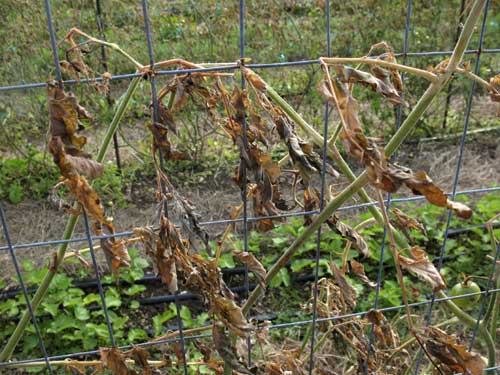
Heirloom pole beans damaged by the cold. Bee Heaven Farm, Jan. 15.

It was simply too cold for too long, and pole beans and heirloom tomatoes at Bee Heaven Farm didn’t make it. Margie Pikarsky and her crew covered them up with Reemay (floating row cover) for two weeks. The plants made it though the first freeze right after New Year’s, and at first it seemed like they would survive the cold. But Reemay wasn’t effective on that fateful Monday morning. Pole beans, including the dappled Dragons Tongue beans blogged about on Mango & Lime are pretty much all dead. Leaves are burned and withered, and it’s uncertain if the plants will have enough energy to grow new leaves and blooms. The heirloom tomatoes are also pretty much destroyed. Don’t expect too many heirloom tomatoes this season at the farmers market. Read more about the freeze at the Bee Heaven Farm blog. Not all was lost, though. I saw carrots, radishes, kohlrabi and dill looking no worse for the wear.

Heirloom tomato plant completely destroyed by the cold. Bee Heaven Farm, Jan. 15.

Gabriele Marewski of Paradise Farms covered her raised vegetable beds with Reemay and her vegetables survived, along with the microgreens. But the edible flowers that she is known for did not. “They were vining too much and it was almost impossible to cover them all,” she explained. “The flowers are a total loss.” Crop insurance doesn’t cover edible flowers or microgreens, and considers them “experimental,” and the quantities she grows are too small to get coverage. Oyster mushrooms slowed down because of the lower humidity, but Gabriele expects a big flush of growth as it warms up, and plenty of mushrooms in time for market this Saturday.

[Note: Heard that Worden Farm had major losses and is replanting fast and furious. They had much colder temps for much longer up in Punta Gorda. Hope to get an interview with them soon.]

So, for the next month or two, pickings might be slim when it comes to local produce. You just may not find some things (like beans) that you got earlier in the season, at least not for a while; and other things (like heirloom tomatoes) may not be available at all or in very limited quantities. Despite that, do make it a point to support your local growers when you shop at farmers markets and grocery stores. They need your help to bounce back from their losses.

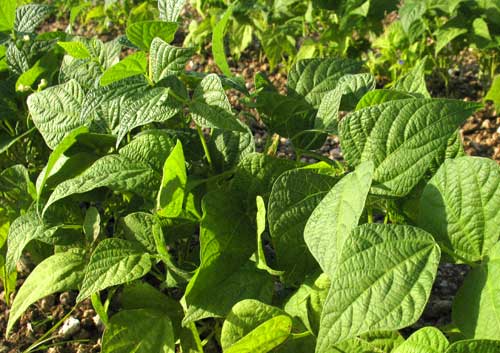
Healthy green bean plant, before the freeze.

Damaged green bean plant, after the freeze.

Piper betel leaf

Fans of piper betel, rejoice! It survived the freeze somewhat well. Robert Barnum told me that the lower leaves got burned by the cold, but the ones higher up survived. Piper betel is a shrubby, branching, leafy vine that climbs as high as the treetops. Robert has to climb up a tall ladder to harvest it from the higher levels. The piper also spreads from tree to tree like ground cover. It appears not to damage the tree it’s on at all, just uses it as a support.

Piper betel is a member of the black pepper family, and is used usually as an outer wrapper, or cooked or steamed. Frodnesor at Food For Thought used it successfully as a wrapper for a Vietnamese dish a few weeks ago. Bill at Tinkering With Dinner combined it in a stir fry with lemongrass and sugar, and got a taste of root beer. Fascinating! But don’t try it raw. La Diva Cucina discovered that the hard way when she put it in a salad a few weeks ago. Cooked is so much better, darling! Robert advises to use piper where you want a smoky, sausagey flavor. He uses it in various ways — as a layer in lasagna, cooked with greens, or blanched first to use as a wrap for sushi rolls. He also created a recipe where he dips the piper betel leaf into tempura batter and fries it.

Robert Barnum stands in front of a tree covered by piper betel. Picture taken before the last freeze.

Medicinal uses of piper betel:

The betel leaf is used in a number of traditional remedies for the treatment of stomach ailments, infections, and as a general tonic. It is often chewed in combination with the betel nut (Areca catechu), as a stimulatory. Some evidence suggests that betel leaves have immune boosting properties as well as anti-cancer properties. [Note: this is NOT the areca that you can get at Home Dept. If you do want to grow it, Robert has it.]

Trade Winds Fruit web site

……….

Broad Spectrum Antibacterial Activity of Betel

One such medicinal plant studied was Piper betle L. Results showed that among the 300 plant species screened, P. betle maintained a broad spectrum antibacterial activity against all the test pathogens, such as Ralstonia, Xanthomonas, and Erwinia. It was also revealed that the P. betle solvent extract had more superior action than streptomycin

Food & Fertilizer Technology Center, Phillipines

Juicing clementines

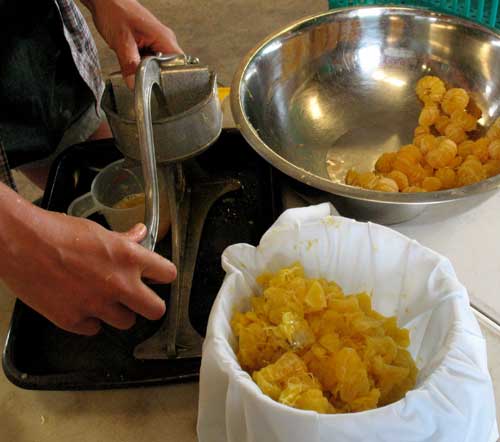
Friday afternoon, the barn was flooded with clementines from Green Groves. CSA members got fruit with pretty skin, but there was still plenty that had blotches from the cold that didn’t look as nice. The fruit inside was still good to eat — but it was way more than everyone could or would want to eat.

So, time to pull out the very useful antique juicer (farm manager Muriel blogged about using it here on the Bee Heaven Farm blog).

Fresh squeezed clementine juice!

The sections were squeezed and drained and squeezed some more to get every drop of juice, which was poured into ice cube trays for freezing. It can be used as an ingredient or reconstituted into juice.

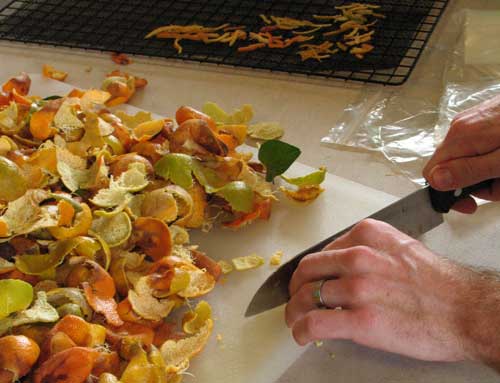
The peels weren’t wasted either. Intern Michael trimmed the bad spots and then sliced the peels carefully into thin strips. Those went on dryer racks to get dehydrated. The dried peels can be used in stir fries, soups and other dishes where you might want a bit of citrus zing.

Slicing clementine peels for drying

Not sure what happened to the squeezed fruit pulp. Perhaps its destiny was the compost heap, but I’m sure that with a little imagination, one could find a delicious use for it also!

Freeze’s toll

The Miami Herald
Posted on Sat, Jan. 16, 2010

Freeze takes huge toll on Florida agriculture

http://www.miamiherald.com/business/story/1428216.html

BY ELAINE WALKER
ewalker@MiamiHerald.com

Although the freezing weather is finally gone, consumers in South Florida and across the country will soon feel the impact at the grocery store.From green beans and yellow corn in Homestead to tomatoes in Immokalee, the freeze had a devastating effect on the vegetable industry. In some cases, entire fields were destroyed, with statewide losses expected to stretch into the hundreds of millions of dollars.

While some farmers have managed to salvage part of their crops and others are already replanting, supply is going to be a problem for at least a month or two, depending on the crop. That in turn translates into higher prices for consumers.

“Tomatoes that were trading for $14 for a 25-pound box, now they are up at $24 a box,” said Gene McAvoy, a vegetable expert with the University of Florida. “Consumers can probably expect to see prices go up about $1 a pound. But at a certain point, the consumer is going to balk and people will start to back away from certain items.”

The timing of the freeze couldn’t have been worse for Florida’s vegetable farmers, who were in the midst of the peak growing season. During the winter months, Florida growers are the largest U.S. supplier of vegetables.

Florida Agriculture and Consumer Services Commissioner Charles Bronson told state legislators earlier this week he believes that about 30 percent of the state’s agricultural crops were damaged or destroyed. With losses expected to reach into the hundreds of millions of dollars, that’s another blow to the state’s already fragile economy.

Florida growers typically generate about $8 billion a year in annual agricultural revenue, said Florida Agriculture spokesman Terence McElroy.

“The industry is going to be hit hard,” McElroy said, “but farmers are a pretty resilient group.”

In Miami-Dade County alone, the losses are estimated at just over $250 million, which is about 40 percent of the more than $600 million in revenue agriculture generates each year, said Charles LaPradd, agriculture manager for Miami-Dade County.

Hardest hit in Miami-Dade were the row crops like green beans, squash and corn, said Katie Edwards, executive director of the Dade County Farm Bureau. About 30 percent of the county’s tomato crop took a hit, Edwards said, but growers are still trying to assess the damage.

“We got some stuff that got hurt and some stuff that made it,” said Freddy Strano, a Homestead tomato grower, who estimates his losses could range between 20 percent and 50 percent of his 250 acres. “It’s hard to tell. Anything on the outside of the plant got exposed and is no good. We’re trying to salvage what we can.”

In the Immokalee area, which is one of the major areas for tomato production, produce losses are estimated at over $100 million, McAvoy said. Tomatoes in Immokalee were nearly wiped out for the winter season.

Bob Spencer of West Coast Tomato says about 95 percent of the tomatoes that he would be picking over the next 45 days in Immokalee are gone. He estimates he lost close to 250 acres of crops, worth hundreds of thousands of dollars.

“We haven’t experienced a freeze like this in 20 years,” Spencer said. “It reminds the ego what can happen. Farming is a tough sport. It’s not flag football. It’s tackle football.”

The last freeze of this magnitude Florida experienced was in 1989. But this recent cold spell potentially was more devastating for farmers because the freezing temperatures lingered for a week — 10 days in some places. Many crops can withstand one or two days of freezing temperatures, but with prolonged exposure there is no escape.

“Typically if you water the crops ahead of the cold period, it will help,” said John Alger of Alger Farms in South Miami-Dade. “A bulletproof vest works only to a certain size gun. If you keep getting shot in the same place, eventually it’s going to get through.”

Alger, who grows sweet corn and landscape trees, estimates he lost “way over a million” dollars from the freeze, which destroyed about 75 percent of his 1,250 acres of sweet corn.

“It’s not only the farmer, but everyone in related businesses from the truck drivers to the crop dusters, the harvesting crew and the packing houses are going to be impacted,” he said. “The multiplier effect on the economy is devastating.”

Florida tomato growers are already worrying about how to avoid panic over the tomato shortages and make the current supply last as long as possible until the spring crop is ready for harvest in late March.

“The tomatoes we have are going to be metered out to try to meet our customer demand,” said Reggie Brown, executive vice president of the Florida Tomato Growers Exchange.

“It’s going to be an opportunity for Mexico to make inroads, and that’s never a good thing.”

© 2010 Miami Herald Media Company. All Rights Reserved.
http://www.miamiherald.com