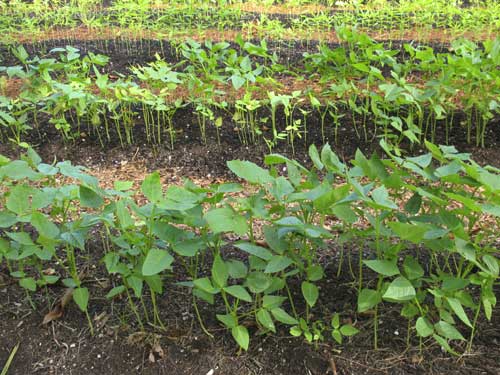
Cover crops growing at Little River Market Garden.
Tucked away in an obscure corner of northeast Miami, a new vegetable garden is starting to take shape in what was an empty city lot. Long straight rows of cover crops — Sunn hemp, cow peas and velvet bean — raise their young leaves to the late afternoon sun. In between rows of cover crop, peanuts are just starting to show pretty little yellow flowers. Loofa vines race to the top of the chain link fence at the front of the property, and a row of cassava flourishes alongside a stepping stone path. Over on one side is a trellis for a muscadine grapevine already forming a miniature cluster of fruit, and sweet potatoes grow beneath. Sage and other herbs are planted in a well-mulched S-shaped bed edged by palm tree logs. In the shade of an ancient mango tree loaded with fruit, a teepee shaped chicken coop holds several brown hens.
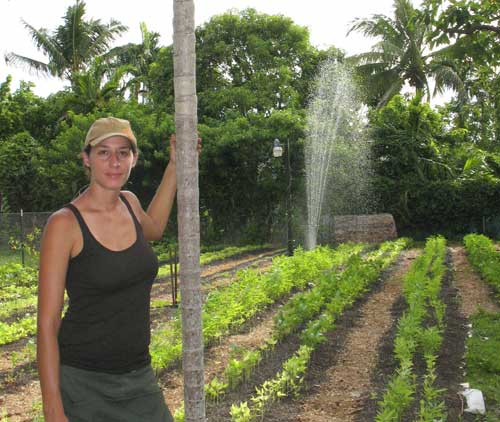
Welcome to the Little River Market Garden. This is the handiwork of Muriel Olivares, last year’s farm manager at Bee Heaven Farm. She created this garden from scratch a mere six weeks ago, planting on land leased from friends. Only grass and several trees were growing in what was once part of a citrus grove many decades ago. Now, weathered cardboard peeks out from the edges of some vegetable rows, and Muriel explained that it was set down right over the grass, with compost piled on top. The cardboard is already breaking down, and vegetable roots will easily push through it. In between planted rows, mulch neatly covers grass. The cover crops will get cut down and as they decompose, will add more nutrients to the compost.
This technique of piling on compost and mulch is called no-till because the soil is not tilled or disturbed by a tractor. Tilth builds up naturally without getting disrupted by tilling, and weeds are less likely to grow because they are smothered by compost and mulch. “No-till improves the soil by building soil structure and adding nutrients with compost,” Muriel explained. “It’s a very old technique. No matter the scale of farming, the concept is the same — never disturb the soil and always keep it covered.”

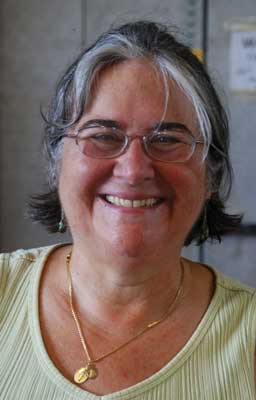
Muriel Olivares
The Garden will provide food for 11 people who have already signed up for CSA shares and flower shares. She says she might be able to squeeze in a couple more members, so if you’re interested, let her know. Her season runs for 21 weeks from November to April. Muriel wants to sell extra veggies and cut flowers at farmers markets, and is already inquiring about getting in to a few in the area. Check out her blog, Little River Market Garden, for news about the garden and updates about markets (once the season starts).
Muriel is confident that her crops and market garden will flourish. She took what she learned working as an intern for a season at a no-till organic farm in upstate New York, and combined that with skills learned at Bee Heaven helping run the CSA and selling at farmers market. Now she is is gambling that she can make a living as a market gardener. “This is my full time job, eight hours a day.” She doesn’t have a “day job” to tide her over. This is it!
So why do this crazy, risky thing? “I really like to be outdoors,” Muriel explained, “and to do what I want to do.” She paused and thought for a moment. “It sounds really weird but I have this connection to plants. I’m absorbed by them. I’m interested in them. Working with plants gives me mental energy.” She chose the urban location because she likes the city and found Redland too isolated. “This is a nice, happy medium. It’s very peaceful, but you’re in the city.” Here she is close to home, her friends, and her customers. When market season starts in winter, look for Little River and say hi to Muriel, the new generation of urban farmer.
Little River Market Garden
8290 NE 4th Ave.
Miami, FL 33138
mail@littlerivercsa.com
Read Full Post »



 Redland Rambles