Greetings once again, Redland Ramblers! Guest blogger Melissa Contreras here again, founder of Urban Oasis Project, urban micro-farmer. I’m back to tell you about day two of my trip to the Small Farms/Alternative Enterprises Conference last weekend. 
After rising early, we all piled into Margie’s van and headed over to the Osceola Heritage Park for the official beginning of the conference. Since I know that all you local foodies want to know about the food, let me start with breakfast: rather light fare was provided at the conference, but like our full lunch, it consisted mostly of Florida farm-grown food. A deep dish frittata of free-range Florida eggs with cream from grass-fed cows was served, accompanied by Lambeth Groves’ orange juice, cold and fresh, a perfect blend of sweetness and acidity. We were treated to Florida’s “other juice,” Muscadine grape juice: crisp, lightly sweet, and perfumed of dewy-misted grapes, from Lakeridge Winery and Vineyard in the high country of Clermont. Certified organic blueberries from Gail and Mike Waldron of Bay Lake Blueberries in Marion County mingled with mangos from our own Dr. Jonathan Crane of TREC in Homestead. Fair trade coffee was provided by Sweetwater Organic Coffee Company of Gainesville, which purchases from Rainforest Alliance-certified small farmers in the Tropics. For our coffee, we actually had the luxury of choosing milk from 2 small dairies, Dakin Dairy Farm of Myakka City, or Kurtz and Sons Dairy of Live Oak. Bubba and Leslie Kurtz run a “grass-fed dairy farmstead” of Jerseys and Shorthorns, and work to keep their milk as close to Nature as possible. This is not a business slogan for them, it is a way of life. After coffee finished with Nature’s perfect food, I was ready for a full day of conference and break-out sessions.
We all headed over to the big lunch room for the opening session. Welcomes came from kick-off speakers Dr. Joan Dusky of UF/IFAS in Gainesville and Dr. Ray Mobley of FAMU in Tallahassee, a co-sponsor of the event. FAMU and UF and are Florida’s 2 land grant universities, dating back to the ugly days of segregation, when black people went to one university and white people went to another. (Beside the obvious injustice of this, it begs another question- where did the original inhabitants of this land go? But that is another story.)
Next came the Florida Innovative Farmer Awards! These awards are given to farmers and ranchers who are leaders and innovators, based on the following criteria (quote):
- Success in making farming systems more profitable over the long term.
- Ability to use farming practices that enhance, rather than harm, natural resources.
- Leading -or participating in- activities that support viable communities, either through economic development or contribution to regional food systems.
- Effective outreach and/or education about sustainable agriculture ideas and practices to others, such as producers, community leaders, agricultural educators, and the general public.
There were 3 winners of these awards, the first being Chris and Eva Worden of Worden Farm in Punta Gorda. They got up on the stage in front of their small farmer peers, and were given a well-deserved round of thunderous applause. Both are Ivy League educated, Yale and Cornell, but are very down-to-Earth and in love with their vocation and avocation, farming. Upon acceptance of the award, Chris said to the audience, “We love to grow crops.” They grow 50 different varieties, mostly vegetables, some fruit, and do it organically, using soil and water conservation techniques. They have a CSA, sell at farmers markets, have workshops at the farm, art programs, and “grow future farmers and gardeners.” They help community gardens, about which Eva knows a thing or two, having authored papers on the subject. She said “anyone who works with community gardens knows that it is easy to start one, harder to maintain them, so we stay with them, encourage and help them.” Eva explained that they “grow great crops, connect with the local community, and promote the viability of the family farm.”
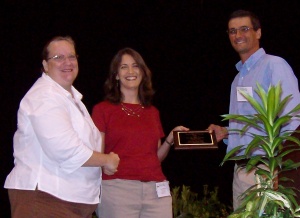
(L-R) Christine Kelly-Begazo, Eva Worden, Chris Worden. The Wordens receiving the Florida Innovative Farmer Award, a happy achievement for the work they love!
I went to Worden Farm last year with Farmer Margie and the WWOOFers, and my folks from Urban Oasis Project. We had a tour of the farm, and got to see the amazing results Chris and Eva get from good stewardship of their 55 certified organic acres. Because they supply some of the food in Redland Organics CSA shares, I thanked them for feeding my family. By the way, have you thanked your farmer lately?
The second recipient of the awards was Trish Strawn of Deep Creek Ranch in Deland. Trish and her dad, David, work the family farm which has been around since 1883. Trish said they got into grass-fed beef because her dad had a health issue, but she said if you ask her dad, he’ll say it’s because they’re “cutting edge.” The room broke into laughter.Trish is Co-Leader of Slow Food Orlando, and a founding member of the Florida Food Policy Council. She is also a lot of fun to go out and have a beer and a lot of good laughs with, which we did later that night. Trish and her dad are the real deal. Joel Salatin must be proud.
The third award recipient was George Owens of Chipley, FL, who has a mixed cattle and timber/forestry operation, or silvopasture. George could not be present for the awards because his son had just come home for a short visit from Afghanistan. All were very happy for him. The award presenters said “we tend toward a monoculture system, so when we get someone who does integration, we want to encourage it.” I am a believer in agroecology, and it is very encouraging to hear agricultural professionals talk about moving away from monocultures!
I was very excited to hear my friend Will Allen of Growing Power, Inc. give the keynote address. Unfortunately, Will had some knee surgery which made it impossible for him to travel to the conference, though that was the original plan. Technology to the rescue! The AV geeks got the satellite/internet hookup to Will Allen up and running, and we were able to see and hear him on 2 large screens, and he was able to see and hear us.

That's me with Will Allen at a Growing Power workshop last year. Will loves scooping Lake Perch out of his aquaponics tanks! He loved to fish when he lived in Miami too.
Larger than life on the big screen, Will spoke about the history of Growing Power, all the amazing past, present and future projects they have, and was enthusiastic and inspirational as always. Larger than life is a profound statement when referring to Will Allen, who stands tall at 6’7” and weighs 230 pounds. Will played basketball for the University of Miami in the 1970’s, and still wears an orange and green UM cap with his signature royal blue Growing Power sweatshirt with cut-off sleeves. His biceps are bigger than many supermodel’s waists, and he keeps them that way by working hard every day, growing food for Milwaukee’s inner city on 3 acres, 2 blocks from one of the country’s largest low-income housing projects, in what was an urban food desert until Will’s good food movement became a good food revolution. Will is not an armchair CEO. He gets his hands dirty. He loves farming like Chris and Eva Worden do. I think some of us are born agrarian. It is not a choice, it’s in our blood, and it’s who we are.
Will showed many slides of Growing Power in action: composting thousands of tons of Milwakee’s food and brewery waste and “growing soil” as he says; passing compost through the digestive tracts of thousands of worms, creating rich worm castings fertilizer; raising tilapia and lake perch in the bottom level of a 3-tiered, homemade aquaponics system, with watercress growing in the middle layer, and tomatoes on top; raising chickens and bees in the city; providing a safe after-school space for urban youth to learn green job skills; feeding senior citizens healthy food with a “food basket” CSA; providing a retail grocery space with their fresh salad greens, eggs, and so much more to the neighborhood in which Growing Power’s urban farm resides.
“If people can grow safe, healthy, affordable food, if they have access to land and clean water, this is transformative on every level in a community. I believe we cannot have healthy communities without a healthy food system.”
Will is a major inspiration for what we do in Urban Oasis Project, doing our part to make good, clean, safe, healthy, and local food accessible to all. Access to real food should be a right of all citizens. Will says “we can’t wait around for government or others to do it, we have to do it, just start doing things.”
I could go on about Will Allen forever, but I’ll stop here. Please come back for Part Three, highlighting local food lunches and conference workshops!

 Redland Rambles