Feeds:
Posts
Comments

Archive for June, 2011

Dances with rebar


Sadie working rebar out of the ground.

After Bee Heaven Farm’s CSA season ended in May, work shifted to cleaning up planting beds and putting things away. Irrigation hoses and tapes that watered plants at ground level were rolled up. Bamboo poles that supported colorful heirloom beans were pulled up and stacked in the barn. And the toughest job of all was to take down the tomato trellising.

Giving a good tug to see if rebar will come loose.

Heirloom tomatoes are indeterminate, meaning their vines just grow and grow. Their limit is determined by the height of trellising. At Bee Heaven Farm, the support is about 6 feet. Rebar — just like what you’d find on a construction site — is set into the ground several feet apart along each row. Wire mesh is run along the rebars from one end of the row to the other, and this is what supports tomato vines. But when the growing season is over, the mesh needs to be rolled back up and rebar pulled out and put away in the barn for the summer.

Triumphant Sadie takes rebar back to the barn.

Farm interns Mike and Sadie had the tough job of removing trellising, including all the rebar. How hard could it be to pull a piece of metal out of the ground? Pretty hard, I discovered. The soil is dry and holds the steel like cement. You have to wiggle the rebar around, widen its hole, pour some water in to soften the soil, push and pull and twist the rebar around, add more water, maybe catch your breath, and do it again until finally, finally it loosens up and you can tug it out of the ground. (It’s quite a workout for the arms!)

Sadie had her own rebar dance going. She swayed back and forth using her arms and body weight to move the rebar, and worked around in a big circle. Occasionally she stopped to pour a bit of water into the hole she was making.

Ginormous wooly bear caterpillar rescued from a hole in the ground.

There was a moment of life and death drama when a wooly bear caterpillar fell into the water-filled hole. Sadie rushed to rescue it. This is quite a magnificent wooly bear! Not sure what kind of butterfly it grew up to be — any ideas?
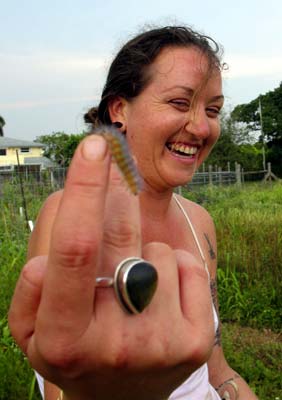
Sadie and the wooly bear.

Read Full Post »

Hani’s cute kids


The baby goats and their mothers nibble on a royal palm frond. Goats are browsers and will eat all kinds of vegetation.

Hani Khouri makes ice cream and several varieties of cheese using milk from his own herd of Nubian goats. He keeps them on his farm in Redland. It’s always fun to visit and take pictures of cute and friendly goats. They, in turn, like to nibble on my shirt and fingers if I’m not paying attention.

The new kids on the farm hanging out underneath the milking stand. The white one still has his umbilical cord. They are about a week old in this picture.

Back in March, Hani’s herd grew to 17 with the arrival of two new kids. They’re both male, which is a problem, because two grown bucks are already in the herd. Hani prefers to keep only one buck with his female goats.

Marylee Khouri holds one of the new kids.

When I went to see the kids, they were only a few weeks old and in that awwww how cuuuute stage. Now they are four months old, bigger but still cute, and Hani is looking to sell them — but only to the right buyer. “Not to eat, and no santeria!” he said. He’d like to see them go to a herd where they can grow up and live out their lives.

If you are interested please contact Hani at www.hanisorganics.com If you are located in Miami-Dade or Broward counties and are interested in purchasing goat cheese, goat milk ice cream, or Mediterranean food, you may do so through his web site.

Read Full Post »

Florida Small Farms Conference


The University of Florida’s (UF) Institute of Food and Agricultural Sciences (IFAS) and Florida A&M University’s (FAMU) Small Farms and AlternaTeam are pleased to announce that the third annual Florida Small Farms and Alternative Enterprises Conference  will be held in Kissimmee, Florida July 15 – 17, 2011.

Only in its 3rd year, the conference already attracts nearly 800 people. It provides farmers with in-depth, cutting edge educational information; facilitates networking, dialog, and visioning among members of the Florida small farms community, and increases awareness of the small farms industry to decision makers, supporting institutions, and the general public.

Who Should Attend

· Small Family Farms
· Transitional Farmers
· Beginning Farmers
· Allied-industry Reps.
· Educators
· Researchers
· Agricultural Associations
· Policy-makers
· Foundations
· Anyone interested in becoming a part of, and strengthening the small farm community in Florida

Additional Conference Highlights

In addition to the educational sessions and optional pre-conference activities, highlights include:
·    Featured Florida farmers
·    Livestock arena with live animal exhibits
·    Local foods
·    Large exhibition showcasing products and technologies

For more information and to register online
http://conference.ifas.ufl.edu/smallfarms/index

For specific questions, please contact Mandy Stage, conference coordinator, at mstage@ufl.edu

Read Full Post »

So ugly and so big

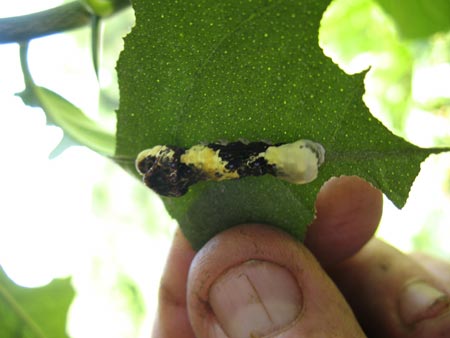
The caterpillar of the swallowtail butterfly, with evidence of its enormous appetite.

Last month I stopped by Possum Trot Tropical Fruit Nursery, and as usual, brought my camera. I look forward to those visits, because there’s always something new happening. Walking around with Robert Barnum looking at trees and plants never gets old. Robert pointed out something that looked like a massive bird dropping on a leaf, a blotchy browish-black and white blob, and said it was actually the caterpillar of the giant swallowtail butterfly. It was the biggest, ugliest caterpillar I had ever seen. And it had been quite busy, was chewing up large chunks of a Ponderosa lemon seedling’s leaves. In fact, they like eating citrus leaves very much, which could be a problem. Citrus greening is killing local citrus trees, so there goes its food supply.

Touching the caterpillar triggers a defense response.

The caterpillar’s ugly looks were actually its main defense from getting eaten. A bird would look at that and wouldn’t think it’s food. The caterpillar also had another way of defending itself, Robert said as he touched its back. It immediately arched up a bit and something that looked like a red forked tongue came out of one end. It’s called an osmeterium and it gives off a noxious odor to repel its predator. Robert asked if I wanted to smell that finger, but I shied away, no thanks, take your word on it.

That was in May, and by now the caterpillar and its buddies have most likely decimated the lemon sapling and any others nearby, gone through their chrysalis stage (which lasts about 10-12 days) and are most likely now transformed into the giant swallowtail butterfly. The adult butterfly has a wingspan of 4 to 6 inches, and it’s breathtaking to see a butterfly that big in flight.

A stressed swallowtail caterpillar displaying its osmeterium.

Read Full Post »

Two grower supported farmers markets got local press this month. Upper Eastside Farmers Market and South Miami Farmers Market have each been written up in the area’s free weekly papers. The Miami New Times picked South Miami as the best farmer’s market of 2011 in their Best of Miami issue that came out this week. The Biscayne Times ran a cover story on Upper Eastside in its June edition. Not bad for two little markets that burst upon the scene just this past winter! Both markets will be open through the summer, so go take a look at what’s growing now and good to eat!

By the way, I’ve discovered that both markets will accept your compost. Save your fruit peels, vegetable trimmings, juicer pulp and coffee grounds in a bag in the freezer, then drop it off at market. (For an urban condo dweller like me, without a yard to dig around in, this is a great way to make sure that my uncooked food scraps get turned into compost.) At Upper Eastside, give your green gold to Art. At South Miami, they have a convenient collection bin.

Read Full Post »

Older Posts »