Feeds:
Posts
Comments

Archive for June, 2011

Got the following message from Antonio Guadamuz and thought I’d pass it along to all who want to put their money where their mouth is. Below is a checklist of many ways that you can help support Urban Oasis Project with their various efforts to get fresh, local and organic food to under-served neighborhoods. This organization is behind the emergence of two new grower supported markets (in Liberty City and Upper Eastside), and has created dozens of edible gardens for families in need. Now they’re growing in many new directions. Don’t have time to volunteer? UOP is a 501 (c) 3 charity and your donations are tax deductible.


It’s never been a better time to get involved!

Urban Oasis Project has been driven over the past two years mainly by the volunteer efforts of Melissa Contreras, Art Friedrich and Antonio Guadamuz — and they couldn’t even begin to count the number of hours they’ve planted gardens, organized events, networked with people, written grants, coordinated farmers markets, driven vegetables from farm to market, and so much more.

We’re moving into a new phase of the project! Melissa, Antonio and Art will have nearly full-time positions working in our partnership with Earth Learning to create a new sustainable farm and market in East Homestead at Verde Gardens — and it’s going to be impossible to keep up all the other aspects of UOP without a broader group of of members actively taking on responsibilities.

[Urban Oasis Project is no longer affiliated with Verde Gardens!]

Here’s a list of some things that we’re doing that you can help with:

Farmers Markets
Market Assistance —  Helping set-up the market, making the displays pretty, selling veggies, and breaking down. Thursdays and Saturdays.
Market Expansion — Making educational displays, cooking demos, recruiting new vendors, recruiting musicians, etc. Be creative!
Market Outreach —  Promoting the market through flyers, directly to passerby at markets as well as at neighborhood events, homes, stores etc.

Garden Building
GIVE Garden management — Contacting interested recipients, setting up dates to plant, organizing volunteers and materials, follow-up contacts and visits.  Creating handouts for distribution.

Potlucks and Workshops
Organize Workshops — Recruit folks who want to teach, promote the workshops. We’d love to be able to expand this program to reach more low-income people as well! Host a potluck and/ or workshop yourself.

Other Initiatives
Food Truck Project — If we have committed project leaders, we’d like to have our own Food Truck with a permanent garden in the bed, to travel around and give educational presentations.

Homestead-Verde Gardens Farm and Market — Looking for volunteers and workers for the new Verde Gardens project in Homestead! A 22 acre organic, permaculture designed farm we’re building from scratch! Daily work being done so you can come almost anytime!

[Please contact Art Friedrich at 786-548-3733 if you wish to volunteer for Urban Oasis Project activities and events.]

These are a few of the things we do. Do you see a way to tap in? Every little bit counts! The most important thing to us at this point is consistency. You must be able to do what you commit to, otherwise it doesn’t help anybody!

Please call us or email with any questions and to get started! We can do lots to help out, you will be supported!

Thanks,
Antonio Guadamuz
Vice Treasurer
Urban Oasis Project
Read Full Post »

What does the new Miami-Dade County mayor have in common with growers in Redland? They have the UDB, or Urban Development Boundary — a line in the county’s master plan designed to limit development from encroaching on precious farmland. Read this excellent article in the Miami Herald which lays out where Carlos Gimenez and Julio Robaina stand on this sensitive issue. Then don’t forget to vote in the runoff election on June 28!

Mayor will have key role on holding line on development

The new mayor of Miami-Dade County will be more important than ever when it comes to holding the line on building outside the Urban Development Boundary, following state changes recently signed into law by Gov. Rick Scott.

By Matthew Haggman

mhaggman@miamiherald.com

When it comes to moving the Urban Development Boundary, the power of Miami-Dade County government, and its soon-to-be new mayor, has never been greater.

For more than three decades, the UDB — the line that keeps growth from encroaching west and south into fragile agricultural lands and wetlands — has been a critical curb on sprawling large-scale development from encroaching on the doorstep of the Everglades. But recent changes by the Republican-controlled Legislature that were signed into law by Gov. Rick Scott have severely limited state oversight of planning decisions by city and county governments — such as moving the UDB. State planners previously served as a check on such efforts and could stand in the way of decisions to move the line, but now can only provide non-binding comments in most cases.

Read more: http://www.miamiherald.com/2011/06/15/2268668/mayor-will-have-key-role-on-holding.html

Read Full Post »

Local goes national

Remember Earth Dinner in April? It attracted the attention of Matt Kronsberg, a freelance writer in New York, who flew down to partake of our locavore bounty, and wrote an article about the feast for Gourmet Live. (You may remember Gourmet magazine. It stopped publishing on paper a while ago and migrated into cyberspace, continuing in form of a web site, and an iPad publication called Gourmet Live.)

Those of us without iPad or iPhone can’t even see the article, so I asked Matt to send a copy, which he graciously did. I converted his email into a 4.3 MB PDF file, which you can download here. Don’t know how many copyright laws I’m violating with this deed! Enjoy it while you can, and feel free to post your comments about Matt’s article.

Read Full Post »

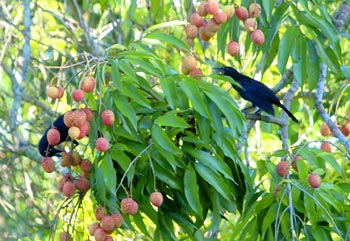
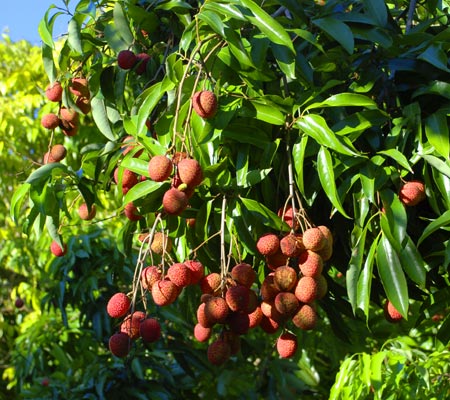
Organic lychees ripening in the morning sun.

The lychees in this week’s summer fruit offering come from Green Groves, not too far from Bee Heaven Farm. Steven Green, the grower, invited me to see how lychees get picked. He had an order from Whole Foods, and hired a picking crew to help. If you were in Whole Foods last weekend or this weekend and saw pint containers of organic lychees for sale, those were the ones!

Up in the cherry picker, Gonzalo picks lychees.

Picking work starts early. Golden morning sunlight was just breaking over the tops of trees from the grove across the road. The air was cool and full of sounds of birds. Dew was still clinging to weeds under the lychee trees. Ripening fruit hung in heavy clusters on the trees. At 7 am, the crew was already getting started. They had dropped off their cherry picker the day before. It was a simple contraption — an engine on three wheels, with a boom arm and bucket. Gonzalo, one of the workers, stood in the bucket and manipulated the controls to raise the boom and drive the picker to a different spot. When I arrived, he was already at tree top level gathering fruit.

Gonzalo held a pair of heavy duty clippers in one hand, and reached with his other hand to grab clusters of lychees called panicles. He snipped the panicle and placed it into one of the bins fastened to the sides of the bucket. He started with the first tree by the gate, and worked from top down. Then he moved to the other side of the tree, gracefully maneuvering the picker, and again clipped fruit from the top down. “Usually the whole tree ripens at the same time. The lower branches ripen before the upper. And the top gets eaten by grackles,” Steven said with a laugh. “I have enough to share.” He has 125 trees planted on two acres, and has been growing lychees since 1992, and avocados for 15 years before then.

Hidalgo loads fruit that Gonzalo gathered.

The rising morning sun shone on Gonzalo’s face as he worked silently and quickly. Bins filled up with lychees. The picker’s gasoline engine clattered, and grackles screeched from a nearby tree. He lowered the bucket and Hidalgo came with a gardener’s cart and dumped lychees into it. When the cart was full, he walked back with the cart to the improvised packing house. A long table had been set in the carport of Steven’s house. Hidalgo dumped lychees onto the table. It had a raised lip along the edges, to keep precious fruit from rolling away.

Steven shows Leticia the acceptabe size for coffee spots.

Leticia, the owner of the picking company, stood at the table and checked each individual fruit. She has been packing fruit for 25 years and has a keen eye for the perfect ones. “This crew knows ripeness,” Steven said. They have worked for him for many years. Steven reviewed with Leticia how he preferred to grade the fruit. The perfect ones went into a green bin. The less than perfect ones, called number twos, were tossed into a box. A number two lychee was one that had a brown blemish called a coffee spot. Steven explained the coffee spots were harmless and didn’t affect flavor or quality of the fruit. Spots the size of a pencil eraser were ok, but bigger ones were not. Spotted number twos are still good to eat, but in this case would get sold to make wine or ice cream. Steven pointed out, “Buyers of number twos are price sensitive and understand that the blemishes have no effect on fruit quality except for appearance.”

The sweet perfume of ripe lychees filled the air. Steven showed me the difference between a perfectly ripe lychee and one that wasn’t quite there. The not as ripe fruit’s skin had little spines or bumps. A ripe fruit’s bumps flattened out. Steven explained that as it ripened, the lychee grew more plump and rounded, which stretched its skin and flattened out the bumps.

Hidalgo, Gonzalo, Betty, Steven and Shelly grading and packing fruit.

Picking is all a matter of timing. Pick too early and the lychees are a little sour. (I happened to eat some of those a couple weeks ago.) Wait a little for the fruit to ripen more and it gets sweeter and tastes like lychee. “If you wait too long to pick, overripe fruit tastes like sugar water and you lose the lychee flavor,” Steven explained. Picking also has to do with market timing and getting a good price. The first local lychees to hit the local market got top dollar, getting $46 for 10 pounds wholesale. When Mexican lychees came in last Monday, May 30th, the prices crashed down to $25 and are now tumbling even lower. (These are prices for conventionally grown fruit. Organic lychees can fetch considerably more.)

Steven grumbled that NAFTA is the reason for the drop. “In Mexico, growing is much less expensive, and the quality is less, not anywhere as good as locally grown. They pick earlier because they need the extra time in shipping.” NAFTA gives offshore fruit — as growers call imports — another unfair advantage. “Mexican lychees may have prohibited pesticide residues, or have been treated with sulfites to preserve their color. USDA doesn’t have the manpower or resource to inspect all the fruit coming in. Also the retailer is supposed to mark COOL (Country of Origin Label) but there’s almost no enforcement against retailers that don’t. For organic fruit, that’s no problem, because origin is part of the certification.”

A case of organic lychees destined for Whole Foods.

Steven showed me the label that went on each pint clamshell and cardboard case. Among other information, the label had the “Redland Raised Fresh From Florida” logo and the grove’s organic certification number. Shelly stuck labels onto pint sized plastic clamshell containers, then filled one container at a time with number one lychees, and packed 12 to a case. Steven put labels on the cases. The crew would pick and pack fruit for a few more hours. A driver was coming later that afternoon to pick up their order of 40 cases. Steve’s lychees would be in local stores for the weekend selling for $6.99 a pint.

Look carefully and you’ll see a pair of common grackles feasting on fruit.

On my way back into town, I passed by a woman selling lychees by the side of Krome Avenue. It was completely the opposite of a supermarket — a tent, a bin full of lychees, and an ancient looking scale. Three cars had pulled to the side of the road and people were handing her cash for pounds of sweet fruit. Hand lettered signs nearby said LEECHEES $2.00. For that price, most likely the lychees were grown locally and were not organic. I was reminded of something I heard a farmer once tell me: “Growers are price takers, not price makers.” On that sunny Thursday morning deep in the heart of Redland, two kinds of lychees were being sold, and two kinds of prices were being made.

Read Full Post »

     The CSA’s been finished for a few weeks, and I don’t know about you, but I’ve been craving those veggies and salads! The fruitful bounty of summer helps compensate – I get so distracted with the juicy tropical fruits, and soon the avocados, that I almost forget what I’ll be missing until the fall. Another windfall of summer is that there’s EGGS available! We’ve been eating them in omelets, quiches, sandwiches…finally, getting our fill.

     Bee Heaven Farm has officially started the summer season offerings, coinciding with the first lychees and mangoes. The new on-line web store will let you order until Thursday June 8th at 3pm for Friday’s harvest. You’ll be able to choose from 2 places to pick up your order on Saturday- the farm, or Joanna’s Marketplace in Dadeland. There’s a pretty good assortment of goodies, including Rachel’s Eggs (certified organic), Tilapia, Hani’s cheese, hommos, baba ghanoush and tabbouleh. You’ll also find local raw honey, callaloo, herbs , carrots, parsnips, Black Spanish radishes (spicy!), and other yummy things. Fruits include several varieties of mangoes, mamey sapote, white sapote, two kinds of lychees, and a great deal on a 10-pound box of certified organic lychees from BHF’s Green Groves – plenty to indulge, share, freeze, make lychee syrup (pancakes!), and even wine. According to Kathy, longtime CSA member and home vintner, you need about 5 pounds of lychees per gallon of wine.

    The link to the store is not published on the website, but you can get to it from here: www.redlandorganics.com/BHFwebStore.htm When you place your first order, you’ll need to set up an account (no charge), then you can order every time there’s an offering. The summer web store will only be ‘open’ on weeks when we have something to sell. We might not have something every week, but when we do, the store will be open from Tuesday morning through Thursday 3pm.

     So, locavores, go get some goodies before the store closes!

Read Full Post »

« Newer Posts - Older Posts »