Feeds:
Posts
Comments

Archive for August, 2011

A two foot long jakfruit split open.

Last Saturday I shopped at two markets, one small and friendly, and one big and corporate. First, I stopped by to see what was new at the Upper Eastside Market, and it was loaded with good things to eat. Who says it’s too hot to grow anything here in the summer? Over at the Nature Boyz juice stand, Clive had a couple of good sized jakfruit available. They are starting to mature this time of year. Further down the row of tents, I found locally grown okra, collards, calabaza, lemongrass, fresh akee and annona fruit. You could get callaloo and plantains from Three Sisters Farm in Redland, sweet potatoes grown on a small farm in Kendall, and loads of starfruit from a garden just down the street in Miami Shores. The eggs were from hens kept somewhere in North Miami, shhhhh! They even had bags of white and brown organic rice grown and milled in Belle Glade. Almost everything at this market is local — sourced either from Miami-Dade County or somewhere in Florida.

Local avocados grown for Uncle Matt’s.

My next stop was Whole Foods in Aventura. I’d heard there was local fruit in the stores, and wanted to see for myself. I easily spotted a nice heap of shiny and fresh green avocados carrying the Uncle Matt’s brand, and grown locally by Murray Bass. Nearby were medium sized mamey from Health and Happiness Farm, but their pints of longans had sold out.

The fruits looked pretty good, but specialty items were another story. Packets of allspice leaves and berries from Bee Heaven Farm were starting to look a little brown. Bunches of wilting garlic chives, also from Bee Heaven, were piled in a shallow basket in an open cooler. They were starting to wilt, and looked in desperate need of a mister. One shelf up were boxes of extremely perishable edible flowers from Paradise Farms that looked flat, dried up and inedible.

Overall, I have to give Whole Foods credit for making a good effort to support local growers. They are doing an OK job of sourcing local fruits this summer. But, by the looks of things, their produce people could use training on how to handle delicate specialty items. And of course, there’s just no comparison to shopping at the neighborhood farmer’s market, which has plenty of extremely fresh, locally sourced items!

Read Full Post »

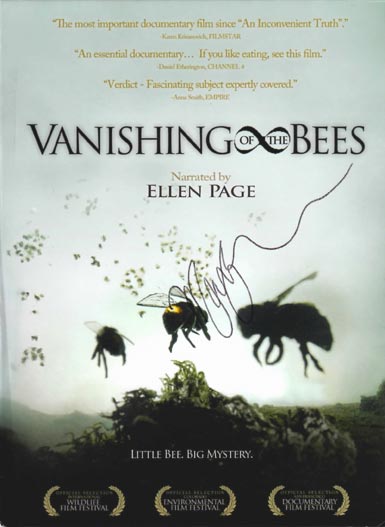
Vanishing of the Bees, an intriguing new documentary about Colony Collapse Disorder, is back in town for a FREE one-night screening.  

Date: Sunday August 21, 2011
Time: 6:30 pm to 8:30 pm
Location: Fairchild Tropical Botanic Garden
10901 Old Cutler Road
Coral Gables FL 33156

Back in May, Vanishing of the Bees showed for only one night at the new, state of the art Coral Gables Cinematheque. And it was a good turnout — over 200 people packed the auditorium. Proceeds from that screening went to support Slow Food Miami’s school garden program.

Beekeeper John Herring and filmmaker Maryam Henein at the May screening.

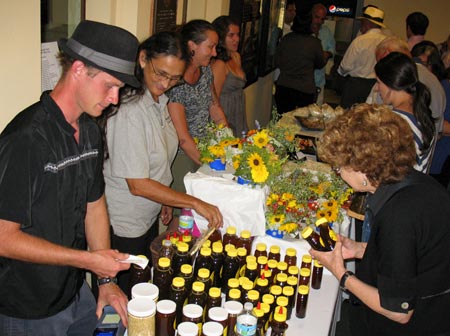
The filmmaker, Maryam Henein, was present to introduce her film and answered questions after the showing. She was accompanied by John Herring, a beekeeper from Broward County, who brought a sample hive and various tools of his trade, who also answered questions about bees. Farmer Margie Pikarsky and interns Mike and Sadie from Bee Heaven Farm came with many boxes of local honey and wildflower bouquets for sale.

Vanishing of the Bees is a real-life mystery story which begins with two commercial beekeepers, David Hackenberg and Dave Mendes, who tell similar stories of how one day they came to check on their hives and found them inexplicably empty. They realized their problem wasn’t only with their hives, or happening in Southwest Florida where they were located. It was a growing, serious problem in 35 states and also in Europe. Bees were either vanishing, or their immune systems were succumbing to all kinds of pathogens. Populations were dying faster than they could be replaced, and nobody knew why. The film goes on a journey that follows David and Dave as they try to solve their mystery, and in the process they discover how they can keep their bees healthy and productive, and their beekeeping businesses alive.

Through the course of researching and making her film, Maryam became a passionate and tireless activist for the honeybee. Her love and concern is clearly apparent in the film, which weaved a magic spell around the audience that night. As the story unfolded, people were pulled in; and at one scene in the middle, you could almost hear a pin drop as facts built up and pointed to the most likely causes of bee die-offs. The camerawork is amazing, bringing you very close to slow-motion bees in mid-flight, and editing and animation are superb.

Support the bees

The film does end on a hopeful note, that it’s not too late for ordinary people to save the honeybee. “Colony Collapse Disorder is a wake up call,” Maryam said after the screening. “There’s a big abyss between the people who know and the people who don’t know. Every one of you is a worker bee” to get out the word and take action.

She mentioned several ways you can help the bees and support your own good health. The easiest thing to do is buy organic produce and local honey. (You can find both at local farmers markets.) Organic farmers are not allowed to use systemic pesticides or other dangerous chemicals that can harm bees. Most organic farms tend to have a happy mix of several kinds of plants that support bees, and most farms keep hives and sell local honey. 

Mike and Margie from Bee Heaven Farm with honey and wildflower bouquets for sale at the screening.

Another simple thing you can do is avoid buying “honey-flavored” breads, cereals and other products. They are sweetened with honey blends imported from China. “Funny honey” is diluted with lactose syrup, high fructose corn syrup or other sweeteners. It is also tainted with strong antibiotics and lead residues. Corporate bakeries — and the film named General Mills and Pillsbury — buy imported honey because it is very cheap. (Real honey costs a lot more because U.S. beekeepers can’t produce enough to meet demand.) 

If you have the space, a fun thing you can do is plant a bee-friendly garden, with an assortment of plants that bloom throughout the year to attract pollinators. Choose low-maintenance native plants and wildflowers, keep fruit trees, or raise vegetables in your garden or in containers on your patio or balcony. Whatever you do, DO NOT use systemic pesticides! Those are the kind that are applied once a season or once a year as a soil drench, and “provide protection without spraying.” Plants suck those chemicals up through their roots, and all their cells and pollen itself become poisoned. Bees then gather tainted pollen, bring it back to their hive, and make themselves very sick from it, sick to the point of death. 

Support the film

Vanishing of the Bees is a completely independent production, and it took a long time and a lot of money to make it happen. From researching and writing the script to the final edit took about four years to make, and it cost half a million dollars. (Just the editing alone took a year and cost a good chunk of money.) Maryam raised funds a little bit at a time, from donations and sponsorships, and they went toward paying film expenses. When she wasn’t filming, she supported herself at times as a waitress, and admitted that for a while she was on food stamps and maxed out credit cards to survive. 

Maryam and her producers are making their money back with donations and DVD sales. Right now, they are running a promotion and selling the DVD on their web site for a reduced price of $14.99 for a personal viewing license. (They might also be selling the DVD at Sunday’s screening.) Maryam wants to get her DVD into schools. “Education is the beginning,” she said. “We are the generation waking up. The change is coming up in the generations behind us.” At the time of the May screening, she needed to raise about $12 thousand to develop a companion study guide. She is self-distributing her film, and is actively seeking venues for future screenings. The next Florida screening is in Tampa on August 29th.

Read Full Post »

UPDATE: Mayor Gimenez is coming to Homestead to meet with the community!

An additional Town Hall Meeting was recently scheduled for August 24, 2011 at 7:00 pm. The address is: William Dickinson Community Center, 1601 Krome Avenue, Homestead FL. 

By now you’ve already heard that the new Miami-Dade County Mayor, Carlos Gimenez, is cutting the county budget. When it comes to local agriculture, these cuts could run very deep.

To slash an estimated $1.2 million from the county’s general operating fund, over $700,000 for UF/IFAS Extension Services was proposed to be gutted. If county funding is drastically cut, Extension will lose matching funds from University of Florida. To shave off another $300,000 in the budget, the county Agricultural Manager’s office would be completely eliminated.

Cuts to Extension

Since the Palmetto Bay Town Hall meeting on August 9th, Mayor Gimenez said he would reinstate full funding to Extension, and partial funding for the Agricultural Manager. (However, it is unclear what “full funding” means for Extension, since its budget was cut by 20% back in 2009 by former mayor Carlos Alvarez, and never completely restored since then.)

The originally proposed budget cuts put some Extension programs at risk of disappearing, and crippled others. At risk were a number of important consumer and agriculture programs that have a huge impact on the community, such as the 4H youth leadership program, and various consumer services for low income families and seniors.

Both the urban horticulture program assistant position, and the Commercial Agriculture and Horticulture programs were threatened with elimination. These programs provide ongoing training and certification for vegetable and fruit growers, landscapers and nurserymen. Growers would have to spend extra money to travel to other counties to get their industry-required training.

Ongoing workshops and seminars for commercial farmers were slated to be completely wiped out. This is the heart and soul of Extension, which teams up with UF researchers to provide growers the latest information how to fight diseases and pests (like the red bay ambrosia beetle which threatens the avocado industry), new methods of production, and new varieties of plants and crops.

Agriculture Manager

Also on the chopping block was the county Agriculture Manager. The job is currently held by Charles LaPradd, a fourth generation local grower who acts as the liason between county government and local growers. His voice is the only one in local government speaking up for the county’s $2.7 billion industry in this county. (That’s only second to tourism in income in Miami-Dade.) In the space of six years, the Ag Manager brought in almost $7 million in grant funding used to support and promote local agriculture.

Among many projects, one of the most visible was the Redland Raised campaign, designed to get branding and recognition for locally grown food in Publix supermarkets. Charles was involved in the push to pass three new county ordinances last year that promote B&B’s and agritourism, and allow growers to make and sell jams, pickles and other value added products.

Be the voice

The current budget proposal is only preliminary. It can and has already been changed. Bowing to pressure from a vocal showing at a packed Town Hall meeting in Palmetto Bay last week, Mayor Gimenez has already reversed his stance.

Go and make your voice heard in person! Mayor Gimenez is holding a series of Town Hall meetings through the month of August, at various places around the county. It’s rumored that the mayor said the squeaking wheel will get the grease, so word to the wise, get out there and squeak speak!

The remaining meetings are listed below:

Tuesday, August 16, 2011

Location: Miami Art Museum, 101 West Flagler Street, Miami, FL 33130
Time: 7:00pm – 8:00pm

Thursday, August 18, 2011

Location: Coral Gables Country Club, 997 North Greenway Drive, Coral Gables, FL 33134
Time: 7:00pm – 8:00pm

Wednesday, August 23, 2011

Location: Hialeah Senior High School, 251 East 47th Street, Hialeah, FL 33013
Time: 7:00pm – 8:00pm

If you can’t make it to a Town Hall omeeting, contact Carlos Gimenez’s office at:

Office of the Mayor
Stephen P. Clark Center
111 NW 1st Street
Miami, FL 33128
mayor@miamidade.gov
305-375-5071

However, the commissioners still need to vote on the proposed budget, and there’s a good chance their vote could still reduce or eliminate funding. There will be two public hearings, on September 8th and September 22nd, at Commission Chambers in the Stephen P. Clark Center in downtown Miami. Next comes the commisioners’ final approval for the budget. You can find a list of commissioners and their contact information here.

Locavores, this is not the time to be complacent and think the worst is over. Don’t sit back and watch support and resources dwindle for your local farmers and fellow citizens.  Educate your commissioners on how important Extension and the Ag Manager are to local agriculture — and the local food scene. You still have time to let them know how the budget cuts will also impact your eating choices or your business.

Download the proposed FY 2011-12 budget from the county web site.

Download an intelligent and passionate editorial written by Mike Dill, re the impact of cuts to ag services, which was recently published in the South Dade News-Leader.

Read Full Post »

Mayor Gimenez backtracks on cuts to agriculture budget

Following an outpouring of support, agricultural services will not face the drastic reductions originally proposed in the county budget.

The Miami Herald, posted on Friday August 12,2011.

By Christina Veiga
cveiga@MiamiHerald.com

More than 100 people packed into the council chamber at town hall in Palmetto Bay for a meeting the discuss the Miami-Dade County budget, Tuesday, August 9, 2011. Miami-Dade Mayor Carlos Gimenez discussed his proposed county budget, answered questions, and took public comments.

South Miami-Dade’s agriculture community will not face the dire cuts originally proposed in Mayor Carolos Gimenez’s preliminary budget.

The announcement, made Tuesday by a mayoral aide at a budget town hall meeting in Palmetto Bay, was met with cheers from supporters who have recently flooded elected officials with calls, e-mails, letters and visits.

The county’s agricultural extension service and agricultural manager’s office will still face cuts, however. Ag extension is now poised to lose $140,000 instead of the $800,000 originally proposed. And the agricultural manager’s office is expected to lose its assistant, while the rest of the manager’s budget will be restored with a federal grant, county spokeswoman Vanessa Santana-Peñate said.

Still, compared to the drastic cuts initially proposed, the new plan is a “tremendous blessing,”said Theresa Smith, director of communications for the Dade County Farm Bureau.

To read more: http://www.miamiherald.com/2011/08/10/2353728/mayor-gimenez-backtracks-on-cuts.html

Read Full Post »

Chewy dried bananas

Bunches of blotchy and bruised bananas.

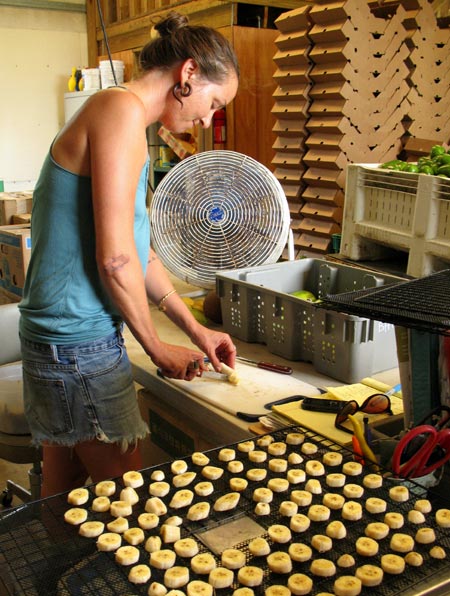
Sadie was working in the barn the last Saturday when I came to pick up my summer fruit order. She was sitting at a table with several bunches of blotchy bananas. They didn’t look very good, but when Sadie peeled one, the flesh was perfectly ripe and ready to eat. Because the skins weren’t pretty enough, the bananas would be used in another way.

The drying rack filled up with sliced bananas as Sadie cuts up more.

Sadie trimmed bruised spots, and cut thick slices, almost a half inch thick. Those were laid on a dehydrator drying rack spaced about an inch apart. When the rack was full, it went inside the large dehydrator humming in a corner. It already held several racks of bananas and star fruit in various stages of dryness. The fruit will take several hours to dry. Then it will be put in the Fruits of Summer dried fruit mix that Bee Heaven Farm sells at farmers markets in the winter.

Sadie showed me a plastic bag full of dried banana slices and offered me some. “I think it tastes like banana bread,” she said. The thick slice was chewy and sweet and had an intense flavor. “I like thick ones. Thin slices dry up too crispy,” she continued. I reached for another slice and chewed slowly. Yeah, it tasted something like banana bread, only better — there weren’t all the other ingredients to dilute the flavor.

If you have a dehydrator, making dried fruit is easy to do. All it takes are a few hours or overnight. Dried bananas and other dried items keep well sealed in a plastic bag and refrigerated.

Halfway dried banana slice hot out of the dehydrator.

Read Full Post »

Older Posts »