Feeds:
Posts
Comments

Archive for the ‘farm’ Category

Mullberries

Mullberry picking in full swing.

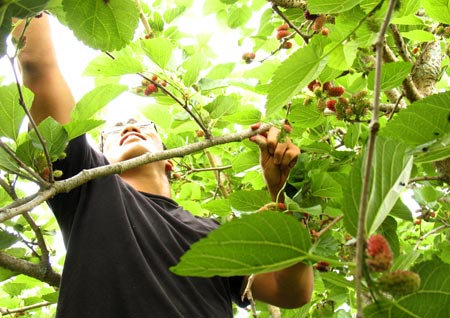
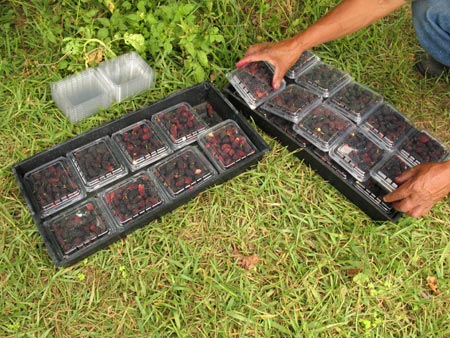
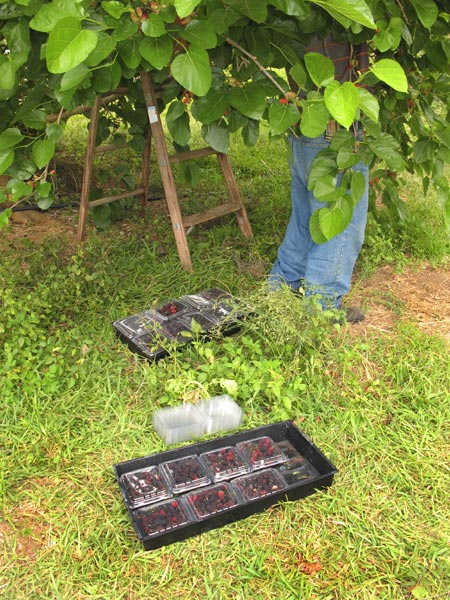
On a farm visit last Friday, I strolled past one of the mulberry trees and saw something going on. Human legs showing from under the full, leafy branches, and also the legs of a wooden step ladder. I circled around and saw packages of mulberries lying on the grass. The legs belonged to Pedro, the farm’s helper.

Weber was perched on the ladder, searching for the darkest, sweetest fruit.

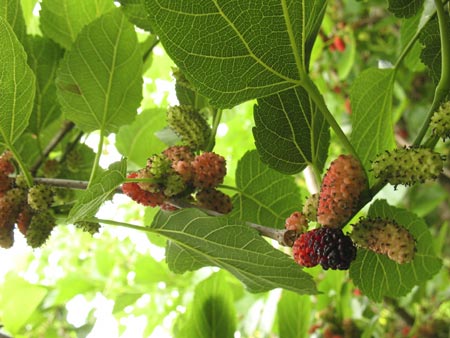
I ducked under the branches and looked around. Weber, the new intern, was partly visible in the sea of leaves and branches. He was standing on the ladder reaching and picking fruit. “I’ve never seen a tree this full of fruit,” Weber told me. And it was true, every branch was loaded with ripe, ripening or still green berries. “The bees have been doing their job,” I told him. The tree is right by the hives and a flight path the bees take in and out of the hive area. They had done a thorough job of pollinating blossoms a few months before, and seems every one had set fruit.

The berries don’t all ripen at once.

I offered to help pick, and scouted branches for the darkest, ripest fruit. They were deep purple and fell off into my hand at the slightest touch. The darker they are, the sweeter the flavor. The thing with me and mulberries is that for every two that go into the box, at least one goes into my mouth!

But don’t worry, I didn’t eat all of them. There’s plenty left. Look for ripe, juicy mulberries at market this Sunday and in the next week or so. But once they’re gone,  they’re gone until next spring.

Friday’s harvest.

Read Full Post »

Baby chicks grew up fast!

More pictures of the baby chicks as they grew up. They didn’t stay in the cute fluffy stage for very long, getting bigger and looking more bird-like with every passing week. At 31 days old, they were scooting around quickly, peeping almost incessantly. They were getting harder to catch and hold, too. The visiting camera scared them at first and they ran to huddle in the darkest corner of the chicken tractor for protection.

Most of the baby chicks huddled up safe in their corner of the tractor.

Anytime is feeding time when you’re a growing chick. Chicken feed is inside the red container.

At my visit one week later, I lifted the lid of the chicken tractor, and one chick flew up to the top of its water jug, startling me. At 38 days, the little birds can fly! They are looking leggier and more hen-like, with their little combs forming. Definitely at that awkward teenage stage, with their heads looking a little out of proportion to their more fully formed bodies. The growing birds are showing curiosity about the camera instead of running and hiding. Or maybe they just want more food!

One of the few pictures where a chick wasn’t a blur in motion.

Instead of timid, the chicks are curious about the glass eye spying on them through a hole in the tractor.

At the next photo session three weeks later, the little birds are much bigger at 59 days. There’s no mistaking looking at them that these are young chickens. Their combs have grown a bit. There’s not as much racing about going on, either, and their voices changed from peeping to something a bit deeper.

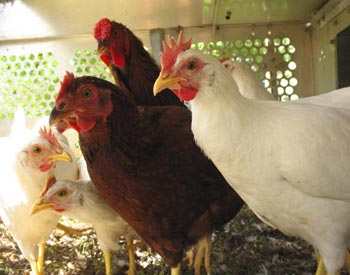
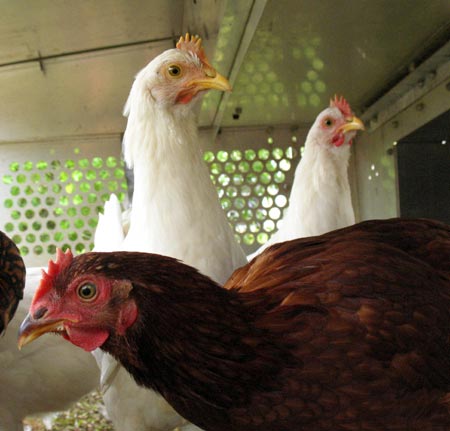
The white birds are Leghorns, the brown blur is a Rhode Island Red, and the other dark one is a mystery breed.

Getting the eye from the young leghorns.

At the most recent visit, my bird friends are 108 days old, or four and a half months. Farmer Margie calls them the “young ladies.” They certainly look all grown up, with their combs and wattles. They strolled about instead of racing and peeping, and they speak like hens, buk buk buk. The big brown one definitely looks and acts like a young rooster, coming front and center to see what the visiting glass eye is up to. He also has a spike feather in his tail, a sure indicator that he is a he. The young rooster isn’t crowing yet that I could tell, but that will come soon. The hens will start laying eggs in a few weeks. Yup, the kids are almost all grown up!

Gathering for the family portrait.

Egg color is linked to the color of the earlobe. Yes, chickens have earlobes, located just behind the eye. Brown lobe, brown egg. White lobe, white egg.

See the spike feather in the brown bird’s tail? That’s a pretty good sign that he might be a rooster.

Read Full Post »

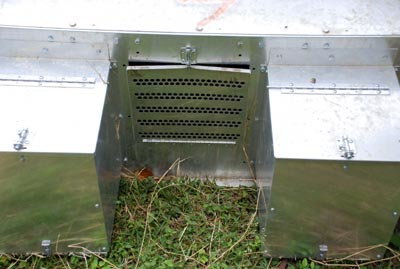
Feral dogs worked open this latch and managed to get inside the chicken tractor.

Last week Farmer Margie told me that feral dogs came on her property again and killed several chickens. Margie had heard her own dogs barking in the middle of the night, got up and went to investigate. She discovered that a chicken tractor closest to the road had been broken into by feral dogs. Four hens lay dead. The big golden rooster known as Fancypants (Margie’s daughter Rachel named him) was injured but survived.

There have been several chicken kills at Bee Heaven over the last three or four years due to feral dogs. They come at night through gaps in the fence, looking for something to eat — or kill. They smell chickens and are big and strong enough to somehow break in to the tractors, the portable metal coops that the chickens live in.  Several dozen chickens so far have been killed by feral dogs.

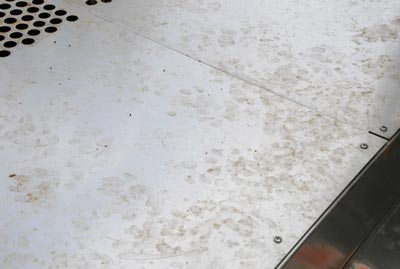
Bloody pawprints on the top of the chicken tractor.

The worst killing happened on January 16, 2009. Two large dogs (you could tell by the bloody paw prints) broke in to three chicken tractors and decimated about two dozen birds. Feathers and blood and torn chicken parts lay scattered in the front yard. Margie lost good birds that night: Goliath (that was my name for him), the large gentle Cuckoo Maran rooster, and Henita, the little black hen with black shiny feathers.

Feral dogs are the biggest reason why egg production is way down for the second season. There just aren’t enough hens at Bee Heaven to meet the demand for eggs. And it takes some time for baby chicks to grow up and start laying.

Feral dogs are also a huge, ongoing problem in Redland. I’ve heard stories about dogs killing chickens at other farms. At least one dog was spotted with a chicken in its mouth. It got shot. End of problem? Not really.

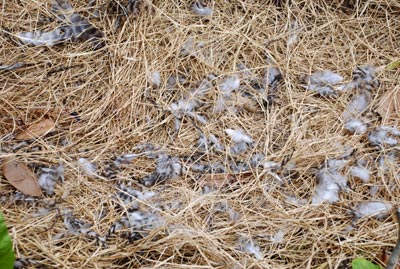
These feathers are all that’s left of a chicken killed by dogs.

The problem continues as long as people keep dumping their unwanted dogs in farm country. What are they thinking when they do that? That someone will magically take in and care for the now-discarded family member? Not likely, and dogs go feral and become hard to catch. They run in the night killing chickens and other animals to survive. Is this what the owners want for their once beloved pets?

Read Margie’s post Requiem for a rooster at Bee Heaven Farm’s blog.

Read Full Post »

By CHRISTINA VEIGA

cveiga@miamiherald.com

As farmers start counting their loses from a historic early freeze, Miami-Dade County officials sought to reassure local growers in the deep southern portion of the county that help is on the way.

Farmworkers, however, may not be so lucky.

County Manager George Burgess and Agriculture Manager Charles LaPradd walked through a field of badly damaged tropical produce and told farmers the U.S. Department of Agriculture is close to issuing a state-wide disaster declaration.

That would make low-interest loans and grants available to growers whose crops suffered in cold temperatures earlier this month.

“It’s very expensive to go through a freeze,” said LaPradd, who serves as a liaison between growers and county officials. “Without the declaration, you don’t get any help.”

To read more, click here.

Read Full Post »

A long, cold December

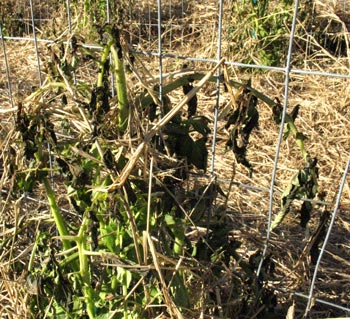
December: Warm weather veggies like asian eggplant weren’t able to take the cold.

It’s balmy now, but last month was a long, bitter December. Three cold spells hit Redland hard with night after night of record-breaking low temperatures that dropped to freezing and below. It was the coldest December on record in South Florida, according to the National Weather Service, and the coldest stretch of temperatures in the South Dade agricultural areas since 1989. The last time temperatures were even slightly this cold was last January, when we had almost two weeks straight of severely cold weather, also with lows in the 30s and below.
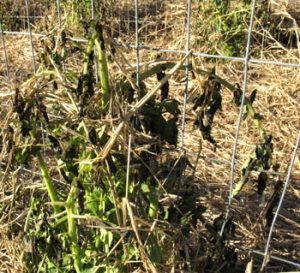
December: Tops of tomato plants froze despite being covered in straw to keep warm.

Farmer Margie told me Bee Heaven Farm got “a blanket of frost” during the second freeze early in December. (She posted many pictures of frost damage on the farm’s Facebook page.) Besides running irrigation, she had her own ideas about how to protect her plants from the freezing temperatures. If you came by for Farm Day in mid-December, you saw a lot of straw piled along rows of plants. That straw was piled on top of young pole beans and young tomatoes, forming “teepees,” as Margie put it. The straw acted like a blanket to keep the cold out. It mostly worked, except in places here and there where wind pushed straw aside and exposed plants to killing cold. Some tomato plants showed damage, and some in the same row looked ok. On my latest visit last Friday, I noticed that a few survivor tomato plants were blooming and a couple others already had fruit growing. Heirloom tomato lovers, have hope!
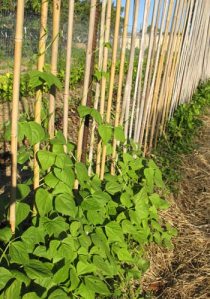
January: Some pole beans survived freezing temperatures. The smaller plants down the row replaced the ones that couldn’t take the cold.

Pole bean plants that survived looked vigorous last week with promising tendrils twirling up bamboo poles. Bush beans (Tongue of Fire and Dragon’s Tongue) were looking pretty good too. They had been covered with a two layers of a long white blanket of spun polyester called Reemay, its sides weighted down with straw so they wouldn’t get blown around by the wind. It worked fairly well, and lots of those beautiful purple and red colored beans made it to market the last two weeks.

The cold made plants go dormant, and their growth slowed down for a while. In the last few days of warmer weather, they suddenly hit a growth spurt. Tomato and pole bean plants with significant damage were removed and replanted. As I looked around Bee Heaven, it was hard to tell where the freezes had left damage.

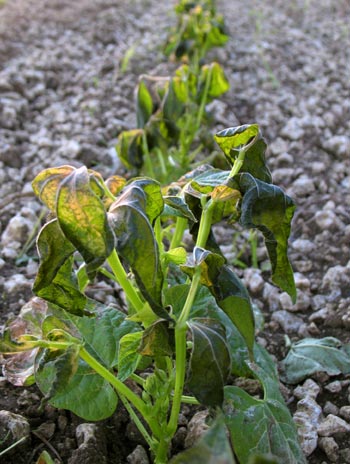
But not everybody fared so well. After the second freeze in mid-December, I went out to look at one of Dan Howard’s bean fields. (Dan runs Homestead Organic Farms, and plants about 100 acres of beans and other vegetables every season.) The bean plants were still on the small side, not even half
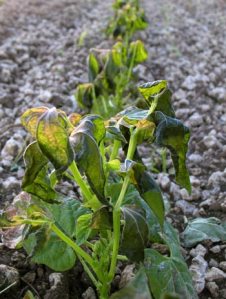
December: Green beans in one of Dan’s fields didn’t make it. See the damaged leaves? Imagine a 20 acre field looking like this.

grown, and in the late afternoon sun, they seemed ok. But when I stooped down and looked more closely, I saw that almost almost every plant had discolored leaves damaged from the cold. Dan said he had sprayed water on his fields all night long. Ideally, water would freeze and ice would coat the plants to preserve them from further damage. Didn’t look like it worked all that well in the field I visited, yet Dan said that some of his other fields got less damage. He’s replanting beans and starting over this month.

December’s freezes hurt large commercial growers in South Dade with $273 million in crop losses, according to the Florida Dept. of Agriculture. (Last January, growers were hit with $280 million in crop losses.)
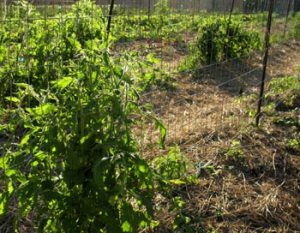
January: Some tomatoes survived. This plant is about knee high. Note gaps in the rows where damaged plants were removed and replanted.

The recent losses have their impact on us eaters as well. According to a recent article in the Miami Herald, prices for green beans, corn and yellow squash have gone up dramatically due to short supplies. And we still have a couple more months of winter to go. The long-range forecast did call for temperatures warmer than average. Hopefully that will turn out to be the case.

Read Full Post »
« Newer Posts - Older Posts »