Feeds:
Posts
Comments

Archive for the ‘farm’ Category

Oriental Fruit Fly

Article written on September 11, 2015 by:

Jeff Wasielewski, Commercial Tropical Fruit Agent, Miami-Dade, UF/IFAS Extension

The Invasion

Sometime before dawn on Wednesday, September 2, 2015, a quarantine went into effect in a 85 square mile area of the Redland housing packing houses, tropical fruit groves, vegetable fields, fruit stands, plant nurseries, and homes. The quarantine is serious business, and a multi-million dollar agricultural industry is at stake.

The quarantine went into effect 24 hours after a public announcement was placed in The Miami Herald, and was prompted by Florida Rule 5B-66, which states “State and federal agricultural officials are mandated to keep the Oriental fruit fly out of this country. Wherever Oriental fruit flies are found in the continental U.S., the pest must be eradicated.”

Tens of thousands of traps lie waiting throughout Florida at any given time with the sole purpose of alerting the Florida Department of Agriculture and Consumer Services (FDACS) to the presence of the Oriental Fruit fly and other invasive and destructive species of fruit flies. The FDACS website lists seven previous oriental fruit fly finds and subsequent eradications in Florida.

The Oriental fruit fly, Bactrocera dorsalis, is taken extremely seriously because the species has massive host list of 435 plants; they are the strongest fliers of all the fruit flies, and one female fly lays an average of 600 eggs in 30 days. According to Mark Fagan, the public information specialist of the Division of Plant Industry, a specialized division within FDACS, 30% of females can push out a whopping 50 eggs in a single day, or 1,500 eggs in 30 days.

Females lay their eggs in host fruit or vegetables, then the young hatch and feed on the fruit, effectively making the fruit impossible to sell and unpalatable. The larvae then enter the soil below them, pupate, and emerge as flies to begin the cycle yet again. This fly has the power to completely devastate the multi-million dollar agricultural industry in South Florida and trigger regulations that would cripple the industry and put thousands upon thousands of jobs in jeopardy.

Past finds of the Oriental fruit fly did not trigger quarantines because the number of flies was minimal with the previous high being 12 males and 4 females found in Tampa in 1999.

The Redland invasion of 2015 was markedly different because of the extraordinary quantity of flies captured. After finding a lone male fly in a trap on August 17, outside of the quarantine area, FDACS later found an immediately alarming 45 male flies in a single trap on August 28. The historic 45 fly find was located in the heart of our agricultural industry in South Florida. Male flies are the first to be captured because the traps use a pheromone that tricks the males into thinking he is near a receptive female.

Enhanced trapping and scouting soon turned up even more males, as well as a mango fruit infested with Oriental fruit fly larvae. Co-incident Commander Bryan Benson, of FDACS, called these finds, “an unprecedented amount of Oriental fruit flies…with the capacity to devastate the local agricultural industry.”

FDACS, the USDA, Miami-Dade County, UF/IFAS Extension, and the University of Florida’s Tropical Research and Education Center have worked together, and readily shared information and resources to educate all interested parties about the rules and effects of the quarantine.

The response from the agricultural industry has been tremendous. The Miami-Dade Extension office has already hosted five workshops dedicated to educating the industry, with over 600 people in attendance that were there just so they could do the right thing and help to stop the fly from spreading.

Quarantine Facts:

• A compliance agreement needs to be filled out and signed, in person, with FDACS regulatory staff for any fruit, vegetable growers, packers, or sellers/stands located within the quarantine area that wish to sell or move any of the 435 host plants, vegetables, or fruits during the quarantine. Parties outside of the quarantine area that want to move produce into the area to pack or sell, must also sign a compliance agreement.

• Some nurseries within the quarantine area need to sign a compliance agreement. You can still buy plants from these nurseries as long as the grower has signed the agreement or is selling a product that is not regulated under the quarantine (soil, mulch, rocks, fish, wood products, or any plants that are not near or under a fruit fly host tree or have host fruit on the plant).

• Homeowners located within the quarantine zone cannot move fruit or vegetables on the host list off of their property. They can grow and eat the produce at their home, but cannot, under any circumstance, move the produce off their property until the quarantine is lifted.

• It is possible to sell and buy produce within the quarantine area if the vendor has signed a compliance agreement and is taking the proper precautions (covering produce with approved mesh, bags or cases). If in doubt, ask the vendor if they have signed a compliance agreement.

• Homeowners and fruit and vegetable growers outside of the quarantine area, or not affected by the quarantine because their crop is not in season, do not have to, or need to, spray any additional pesticides, or bait spray. Baits and sprays are part of the compliance agreement, but do not affect others, especially homeowners, and are not needed or recommended.

Stopping the Oriental Fruit Fly

The rules and regulations regarding the quarantine are difficult to complete and understand, but they are necessary to stop the Oriental fruit fly from jumping out of the quarantine area and making life even harder, if not impossible, for the hardworking farmers and agricultural community of the Redland. These men and women are your neighbors and often visit my office completely drenched in sweat after working countless, difficult hours in the fields tending to their crops.

The silver lining could be the fact that the trap and kill program designed for the Oriental fruit fly is, in the words of DPI’s Mark Fagan, “extraordinary”. FDACS men and women are working seven days a week to hang baited traps, strip trees of fruit in the “hot zone”, and to eradicate this destructive fly completely.

This can all go away if the traps remain empty for two full life cycles of the fly. The lifecycle fluctuates based on climatic conditions with hotter temperatures producing lifecycles around 30 days and cooler temperatures pushing the cycle nearer to 45 days. If all goes well, the quarantine could be over by late November or early December.

The Redland is an area unlike any other on the planet. It is home to an incredible array of tropical fruit and vegetables, with crops as well knows as avocados and squash, and as unique as sugar apples and winged beans. Vegetable fields and fruit groves are intermixed and produce crops side by side tended by people as varied and diverse as the very crops they grow. That one of a kind diversity could be lost if the Oriental fruit fly permanently sets up shop in the Redland, so let’s all work together to not let that happen.

Information:

For the quarantine map, a list of the 435 host plants, a copy of the compliance agreement, and more information on the Oriental fruit fly, visit the Fresh From Florida website.

Call the Fresh From Florida Helpline at 1-888-397-1517 to request to be visited to sign a compliance agreement.

Contact Miami-Dade Extension Commercial Tropical Fruit Agent, Jeff Wasielewski, at 305-248-3311, ext. 227 for more information regarding the quarantine and the compliance agreement.

Download the OFF Quarantine Map.

Download the OFF Host list by scientific name.

Download the FDACS Compliance Agreement Cooperative Fruit Fly Eradication Program

Read Full Post »

Lychees in the morning

Come and get your last taste of lychee sweetness before it’s all gone for the summer! Bee Heaven Farm will be selling Green Grove organic lychees the weekend of June 13th and 14th at the Redland Summer Fruit Festival, located at the Fruit and Spice Park.

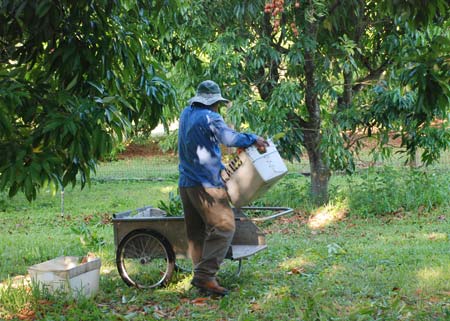
Juan, up in the bucket, picking lychhes.

Up in the bucket picking lychees.

As the early morning sun painted dappled golden light on the lychee trees, Steve Green met me at the front gate and let me into his grove. The picking crew of three had already arrived less than an hour before. This was the second picking of the season, and there would be a few more more in May and June before all the fruit was all harvested. I walked down a row of lychee trees and heard Juan, the picker, before I saw him. He stood in the bucket of a yellow machine on wheels with a crane arm (known as a cherry picker) and rose up the side of a tree. A stack of plastic bins was fastened to the side of the bucket, where he put clusters of ripe lychees. Juan started at the top of a tree, and with an experienced eye, checked every cluster for ripeness. He clipped only the ripe clusters and put them into the bin, and angled around the tree to reach more fruit.

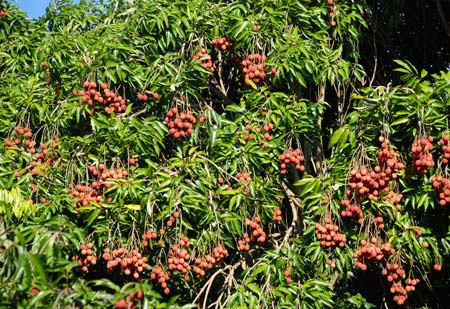
Clusters of lychees ripening in the morning sun.

Clusters of lychees ripening in the morning sun.

You can’t tell by the color when a lychee is ripe. “When they are ready, lychees get rounder, and the little spikes in the skin flatten out,” Steve explained to me as he rubbed his thumb over the rough skin of a lychee he took from a bin. “Ripeness depends on how much sun and rain the fruit gets. Not all the fruit on a tree will ripen at the same time,” he added. Steve knows when the fruit is ripe to pick by tasting a few when the time comes. “An unripe fruit has some bitterness and too much acidity,” he said, “while a ripe fruit has a balance of tart and sweet.” He cracked the skin with a bite, then peeled and tasted. “One more day and it’ll be perfect. But I like mine a little on the sour side.” He handed me a lychee, and for me it was not too sour and just the right amount of sweet.

Grower Steve Green getting ready to taste a lychee for ripeness.

Grower Steve Green getting ready to taste a lychee for ripeness.

Steve’s dogs can also tell when it’s time to pick. “When the lychees are ripe, they’ll pull some fruit down from the low hanging branches of the trees,” Steve said. “They will make a small stash, and then eat the fruit, but not the skins or pits.” His dogs earn their keep by chasing after squirrels, possum and other intruders that also like to eat fruit.

Jose, the runner, gathers picked lychees.

Gathering picked lychees.

The second man on the crew, Jose, was the runner. He brought more empty bins to the picker, and returned full bins back to the packing table set up beside the farm house. Because this is a certified organic grove, everything that comes into contact with the fruit — the cherry picker, wheelbarrow, table, and all the bins — had been triple sanitized to meet organic standards.

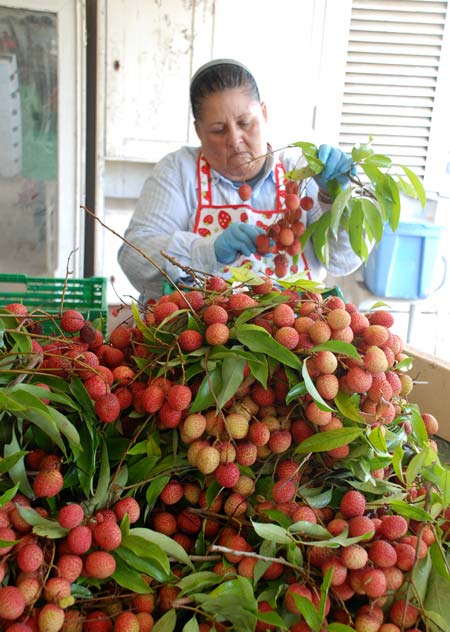
Leticia removes fruit from the clusters, in preparation for sorting and packing.

Leticia removes fruit from the clusters.

Jose dumped a full bin onto the work table, where Leticia, the experienced crew boss and packer, plucked each fruit from its cluster. Her job was to sort the fruit, separating the perfect ones from the less perfect. The lychees that were ripe and pretty went off to one side of the table, to be packed into pint-size plastic clamshells, twelve pints to a box.

The fruits that were split or stained went into a bin off to the other side. Those were graded number twos, and were just as tasty but not as pretty. “The brown spots on the skin of a lychee fruit are called coffee stains,” explained Steve. “They happen when the sugar leaks out that area develops a stain.”

Lychees going from the branch to the bin.

Lychees going from branch to bin.

Back in the grove, Juan, the man in the picking machine, maneuvered around a few trees that didn’t have any fruit on them. Occasionally some trees just won’t bear fruit, even though other trees in the grove are loaded. This season, Steve estimated that his harvest was below average. “A good year is when every tree is loaded,” he said. “I expect to pack out about two thousand pounds this year. In a really good year I’ll pack out fifteen thousand pounds.” On that particular day, they expected to pick 600 pounds of lychees, or 720 pint containers full.

Trees loaded with fruit ripening in the sun.

Trees loaded with fruit ripening in the sun.

Lychee trees are notoriously temperamental. They need the perfect set of circumstances in the winter — a dry winter with enough hours of sufficiently cool temperature or else they just won’t bear in the summer. The whole grove can easily go several years without bearing fruit. When lychee trees do bear, their season is short, four to five weeks on average. Picking usually starts in mid to late May. All of these factors combined make for high retail prices for fresh fruit.

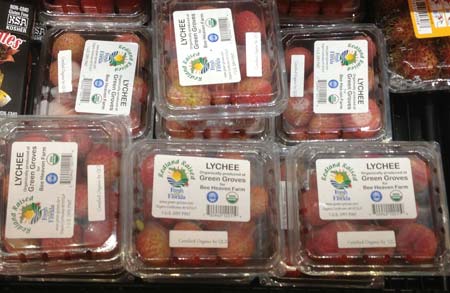
Available at local Whole Foods Markets.

Available at local Whole Foods Markets.

As the sun rose higher in the sky, the fruit picking and packing went on. Most of this day’s harvest was going to local Whole Foods stores, the rest to an organic wholesaler. “The Pinecrest produce manager  ordered them and  put them on display in their organic produce section,” Steve said of his pint boxes of lychees, “and the other stores can get them from their regional warehouse.” (I’ve seen Green Grove lychees at the Aventura store.) The number two fruits that were stained but not split were destined for the Bee Heaven Farm web store. (The splits are given to lychee-hungry friends who drop by at the end of harvest days.)

Green Grove lychees are certified organic, so Steve can command higher prices than growers who do not follow such strict growing practices to receive USDA certification. But the extra income goes to pay for extra labor and materials used to control weeds, pests, and diseases. Approved treatments are more expensive,  not as effective, and need to be applied more often. Weeding is done by hand rather than using any herbicide. An organic grower can’t use conventional chemical sprays or fertilizers.

Picking lychees with a cherry picker.

Picking lychees with a cherry picker.

On a walk through the grove, Steve pointed out a handful of trees that had been attacked by two different pests — one group by lychee bark scale insect, and a few others by the Sri Lanka weevil. Scale sucks sap and kills branches, and the weevil cuts notches along the edges of the leaves. The scale is kept in check with regular applications of fish oil spray approved for organic farms, and the weevil is simply tolerated.

Overall, the grove looked fairly healthy, and most trees were loaded with fruit. Steve expected to pick another crop in early June. Then harvesting would be pretty much done for this year. If we have a cool and fairly dry winter coming up, hopefully we can expect a good crop of lychees next year.

Read Full Post »

Tickets Available For Paradise Farms 2015 Dinner in Paradise Series

Join the organic farm in celebrating its 10th season!

Stumped for the perfect present this holiday season? Even the most finicky of foodies will be ecstatic to receive a seat at the table during Dinner in Paradise’s 2015 series with a nearly all-new lineup of culinary talent. Tickets go on sale just in time for last-minute gifts at paradisefarms.net or by calling 305.248.4181.

Paradise Farms, an organic boutique operation founded by Gabriele Marewski in 1999 in Homestead, Fla., focuses on Miami’s emerging chef scene as the theme for its 10th annual year of hosting multicourse, farm-to-table repasts in an open-air gazebo surrounded by lush tropical landscaping. Following a reception, guests are treated to a farm tour before sitting down to dinner with wine pairings selected by wine director, Shari Gherman.

January 2015

To kick off the season on January 11, The Federal’s Cesar Zapata, Haven’s Todd Erickson and Eating House’s Giorgio Rapicavoli team up for a mouthwatering evening that showcases their progressive take on cuisine that’s reshaping the city’s palate. Zapata stars in “Best New Restaurant,” a cable television show contest hosted and judged by kitchen veteran Tom Colicchio that premieres on Bravo on January 21. Rapicavoli is a frequent winner on Food Network’s “Chopped,” while Todd Erickson took home the top prize for Miami New Times’ Iron Fork Competition in 2014.

The January 25 dinner partners Gabriel Orta and Elad Zvi of Broken Shaker and their newly opened 27 Restaurant & Bar; Kris Wessel of Oolite, who hosted Anthony Bourdain for the TV host’s upcoming travel show about Miami, and Diego Oka of La Mar, a Peruvian import by one of the world’s most acclaimed chefs and restaurateurs Gaston Acurio.

February 2015

Adrianne Calvo, the Cuban proprietor of Chef Adrianne’s who appears regularly on television and just released her third cookbook, William Crandall, the Midwestern chef de cuisine for Azul at Mandarin Oriental Miami, a long-time participant in Dinner in Paradise that always draws crowds, and Andrew Gilbert, The Seven Dials’ British chef owner who puts a modern, organic twist on classic English fare, show off their techniques on February 1.

March 2015

Marewski, who has been a vegetarian since her teens, is especially proud to feature a plant-based dinner on March 1. It brings together Keith Kalmanowicz of Love & Vegetables, who has a large local following through his dishes that elevate the category to a gourmet level; Billy Devlin, the chef de cuisine for Basil Park, which has received rave reviews by food critics for its delicious, healthy menus, and chef Enrique Ruiz of Temple Kitchen, a vegan restaurant and juice bar that was a hit during the inaugural Seed Food & Wine Festival in Miami in October.

Flower fans will be excited to attend the farm’s annual Edible Flower Festival on March 14. Richard Sandoval Restaurants’ appropriately named executive chef Jose Luis Flores makes a special visit to Miami again to cook with the hospitality group’s Toro Toro executive chef Eric Do. Their dishes incorporate the farm’s more than 50 types of edible flowers such as calendula, borage and nasturtium. Please note that this dinner occurs on Saturday, rather than the usual Sunday event.

Falling on Palm Sunday, March 29’s meal pairs Aaron Brooks, the Australian executive chef behind Four Seasons Miami’s modern surf and turf concept Edge Steak & Bar; Mike Pirolo, who garnered a rare, four-star review from The Miami Herald while at Scarpetta before opening his locals’ mainstay Macchialina Taverna Rustica, and Gabriela Machado, the highly artistic founder of Copperbox Culinary Atelier restaurant and owner of Contrabando Catering Company.

April 2015

April is shaping up to be a terrific time to visit the farm, too, with three incredible dinners. On the 12, Sean Brasel of Meat Market, which expanded to Palm Beach earlier this year, and Timon Balloo of the always packed Sugarcane and Bocce Bar return to cook with newcomer Dena Marino of MC Kitchen, who honed her craft in kitchens from Napa to Aspen, and has challenged Masaharu Morimoto on “Iron Chef America.” The 19th combines Danny Grant, a Best New Chef for Food & Wine who joined 50 Eggs (Yardbird, Khong River House, Swine) after wowing diners with his fine dining concept 1826 Restaurant & Lounge; Jacob Anaya, executive chef for popular casual eatery and craft beer and wine bar OTC, and Najat Kaanache, a Spaniard who worked at El Bulli, Alinea and Per Se before launching her Piripi Miami in Coral Gables any day now. Finishing out the season on the 26th, Jodrick Ujaque of Homestead-based Chefs on the Run doesn’t have to venture far to join Richard Torres of Bread + Butter, an updated approach to Cuban comfort food that expanded with Little Bread Cuban Sandwich Co. in Little Havana, and Nicolas Cabrera of Coya Restaurant & Bar, a British import featuring Peruvian cuisine from the owner of Zuma.

Community Support

“Paradise Farms is offering our community a wonderful opportunity this holiday season to support women and families in need, and they are helping Lotus House build community support and raise public awareness, as dinner guests come together to enjoy a meal in their beautiful gardens,” said Constance Collins, Lotus House Director. “This incredible support will help fund life-saving shelter, sanctuary and holistic supports at the Lotus House so that the special women, youth and children we serve can heal, reclaim their lives, and bloom into who they are truly meant to be.”

Sponsors

Paradise Farms would like to thank the event’s generous, long-term sponsors including Whole Foods, Schnebly Redland’s Winery, Strategic Importers, Lucini Italia, Brustman Carrino Public Relations, as well as DIP co-founder Michael Schwartz.

Reservations and Gift Certificates

Please go to our website www.paradisefarms.net to make reservations.

For gift certificates, please call Paradise Farms office: 305-248-4181.

We look forward to seeing you!

Read Full Post »

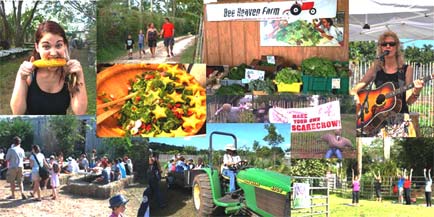
Farm Day fun! Collage by Margie Pikarsky

Farm Day fun! Collage by Margie Pikarsky

10th Annual Farm Day at Bee Heaven Farm

Come to the country * Fun for the whole family * Bring friends!

Sunday December 21st * 11:30 am to 3 pm

Farm Food * Activities * Hay Rides * Farm market and nursery

Live Music * with local singers Jennings and Keller: Fusion Folk Americana

Yoga in the Corral * with CSA member Sheelah Davis of OM Brew Yoga

FREE ADMISSION * Food $10 * Yoga $5 donation * Bring cash. Drooling is free!

We accept credit/debit/SNAP for purchases.

Directions:
From southbound on US1, turn west (right) on Bauer Drive (SW 264 St.) and go approx. 5 miles. The farm is about 1/3 mile west of Redland Road (SW 187 Ave.) Look for the farm signs and flags on your left. Please angle park on the swale and walk on in.


Read Full Post »

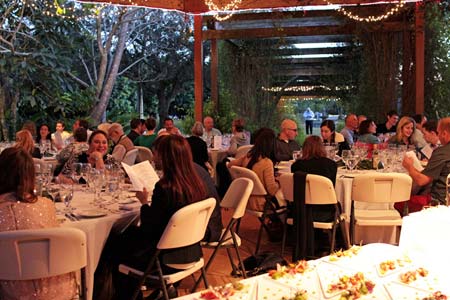
Dinner in Paradise, January 26, 2014. Photo by Kelly Samardak, Shortstackphoto.com

Dinner in Paradise, January 26, 2014. Photo by Kelly Samardak, Shortstackphoto.com

Announcing the 2015 Dinner in Paradise season line up! The New Generation of Chefs in Miami!

This season’s line up was inspired by Gabe Orta (Broken Shaker) who posted on Facebook: “Happy to see so many friends and colleagues opening great restaurants and bars all over town. Exciting to see a new generation of Miami hospitality finally here #letsdothis.”

It is very exciting for Dinner in Paradise to be a venue to give this new generation of chefs greater exposure. Who are these chefs and what are they up to? Let’s find out where their creative expression takes you! You will want to experience the entire season. It’s not just dinner, it’s an experience!

January 11th
* Cesar Zapata: The Federal
* Todd Erickson: Haven South Beach
* Giorgio Rapicavoli: Eating House Miami

January 25th
* Gabriel Orta & Elad Zvi: 27 Restaurant & Bar
* Kris Wessel: Oolite Restaurant & Bar
* Diego Oka: La Mar at Mandarin Oriental

February 1st
* Adrianne Calvo: Chef Adrianne’s
* William Crandall: Azul/Mandarin
* Andrew Gilbert: The Seven Dials

March 1st  Plant Based
* Keith Kalmanowicz: Love & Vegetables
* Enrique Ruiz: Temple Kitchen
* Billy Devlin: Basil Park

March 14th  Edible Flower Festival (Saturday)
* Eric Do & Chef Jose Luis Flores: Toro Toro
* Todd Phillips: mixologist

March 29th
* Aaron Brooks: Edge Steak & Bar
* Mike Pirolo: Macchialina Taverna Rustica
* Gabriela Machado: Contrabando

April 12th
* Sean Brasel: Meat Market
* Timon Balloo: Bocce Bar/Sugarcane
* Dena Marino: MC Kitchen

April 19th
* Najat Kaanache: Piripi Miami
* Danny Grant: 1826 Restaurant & Lounge
* Jacob Anaya: OTC

April 26th.
* Jodrick Ujaque: Chefs on the Run
* Richard Torres: Bread & Butter
* Nicolas Cabrera: Coya Restaurant & Bar

Please arrive at 5 p.m. for a cocktail reception,  followed by a farm tour, dinner and bonfire. (Arrival time changes to 6pm on March 14th).

For reservations, visit paradisefarms.net. Each dinner is $165.50 per person + tax. Reservations are required. Buy a table of 10 and get one seat free. Buy a season of 9 and get one free. GIFT CERTIFICATES ARE AVAILABLE.

Paradise Farms would like to thank the event’s generous, long-term sponsors including Whole Foods,  Strategic Importers, Schnebly Redland’s Winery, Lucini Italia and  Brustman Carrino Public Relations, as well as DIP co-founder Michael Schwartz.

Read Full Post »

« Newer Posts - Older Posts »