Feeds:
Posts
Comments

Archive for the ‘farm’ Category

Juicing clementines

Friday afternoon, the barn was flooded with clementines from Green Groves. CSA members got fruit with pretty skin, but there was still plenty that had blotches from the cold that didn’t look as nice. The fruit inside was still good to eat — but it was way more than everyone could or would want to eat.

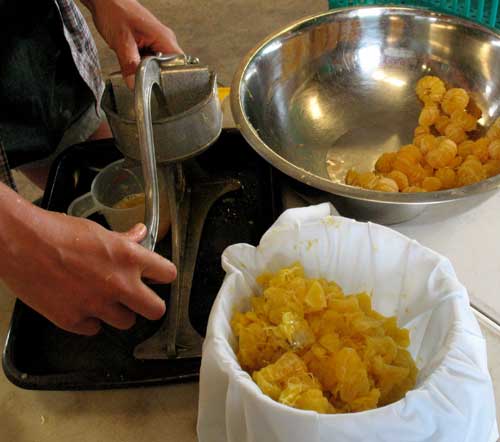
So, time to pull out the very useful antique juicer (farm manager Muriel blogged about using it here on the Bee Heaven Farm blog).

Fresh squeezed clementine juice!

The sections were squeezed and drained and squeezed some more to get every drop of juice, which was poured into ice cube trays for freezing. It can be used as an ingredient or reconstituted into juice.

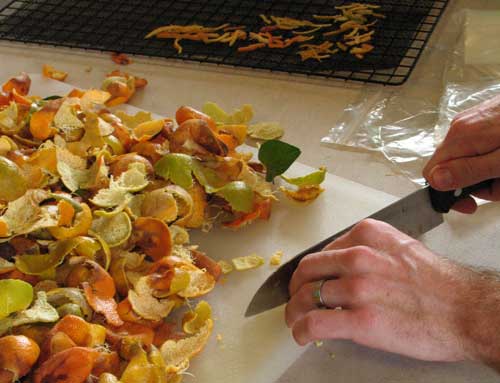
The peels weren’t wasted either. Intern Michael trimmed the bad spots and then sliced the peels carefully into thin strips. Those went on dryer racks to get dehydrated. The dried peels can be used in stir fries, soups and other dishes where you might want a bit of citrus zing.

Slicing clementine peels for drying

Not sure what happened to the squeezed fruit pulp. Perhaps its destiny was the compost heap, but I’m sure that with a little imagination, one could find a delicious use for it also!

Read Full Post »

Record-breaking cold temperatures rolled in, and a freeze warning was issued for several nights in a row this week. The farmers in Redland scrambled to protect their crops from the freezing cold, but generally fared well. CSA growers located further north — Worden Farms in Punta Gorda, and C&B Farms in Clewiston — got frost damage on Tuesday night. They’re still evaluating how much damage they got, and if any crops were lost.

As a result, there may be less in the share box this Saturday and maybe for the next week or so. Freeze damage is one reason, and less veggies growing is another. “Plants don’t like to grow when it’s cold. They like to go dormant,” grower Dan Howard explained to me. If there’s a killer frost and lettuce (for example) is burned by cold, that’s it, there’s no more local lettuce to eat until it’s replanted and harvested again. Remember, as CSA members, you agreed to share the same risks as the growers! No faking it with lettuce from Belize or somewhere… not in this CSA! (Also, because vegetables were damaged by the cold, or were not ready to pick, there will be less in the stores and the prices will go up.)

Reemay, or floating row cover, protects delicate greens and pole beans against freeze damage.

Margie Pikarsky at Bee Heaven Farm protected delicate basil, heirloom tomatoes, and pole beans with large sheets of Reemay, or floating row cover. It’s a spun polyester fabric that is used to cover plants, much like a blanket. The row cover acts like a blanket to hold in the heat and keep plants warm. Margie added she’s not watering as much, because that runs the risk of plants mildewing, or hot condensation cooking entire plants. Her crops have been covered since the first freeze warnings on Saturday, and the Reemay will stay up until the cold blast forecast for this coming weekend.

On Wednesday afternoon, Dan Howard of Homestead Organics, was cautiously optimistic. “Tuesday night it went down to 33, 34 degrees, but not a killer freeze,” he told me. He had prepared his bean fields by watering them quite extensively during the day on Tuesday. (It’s just too much acreage to use row cover.) Dan explained that his crews “soaked the ground down real good. Water insulates the ground to keep it from getting colder. Well water is 75 degrees, the same temperature year round. Dry ground gets colder than wet ground.” He explained that ground temperature is the most important for the plants, keeps the roots from freezing.

If the temperature gets below 32 for any length of time, plants will become permanently damaged from the cold. “Anything below 32 is bad, and at temps of 28, 29 degrees, it’s a total loss,” Dan explained. Monday night wasn’t that severe because there was a blanket of cloud cover, which acted as insulation and kept the temperatures from dropping too low. Tuesday night the sky was clear and temperatures dropped — but it was windy, and that made a difference. The moving air keeps ice from forming on the leaves. “If there’s no wind and clear sky, you get frost,” Dan said. And frost is what kills plants. It coats the leaves and burns them much like frostbite. Leaves turn black and wilted from the damage and the plant will die. Farmers can knock ice off the plants by spraying fields with water in the middle of the night, Dan explained. That’s why they’re up all night, watching the temps, checking the plants watering in the fields and groves.

In a similar vein, Robert Barnum of Possum Trot Nursery watered his tropical fruit grove on Tuesday night. He has giant pumps to draw well water, and tree-high sprinklers dotted through his grove. Tuesday night temps dropped to 36, and Robert was up at midnight and again at 3 am watering and checking on his trees. He explained that water gives off heat as it freezes, 353 kilocalories per gram of water to be exact, and that bit of heating warms the plants. Once the water on the plant freezes, it keeps the temperature constant at 32 degrees even if air temperatures drop below that, because a heavy coat of ice acts as insulation. But you have to keep watering, he insisted, to keep that small but important heating process going.

By Wednesday night Robert was less optimistic than Dan, and said the thermometer already read 39 degrees at 9 pm. The sky was clear and the winds were dying down. It looked like there would be a killer frost that night. Margie said the temperature dropped hard and fast — and then something unexpected happened. Some light cloud cover rolled in, and those clouds were enough to act like a blanket keeping heat from radiating away from the ground at night. Temps hovered around freezing, then came back up a bit. “I never saw anything like that,” Margie told me. But the main reason why the anticipated killer frost didn’t happen, according to Jonathan Crane at TREC: when the temperature fell to 35 it also reached the dew point. When the temperature meets the dew point, heat is released and the temperature rises, and that is what happened on Wednesday night. (There might have also been a bit of ground fog.) End result, no freeze, and crops were spared — this time. A more severe blast of cold air is forecast for the weekend, and growers (especially to the north of us) are bracing themselves.

To learn more about how frost forms and dew point, take a look at this web page.

Read Full Post »

This summer, there was great concern among commercial avocado growers in Redland (including Bee Heaven Farm) about the apparent discovery of the redbay ambrosia beetle, which rapidly kills avocado trees, and has been located in North and Central Florida. At least one tree in Redland was suspected of infestation and was burned. UF/IFAS held a workshop (which was blogged) giving information about the beetle and laurel wilt, the lethal fungal infection that it causes.

If you have avocado trees on your property in town, don’t think you’re immune. Learn what the signs are and watch your trees carefully. There’s good information at Save The Guac and the UF/IFAS sites.

Farmer Margie told me in summer that she will take a wait and see attitiude with her grove. Both she and Gabriele Marewski of Paradise Farms (who also raises avocados) are cautiously optimistic that a healthy, unstressed tree may not get infested and die. So far so good, fingers crossed.

Here’s a good follow-up article about the situation, published in the Miami Herald on Dec 26th.

Avocado growers fear spread of Asian redbay ambrosia beetle

After enjoying a season of near record-high avocado prices, farmers of Florida’s second-largest tropical fruit crop are now worried about a potentially deadly invasive pest.

http://www.miamiherald.com/457/story/1398662.html

BY NIALA BOODHOO
nboodhoo@MiamiHerald.com

This year’s avocado season is making farmers happy: The 920,000-bushel crop, grown mostly in southern Miami-Dade County, is fetching prices that are almost 50 percent better than a few years ago. But as the season comes to a close, those in the Florida avocado industry are casting a wary eye to Martin County, where the redbay ambrosia beetle continues its march southward.

Growers, scientists, and the local, state and federal governments are in a race against the beetle as it makes its way south to the $30 million avocado industry.

The beetle, believed to be a native of Asia, is described by scientists as smaller than Lincoln’s nose on the penny. But it carries a fungus that has proved lethal to many trees in the laurel family, including redbays and avocados, from the Carolinas through Georgia, and now Florida. There is no method to cure the disease.

After citrus, avocados are Florida’s largest tropical-fruit industry. This year’s crop was more than 50 million pounds, virtually all of that grown on 7,500 acres in Miami-Dade.

“The avocado industry is very concentrated in one area,” said Craig Wheeling, president of Brooks Tropical in Homestead, one of the largest growers, packers and shippers of Florida avocados. “It’s kind of an all-or-nothing fight down here.”

Wheeling said his best avocados were getting about $16 a bushel — 45 percent better than the $11-a-bushel prices three years ago. He attributed the higher prices to not just a smaller crop, but to growing demand for Florida avocados. And he said that’s what makes it even more crucial that scientists find a way to combat the beetle and the fungus-causing disease it carries.

Females carry the fungus spores in a special pouch within their mouths. When the insects bore into a healthy tree to check if it would be suitable for nesting, the tree is inoculated with fungi that cause a disease called laurel wilt. As it spreads, the tree’s water system is disrupted, causing the leaves to wilt so quickly they don’t even fall off.

The larvae and adult females feed off the fungus — essentially, the beetle carries its farming system with it, said Jonathan Crane, a tropical-fruit plant specialist with the University of Florida’s Institute of Food and Agriculture Sciences in Homestead.

There are dozens of varieties of beetles that have a symbiotic relationship with a fungus it carries. The one beetle/fungus combination that has proved deadly to the redbay and Florida avocado tree is a specific variety with the scientific name raffaelea lauricola. It was first detected in Georgia in 2002.

It took a few years to spread through Georgia and was first found in Florida’s northern counties in 2005. On its own, the beetle can fly about 20 miles.

It has spread exponentially quicker the past two years to Central Florida, experts believe, because diseased trees have been cut down for firewood and brought south.

In late July, the local industry panicked after the state issued a press release saying a confirmed case of the beetle had been found in a Homestead grove.

Growers, including Brooks, spent hundreds of thousands of dollars to cut down and burn trees that looked weak or infected, and to spray groves with extra pesticides.

That initial test proved to be a false positive because the science behind tracking and typing the fungus is just developing, said University of Florida forest pathologist Jason Smith. The beetle and fungus have never been studied in Asia, where it is believed to come from, because trees there haven’t died.

“Nobody had ever looked at this,” Smith said.

It took weeks to confirm that the disease hadn’t reached Miami-Dade. Even so, the industry remains on guard.

“It’s still a threat,” said Miami-Dade County’s agricultural manager Charles LaPradd. “What I would love to say is that it will never get down here, but that’s fantasyland.”

Local growers say what happened this summer was a test.

The summer scare caused growers to start regular meetings with local, state and federal agriculture officials and scientists, who said they are close to a method that would confirm the disease in a day or so.

Most of the research is being spearheaded by the University of Florida, which received a $1.2 million USDA grant to find a way to beat the beetle.

One possible method might involve sterilizing the large equipment that is used within groves to prune trees, Smith said. Others are looking at the natural resistance that has been found in Asia and among some local varieties of trees. Additional research is going into fungicides that need to receive federal approval before being used.

In the meantime, the state agriculture department has also started a marketing campaign based on one of the fruit’s most popular uses, guacamole, at www.savetheguac.com. It’s designed to help educate the public about moving firewood and how to spot diseased trees.

“There are tens of thousands of backyard avocado trees in South Florida,” said state agriculture spokesman Mark Fagan.

“We can’t go into every backyard and inspect every avocado tree — we need the public’s help.”
© 2009 Miami Herald Media Company. All Rights Reserved. http://www.miamiherald.com

Read Full Post »

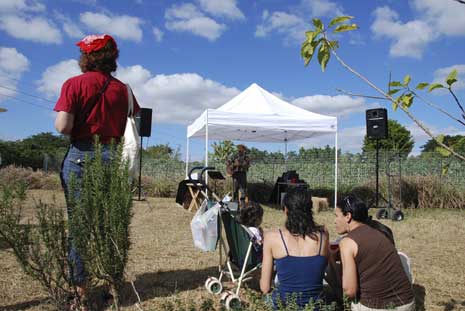
Hanging out at Farm Day 2008. (Grant Livingston was the musician last year.)

Farm Day

Come to the country!
Fun for the whole family!

Sunday, December 20
11:30 am – 3:30 pm

* Food * Activities * Hay Rides *
* Farm Market *
Locally-grown seasonal organic produce, dried fruit, heirloom tomato plants for sale.
* Live Music *
With Jennings & Keller: Fusion Folk Americana

Your optional $10 donation helps support our internship and student artist programs
and includes a chance to win a Smith & Hawken BioStack Composter ($129 value).

Directions:
From southbound US1, turn right (west) onto Bauer Drive (SW 264 St.) and go approx. 5 miles. The farm is about 1/3 mile past Redland Road (SW 187 Ave.) Look for the farm sign and flags.

This is Bee Heaven Farm’s annual open house. Every year more and more people show up. Last year over 200 folks participated in the event. Here’s some tips so you can have more fun: Get there early! Bring your kids, but leave the dogs at home. Bring a covered dish to share in the potluck. Bring money to buy veggies, honey, fresh herbs and flowers, and other farm goodies. Bring old clothes to make scarecrows.

Most of the local farmers who have been growing food for the CSA will be at the party. Confirmed rsvp’s: Robert Barnum of Possum Trot Nursery who will cook local foods and roast corn. Hani Khouri of Redland Mediterranean Organics will have goat milk ice cream, goat cheese and authentic Lebanese dishes, and will bring his fryer to make falafel. Still waiting on rsvp’s: Cliff Middleton and the other Clifton of Three Sisters Farm (callaloo and yuca); Gabriele Marewski of Paradise Farms (oyster mushrooms), Dan Howard of Homestead Organics (green beans, yellow squash, zucchini) and Murray Bass of Wyndham Organics (avocados).

The donations collected will go toward two very worthy causes. Farm Day overlaps during Art Loves Farms, an art students residency at Bee Heaven. Eight students from DASH will be living on the farm for four days making art, which will be exhibited at a later date. The donations will be split between an honorarium for a guest artist who will give a workshop with the students, and farm internship expenses. Almost all the farm workers are interns or volunteers who have come from all over the United States, sharpening their farming skills learning how to grow new crops. Some of the volunteers/interns have gone on to run farms of their own. (Oh, and if you see a videographer roaming around, that would be me documenting both events.)

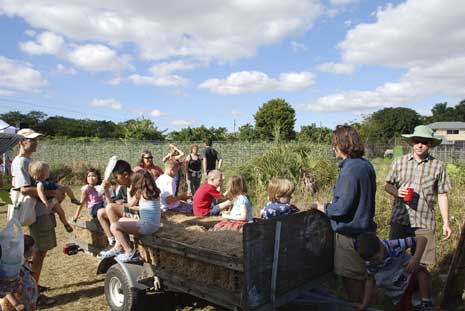
Here are some pictures from last year’s Farm Day.

Sylvia, CSA member and site host, shopping at the mini market.

Kids of all ages get up close with a real tractor.

All aboard for a hayride.

When was the last time you made a scarecrow?

Read Full Post »

text by Art Friedrich, urban farmer, member of Urban Oasis Project
photos by Antonio Guadamuz, member of Urban Oasis Project

Saturday, Nov 28, 2009

Art Friedrich and partner Luigi (in flannel) touring ECHO

Getting out beyond SE FL to see what other things are happening in organic and sustainable agriculture in Florida, 16 folks headed out to ECHO (Educational Concerns for Hunger Organization) Global Farm and Worden’s Organic Farm in N. Ft. Myers and Punta Gorda, respectively. The group consisted of a number of the workers and WWOOF’ers from Bee Heaven Farm, as well as the big brain behind it all, Farmer Margie. Joining them were a number of local food enthusiasts from Urban Oasis Project and some of the new batch of Master Gardener Interns. [Note: Margie organizes a trip to ECHO and Worden every year during the Thanksgiving weekend, for the purpose of enlightening her farm interns and volunteers, and others who want to make the trip.]

Our first stop was the ECHO Global Farm, a christian based project started over 25 years ago to combat the problem of world hunger, primarily in the tropical zone, using the most concrete and long-lasting ways. Tours are available daily, and are well worth the $8. The tour consists of two hours of seeing and hearing about numerous fascinating plants, and methods of growing highly nutritious foods using unconventional and conventional methods that require little monetary outlay. There are six different recreated environments, such as a rainforest, an arid area, a monsoon climate (like we have, with 6 months dry and 6 months really wet), and the fascinating urban garden section.

Container gardening taken to a new level.

The urban garden section showed some great examples of reusing trash, such as old tires, to create containers. Also fascinating was the wicking gardens that are mostly made up of a carpet with a little bit of soil in top and some gravel or even cans wrapped in socks for the plants to have structure to grow on. You fill a closed bucket with a hole in the bottom with water, stick it on an edge of the carpet, and let the garden suck the moisture out as it needs it! This is a great way to use a minimum of water and soil. While some of us had questions about the safety of carpet material, other types of substrate could be developed. Probably any old canvas or woven mat material would do. They try laying the carpet out in the natural UV rays of the sun to break down harmful chemicals.

I also enjoyed the mention of their research using human urine as fertilizer — it is packed full of good nutrients and is sterile! In some countries, this has been government sanctioned for a while, such as in Sweden, where some housing developments have been built with urine diverting toilets that drain to some big tanks. When the farmers need fertilizer, they just pull up, pump some of the liquid gold out, and spray it right on their fields! The savings in water and fertilizer are stellar, and it is only cultural taboo that makes the subject so difficult.

Urban homesteading at its finest!

The Moringa tree is a favorite plant there. They call it the Miracle Tree. One can eat almost any part of it, and it is incredibly dense with nutritive value, and the tree grows in almost any condition. I’ve started my own little plantation at my house in S. Miami.

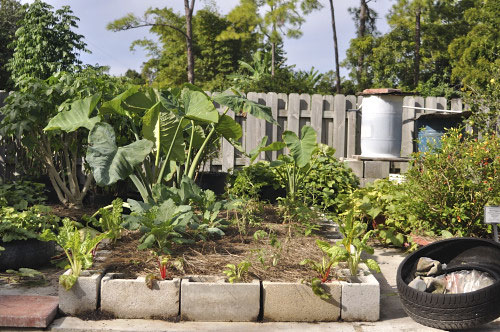
Rustic raised bed

ECHO is also a seed bank, and they send seeds all over the world to see what works, with attention to both the physical and the cultural aspects. This aspect impresses me. It is applied science that recognizes humanity’s needs as a driving force in experimentation. And the needs of the global poor are great, but with sensitivity and ingenuity, the poor can be given the tools they need to improve their own lives in a sustainable and self-empowering way. ECHO taps into their own knowledge and traditions and offers a broader knowledge base for them to work with.

Endless fields at Worden Farm

The second half of our day was visiting Worden Farm in Punta Gorda. The farm is a brilliant example of hard work and smart planning to generate massive amounts of organic vegetables, sold all along the Gulf Coast. The farm is 55 acres, with about 35 in production, and is only six years old. The soil is almost pure sand, so lots of chicken manure is used as their fertilizer, as well as cover crops to slowly improve the quality. Long rows of raised beds made with plastic sheeting make upkeep relatively easy, and the veggies all looked absolutely flawless.

Drip irrigation system at Worden Farm

The plastic sheeting with drip tape irrigation underneath also helps limit water use, as well as the extra work of short watering cycles very frequently. Extra work to reduce the negative environmental impacts of the farm is a tradeoff they are happy to make. Those plastic sheets at the end of the season don’t hit a trash pile. They go to an agricultural plastics recycler.

Touring Worden Farm by electric cart. L-R: Wwoofer, Eva Worden, Cesar Contreras, Margie Pikarsky (back turned), Melissa Contreras

Farm Ferrari

Cow at Worden Farm

Read Full Post »

« Newer Posts - Older Posts »