Feeds:
Posts
Comments

Archive for the ‘farm’ Category

mike-digs-holes

Mike digging holes spaced two feet apart

So, what’s getting planted at Bee Heaven? Radishes, pole beans and lots and lots of heirloom tomatoes. Stopped by last Friday and saw that most of the prep work had been completed. Irrigation drip lines have been run, connected and leaks mended. Rebar stakes were driven into the ground, and rolls of wire mesh trellising stretched across as a support for the tomatoes. As the plants grow, they will get tied to or weaved into the mesh. When I arrived, Mike and Cassidy were digging holes spaced two feet apart for the tomato transplants.
planning

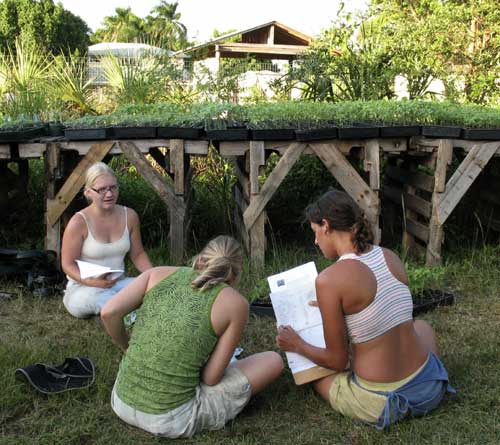
Jade, Devin and Muriel decide which tomato plants go where

Muriel and her crew Jade and Devin planned which varieties would get planted where. At least 30 varieties of heirloom tomatoes are grown on the farm. Chalk’s, Red Fig, Aunt Ruby’s, and Cherokee varieties are from Slow Food’s Ark of Taste list. Muriel explained that first she groups by types — cherry with cherry, or roma with roma. Then the colors are alternated — yellow, orange, green, red, pink, brown and black (actually very dark red) — instead of grouped together. This tomato rainbow, as Jade described, is carefully mapped out. When it’s time to pick, you know what you’re picking. Last season, several varieties of same-colored tomatoes had been planted next to each other, and it was difficult to tell them apart, especially when the fruit wasn’t completely ripe.

cassidy-plants

Cassidy plants a tomato start

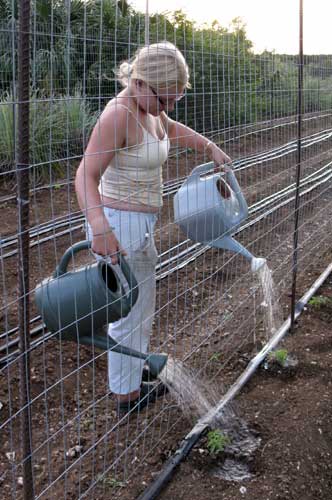
Margie watered the starts (seedlings or baby plants) while they were still in their little plastic pots. Once it was decided which varieties went where, Mike brought over flats of starts, and Cassidy set each plant into its hole and tamped the soil down. Jade followed with watering cans and gave each transplant a good drink. When transplanting tomatoes, remove the bottom leaf or two, and set the plant deeply into the ground, up to the cluster of of leaves. The stem will produce more roots, which results in a stronger plant.

Over in another bed, shunjiku radishes had put up their first leaves, and pole beans were sprouting. Drip irrigation lines bring measured amounts of water directly to the plants. Otherwise, not much is growing yet. Margie explained that she started planting late because rain delayed the bedding process. The CSA season is starting in a couple of weeks and I’m wondering what I’ll find in my box. Rumor has it the first share might have green beans from Homestead Organics and lemongrass from Bee Heaven, among other things. Maybe. Whatever is available, Margie said.
jade-watering

Jade watering tomato transplants

When you get local food from a farmer’s CSA, you get what’s growing at that time, during that part of the season. Each fruit, vegetable and herb takes a certain amount of time to grow and mature. Greens and radishes take a few weeks to grow, so you’ll see a lot of those at the beginning. Carrots, potatoes, beets and onions take longer, so you’ll see those toward the end of the season. The heirloom tomatoes will start appearing in December and January. That’s the experience of eating in season.
Read Full Post »

Go make your beds

A lot of behind the scenes prep work goes on at Bee Heaven Farm before the first seeds are planted. The cover crop, which fixes nitrogen and other nutrients, has been mowed and tilled under to also add organic matter to the soil. The next step is to create rows of raised beds, where the vegetables will get planted.

Making beds

Making beds

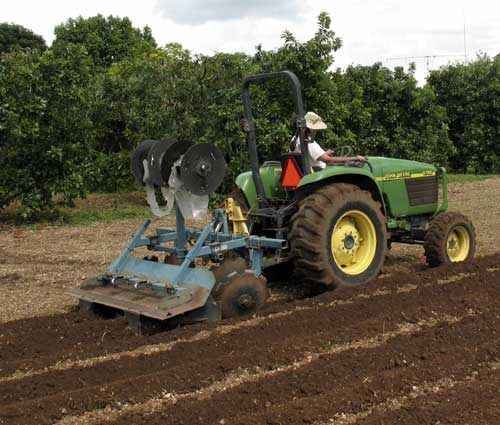
The bedding attachment behind the tractor cuts into the soil and shapes it into a bed with channels on either side (where tractor tires pass). Native soil is not very deep in Redland. It averages about 1/4 inch over limestone rock. At Bee Heaven Farm — after rock-plowing, years of building up organic matter, and mounding up the beds — soil is maybe 4-6 inches deep, and very rocky. That’s it! That’s what your food grows in! The beds then need to be shaped and leveled by hand with a hoe. Rows of plants will then get planted by hand or with a seeder in each bed, either as transplanted starts or directly seeded. Tomatoes are planted in one row, beets in 4 rows, greens in 8 rows, or anything in between.

Bedding attachment

Bedding attachment in action

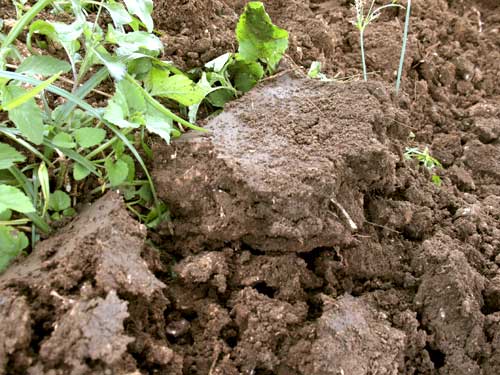
This past Saturday when I arrived, Farmer Margie was driving the tractor with the bedding attachment on the back, making passes up and down the main planting area. The bedding process wasn’t going very well. I saw one row wasn’t straight, kind of tapered into the next row. As she climbed down from the tractor, Margie explained that was where the tractor had actually slipped in the ground. The soil was wet from scattered rain showers blowing through because of a cold front. The wet soil was also getting compacting into clay-ey clumps, losing aeration and fluffiness that had been created by tilling. (For a detailed explanation of soil compaction and air spaces, read Margie’s post on tilth at Bee Heaven Farm’s Blog.)

Wet soil clumps

Wet soil clumps

Margie grumbled that she would have to wait until the weather cleared and the soil dried out, then till all over again to erase the curving beds of compacted soil, and attempt bedding again. Clearly every step of the growing process is affected by weather, in ways both subtle and obvious. Too much rain, not enough rain, too hot, too cold, too windy — the farmer is almost always at the mercy of the weather.

Read Full Post »

If you’re new to this area, you might be thinking ah, fall, time for harvest. Not! The growing seasons are upside down this far south. During the long, hot summer, most growers take a break. They start preparing the soil and planting in September and October. This time of year is their “spring.” The first crops are harvested around November, maybe earlier, depending on what you’re planting. So if you’ve had a garden when you lived in northern latitudes, and you want to have one here, you have to adjust for the location and climate and soil.

Farmer Margie was interviewed for a recently published article in the Fort Lauderdale Sun-Sentinel called How to plant a fall vegetable garden in South Florida. In it she discusses all-important soil preparation and how to grow heirloom tomatoes (one of her specialties). You can read the article online. (Hopefully they will keep it in the online archives for a while!)

Read Full Post »

Several months ago, I blogged about Jaideep Hardikar, a journalist from India who was here in the States on a fellowship. He wrote the article The Farmers Among Us that was published in the Sun-Sentinel. The original article profiled several growers who belong to Redland Organics, but is no longer available online. A shortened version was published on the front page of the Business section of the Miami Herald on Tuesday Oct. 13th. You can read it here.

According to the article,

Across the United States, consumers are increasingly buying directly from local farms through a model started decades ago in Switzerland and Japan now known as Community Supported Agriculture.

Nationwide, sales from farms directly to consumers — including CSA and farmers markets — jumped 49 percent from $812 million in 2002 to $1.2 billion in 2007, according to the most recent Department of Agriculture census. That’s twice as many sales as a decade earlier, the federal agency said.

Estimates of active CSA programs vary, but the 2007 U.S. census found more than 12,500 farms selling directly to consumers in every state. The National Center for Appropriate Technology, an agriculture think tank, estimates CSA programs supplied food to more than 270,000 households last year.

Farmer Margie told me that last season she had 440 CSA members, and has 465 members this season. She started Redland Organics CSA in 2002 with only 25 members. There are at least 100 on the waiting list. Turnover varies, maybe about 35%. Margie also mentioned that in January there will probably be a very limited number of trial shares available, and only to those folks already asking about them. She is pretty much at full capacity already. If you’re not a CSA member, but still want to get the same food, you can shop at the South Florida Farmers Market in Pinecrest.

Read Full Post »

If you attended the End of Summer Brunch, you most certainly encountered Ladybird, a friend of Robert’s who was assisting in the serving line and wherever else needed. Her bubbly personality and helpfulness were hard to miss. She had such a wonderful time that she wrote a poem about the brunch and sent it in (see below).

What did you like about brunch? What do you think could have been improved? Farmer Margie and Robert would like to know, so the next event at Possum Trot is an even better experience. Please post your thoughts in the comments below. If you prefer, you can send them to me at redlandrambles(at)gmail.com and I will forward them.

Brunch centerpiece

Basil, ginger and starfruit centerpiece

END OF SUMMER BRUNCH POEM
by ROBBIN “LADYBIRD” HINEZ

Under a hammock of exotic tropical fruit trees
Partners with Margie of the heaven of bees
An organic summer brunch fit for a king.
The humble chef is Robert of Possum Trot Nursery
Everyone is greeted with lemongrass tea and passion fruit punch drunk pleasantly.
Then they were seated at a long table set for ninety.
The centerpiece of basil and red ginger arranged beautifully,
The buffet was set so tastefully, smoked eggs and a scramble with pesto from the pepper tree
A goat cheese topping torched and assorted fruit salad of many varieties.
The muffins were freshly baked with yogurt sauce
Accompanying boiled jackfruit seed salted lightly
Everything was incredibly tasty. Taste the bignay antedesma wine if you please
Robert, we so appreciate your outstanding cretivity.
The flavors you introduced inspired under the hammock of tropical fruit trees.

Read Full Post »

« Newer Posts - Older Posts »