Feeds:
Posts
Comments

Archive for the ‘farmer/grower’ Category

You haven’t heard much from me these last few months because I’ve been feeling de-pleated by condo board responsibilities. Small problems were looking big, and bigger problems looked overwhelming. Time to hit the reset button, so I headed down to Bee Heaven a couple weeks ago to get some much needed farm therapy.

Fall is planting time down in Redland. Summer is just too hot, too buggy and too rainy to grow much of anything. Planting starts in the fall near the start of the dry season, and harvest is in the spring. The growing seasons here are completely upside down compared to the temperate climate Up North.
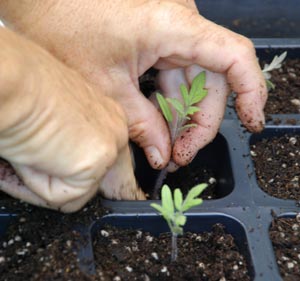
Jane transplanted starts into their first pot.

It was a sunny, breezy Saturday afternoon when I visited Bee Heaven. Margie and her manager Jane Cameron were puttering in the potting shed, transplanting starts, or baby vegetable plants, from the seed beds to small pots. A bit of soil went into the bottom of each pot. Then, one by one, Jane carefully lifted each start out of its bed and placed it into its new home. She set the plant down with one hand, put more soil around it with her other hand, and pressed the soil down gently. The work had a gentle rhythm. Repeat it a hundred more times or so, and that was the afternoon’s task.

Growers will tell you there’s something hopeful about working with baby plants. “It’s so exciting to see them grow from seed,” Jane said. “It’s empowering. It feels exciting to see the plant first poking out of the ground, to see the energy. You don’t get that with a plant already started that you buy from the store.”

You’re not thinking of bugs, or disease or freeze — although those risks are there, even at that stage. Some starts’ leaves had evidence of bugs munching along the edges. Another start revealed a small black caterpillar near its roots, as it was gently lifted out of the seed bed. The caterpillar would grow up to be a butterfly of some kind, Margie explained, but in the meantime, it was chomping on little roots. A note was made in the input log, and the plants and seed tray would be treated with BT for the caterpillars.
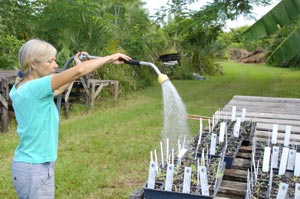
Jane watered the starts after transplanting.

Labels were placed into the pots, so you knew what kind of plant it was. Trays of pots were taken to an outside table made from old wooden pallets, where the starts soaked up sunshine and would grow and grow. Jane watered them lightly, holding the spray nozzle high above, so water fell gently like rain. Smaller starts were waiting on other outside tables nearby, still too young for transplant, maybe in a few more days. “They aren’t finished sprouting,” Margie said. When the little plants show four true leaves, then they are ready to pot up.

Most of the starts I saw that day were heirloom tomatoes with exotic names like Black From Tula, Red Calabash, and Zapotec Pleated. “ZAP-otec. That sounds like the name of a pharmaceutical,” Jane remarked. “Feeling de-pleated? Try Zapotec,” Margie chimed in. “It will pleat you back in no time!” Now there’s an idea — plant (and eat) heirloom tomatoes to be re-plete with energy.

Work done, I ambled around Bee Heaven to see how other things were going. Bright sunshine and clear blue sky were good medicine in itself, and soon I was feeling less de-pleated. A light breeze ruffled leaves, and mockingbirds twittered background music from a nearby big tree and from the hedges further over. Roosters living in nearby chicken tractors got a call and response chorus going. “Ur-ur-ER-ah,” one rooster called, and another responded an similar way, and another, and suddenly I was in the midst of poultry opera. “Here I am, how are you,” they seemed to be calling. “I am here,” I told them. (Yes, I talk to chickens.) I am here, I am fine, pleated and replete. Farm therapy works!

Read Full Post »

Didn’t make  it to the 2010 Florida Small Farms Conference? Speaker presentations on Alternative Energy, Alternative Enterprises, Business and Marketing, Horticulture, Livestock, and Organic and Sustainable Farming have been posted as downloadable PDF’s on the conference web site.

Click here for the presentations page.

Read Full Post »

Sunday, October 17th Rain or Shine
From 10am-3pm
at the Little River Market Garden
8290 NE 4th Ave.
Street parking all along our block


Heirloom tomato seedling ready for transplanting into your garden. Photo by Muriel Olivares.


We’ve prepared a really nice selection of our favorite varieties, mostly heirloom, grown in 65% homemade compost and 35% sphagnum peat moss. NO chemicals, NO pesticides.

All plants are in 4″ re-used plastic pots.

$4.00 each, every 5 get one free!

All seed packets are $3.00 each.

CASH ONLY PLEASE!

Bring boxes, carts or bags to carry your seedlings home.

SEEDLINGS:

CHERRY TOMATOES: Sungold, Black Cherry, Amish Red, Ghost Cherry
SAUCE TOMATOES: Amish Paste, Federele
SLICING TOMATOES: Cherokee Purple, Gold Medal, Lime Green Salad, Florida Pink, Black Prince, Green Zebra
PEPPERS: Golden Hot, Early Jalapeno, Biscayne Cubanelle, Antohi Romanian
EGGPLANTS: Orient Charm, Black Coral, Long Italian Purple, Raveena
BASIL: Genovese Basil
ARUGULA: Rocket

SEEDS:
*Luffa Gourd, *Mustard, *Gandules a.k.a Pigeon Peas, Sunhemp, Buckwheat, Cow Peas

*There will also be a small selection of seeds for sale.  These are plants that grow very well in our climate and most of them make good cover crops.

For more information:

web site: Little River Market Garden
phone: 786-991-4329

Read Full Post »

Pie…. ah, who doesn’t love pie. Fruit pie, custard pie, pie with whipped cream on top, pie with ice cream, pie with a light flaky crust. Pie! As much as I love eating pie, I haven’t had much luck making it. Have been thwarted by the most important step — making a crust that is light and flaky, not tough and rubbery.

Growers Teena Borek and Robert Barnum

The Cantankerous Chef aka Robert Barnum spent his summer vacation patiently working on pie crust. He was passionately in pursuit of the perfect light, flaky crust to use in his tropical fruit pies. He told me that I could get a taste of that perfection in his homegrown longan-walnut-‘bola raisin pie at the Slow Food Miami “Pie on the Porch” competition this past Saturday.

It was a great afternoon to hang out on the wide wraparound porch at the historic Merrick House while sipping lemonade. Kids ran around on the lush green lawn under the shade of huge live oak trees. A vegetable garden had been set up on a side lawn. It was round, with coral rock borders, and looked very much like a pie cut into four slices. Boy Scouts from

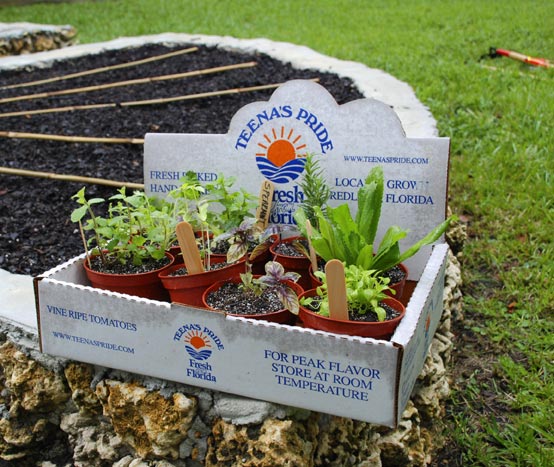
Little plants ready to grow.

Troop 4 tilled the soil, and starter plants provided by Teena’s Pride Farm were waiting to get planted into the beds. Slow Food Miami director Donna Reno explained this would be a historically accurate kitchen garden, growing foods much like the ones the Merrick family ate. The garden and pie competition are two of several events to  commemorate the 100th anniversary of the Merrick House.

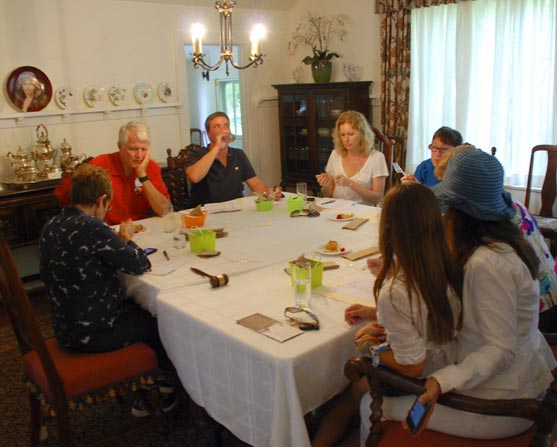
By the time I arrived, the porch was packed with eager, hungry people. Serving tables were set up, but where were the pies? They were inside the house getting judged. The seven judges aka the Supreme Court of Pie, led by Chief Justice of Pie Hedy Goldsmith herself, were ensconced in the dining room of the Merrick House. They were seated around a large table, armed with scorecards, plastic forks and glasses of water.

The Supreme Court of Pie

In the adjoining kitchen, 23 pies were arrayed on the counter. The pies were judged one by one. Three thin slices were cut and brought out to the table. The judges sampled and passed around the slices, discussed them briefly, and made their marks on score sheets. The judges evaluated pies on overall appearance, taste, overall impression, creativity, regional ingredients, and name. It was serious, intense work.

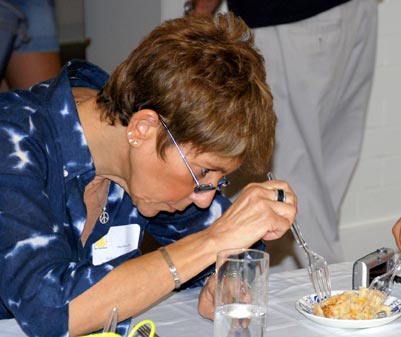
Pastry chef Hedy Goldsmith goes eyeball to eyeball with coconut pie.

According to the competition rules, “All pies must be made with a fruit or main ingredient that grows locally.” The pies had to be homemade, using home grown or local, and non-artificial ingredients. The pies had small cards describing what they were, but contestants were not identified.

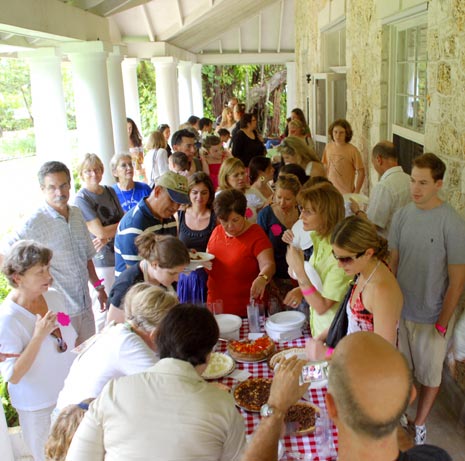
Once the pie was judged, a runner brought it out to the porch, where hungry guests were waiting for a taste. As a Slow Foodie began slicing and doling out pieces, people immediately mobbed the table. You’d think they hadn’t eaten pie in ages. “It’s a feeding frenzy out there,” the runner commented when she returned to the kitchen. I was intrigued by a green avocado pie and a salmon-colored mamey pie, but those vanished before I made it to the table.

The first pies to emerge from judging got mobbed.

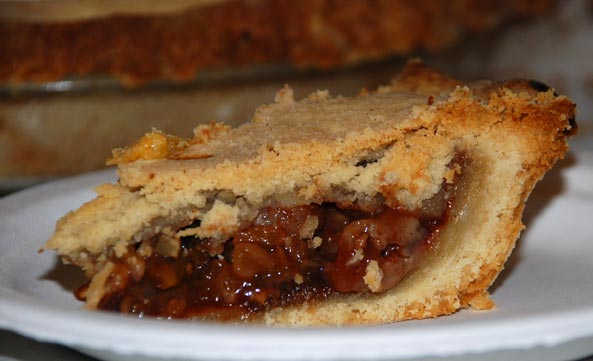
Tracked down Robert’s longan-walnut-‘bola raisin pie and dug in. It was a pie of complex flavors and unusual textures. Am not a fan of fresh longan, but baking mellowed and sweetened its flavor, and it tasted more like lychee. Encountered chewy bits of ‘bola raisins made from dried carambola, and crunchy bits of walnut. The texture reminded me of mincemeat pie, but count on Robert to push a recipe and turn the familiar into something different. As for the perfect crust, yes, it was light and crumbly, as promised. (If you want The Cantankerous Chef to make you a pie, and maybe dinner to go with it, give him a call at 305-235-1768.)

Most of the pies that I tasted (but I didn’t taste them all) followed the competition rule that the predominant ingredient must be local — mango, avocado, mamey, passion fruit, guava, coconut and longan to name the ones I saw. Some were nowhere near local — apple, apricot, pecan, chocolate — but they sneaked into the competition anyway.

The official winners were blueberry (could be local, blues grow in Florida), chocolate pecan (not local), and papaya (could be local). Details are posted on the Slow Food Miami web site.

Robert Barnum's longan-walnut-bola raisin pie.

Robert’s longan-walnut-‘bola raisin pie won an Honorable Mention. His cantankerousness vanished for a few moments. “Yippee!” he cried out happily. “I’m in fourth place,” he kept telling me. Yes, indeed. Good to see his work receive public recognition on its merits alone. Good to see SFM inching closer to recognizing local food.

In the past, SFM was chided about using (or not using) local food at its locavore events. With this pie competition, the group came one step closer to walking the walk. If the Holy Grail of a locavore event is that the ingredients (all, most, or as much as reasonably possible) are sourced locally, this event came a bit closer. However, pies made from non-local ingredients (for example apple, chocolate, pecan, apricot) should have been kept out of competition.

Foodies Naomi Ross and Brian Lemmerman enjoying pie bliss on the porch. They bicycled over from UM in the rain to taste something good to eat.

If you missed the pies, you can still visit Merrick House. It’s a lovely place, and one of the few structures that still remain from an earlier era. I’m glad I was able to visit it briefly, and want to come back another time to tour the house and grounds.

Merrick House
907 Coral Way
Coral Gables, FL 33134
305-460-5361, 305-460-5095

Kara Kautz, Historic Preservation Officer

Read Full Post »

Hello Redland Ramblers!


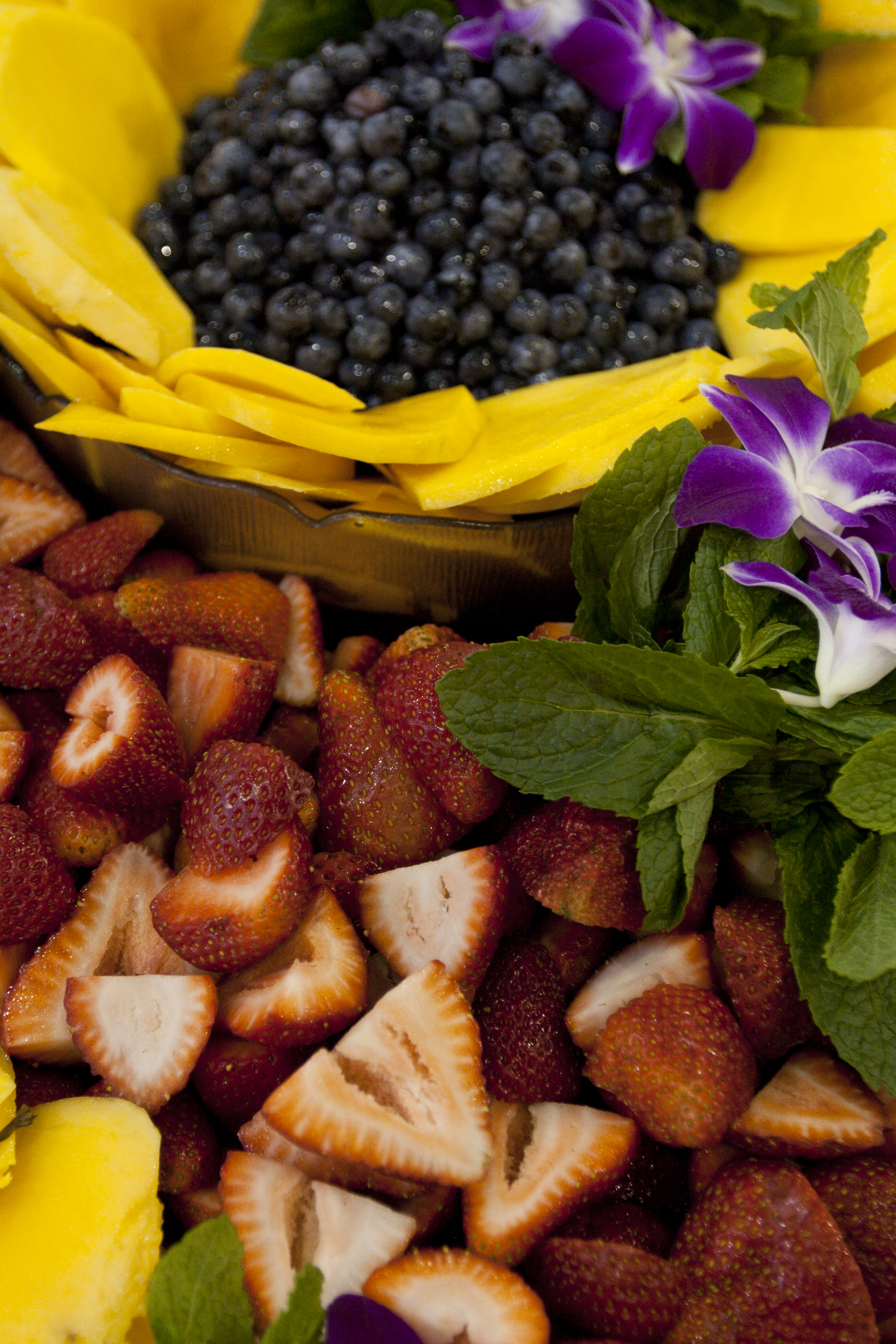
Mangos from Dr. Jonathan Crane at TREC, blueberries from Gail & Mike Waldron in Marion County.

Guest blogger Melissa Contreras here again. It’s been several weeks since the last post, and I apologize for that. Most of that time was spent waiting for photos from the official IFAS photographer, my one reliable source of photos from the conference. The poor overworked guy was traveling with several assignments to keep up with, and apologizes for not getting them out in a timely manner. We forgive him. Life’s too short. As promised, this post details the fabulous Florida local food lunches and the Conference workshops. If it’s not enough, well then I guess you’ll just have to attend next year’s conference!

There are omnivore and vegan options at every year’s conference, and both are amazing, featuring Florida food, real food: meat from pastured animals, vegetables and fruits from our fair state’s wide repertoire, milk from small herds of grass-roaming and grass-eating cows, and eggs from hens which get to freely scratch the soil  and eat a smorgasbord of bugs and assorted plants, expressing their “chicken-ness” under the Sunshine State’s skies.

Omnivores loved the delicious Gilchrist Brand Sausage from Jonnie Thompson of Ocala, who emphasizes humane animal treatment.

The fabulous  selections from this year’s menu:

Menu

These delicious dishes were made with food provided from small farms all over Florida. Our Redland farmers provided ‘Donnie’ avocado (Bee Heaven Farm), mangos (Dr. Jonathan Crane of TREC), and longans from Guara Ki farm. Summer in the Redlands  means tropical fruit, so we gave the rest of Florida a taste of the tropics.

Breakout sessions followed several tracks of interest: alternative energy, business and marketing, livestock, horticulture, organic and sustainable farming, policy and regulations. This conference is geared toward small farmers, and there were lots of them present looking for ways to make their farms better, branch out into new enterprises, market their products, and more. This year’s  included urban farmers and local food enthusiasts and activists, in addition to farmers.

Yummy Florida okra and blackeye peas from William Moore at Bluefield Organic Farm in Okeechobee.

The different tracks of interest included valuable lectures and workshops. Here’s a sampling of the workshops: Earth Wind and Fire: Renewable Energy Options; Agritourism; Aquaculture and Aquaponics; Minor Fruit Crops; The Excitement about Social Marketing – How it Can Help Your Operation; Pasture Management; Grass Fed Beef: How Do We Get There?; Poultry Management; Expanding Your Fruit Portfolio: Stone Fruit & Muscadine Grapes; Healthy Schools, Healthy Kids – Florida Farm to School Programs; High-Quality Compost for Organic and Conventional Farms; Advanced Disease Management for Organic Vegetables; Small Farm Friendly Approaches to Food Safety; Diversifying the Income Portfolio for Organic Products; and Direct Marketing Regulations (How to Get Products to Market Legally).  Next year’s workshops will be scheduled according to feedback from this year’s conference.

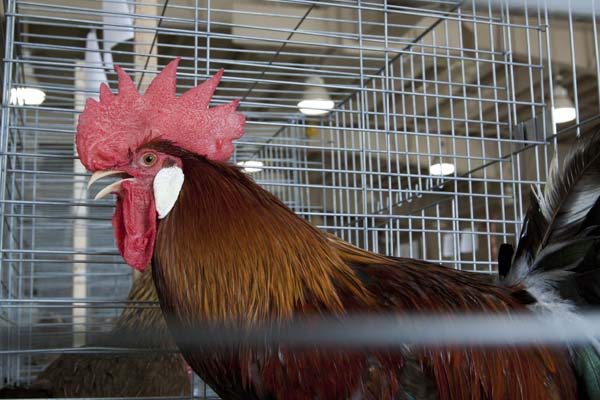
I am the handsomest rooster at the Small Farms Conference and I approve this message.

It was an information-packed weekend, with plenty of fun and networking.  Vendors in the exhibition hall sold everything from organic t-shirts with organic slogans on them, to fish emulsion fertilizer, to packaging for tomatoes and strawberries, to complete aquaponics systems, to worm poop fertilizer, to hydroponic growing systems, to Florida grass-fed beef, to info about becoming certified organic, and so much more.

And who doesn’t love seeing the animals at the livestock exhibit? I spent an hour in there looking at and sometimes petting cows, llamas and alpacas with babies (below), and lots of interesting and unusual poultry breeds.

We love the local, organic hay at the Small Farms Conference--mmm...

Did I mention that this conference was next door to the national convention of Jehovah’s Witnesses? This made for heavy traffic on Sunday morning, with the JWs in their Sunday best. This explains why they did not come knocking on your door that weekend….(I stand corrected- it was a regional conference, thanks for finding that out Margie. There sure were lots of them… )

So, Marian will be back soon. I have to stop or someone might think I have taken her blog over. A coup de blogue, golpe de blogo, or other messy affair could be suspected, but no worries, she will be back to tell you more of the Redlands and its farmers. Thanks for letting me share…

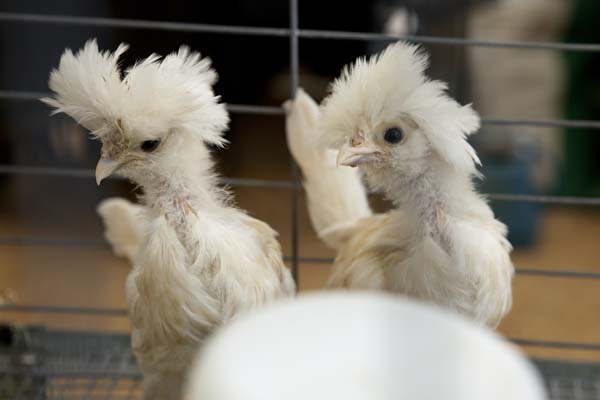
Gratuitous cuteness.

Read Full Post »

« Newer Posts - Older Posts »