Feeds:
Posts
Comments

Archive for the ‘farmer/grower’ Category

Greetings once again, Redland Ramblers! Guest blogger Melissa Contreras here again, founder of Urban Oasis Project, urban micro-farmer.  I’m back to tell you about day two of my trip to the Small Farms/Alternative Enterprises Conference last weekend.

After rising early, we all piled into Margie’s van and headed over to the Osceola Heritage Park for the official beginning of the conference. Since I know that all you local foodies want to know about the food, let me start with breakfast: rather light fare was provided at the conference, but like our full lunch, it consisted mostly of Florida farm-grown food. A deep dish frittata of free-range Florida eggs with cream from grass-fed cows was served, accompanied by Lambeth Groves’ orange juice, cold and fresh, a perfect blend of sweetness and acidity. We were treated to Florida’s “other juice,” Muscadine grape juice: crisp, lightly sweet, and perfumed of dewy-misted grapes, from Lakeridge Winery and Vineyard in the high country of Clermont. Certified organic blueberries from Gail and Mike Waldron of Bay Lake Blueberries in Marion County mingled with mangos from our own Dr. Jonathan Crane of TREC in Homestead.  Fair trade coffee was provided by Sweetwater Organic Coffee Company of Gainesville, which purchases from Rainforest Alliance-certified small farmers in the Tropics. For our coffee, we actually had the luxury of choosing milk from 2 small dairies, Dakin Dairy Farm of Myakka City, or Kurtz and Sons Dairy of Live Oak. Bubba and Leslie Kurtz run a “grass-fed dairy farmstead” of Jerseys and Shorthorns, and work to keep their milk as close to Nature as possible. This is not a business slogan for them, it is a way of life. After coffee finished with Nature’s perfect food, I was ready for a full day of conference and break-out sessions.

We all headed over to the big lunch room for the opening session. Welcomes came from kick-off speakers Dr. Joan Dusky of UF/IFAS in Gainesville and Dr. Ray Mobley of FAMU in Tallahassee, a co-sponsor of the event. FAMU and UF and are Florida’s 2 land grant universities, dating back to the ugly days of segregation, when black people went to one university and white people went to another. (Beside the obvious injustice of this, it begs another question- where did the original inhabitants of this land go? But that is another story.)

Next came the Florida Innovative Farmer Awards! These awards are given to farmers and ranchers who are leaders and innovators, based on the following criteria (quote):

  • Success in making farming systems more profitable over the long term.
  • Ability to use farming practices that enhance, rather than harm, natural resources.
  • Leading -or participating in-  activities that support viable communities, either through economic development or contribution to regional food systems.
  • Effective outreach and/or education about sustainable agriculture ideas and practices to others, such as producers, community leaders, agricultural educators, and the general public.

There were 3 winners of these awards, the first being Chris and Eva Worden of Worden Farm in Punta Gorda. They got up on the stage in front of their small farmer peers, and were given a well-deserved round of thunderous applause. Both are Ivy League educated, Yale and Cornell, but are very down-to-Earth and in love with their vocation and avocation, farming. Upon acceptance of the award, Chris said to the audience, “We love to grow crops.” They grow 50 different varieties, mostly vegetables, some fruit, and do it organically, using soil and water conservation techniques. They have a CSA, sell at farmers markets, have workshops at the farm, art programs, and “grow future farmers and gardeners.” They help community gardens, about which Eva knows a thing or two, having authored papers on the subject. She said “anyone who works with community gardens knows that it is easy to start one, harder to maintain them, so we stay with them, encourage and help them.” Eva explained that they “grow great crops, connect with the local community, and promote the viability of the family farm.”
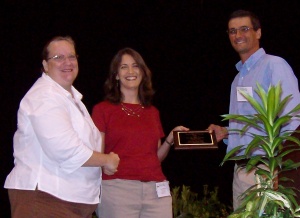
(L-R) Christine Kelly-Begazo, Eva Worden, Chris Worden. The Wordens receiving the Florida Innovative Farmer Award, a happy achievement for the work they love!

I went to Worden Farm last year with Farmer Margie and the WWOOFers, and my folks from Urban Oasis Project. We had a tour of the farm, and got to see the amazing results Chris and Eva get from good stewardship of their 55 certified organic acres. Because they supply some of the food in Redland Organics CSA shares, I thanked them for feeding my family. By the way, have you thanked your farmer lately?

The second recipient of the awards was Trish Strawn of Deep Creek Ranch in Deland. Trish and her dad, David, work the family farm which has been around since 1883. Trish said they got into grass-fed beef because her dad had a health issue, but she said if you ask her dad, he’ll say it’s because they’re “cutting edge.” The room broke into laughter.Trish is Co-Leader of Slow Food Orlando, and a founding member of the Florida Food Policy Council. She is also a lot of fun to go out and have a beer and a lot of good laughs with, which we did later that night. Trish and her dad are the real deal. Joel Salatin must be proud.

The third award recipient was George Owens of Chipley, FL, who has a mixed cattle and timber/forestry operation, or silvopasture. George could not be present for the awards because his son had just come home for a short visit from Afghanistan. All were very happy for him. The award presenters said “we tend toward a monoculture system, so when we get someone who does integration, we want to encourage it.”  I am a believer in agroecology, and it is very encouraging to hear agricultural professionals talk about moving away from monocultures!

I was very excited to hear my friend Will Allen of Growing Power, Inc. give the keynote address. Unfortunately, Will had some knee surgery which made it impossible for him to travel to the conference, though that was the original plan. Technology to the rescue! The AV geeks got the satellite/internet hookup to Will Allen up and running, and we were able to see and hear him on 2 large screens, and he was able to see and hear us.

That's me with Will Allen at a Growing Power workshop last year. Will loves scooping Lake Perch out of his aquaponics tanks! He loved to fish when he lived in Miami too.

Larger than life on the big screen, Will spoke about the history of Growing Power, all the amazing past, present and future projects they have, and was enthusiastic and inspirational as always. Larger than life is a profound statement when referring to Will Allen, who stands tall at 6’7” and weighs 230 pounds. Will played basketball for the University of Miami in the 1970’s, and still wears an orange and green UM cap with his signature royal blue Growing Power sweatshirt with cut-off sleeves. His biceps are bigger than many supermodel’s waists, and he keeps them that way by working hard every day, growing food for Milwaukee’s inner city on 3 acres, 2 blocks from one of the country’s largest low-income housing projects, in what was an urban food desert until Will’s good food movement became a good food revolution. Will is not an armchair CEO. He gets his hands dirty. He loves farming like Chris and Eva Worden do. I think some of us are born agrarian. It is not a choice, it’s in our blood, and it’s who we are.

Will showed many slides of Growing Power in action: composting thousands of tons of Milwakee’s food and brewery waste and “growing soil” as he says; passing compost through the digestive tracts of thousands of worms, creating rich worm castings fertilizer; raising tilapia and lake perch in the bottom level of a 3-tiered, homemade aquaponics system, with watercress growing in the middle layer, and tomatoes on top; raising chickens and bees in the city; providing a safe after-school space for urban youth to learn green job skills; feeding senior citizens healthy food with a “food basket” CSA; providing a retail grocery space with their fresh salad greens, eggs, and so much more to the neighborhood in which Growing Power’s urban farm resides.

“If people can grow safe, healthy, affordable food, if they have access to land and clean water, this is transformative on every level in a community.  I believe we cannot have healthy communities without a healthy food system.”

Will is a major inspiration for what we do in Urban Oasis Project, doing our part to make good, clean, safe, healthy, and local food accessible to all. Access to real food should be a right of all citizens. Will says “we can’t wait around for government or others to do it, we have to do it, just start doing things.”

I could go on about Will Allen forever, but I’ll stop here. Please come back for Part Three, highlighting local food lunches and conference workshops!

Read Full Post »

Hey there Redland Ramblers! This is guest blogger Melissa Contreras, founder of Urban Oasis Project. Last night, a group of Redland and Miami farmers and I returned home after a weekend at the 2nd Small Farms/Alternative Enterprises Conference in Kissimmee.  I have always been a farmer wannabe, and as such, I grow food for my family, my pet bunnies,  and a few friends on my 1/4 acre “urban homestead” in Kendall.  I was happy to learn at the conference that this small scale of growing is now being officially considered as part of our local food system, as it should be! The University of Florida/IFAS Extension isn’t just for big farmers and agribusiness, we little people count too!

Cast of characters on this road trip included Bee Heaven Farmer Margie, husband Nick, their new farm manager Jane;  Muriel of Little River Market Garden, Mario of Guara Ki Farm, and me.  Meeting up at Bee Heaven Farm, we shared a ride in Margie’s van, and took the scenic route around the shores of Lake Okeechobee on US 27. It was beautiful! Cows and egrets mingled in green pastures, Nick spotted a sandhill crane, and tri-color herons searched for underwater snacks near the water’s edge. Along the way, through what was once a river of grass, we saw fields of sugarcane (some organic), and picturesque views which reminded me that while South Florida is often thought of as a metropolitan built environment,  it still belongs to Mother Nature, though altered. Hopefully Everglades restoration will return the river of grass to its rightful owner.

After 4 hours on the road, we arrived  and checked into our hotel, the posh and sophisticated Super 8. Hey, we’re on a budget, OK?  I shared a suite with Margie, Nick, and Jane.  After repeated promises to Jane that I would not confuse her with my husband in the middle of the night, she decided to sleep on the couch.  But, I digress.  We had a nice lunch in restored historic downtown Kissimmee, an old cowboy town with a lovely lakefront, unique and colorful wooden homes with gingerbread mill work, unusual eateries and watering holes like ” The Wicked Stepsister,” a nice antique shop,  and so much more. Next time you’re in the neighborhood, take a break from the Orlando area tourist traps and visit this authentic town.

After lunch, we proceeded to the Osceola Heritage Center, site of the next day’s convention, for meetings of the Greater Everglades Foodshed Alliance, the Florida Food Policy Council, and a pre-conference pow-wow with Extension agents from all over Florida. The Greater Everglades Foodshed Alliance meeting was a recap of the Food Summit for interested parties.  The Florida Food Policy Council will “bring together stakeholders from diverse food-related sectors to examine how the food system is operating and to develop recommendations on how to improve it. FPCs may take many forms, but are typically either commissioned by state or local government, or predominately a grassroots effort. Food policy councils have been successful at educating officials and the public, shaping public policy, improving coordination between existing programs, and starting new programs.” (definition from foodsecurity.org). We are forming a soon-to-be Miami food policy council. (Contact Mario if you have a stake in our local food system and want to participate in this new effort.)

Those who attended the informal Friday meetings were also invited to sit in on the pre-conference event for UF/IFAS Extension agents, in which  Dr. Danielle Treadwell, Dr. Mickey Swisher, and Sarasota Extension’s new Director and doctoral candidate Evangeline “Van” Linkous  talked about our changing food system from their different points of view and varying expertise.  Dr. Treadwell champions UF research in organic and sustainable farming, and feels that “educating consumers is an important part of what we do.”  Dr. Swisher said she was surprised to discover the “30 mile problem” in which  “disadvantaged communities in Florida’s urban areas often live 30-40 miles from areas where fresh produce is grown.”  Van’s background is in planning and she was a member of the Delaware Valley Regional Planning Council before coming back to Florida from Philadelphia and the University of Pennsylvania. She feels that much urban zoning could be converted to mixed-use, which could mean urban farms and farm stands could be located within high-density urban populations, giving urbanites more access to local, fresh food. A kindred spirit! We are quite lucky to have these three women in Extension.

So, if you’re catching on to a theme here, the conference tagline was “Sustaining Small Farms…Strengthening Florida’s Communities.”  There was much excitement among attendees on that Friday before the conference, seeing our major research institutions catching onto interests of so many people in local food,  and food justice as a paradigm shift from our current system. Further illustrating this point is the choice of keynote speaker for the conference: my personal hero, Will Allen, founder of  Growing Power, Inc.

I will write more about Saturday of the conference in the next post:  keynote speaker Will Allen, the three Florida Innovative Farmer Award winners, conference workshops, amazing local foods lunch and more! Come back  for more, including pictures!

Read Full Post »

Melon run

Farmer Margie, winter melons, and Mike Counts.

Last month I rode up with Farmer Margie to C&B Farms up near Clewiston to load up with fruit for the summer fruit sales. We came back packed to the rafters with melons. Loaded in the back were three boxes of cantaloupes (the last of the season this far south), and six big heavy boxes of some of the cutest round watermelons I ever saw. They are called “personal size” and it’s easy to see how one person could very easily gobble one up. And at the other end of the size scale, we snagged several ginormous winter melons that had originally been destined for Asian communities up north. Each one of the winter melons was about 20 pounds, but that is just a guesstimate.

The CSA got a lot of food from C&B Farms through the regular season. A quick look at the newsletters (you read and kept yours, didn’t you?) shows that we ate zucchini, celery, rosemary, strawberries, yellow squash, green beans and mint — to name a few things — grown there. Margie kept telling me that I ought to go up and visit C&B, so when she called me the other day about making the melon run, I jumped at the chance.

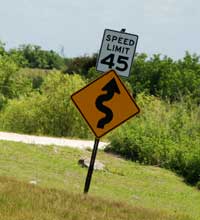
Snake Road wiggles like a snake.

We rode up up I-75 and headed west on a bright sunny morning with big puffy clouds in the sky. Margie spotted all kinds of things — an occasional bird perched in a dead maleleuca tree, big green shrubs studded with pale pink wild hibiscus native to the Everglades, and a golden brown snake rippling across the road. About an hour into the journey, we turned onto Snake Road (but didn’t see any snakes there). Swamp lilies grew in the canals on either side of the road as it turned and twisted past cow pastures dotted with cabbage palms and cypress domes. Swallow-tailed kites soared above. The sawgrass was in bloom, sending up long feathery clusters of small, reddish flowers. We passed through the bustling Big Cypress Seminole Indian Reservation, took a turn and found ourselves in the Devil’s Garden agricultural area.

C&B Farms in Clewiston

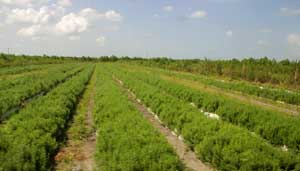
C&B Farms is sandwiched between Clewiston and the edge of the Everglades. According to owner Chuck Obern, the farm is 2500 acres in size, with 1500 acres that are tillable. Of that, 1000 acres are planted  conventionally and 500 acres are in organic production. Chuck offered us a quick tour of his farm, so Margie and I hopped into his truck and headed down a sandy road into the heart of the farm. One side of the farm is organic, and the other side is conventionally farmed. The two sides are separated by a large ditch and a row of of trees. Each side has separate farming equipment and packing lines, where the produce is rinsed and boxed, and there’s a separate organic section in the enormous cooler.

A 2-acre block of rosemary.

Mid-June is pretty much the end of the season and there wasn’t that much growing at C&B. It’s already too hot. We passed by two-acre blocks or fields of herbs — dill that had already bolted, marjoram, knee high sage, bushy rosemary, tarragon, oregano, spearmint, and parsley. We passed by long brown piles of compost, which is used mostly for water and nutrient retention, or as a soil conditioner. The soil is light gray and sandy, very sandy, and it’s amazing they can get so much to grow in it. We passed by blocks of cantaloupe, personal sized watermelons, and butternut squash.

Pumping station for drip irrigation. Barrels hold liquid fertilizer.

Crops are irrigated two different ways. There’s an automated double drip irrigation system (double meaning two lines of drip tape per planting row). Water is pumped from a ditch or a well, and liquid fertilizer is mixed in. A computerized system controls how much water is sent where and when. There’s also the seep irrigation system in which water is pumped into or out of the ditches to raise or lower the water table under the fields. The water seeps into the soil from underneath, rather than drip down from the top. Seep irrigation water is reused or recirculated several times before it is sent to a retention area. Excess water is treated to remove phosphorus before it is released back into a canal bordering the Everglades ecosystem.

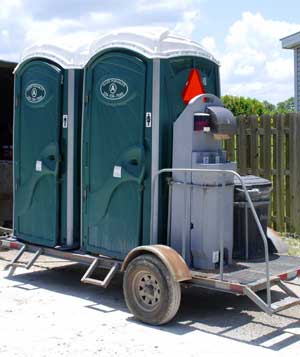
During peak season, 500 workers are in the fields picking and packing. But at the end of the season, with a lot less growing, there are only about 100 workers. Fields were dotted with trailer-mounted portapotties complete with a handwashing and sanitizing station, as required by recent federal food safety laws. These regulations also require that workers can’t wear jewelry or bring outside food or drink into the fields.

The federal food safety act is actually many sets of guidelines that came about after the e. coli incident with contaminated jalapenos from Mexico a few years ago. Since then, domestic growers have to comply with stricter standards of produce handling cleanliness. To check compliance, a major food safety certifier comes once a year to check procedures, equipment, and records over a period of three days.

Mobile portapotties, with handwashing station, that are taken out to the fields.

Surprisingly, Central and South American growers do not have to comply with the same strict federal food safety laws as domestic growers. The vast majority of imported produce is not inspected. At most only one to two per cent (maybe even less) of the food coming in is checked for the same standards of cleanliness and safety, and pesticide residues. “There’s no traceability, no accountability,” Chuck complained. “And no guidelines. It’s not a level playing field.” Imported or “offshore” produce is priced less than domestically grown produce, and American farmers find it hard to compete. Their costs have gone up due to extra work and expenses meeting the new guidelines.

So what should a conscientious food shopper do? “Vote with your dollars,” said Mike Counts, the C&B sales manager. “Your dollar ultimately makes the statement. If enough people do it, they will change.” That said, we finished loading up and headed back out on the highway. One hundred miles later we were back at Bee Heaven, unloading fresh melons that had been picked just a few days before. Maybe it costs a little more to buy local and organic, but as you sink your teeth into those juicy fruits, you’ll have the satisfaction of knowing that you’re keeping a couple of local farmers in business.

Read Full Post »

Cover crops growing at Little River Market Garden.

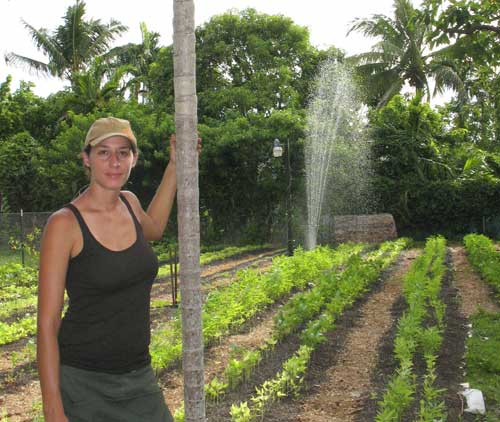
Tucked away in an obscure corner of northeast Miami, a new vegetable garden is starting to take shape in what was an empty city lot. Long straight rows of cover crops — Sunn hemp, cow peas and velvet bean — raise their young leaves to the late afternoon sun. In between rows of cover crop, peanuts are just starting to show pretty little yellow flowers. Loofa vines race to the top of the chain link fence at the front of the property, and a row of cassava flourishes alongside a stepping stone path. Over on one side is a trellis for a muscadine grapevine already forming a miniature cluster of fruit, and sweet potatoes grow beneath. Sage and other herbs are planted in a well-mulched S-shaped bed edged by palm tree logs. In the shade of an ancient mango tree loaded with fruit, a teepee shaped chicken coop holds several brown hens.

Welcome to the Little River Market Garden. This is the handiwork of Muriel Olivares, last year’s farm manager at Bee Heaven Farm. She created this garden from scratch a mere six weeks ago, planting on land leased from friends. Only grass and several trees were growing in what was once part of a citrus grove many decades ago. Now, weathered cardboard peeks out from the edges of some vegetable rows, and Muriel explained that it was set down right over the grass, with compost piled on top. The cardboard is already breaking down, and vegetable roots will easily push through it. In between planted rows, mulch neatly covers grass. The cover crops will get cut down and as they decompose, will add more nutrients to the compost.

This technique of piling on compost and mulch is called no-till because the soil is not tilled or disturbed by a tractor. Tilth builds up naturally without getting disrupted by tilling, and weeds are less likely to grow because they are smothered by compost and mulch. “No-till improves the soil by building soil structure and adding nutrients with compost,” Muriel explained. “It’s a very old technique. No matter the scale of farming, the concept is the same — never disturb the soil and always keep it covered.”

Muriel Olivares

The Garden will provide food for 11 people who have already signed up for CSA shares and flower shares. She says she might be able to squeeze in a couple more members, so if you’re interested, let her know. Her season runs for 21 weeks from November to April. Muriel wants to sell extra veggies and cut flowers at farmers markets, and is already inquiring about getting in to a few in the area. Check out her blog, Little River Market Garden, for news about the garden and updates about markets (once the season starts).

Muriel is confident that her crops and market garden will flourish. She took what she learned working as an intern for a season at a no-till organic farm in upstate New York, and combined that with skills learned at Bee Heaven helping run the CSA and selling at farmers market. Now she is is gambling that she can make a living as a market gardener. “This is my full time job, eight hours a day.” She doesn’t have a “day job” to tide her over. This is it!

So why do this crazy, risky thing? “I really like to be outdoors,” Muriel explained, “and to do what I want to do.” She paused and thought for a moment. “It sounds really weird but I have this connection to plants. I’m absorbed by them. I’m interested in them. Working with plants gives me mental energy.” She chose the urban location because she likes the city and found Redland too isolated. “This is a nice, happy medium. It’s very peaceful, but you’re in the city.” Here she is close to home, her friends, and her customers. When market season starts in winter, look for Little River and say hi to Muriel, the new generation of urban farmer.

Little River Market Garden
8290 NE 4th Ave.
Miami, FL 33138

mail@littlerivercsa.com

Read Full Post »

The Miami Herald has a nice long article about farmer Margie Pikarsky and the Redland Organics CSA. You can find it in today’s Tropical Life section.

Bee Heaven owner: Organic farming is good for the foodie — and the land

BY ANA VECIANA-SUAREZ
aveciana@MiamiHerald.com

On a muggy summer day, as bruised clouds gather overhead, Margie Pikarsky wends her way through her five-acre farm pointing proudly at strips of cultivated land and a growing compost pile. A blue jay swoops across the field, then another. In the distance a cardinal trills.

“I feel very connected to nature,” Pikarsky, 57, says, and then adds with a wry laugh. “I have this Mother Earth thing going.”

Indeed. Pikarsky has been running Bee Heaven, an organic farm in South Dade’s Redland area, since 1995, when pesticide-free farming was more a boutique niche than thriving business. She harvests honey, collects organic eggs and grows familiar fruits and vegetables as well as exotics — mostly Asian greens — that do well in South Florida soil.

She sells them at farmer’s markets and through Redland Organics, a community-supported agriculture (CSA) initiative that allows people to buy “shares” upfront in return for weekly selections of organic produce during the growing season.

Read more: http://www.miamiherald.com/2010/07/22/1740121/mother-earth.html

Read Full Post »

« Newer Posts - Older Posts »