Feeds:
Posts
Comments

Archive for the ‘farmer/grower’ Category

UPDATE: Mayor Gimenez is coming to Homestead to meet with the community!

An additional Town Hall Meeting was recently scheduled for August 24, 2011 at 7:00 pm. The address is: William Dickinson Community Center, 1601 Krome Avenue, Homestead FL. 

By now you’ve already heard that the new Miami-Dade County Mayor, Carlos Gimenez, is cutting the county budget. When it comes to local agriculture, these cuts could run very deep.

To slash an estimated $1.2 million from the county’s general operating fund, over $700,000 for UF/IFAS Extension Services was proposed to be gutted. If county funding is drastically cut, Extension will lose matching funds from University of Florida. To shave off another $300,000 in the budget, the county Agricultural Manager’s office would be completely eliminated.

Cuts to Extension

Since the Palmetto Bay Town Hall meeting on August 9th, Mayor Gimenez said he would reinstate full funding to Extension, and partial funding for the Agricultural Manager. (However, it is unclear what “full funding” means for Extension, since its budget was cut by 20% back in 2009 by former mayor Carlos Alvarez, and never completely restored since then.)

The originally proposed budget cuts put some Extension programs at risk of disappearing, and crippled others. At risk were a number of important consumer and agriculture programs that have a huge impact on the community, such as the 4H youth leadership program, and various consumer services for low income families and seniors.

Both the urban horticulture program assistant position, and the Commercial Agriculture and Horticulture programs were threatened with elimination. These programs provide ongoing training and certification for vegetable and fruit growers, landscapers and nurserymen. Growers would have to spend extra money to travel to other counties to get their industry-required training.

Ongoing workshops and seminars for commercial farmers were slated to be completely wiped out. This is the heart and soul of Extension, which teams up with UF researchers to provide growers the latest information how to fight diseases and pests (like the red bay ambrosia beetle which threatens the avocado industry), new methods of production, and new varieties of plants and crops.

Agriculture Manager

Also on the chopping block was the county Agriculture Manager. The job is currently held by Charles LaPradd, a fourth generation local grower who acts as the liason between county government and local growers. His voice is the only one in local government speaking up for the county’s $2.7 billion industry in this county. (That’s only second to tourism in income in Miami-Dade.) In the space of six years, the Ag Manager brought in almost $7 million in grant funding used to support and promote local agriculture.

Among many projects, one of the most visible was the Redland Raised campaign, designed to get branding and recognition for locally grown food in Publix supermarkets. Charles was involved in the push to pass three new county ordinances last year that promote B&B’s and agritourism, and allow growers to make and sell jams, pickles and other value added products.

Be the voice

The current budget proposal is only preliminary. It can and has already been changed. Bowing to pressure from a vocal showing at a packed Town Hall meeting in Palmetto Bay last week, Mayor Gimenez has already reversed his stance.

Go and make your voice heard in person! Mayor Gimenez is holding a series of Town Hall meetings through the month of August, at various places around the county. It’s rumored that the mayor said the squeaking wheel will get the grease, so word to the wise, get out there and squeak speak!

The remaining meetings are listed below:

Tuesday, August 16, 2011

Location: Miami Art Museum, 101 West Flagler Street, Miami, FL 33130
Time: 7:00pm – 8:00pm

Thursday, August 18, 2011

Location: Coral Gables Country Club, 997 North Greenway Drive, Coral Gables, FL 33134
Time: 7:00pm – 8:00pm

Wednesday, August 23, 2011

Location: Hialeah Senior High School, 251 East 47th Street, Hialeah, FL 33013
Time: 7:00pm – 8:00pm

If you can’t make it to a Town Hall omeeting, contact Carlos Gimenez’s office at:

Office of the Mayor
Stephen P. Clark Center
111 NW 1st Street
Miami, FL 33128
mayor@miamidade.gov
305-375-5071

However, the commissioners still need to vote on the proposed budget, and there’s a good chance their vote could still reduce or eliminate funding. There will be two public hearings, on September 8th and September 22nd, at Commission Chambers in the Stephen P. Clark Center in downtown Miami. Next comes the commisioners’ final approval for the budget. You can find a list of commissioners and their contact information here.

Locavores, this is not the time to be complacent and think the worst is over. Don’t sit back and watch support and resources dwindle for your local farmers and fellow citizens.  Educate your commissioners on how important Extension and the Ag Manager are to local agriculture — and the local food scene. You still have time to let them know how the budget cuts will also impact your eating choices or your business.

Download the proposed FY 2011-12 budget from the county web site.

Download an intelligent and passionate editorial written by Mike Dill, re the impact of cuts to ag services, which was recently published in the South Dade News-Leader.
Read Full Post »

Proposed county budget would gut funding for agriculture

By Christina Veiga
cveiga@MiamiHerald.com

There’s a long way between County Hall and the avocado groves of Redland, the rows of tomatoes in Homestead and the plant nurseries of deep South Miami-Dade.

But more than miles seem to separate county government from the county’s $2.7 billion agriculture industry, growers say.

The budget proposed last week by Mayor Carlos Gimenez guts or completely eliminates services to farmers, nursery growers and others in South Dade.

Agriculture folks say the dramatic reductions reflect how out-of-touch County Hall is when it comes to farming in Miami-Dade.

“If they truly understood the value and the asset that this is, I think they might show a little more respect for it,” said Debbie Brady, a spokeswoman for the Dade County Farm Bureau.

Under the proposed budget, the county would eliminate the Agricultural Manager’s Office, which serves as a liaison between growers and the government. Also gutted: the county’s funding for the cooperative extension office, a partnership with the University of Florida which provides research and education for farmers, and programs for youth and families.

Read more: http://www.miamiherald.com/2011/07/22/2326762/proposed-county-budget-would-gut.html 

Published in The Miami Herald, Sunday July 24, 2011.


Read Full Post »

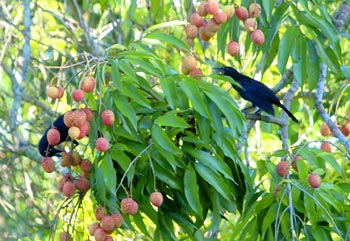
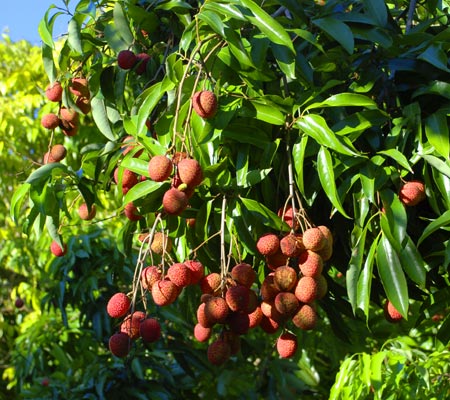
Organic lychees ripening in the morning sun.

The lychees in this week’s summer fruit offering come from Green Groves, not too far from Bee Heaven Farm. Steven Green, the grower, invited me to see how lychees get picked. He had an order from Whole Foods, and hired a picking crew to help. If you were in Whole Foods last weekend or this weekend and saw pint containers of organic lychees for sale, those were the ones!

Up in the cherry picker, Gonzalo picks lychees.

Picking work starts early. Golden morning sunlight was just breaking over the tops of trees from the grove across the road. The air was cool and full of sounds of birds. Dew was still clinging to weeds under the lychee trees. Ripening fruit hung in heavy clusters on the trees. At 7 am, the crew was already getting started. They had dropped off their cherry picker the day before. It was a simple contraption — an engine on three wheels, with a boom arm and bucket. Gonzalo, one of the workers, stood in the bucket and manipulated the controls to raise the boom and drive the picker to a different spot. When I arrived, he was already at tree top level gathering fruit.

Gonzalo held a pair of heavy duty clippers in one hand, and reached with his other hand to grab clusters of lychees called panicles. He snipped the panicle and placed it into one of the bins fastened to the sides of the bucket. He started with the first tree by the gate, and worked from top down. Then he moved to the other side of the tree, gracefully maneuvering the picker, and again clipped fruit from the top down. “Usually the whole tree ripens at the same time. The lower branches ripen before the upper. And the top gets eaten by grackles,” Steven said with a laugh. “I have enough to share.” He has 125 trees planted on two acres, and has been growing lychees since 1992, and avocados for 15 years before then.

Hidalgo loads fruit that Gonzalo gathered.

The rising morning sun shone on Gonzalo’s face as he worked silently and quickly. Bins filled up with lychees. The picker’s gasoline engine clattered, and grackles screeched from a nearby tree. He lowered the bucket and Hidalgo came with a gardener’s cart and dumped lychees into it. When the cart was full, he walked back with the cart to the improvised packing house. A long table had been set in the carport of Steven’s house. Hidalgo dumped lychees onto the table. It had a raised lip along the edges, to keep precious fruit from rolling away.

Steven shows Leticia the acceptabe size for coffee spots.

Leticia, the owner of the picking company, stood at the table and checked each individual fruit. She has been packing fruit for 25 years and has a keen eye for the perfect ones. “This crew knows ripeness,” Steven said. They have worked for him for many years. Steven reviewed with Leticia how he preferred to grade the fruit. The perfect ones went into a green bin. The less than perfect ones, called number twos, were tossed into a box. A number two lychee was one that had a brown blemish called a coffee spot. Steven explained the coffee spots were harmless and didn’t affect flavor or quality of the fruit. Spots the size of a pencil eraser were ok, but bigger ones were not. Spotted number twos are still good to eat, but in this case would get sold to make wine or ice cream. Steven pointed out, “Buyers of number twos are price sensitive and understand that the blemishes have no effect on fruit quality except for appearance.”

The sweet perfume of ripe lychees filled the air. Steven showed me the difference between a perfectly ripe lychee and one that wasn’t quite there. The not as ripe fruit’s skin had little spines or bumps. A ripe fruit’s bumps flattened out. Steven explained that as it ripened, the lychee grew more plump and rounded, which stretched its skin and flattened out the bumps.

Hidalgo, Gonzalo, Betty, Steven and Shelly grading and packing fruit.

Picking is all a matter of timing. Pick too early and the lychees are a little sour. (I happened to eat some of those a couple weeks ago.) Wait a little for the fruit to ripen more and it gets sweeter and tastes like lychee. “If you wait too long to pick, overripe fruit tastes like sugar water and you lose the lychee flavor,” Steven explained. Picking also has to do with market timing and getting a good price. The first local lychees to hit the local market got top dollar, getting $46 for 10 pounds wholesale. When Mexican lychees came in last Monday, May 30th, the prices crashed down to $25 and are now tumbling even lower. (These are prices for conventionally grown fruit. Organic lychees can fetch considerably more.)

Steven grumbled that NAFTA is the reason for the drop. “In Mexico, growing is much less expensive, and the quality is less, not anywhere as good as locally grown. They pick earlier because they need the extra time in shipping.” NAFTA gives offshore fruit — as growers call imports — another unfair advantage. “Mexican lychees may have prohibited pesticide residues, or have been treated with sulfites to preserve their color. USDA doesn’t have the manpower or resource to inspect all the fruit coming in. Also the retailer is supposed to mark COOL (Country of Origin Label) but there’s almost no enforcement against retailers that don’t. For organic fruit, that’s no problem, because origin is part of the certification.”

A case of organic lychees destined for Whole Foods.

Steven showed me the label that went on each pint clamshell and cardboard case. Among other information, the label had the “Redland Raised Fresh From Florida” logo and the grove’s organic certification number. Shelly stuck labels onto pint sized plastic clamshell containers, then filled one container at a time with number one lychees, and packed 12 to a case. Steven put labels on the cases. The crew would pick and pack fruit for a few more hours. A driver was coming later that afternoon to pick up their order of 40 cases. Steve’s lychees would be in local stores for the weekend selling for $6.99 a pint.

Look carefully and you’ll see a pair of common grackles feasting on fruit.

On my way back into town, I passed by a woman selling lychees by the side of Krome Avenue. It was completely the opposite of a supermarket — a tent, a bin full of lychees, and an ancient looking scale. Three cars had pulled to the side of the road and people were handing her cash for pounds of sweet fruit. Hand lettered signs nearby said LEECHEES $2.00. For that price, most likely the lychees were grown locally and were not organic. I was reminded of something I heard a farmer once tell me: “Growers are price takers, not price makers.” On that sunny Thursday morning deep in the heart of Redland, two kinds of lychees were being sold, and two kinds of prices were being made.

Read Full Post »

The choice is not local or organic but how, through your organic food purchases, you can incorporate supporting local agriculture, local communities and and local economies into an organic lifestyle. The more you were into local culture, the more important it is to support organics in your region.
– George Siemon, Organic Valley

Carolann and Ted Baldyga, Hani Khouri

As the locavore dinner unfolded I couldn’t help thinking that maybe this was the way previous generations ate in this area. Crab, wild pig, cobia, coconut for sure, and other foods were later introduced. Many tropical things, whether native or  introduced, don’t grow in more northern latitudes. Jaboticaba, bignay, betel leaf, callaloo, Red Ceylon peach, rangpur lime, Mysore raspberries  — you’re not going to find most of those at a supermarket in Miami — or New Jersey! (But you can find some things at farmers markets, or grow others in your back yard.)

James and Donna Patrick, Laura Veitia

Earth Dinner calls for us to honor the earth, the very dirt we stand on, by honoring our food. And by so doing, we honor our farmers — a stubborn, determined, independent tribe — who work very hard to feed us. In fact most of the growers who provided the ingredients for our dinner were present — Robert Barnum, Margie Pikarsky, Hani Khouri, George Figueroa, Teena Borek, and guests Thi and Bill Squire representing our local Slow Food Miami chapter.

Bill and Thi Squire

Robert and Margie’s Earth Dinner was only one of two in the entire state of Florida. I’m a bit surprised there weren’t more. A wide range of food grows in the spaces outside urban development, and agriculture is the state’s second largest source of revenue. City dwellers are quick to forget that they live among farmers, even as farmers are pushed back by relentless waves of development.

Robin and Carol Faber

Margie stood up and spoke at the close of dinner. “This dinner is about the importance of the local farmer. It’s important that we support the local foodshed and the richness of the local food here. This is the way to keep our country strong and our food safe. By keeping food regional, it’s easier to control food safety.”

Anthony Rodriguez, George Figueroa, Tina Trescone

Know where your food comes from, or how it was grown and processed. Connect the food with the place where you live, and you will be healthier and stronger for it. At last month’s Earth Dinner, the taste of this place was in the food and drink. It was unlike any dinner I’d eaten anywhere else. And it sure made for good experience and good memories! If I were to savor a perfectly ripe Mysore raspberry or take a sip of bignay wine, blindfolded, years from now, I would remember in a heartbeat this dinner and this particular abundant land — thanks to our local farmers!

Read Full Post »

Add family, friends, and sharing stories about this connection with one another, and you have the recipe for change. Each element is of equal importance to an Earth Dinner and to the food culture — spinning yarns, savoring food, learning to truly listen. We have much to connect here, and we need each other’s wisdom to do it.
– Theresa Marquez

Guests settled in at table.

With the sun setting and appetites provoked by wood smoke, guests made their way back to the house and took their seats at table in the high ceilinged, open beamed dining room. Even Robert’s unassuming house has a story. It’s positioned on the property to make the best use of the prevailing breezes and stays cool with cross ventilation (something that contemporary house builders have forgotten to do). High ceilings, large windows and wide overhangs are part of the design to stay cool in tropical heat. Only two fans supplemented the evening breeze to keep guests comfortable.

Each dish that was served came with its own story about where the food came from. Margie and Robert took turns telling those stories, and fisherman George “Trigger” Figueroa also chimed in with his own tales of adventure. The foods were accompanied with wines from Schnebly and some of Robert’s best vintages.

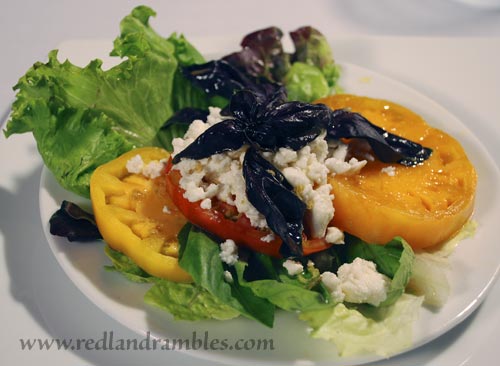
Heirloom tomatoes topped with goat cheese and purple basil.

And so the dinner began, and grew to a torrent of local abundance and deliciousness. Salad featured Teena’s heirloom tomatoes, and right away I fell in love with the orange one called appropriately enough, Tangerine. It has a bright, citrusy flavor, thus the name, and is said to be loaded with lycopene. Other varieties in the salad were Pink Brandywine and Cherokee Purple. Tangy and rich tomato flavors were balanced by crumbles of mild goat cheese. The salad was paired with Schnebly’s avocado wine, which tastes surprisingly crisp and clean, similar to a pinot grigio, and not one whiff of avocado. Teena said she has been growing tomatoes and vegetables in a sustainable way for over 35 years in Redland.

Vichysoisse with multicolor potato chips.

If you attended the Potato Pandemonium dinner last year, you’ll remember the vichyssoise. The soup was light and delicate in flavor and texture, but this time was more orange than lavender in color. (The color is determined by the mix of potatoes in a particular batch.) A handful of crispy potato chips topped the soup and gave it a salty crunch. The creamy half and half used to thicken the soup came from Dakin Dairy in Myakka City. Robert explained the potatoes came from a nearby field where the State of Maine tests their seed crop of spuds every year. Many different kinds in all different colors — red, blue, golden, white — are grown. Robert has permission to forage after they plow the crop under. Potatoes were a popular crop in Redland, grown in clay-like marl soil. But in the last decade, potato fields have given way to fields of houses and paved roads.

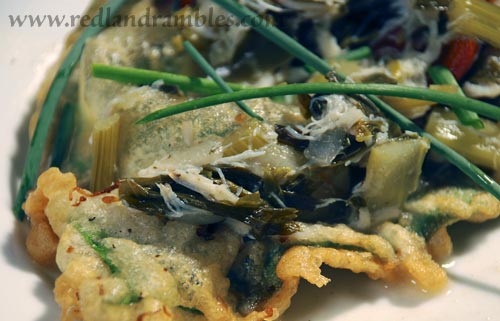
Tempura battered betel leaf and blue crab rangoon.

Tempura battered betel leaf with crab rangoon had also gone through its evolution into a lighter dish. Robert got several pounds of local blue crabs from Card Sound Crabs Company located not too far away on rustic Card Sound Road. The crabs had been swimming just the day before. It took three people about three hours to pick out all the crab meat. (Talk about slow food!) The crab sauce was less creamy than I remembered, and that was a good thing, allowing the delicate crab flavor to come through. The crunchy fried leaf served as a deconstructed fried wonton wrapper and added smoky flavor. This dish was served with Schnebly’s coconut wine, which had a slight coconut flavor that became more pronounced as it warmed.

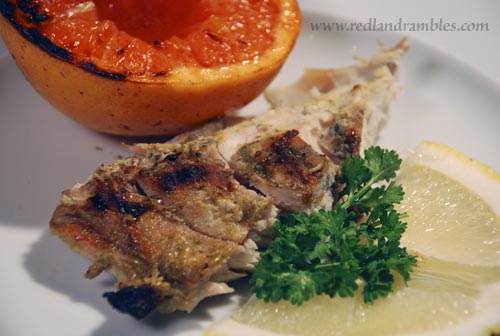
Wild caught cobia with broiled red grapefruit and Ponderosa lemon.

Crab rangoon was followed by another seafood dish, wild caught cobia. It’s a gamefish that migrates from the Gulf, around the coast of Florida and into the Carolinas. When this particular fish was swimming, it was about 38 inches long. Local fisherman George Figueroa speared it while free diving in about 25 feet of water off the coast of Jacksonville, and was present at the dinner to tell the tale.

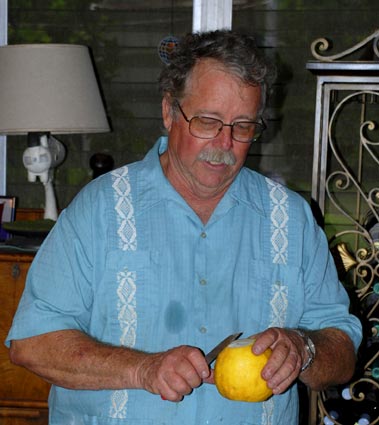
Robert Barnum opens up a Ponderosa lemon.

The carambola glazed, wood grilled fillet was thick and meaty, much like cod, and its flavor reminded me of mackerel. It was served with broiled red grapefruit from David’s Organics and a huge slice of Ponderosa lemon which Robert grows. He passed one around to examine. It was bigger than a softball and had thick bumpy skin. Its taste was mildly acid (similar to Bahamas lemon which Margie grows at Bee Heaven). The dish was accompanied by one of Robert’s wines made from araça, a tart yellow fruit that also makes great ice cream, but is too sour to eat on its own. The araça wine was light in color and a bit fruity, but not quite as complex as chardonnay.

Wood smoked wild boar with tamarind-peach chutney and callaloo.

Smoked wild boar came with its own story too. The meat had been donated by chef Michael Schwartz, who shot it on a hunt in the woods near Lake Okeechobee. (Read about the hunt on Michael’s blog.) George explained to dinner guests that feral pigs roam all over Florida, and can cause a considerable amount of damage as they root for food. But this particular pig was a menace no more. Robert smoked the pork for eight hours in his outside wood fired smoker, using Florida mahogany wood. It was glazed with a tamarind-peach chutney sauce, and served with more of the same on the side. The lightly smoked roast pork was lean and had a slightly chewy texture, to be expected from an animal that got lots of exercise. Fruit for the chutney came from Robert’s grove. Red Ceylon peach has a light colored flesh with red around the pit, and its light peachy flavor makes for a good ice cream (which made an appearance at the ice cream social last summer). Robert explained that this peach is one of very few varieties that had been grown commercially in South Florida over 50 years ago but no longer, because it is susceptible to fruit fly infestation. The wild boar was served with two large dollops of callaloo (also known as Jamaican spinach) grown at Three Sisters Farm. The greens were cooked with scallions and garlic chives from Bee Heaven Farm. The dish was served with Robert’s jaboticaba wine, which was purplish, tasted a bit sweet and grape-like, and went quite well with the chutney. It seemed to be one one of the more popular wines of the night.

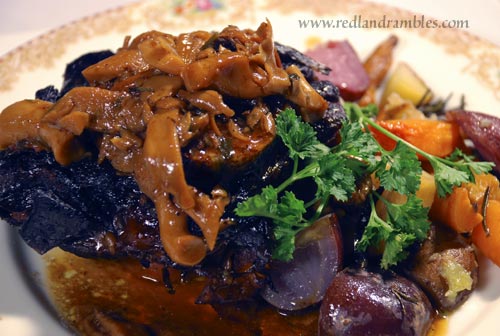
Grassfed beef with oyster muchrooms and roasted multicolor potatoes.

The third entree was grassfed beef raised at Deep Creek Ranch located in DeLand. (According to their web site, the cattle are raised on pasture according to organic practices but are not actually certified organic.) On my plate was a large chunk of meat with a marrow bone that appeared even larger because it was draped with sauteed oyster mushrooms from Happy Shrooms, and was accompanied by a side of smoked multicolor potatoes from the Maine testing fields, carrots and onions from Worden Farm, and parsnips and rosemary grown at Bee Heaven. Robert said the shank meat had been browned and oven braised in a blend of his homemade tropical fruit wines for about eight hours until it was tender. I was starting to get full when the beef arrived, but after one bite, couldn’t set it aside untouched. It had a rich taste and the wine reduction added to the depth of the flavor. The meat was falling off the bone, and a dollop of marrow was worth pursuing with the tip of a knife. The beef was served along with Robert’s bignay wine, which has a dark red color and tastes similar to cabernet. Some people think it’s too astringent, but it held up well to the richness of the beef.

Carambola pie with rangpur lime/sapodilla gelato and fresh Mysore raspberries.

Dessert — as if anyone could eat another bite — was Robert’s familiar square slab of carambola pie made with a whole wheat crust, accompanied by two scoops of rangpur lime/sapodilla gelato made with goat’s milk. The carambola, rangpur lime and sapodilla came from Robert’s grove,  and milk from Hani’s goat herd just down the street. The pie tasted like a tangy peach pie, and the gelato was a light dance of sweet and sour. Both were topped with a sprinkling of freshly picked Mysore raspberries from Bee Heaven. The dessert was paired with a sweet bignay wine that was as thick and strong as an elixir, almost too strong and sweet for me. Robert said he made it with twice the fruit and twice the sugar.

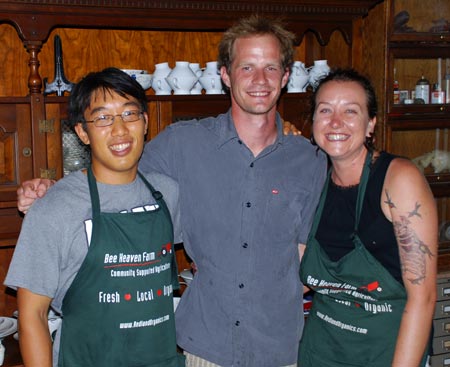
Weber, Mike and Sadie from Bee Heaven Farm helped with prep.

I’ve been to several dinner events at Robert’s and with this one he had outdone himself. His cooking and presentation gets better and better with each event, and it doesn’t hurt that he had excellent fresh local ingredients to work with and lots of willing helpers. Yes, there were a few minor glitches — the appetizer and soup courses didn’t come out of the kitchen in order, others weren’t paced evenly, and a few stray cobwebs lingered in a chandelier. But for the most part, the event went smoothly. Food presentation was professional and the service (by volunteers!) was very, very good. Kudos to Kathy, Karen, Sadie, Mike and Weber!

<< to be continued >>

Read Full Post »

« Newer Posts - Older Posts »