Feeds:
Posts
Comments

Archive for the ‘fruits’ Category

Summertime is down time

summer-moon

Rising almost-full moon on Summer Solstice Eve.

It’s officially summer time! The solstice was last Friday, followed by a supermoon (when the moon is at the very closest to Earth all year). But it sure felt like summer months before. Summer is a hot, humid, sweaty, weedy time at Bee Heaven Farm. The CSA season ended in late April. The last of the carrots got found and pulled up at Gleaning Day in early May. And now the vegetable beds take a well-deserved rest until planting season in fall. Yes, fall — not spring.

If you are from anywhere north of Florida, you’ll quickly discover that farming seasons are upside down here, compared to what you may be used to in, say, North Carolina. There, the growing season is in full swing. Here, farmers let the fields rest and go on vacation. When the fall harvest winds down Up North, the planting season begins down here.

Lost in the weeds. (Can you find the bee?)

Lost in the weeds. (Can you find the bee?)

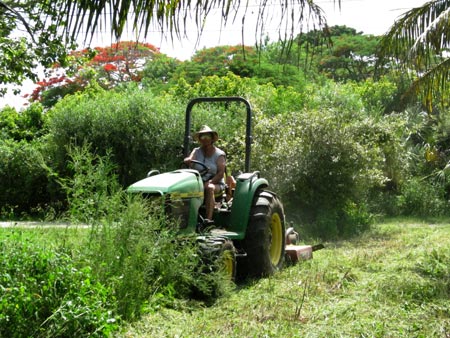
In the last two months, weeds sprang up to waist and shoulder height in the vegetable beds. They flourished because of days of torrential rain. Finally, on a dry day, Farmer Margie attached the brush hog to the green John Deere tractor and mowed them all down.

summer-mow

Weeds have met their match.

Summer is time for fruit. Lychees made their brief appearance for a couple weeks in May. Margie’s creamy Donnie avocados can get as big as footballs. Mangoes in all their varieties are definitely the queen of the summer fruit. Much coveted mamey, with its sweet salmon-colored flesh, is coming in. Massive jackfruit looks primordial with its thick, spiky hide. Sapodilla and longans are ripening. Summer is definitely a good time to become a fruitarian!

summer-avos

Donnie avocados ripening.

Read Full Post »

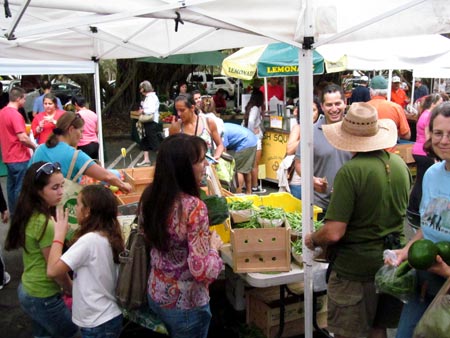
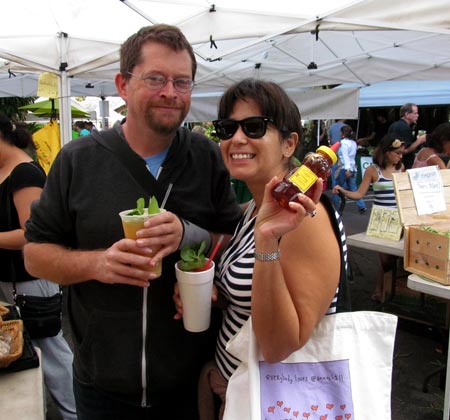
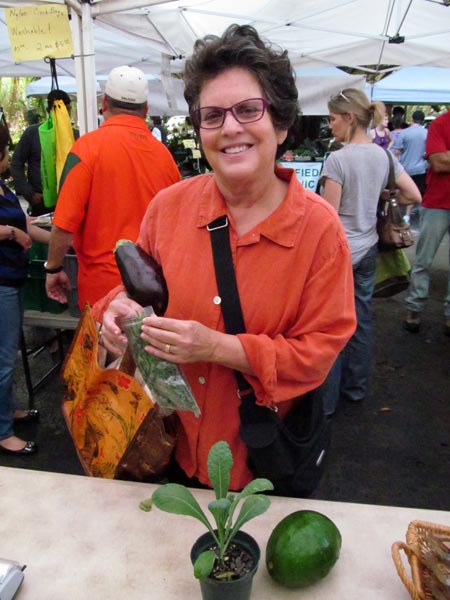
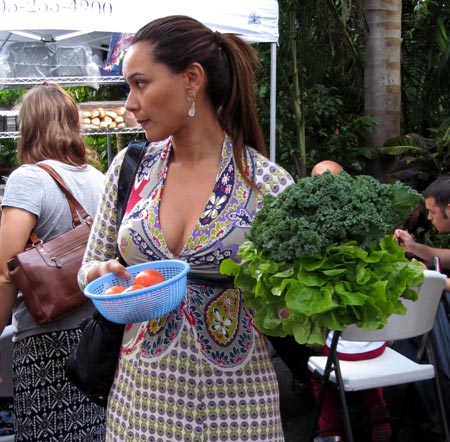
Here’s a look back, the first of a series, of Bee Heaven Farm/Redland Organics at Pinecrest Farmers Market this winter. Their last day was April 28th, 2013, and now the market season is over for them until fall. Farmer Margie, husband Nick, and their hard working crew will be back in December. Until then, enjoy happy memories of mornings at market browsing for ridiculously fresh local fruits and veggies. The following pictures were taken on December 2, 2012.

margie-pfm-12-2

Farmer Margie weighs tomatoes.

market-pfm-12-2

Nick (with straw hat) helping a customer.

nicole-pfm-12-2

Nicole holding sugar cane.

lettuce-pfm-12-2

Red lettuce looks airbrushed.

green-pfm-12-2

honey-pfm-12-2

hugh-pfm-12-2

shopper-pfm-12-2

tomatoes-pfm-12-2

kale-pfm-12-2

shnoz-pfm-12-2

Nose-y eggplants.

Read Full Post »

Strawberry love

double-strawberry

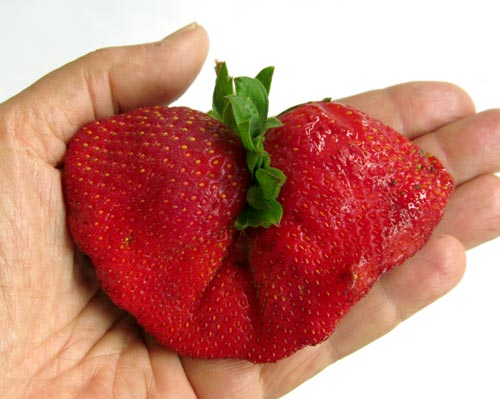
This conjoined strawberry came from Sunshine Organic Farm. Even though I handled it gently, it was so ripe that it bruised easily, and leaked bright red juices all over my hand. Doesn’t it look like a large moth, or perhaps a heart? Grown locally at Sunshine Organic Farm.

Read Full Post »

Fruit of the dragon

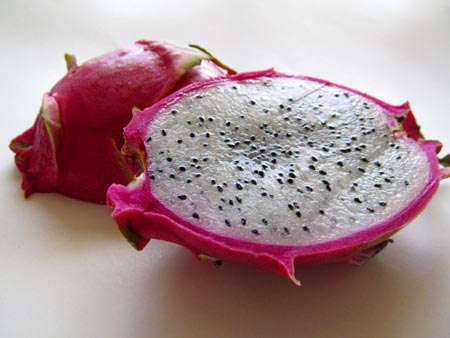
Just the name alone conjures up something rare and mysterious — dragon fruit! The fruit itself looks like a large magenta egg with fins. It has a bright, thick, leathery skin that belies the interior. I’ve seen kids reach for it at market, pick it up and look quizzical. Just what is inside? And how does it taste?

The first time I opened up a dragon fruit or pitaya, I thought, “Alien autopsy, here goes!” and sliced. The inside is a solid grayish-white mass flecked with a million tiny black seeds that remind one of kiwi fruit. (There is also a red variety but it is not as common.) The texture is not as slippery or sweet as kiwi, but firm like watermelon, and only mildly sweet. (Some people compare it to eating styrofoam — but since I’m not into chemical cuisine, I wouldn’t know what that tastes like.) I like to eat it plain scooped out with a spoon, but you could peel it, cut it into slices or chunks and add it to a salad. Pitaya sorbet would be refreshing on a hot day. I’ve heard that you can dry the flesh and it tastes like chocolate, but it doesn’t last long enough at my house to test that out.

The fruit grows on what could be a very abstract, elongated dragon. The plant is a long green ribbon-like cactus that loves to climb and climb. If you’re going to grow it, don’t let it climb too far. I’ve seen it race up to the top of a towering royal palm. Good luck harvesting fruit from there without a cherry picker! Commercial growers build pedestal-type trellises for the cactus, and its ribbons wind and drape around themselves, going up so high and no higher. The point of keeping cactus close is to make it easy to pick its fruit. Buds form at the end of its shoots, and those buds open up into the biggest, most outrageous, huge white flowers that bloom for only one night, but smell sweet and attract a frenzy of nocturnal pollinators. Bees go berserk in early morning, just before the blossoms close, loading up on pollen and nectar. Pitaya has been in season all summer long, but is winding down for the winter.

Farmer Tim Rowan grows several dragon fruit plants, and has a bunch of cool pictures of them in all their stages on his blog here.

Read Full Post »

(part 1 of 2 parts)

GrowFest! was the place to be for plant lovers last weekend! Over 850 adults, plus lots of kids, came to the first-ever event held at the Fruit and Spice Park in Redland. Festival organizer Margie Pikarsky of Bee Heaven Farm was thrilled with the turnout. “It was an unqualified success!” she exclaimed. Over 500 visited just on Saturday alone, exceeding her expectations. She promised that GrowFest will be an annual event at the Park.
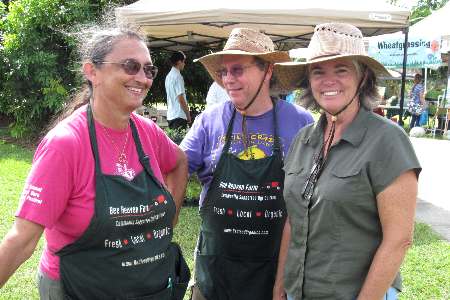
(L to R): Margie Pikarsky, Nick Pikarsky and Louise King of the Tropical Fruit Growers Association

GrowFest! was a grassroots fundraiser for Florida Organic Growers (FOG), which received money from the gate, as well as proceeds from sales of juice and water at their tent. “We raised over $900 for FOG from ticket and raffle sales,” Margie told me. Executive director Marty Mesh was at the event, manning their tent, and answering questions at the screening of their documentary “What’s Organic About Organic” on both days. If you missed your chance see the movie or buy a copy of the DVD, you can order it from the filmmmaker’s web site. “FOG is the non-profit that certifies organic growers in Florida, and also provides education and outreach to growers, consumers, and policy makers,” Marty explained.
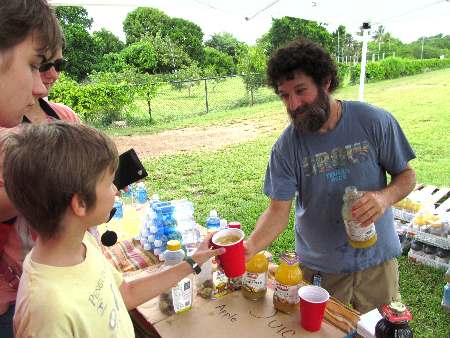
Marty Mesh poured local Lakewood Organics juices at the FOG tent.

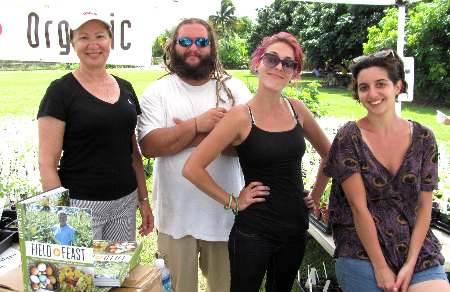
The heart of GrowFest! was all about plants. And there were all kinds to choose from — vegetable seedlings, potted herbs, banana plants and avocado trees, and more. On Saturday morning, I volunteered at the Bee Heaven Farm/Redland Organics tent, and found myself surrounded by baby plants. Long tables were loaded with over 80 varieties of organic heirloom tomato seedlings, several varieties of eggplant, hot peppers, arugula, nasturtiums, Asian greens and perennial herbs like garlic chives, curryleaf, aloe and lemongrass. Farm helper Victor and his wife Ish, and volunteers Nicole and Holly were also there to assist.

Volunteers at the Bee Heaven Farm tent (L to R): Holly Victor, Ish and Nicole.

Lots of people came to buy seedlings, and it was fun talking to them about their gardens. Most were regulars from past seasons who knew exactly what they wanted. The very first shopper was a tall man with a cart who loaded up with over two dozen plants. He said he saved seeds from his tomatoes from the year before, and was back this year to try new varieties. Soon after, Melodee Rodriguez, a dedicated mom who is in charge of the edible garden at Coconut Grove Elementary School, came with a checklist of vegetables and herbs for her school’s garden, which had been put in by Slow Food Miami three years before.

La Diva herself, Laura Lafata, with heirloom tomato seedlings.

Two other growers also had their plants for sale at the Bee Heaven area. Arturo Gonzalez of Sunshine Organic Farms was selling three varieties of avocado trees — Donnie, Simmonds and Catalina. (His farm provided grape tomatoes and a variety of vegetables for the Bee Heaven Farm CSA last season.) Organic growers Bill and Thi Squire provided lots of napa cabbage and two kinds of bok choy seedlings.
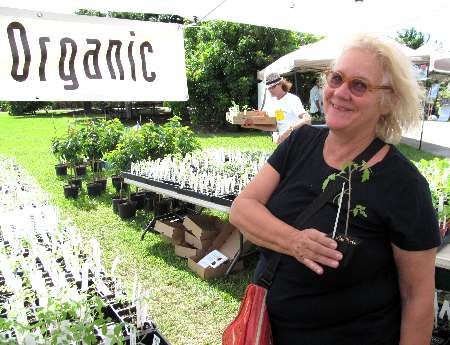
The event’s poster child Beth Dunlop came to pick out several kinds of black tomatoes.

In a big blue tent by the front of the park, Master Gardeners from Miami-Dade Extension were on hand to answer gardeners’ questions about plant problems. Other staffers gave a demo on how to use rain barrels, and the 4-H Kids Zone was set up where kids could play and learn about plants. The Dade County Farm Bureau tent did fun things with kids, based on Ag in the Classroom materials.

Kids hanging out at the Farm Bureau tent.

The villain of the event was the exotic and invasive Giant African Land Snail (GALS). The ravenous creatures are a serious threat because they’ll eat almost any kind of plant, and even gnaw on the stucco on your house. Several people from the state Division of Plant Industry were on hand with empty shells to examine (no live snails!), and had lots of information about the imported pest. A fully grown snail shell was quite pretty, smooth and shiny with brown and white stripes, and was almost the length of my hand. Don’t think of touching live GALS without gloves on because they can carry meningitis and a parasite called rat lungworm. If you see a GALS in your yard, call 888-397-1517 to report it. Over 78,000 GALS have been caught just in the past year.
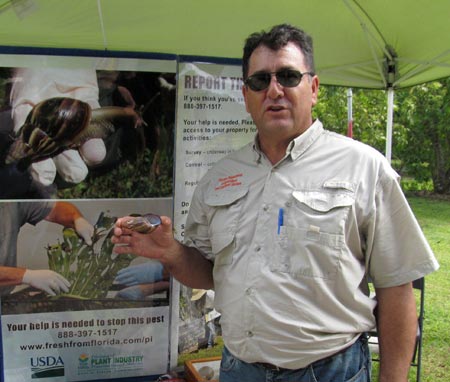
DPI Ag Tech Omar Garcia holds up the shell of a fully grown Giant African Land Snail. Be on the lookout!
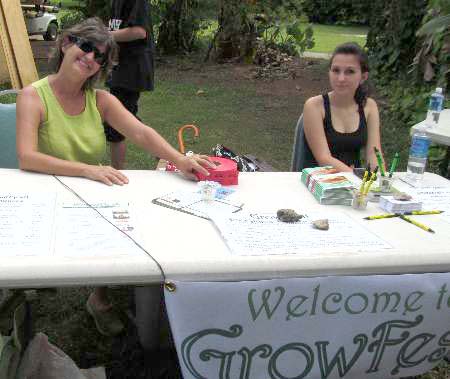
Ann Schmidt (left), the hardest-working volunteer of them all, at the front gate.


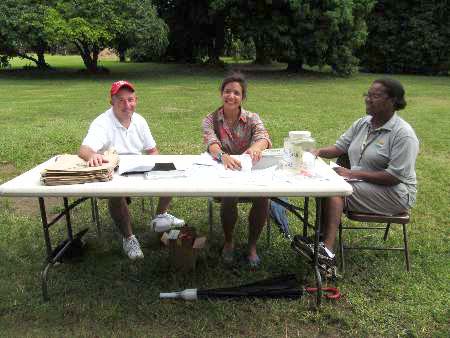
Mike Moskos (left) volunteering at the entrance table.
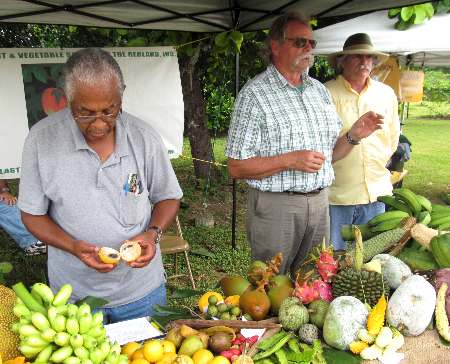
Fruit and Spice Park manager Chris Rollins (center) answered visitors’ questions about tropical fruits.


Read Full Post »
« Newer Posts - Older Posts »