Feeds:
Posts
Comments

Archive for the ‘fruits’ Category

It’s media week for Redland’s organic farmers! See Gabriele Marewski and her luscious summer fruit from Paradise Farms featured on Deco Drive on Tuesday. The produce is the star at Elemis Spa, where they use it in various concoctions to make your skin and body glowing and beautiful. Watch (and read) here:

http://www.wsvn.com/decodrive/articles/deco_features/MI95690/

You will need the latest version of Flash Player to watch the video.

Read Full Post »

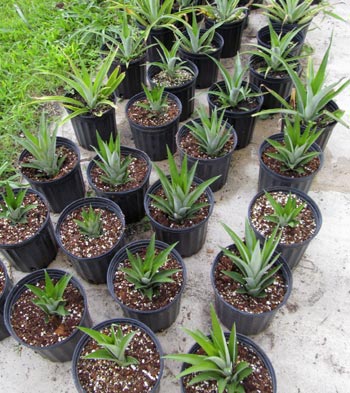
One year old plants which started from hapas.

Recently, farmer Margie and I were invited over to The Lettuce Farm to pick some pineapples. Really! Farmer Tim Rowan has all kinds of fruit growing during the summer, when it’s too hot for lettuce and cabbage.

Whenever you visit a farm for the first time, the farmer will take you on a tour of all the significant plants and features of his or her place. Tim pointed out Tommy Atkins mango trees loaded with blushing round-shouldered fruit, ribbon-like dragon fruit cactus vines ready to bloom and complete with an abandoned bird’s nest, passion fruit vines thick on a trellis, and quite possibly the area’s largest compost pile running the length of his property. The field where he grows lettuces and cabbages in winter was covered densely with elephant grass as tall as our heads, and home to twittering birds.
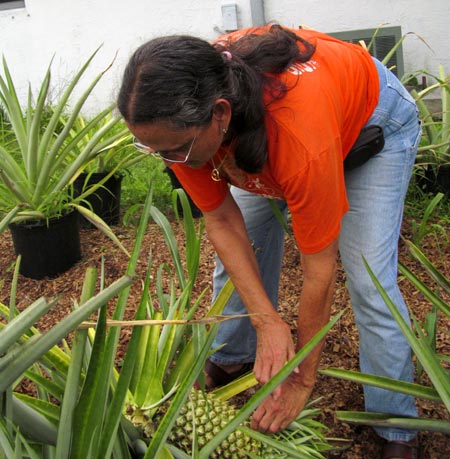
Farmer Margie learns the fine art of picking pineapple.

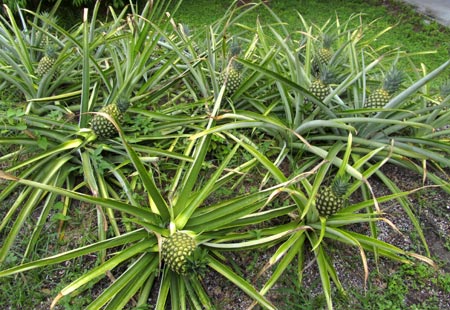
But what drew our attention and curiosity were the large raised beds, loaded with pineapple plants, which ring his modest house. In the west bed, all the plants were two years old, fully grown from green tops cut off pineapples, and they were loaded with fruit. Each plant produces only one fruit, which grows on a stalk at the center of the plant. The fruit were very large, and the ripest ones were peeking out golden through long leaves. In the east bed were plants bearing slightly smaller pineapples, which looked like they would be ready in about a month or so. Those plants were a year old, originally hapas (or slips) that sprouted from the bases of the older plants. Last summer Tim had snapped off hapas and planted them in their own patch. Each mature plant sprouted one or two hapas. Plants grown from hapas bear fruit in one year, but plants grown from tops bear in two.

More hapas potted up. These will be transplanted to a raised bed.

Tim let us pick our own fruit. He pointed out the ripest ones, and told us what to do. Picking a pineapple is fairly simple. Grasp it firmly with both hands, give the fruit a snap to one side and a small twist, and it easily breaks off the stalk. I was once again surprised by how heavy and substantial it was. After picking, Tim aimed a hose at the base of the fruit and washed off a bunch of ants. They are attracted to sugar in the fruit, which start to ripen from the bottom.

Hosing off the ants.

The pineapples we picked were amazingly heavy. Out came the scale to check weight. One was eight and a half pounds and the other was nine. (I haven’t weighed the ones you can get at the store, but they’re about half the size and weight.) Must be the special soil mix and organic fertilizer that Tim feeds his plants! The ripest fruit was ready to eat, and its sweet aroma tantalized us on light breeze, as we chatted on the back patio. Tim’s feisty Chihuahua jumped from his lap onto the table and sniffed at the fruit, which easily dwarfed her. It can truly be said that on that small farm located at the edge of the Everglades, pineapples grow as big as a dog.

Tim’s chihuahua is dwarfed by a giant pineapple.

Read Full Post »
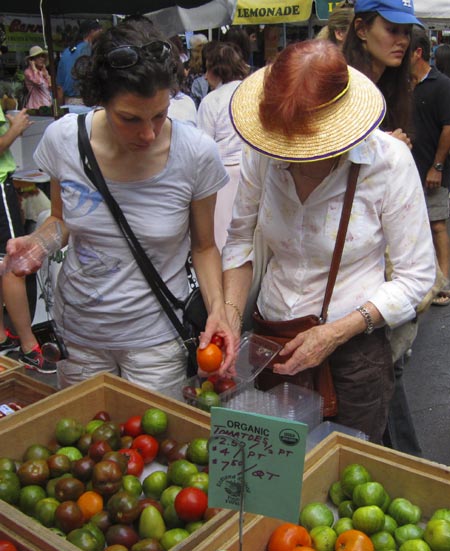
It’s that time of year when heirloom tomatoes are coming in thick and fast. You’ll find them in all shapes and sizes and colors at the Redland Organics tent at Pinecrest Gardens Farmers Market on Sundays.

Big ones, small ones, green, red, yellow, even orange, looking like jewels, enticing you to gather them from their wooden trays.

Eat one and you’ll know why people are crazy about heirlooms. Not only are they beautiful, but they’re just bursting with real flavor, their seed saved for generations.

Green ones tend to be a bit more tart, yellow and orange are sweet, and “black” ones have the richest flavor of all.

To serve, slice and add a little bit of good olive oil and sea salt and you’ve got locavore heaven on your plate and in your mouth.

Read Full Post »

Cleopatra tang’y’rines

Cleopatra tangerines

Tangy indeed! Pop one of the little segments into your mouth and you’re in for a sweet-sour surprise. The Cleopatra variety of tangerine is not shy about expressing its citrusy flavor, but it’s downright sour if you pick it too early. The best fruits are the ones that have just fallen off the tree, their tartness mixing with sun-ripened sweetness.

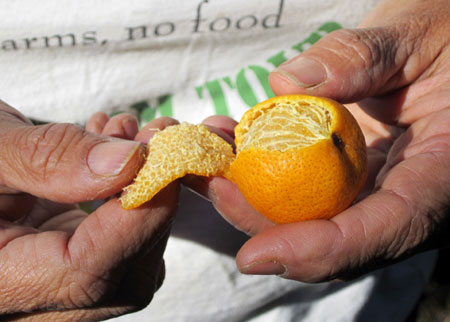
Farmer Margie peels a tangerine.

Cleopatras are a mandarin orange characterized by loose skin and small segments. (This is a variety that’s usually canned, not sold fresh, because of its tartness.) The fruit itself is small, no more than two inches across. The skin is edible, and has a high oil content, making it very aromatic and quite tasty. You can eat the skin fresh, or use it in cooking, like for for orange beef, to flavor oil for the dish.

The Cleopatra tree is usually used as rootstock, to graft another variety of citrus onto it, because it can tolerate cold and resists most diseases. It has been around for a long time, introduced from Jamaica to Florida before 1888.

During the winter season (January and February), the tree will be loaded down with fruit. The season for Cleopatras is starting to wind down, so get them while you can!

Read Full Post »

Small, medium and large

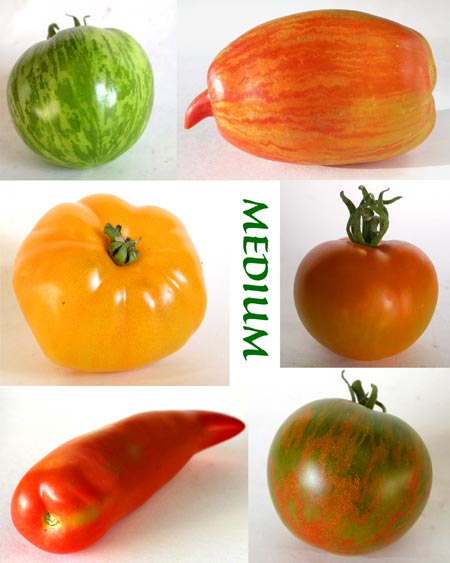
If you’re heading out to the Edible Garden Festival with a hankering for heirloom tomato plants, here are some pictures to give you an idea of what their fruit will look like when they grow up. These collages are only a taste of the types of plants you will find at the Bee Heaven Farm tent. And yes, they are all tasty, and quite addictive!

L to R: Red Pear, Lollipop, Brown Berry, Podland Pink, Matt’s Wild Cherry, Sungold

L to R: Green Zebra, Speckled Roman, Taxi, Jaune Flamme, Opalka, Red Zebra

L to R: Large Red, Cherokee Purple, Italian Heirloom, Brandywine, Cherokee Chocolate (unripe), Costoluto Genovese

Read Full Post »

« Newer Posts - Older Posts »