Feeds:
Posts
Comments

Archive for the ‘location’ Category


Do as Michelle does and shop at farmers' markets!

Hey there Redland Ramblers!

Guest blogger Melissa Contreras here, back again for some more exciting blog-worthy news! All the news that’s fit to blog about Redland farms right here folks!

You know me as founder of Urban Oasis Project, and we have been helping Liberty City residents create food gardens for more access to fresh VERY LOCAL food for quite a while now. As a formerly closeted farmer, now aspiring urban micro-farmer, I must say that I love plants, especially food plants, and I feel really great when I am surrounded by fresh-picked local produce! So, last year, I began helping Bee Heaven Farm sell their lovely produce at 2 local markets, Pinecrest and Overtown.

The Overtown market was the first all local, producer-run market in Miami in recent history, and seeing its success, many of us started to think that this would be great to have in Liberty City, an urban food desert. It’s easy to find processed foods or fast food there. It’s not so easy to find a mouthwatering, voluptuous heirloom tomato, or any tomato for that matter. This is due to inequalities in our food system, in which not all people have access to real food, produced by farmers and not by factories.

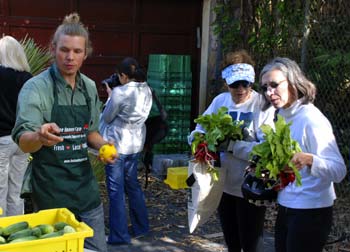
We are so pleased to take one more step toward transforming an urban food oasis from an urban food desert! Our new community farmers’ market will debut in Liberty City this Thursday, featuring lots of Redland produce, and a  dollar-for-dollar match for food stamps (SNAP) users, up to $10 per user,  per market. That’s found money in their pockets for local food!

Some Redland growers represented are Bee Heaven Farm, Three Sisters Farm, Teena’s Pride, and the Homestead Pole Bean Co-op, the only farmers’ co-op left in south Dade.  Hani’s Mediterranean Organics will have goat cheese and his exotic specialties. Redland Organics member Worden Farm from Punta Gorda will be represented as well, with produce grown by those award-winning farmers, Chris and Eva Worden.

We have decided to make one exception to the local rule, although it could still be considered local, depending on your definition, but it definitely regional. Thomas Produce of historically black Liberty City has a relationship with small African American farmers from southern Georgia, who will sell peanuts, pecans, sweet potatoes, and greens.  We are proud to support them, for they too have suffered their own  inequities in the food system. (USDA discrimination suit finally settled today!)

The market will also feature seedlings for your garden and native plants, healthy food, kids activities, music, and monthly health screenings, as well as local organizations. C’mon out!

When: Thursdays from Dec through April from 12 noon – 6pm or dusk (whichever comes first)

Where: Tacolcy Park at Belafonte Tacolcy Center, 6161 NW 9th Ave., Miami, FL 33127

Everyone is welcome!!!


Read Full Post »

Gabriele Marewski of Paradise Farms Organic announces another season with a stellar line up of Miami’s best chefs! Prepare yourself for an incredible evening of rustic decadence as Dinner in Paradise takes you away to a lush and tropical setting.  Upon arrival, guests enjoy a welcome reception with delicious hor d’oeuvres, before heading off on a farm tour, conducted by Gabriele that encompasses this beautiful five acre organic paradise and its fruit trees, edible flowers, mushrooms, and fragrant herbs.  As the sun sets on the evening, the magic truly gets underway.

This year, Dinner in Paradise proceeds benefit the Urban Oasis Project, a not for profit organization, whose mission it is to make fresh local food available to every one. Paradise Farms’ Ready to Grow garden beds will be installed in Liberty City and homeless shelters that house children in Miami Dade County.

Dinners are scheduled from December through February and begin at 5 PM with a cocktail reception followed by a farm tour. Dinner begins at 6 PM. March & April dinners will begin at 7PM with the cocktail reception at 6PM. Each dinner, priced at $165.50 (tax and google fee included), features five courses made with local, organic products, paired with top quality wines. Schedule/Chefs subject to change. Please visit the Paradise Farms web site for updates and to make reservations.

Read Full Post »

The Pinecrest Gardens Green Market opened for the season two Sundays ago, and you couldn’t ask for a better day, sunny and cool, and not too humid. It was a great day to take the kids and dogs outside and stroll among the tents, shop for farm fresh produce and grab a bite to eat.

Farm intern helping shoppers with their purchases.

The big Redland Organics tent dominated the west entrance of the market, and its tables were loaded with a variety of fresh, organic fruits and vegetables. It’s one of many sellers returning this year, and plenty more new ones were added to the mix. There are 50 vendors this year, according to Alana Perez, the Director of Pinecrest Gardens. I caught her prowling the market snapping pictures with her iPhone. She was delighted about the turnout on the first morning of the season. “This has really taken off, it’s huge!” she exclaimed. “The market has community support and it has a loyal following.” And the hungry community was there shopping up a storm. They lined up eight and ten deep to pay at the Redland Organics tent. By noon, Farmer Margie had sold out of grape tomatoes, all greens, and most fruit and vegetables. Only a few green peppers, zucchini, thai basil and some mamey remained.

Eggplants with schnozzles, proboscis, protruberances, and curlicues.

This year the market setup was a bit different. The tents were moved back to a row of banyan trees behind the main parking lot for the Gardens. It was hard to see tents from the road when I drove up. Then I spotted two small signs pointing me to the parking lot. Some vendors would have preferred to be visible from the street, like last year. But Alana Perez explained the move freed up more parking spaces. And Farmer Margie pointed out that the trees provide shade that helps keep produce from wilting in the heat.

Of the 50 vendors, there were more selling non-food items, like stoneware and solar systems. One produce seller groused, “It becomes more like bargaintown.” Bud and Linda, two shoppers who stopped to chat with me, love the market but had mixed feelings about its new incarnation. Bud told me, “I don’t want it to be like a flea market. There shouldn’t be anything that’s not edible.” Linda liked the old location by the street, and found the narrow aisles a bit claustrophobic. Both shop at the market to support local growers. “The people who are local are proud to be local,” Bud pointed out. “As for people who are not, it should be compulsory to say where the food came from.” (If they don’t have a sign, peek under the table at the produce boxes to discover where things came from.)

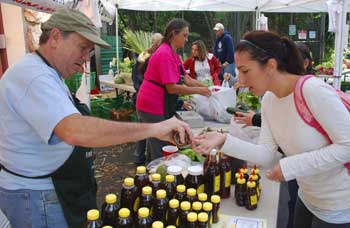
Farmer Nick offers a taste of local honey.

Most produce was local, and customers who want something that’s not ready for harvest right now will just have to wait a little longer. Overheard at the Redland Organics tent:

Customer: I want kale. Why don’t you have kale?
Farmer: Because it’s not ready yet. It’s not in season.
Customer: How come Whole Foods has kale?
Farmer: Because they get it from California!

Farmers markets are about eating in season, celebrating local food, and enjoying freshness you won’t find in any supermarket. Support your local farmers and you’ll support local families too.

Local food bloggers Laura Lafata of La Diva Cucina, Trina Sargalski of Miami Dish, and Paula Nino of Mango & Lime.

Read Full Post »

You haven’t heard much from me these last few months because I’ve been feeling de-pleated by condo board responsibilities. Small problems were looking big, and bigger problems looked overwhelming. Time to hit the reset button, so I headed down to Bee Heaven a couple weeks ago to get some much needed farm therapy.

Fall is planting time down in Redland. Summer is just too hot, too buggy and too rainy to grow much of anything. Planting starts in the fall near the start of the dry season, and harvest is in the spring. The growing seasons here are completely upside down compared to the temperate climate Up North.

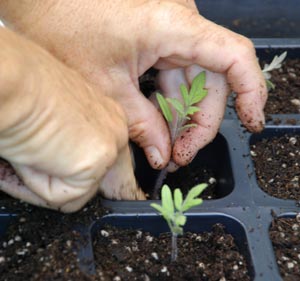
Jane transplanted starts into their first pot.

It was a sunny, breezy Saturday afternoon when I visited Bee Heaven. Margie and her manager Jane Cameron were puttering in the potting shed, transplanting starts, or baby vegetable plants, from the seed beds to small pots. A bit of soil went into the bottom of each pot. Then, one by one, Jane carefully lifted each start out of its bed and placed it into its new home. She set the plant down with one hand, put more soil around it with her other hand, and pressed the soil down gently. The work had a gentle rhythm. Repeat it a hundred more times or so, and that was the afternoon’s task.

Growers will tell you there’s something hopeful about working with baby plants. “It’s so exciting to see them grow from seed,” Jane said. “It’s empowering. It feels exciting to see the plant first poking out of the ground, to see the energy. You don’t get that with a plant already started that you buy from the store.”

You’re not thinking of bugs, or disease or freeze — although those risks are there, even at that stage. Some starts’ leaves had evidence of bugs munching along the edges. Another start revealed a small black caterpillar near its roots, as it was gently lifted out of the seed bed. The caterpillar would grow up to be a butterfly of some kind, Margie explained, but in the meantime, it was chomping on little roots. A note was made in the input log, and the plants and seed tray would be treated with BT for the caterpillars.

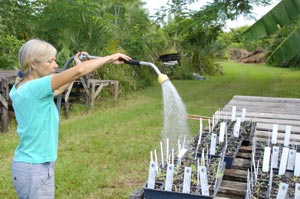
Jane watered the starts after transplanting.

Labels were placed into the pots, so you knew what kind of plant it was. Trays of pots were taken to an outside table made from old wooden pallets, where the starts soaked up sunshine and would grow and grow. Jane watered them lightly, holding the spray nozzle high above, so water fell gently like rain. Smaller starts were waiting on other outside tables nearby, still too young for transplant, maybe in a few more days. “They aren’t finished sprouting,” Margie said. When the little plants show four true leaves, then they are ready to pot up.

Most of the starts I saw that day were heirloom tomatoes with exotic names like Black From Tula, Red Calabash, and Zapotec Pleated. “ZAP-otec. That sounds like the name of a pharmaceutical,” Jane remarked. “Feeling de-pleated? Try Zapotec,” Margie chimed in. “It will pleat you back in no time!” Now there’s an idea — plant (and eat) heirloom tomatoes to be re-plete with energy.

Work done, I ambled around Bee Heaven to see how other things were going. Bright sunshine and clear blue sky were good medicine in itself, and soon I was feeling less de-pleated. A light breeze ruffled leaves, and mockingbirds twittered background music from a nearby big tree and from the hedges further over. Roosters living in nearby chicken tractors got a call and response chorus going. “Ur-ur-ER-ah,” one rooster called, and another responded an similar way, and another, and suddenly I was in the midst of poultry opera. “Here I am, how are you,” they seemed to be calling. “I am here,” I told them. (Yes, I talk to chickens.) I am here, I am fine, pleated and replete. Farm therapy works!

Read Full Post »

Pie…. ah, who doesn’t love pie. Fruit pie, custard pie, pie with whipped cream on top, pie with ice cream, pie with a light flaky crust. Pie! As much as I love eating pie, I haven’t had much luck making it. Have been thwarted by the most important step — making a crust that is light and flaky, not tough and rubbery.
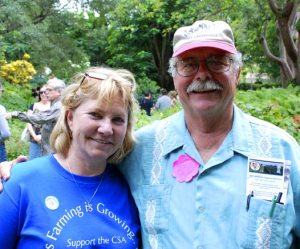
Growers Teena Borek and Robert Barnum

The Cantankerous Chef aka Robert Barnum spent his summer vacation patiently working on pie crust. He was passionately in pursuit of the perfect light, flaky crust to use in his tropical fruit pies. He told me that I could get a taste of that perfection in his homegrown longan-walnut-‘bola raisin pie at the Slow Food Miami “Pie on the Porch” competition this past Saturday.

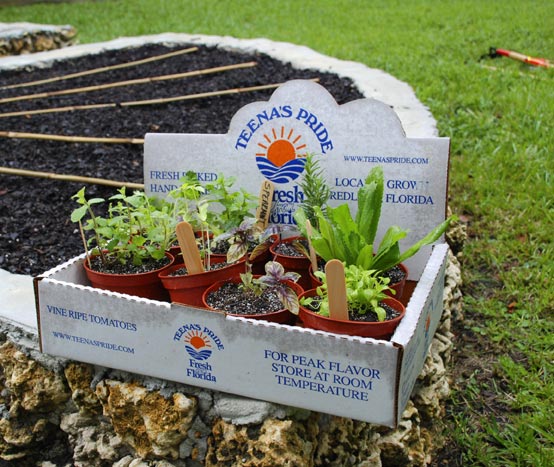
It was a great afternoon to hang out on the wide wraparound porch at the historic Merrick House while sipping lemonade. Kids ran around on the lush green lawn under the shade of huge live oak trees. A vegetable garden had been set up on a side lawn. It was round, with coral rock borders, and looked very much like a pie cut into four slices. Boy Scouts from

Little plants ready to grow.

Troop 4 tilled the soil, and starter plants provided by Teena’s Pride Farm were waiting to get planted into the beds. Slow Food Miami director Donna Reno explained this would be a historically accurate kitchen garden, growing foods much like the ones the Merrick family ate. The garden and pie competition are two of several events to  commemorate the 100th anniversary of the Merrick House.

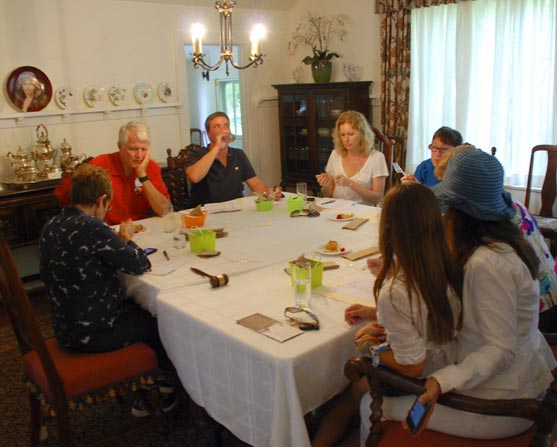
By the time I arrived, the porch was packed with eager, hungry people. Serving tables were set up, but where were the pies? They were inside the house getting judged. The seven judges aka the Supreme Court of Pie, led by Chief Justice of Pie Hedy Goldsmith herself, were ensconced in the dining room of the Merrick House. They were seated around a large table, armed with scorecards, plastic forks and glasses of water.
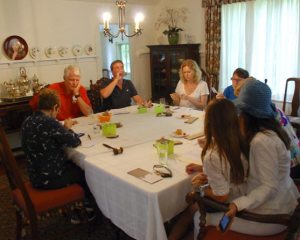
The Supreme Court of Pie

In the adjoining kitchen, 23 pies were arrayed on the counter. The pies were judged one by one. Three thin slices were cut and brought out to the table. The judges sampled and passed around the slices, discussed them briefly, and made their marks on score sheets. The judges evaluated pies on overall appearance, taste, overall impression, creativity, regional ingredients, and name. It was serious, intense work.
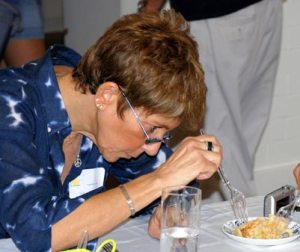
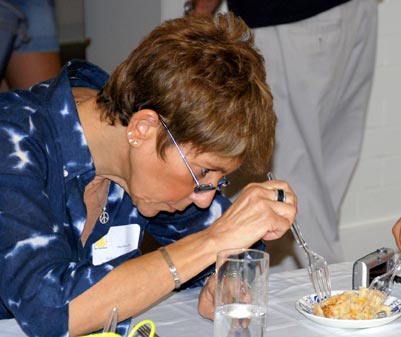
Pastry chef Hedy Goldsmith goes eyeball to eyeball with coconut pie.

According to the competition rules, “All pies must be made with a fruit or main ingredient that grows locally.” The pies had to be homemade, using home grown or local, and non-artificial ingredients. The pies had small cards describing what they were, but contestants were not identified.

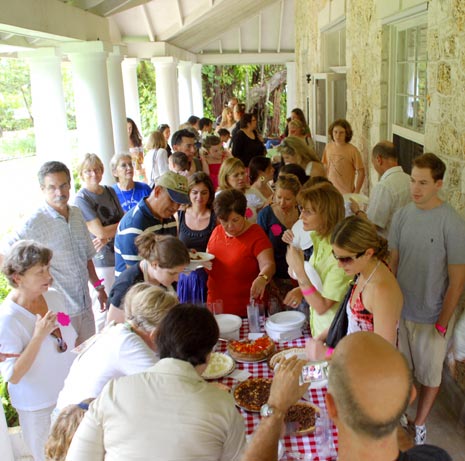
Once the pie was judged, a runner brought it out to the porch, where hungry guests were waiting for a taste. As a Slow Foodie began slicing and doling out pieces, people immediately mobbed the table. You’d think they hadn’t eaten pie in ages. “It’s a feeding frenzy out there,” the runner commented when she returned to the kitchen. I was intrigued by a green avocado pie and a salmon-colored mamey pie, but those vanished before I made it to the table.
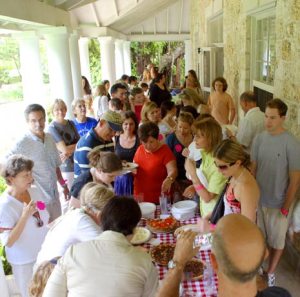
The first pies to emerge from judging got mobbed.

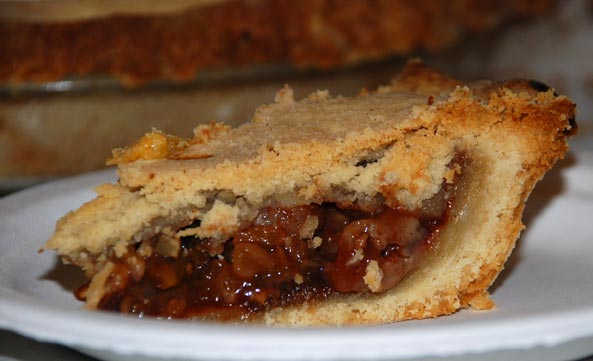
Tracked down Robert’s longan-walnut-‘bola raisin pie and dug in. It was a pie of complex flavors and unusual textures. Am not a fan of fresh longan, but baking mellowed and sweetened its flavor, and it tasted more like lychee. Encountered chewy bits of ‘bola raisins made from dried carambola, and crunchy bits of walnut. The texture reminded me of mincemeat pie, but count on Robert to push a recipe and turn the familiar into something different. As for the perfect crust, yes, it was light and crumbly, as promised. (If you want The Cantankerous Chef to make you a pie, and maybe dinner to go with it, give him a call at 305-235-1768.)

Most of the pies that I tasted (but I didn’t taste them all) followed the competition rule that the predominant ingredient must be local — mango, avocado, mamey, passion fruit, guava, coconut and longan to name the ones I saw. Some were nowhere near local — apple, apricot, pecan, chocolate — but they sneaked into the competition anyway.

The official winners were blueberry (could be local, blues grow in Florida), chocolate pecan (not local), and papaya (could be local). Details are posted on the Slow Food Miami web site.
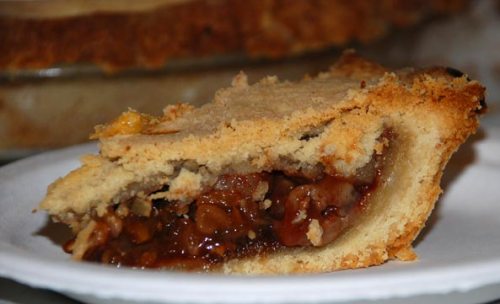
Robert Barnum's longan-walnut-bola raisin pie.

Robert’s longan-walnut-‘bola raisin pie won an Honorable Mention. His cantankerousness vanished for a few moments. “Yippee!” he cried out happily. “I’m in fourth place,” he kept telling me. Yes, indeed. Good to see his work receive public recognition on its merits alone. Good to see SFM inching closer to recognizing local food.

In the past, SFM was chided about using (or not using) local food at its locavore events. With this pie competition, the group came one step closer to walking the walk. If the Holy Grail of a locavore event is that the ingredients (all, most, or as much as reasonably possible) are sourced locally, this event came a bit closer. However, pies made from non-local ingredients (for example apple, chocolate, pecan, apricot) should have been kept out of competition.
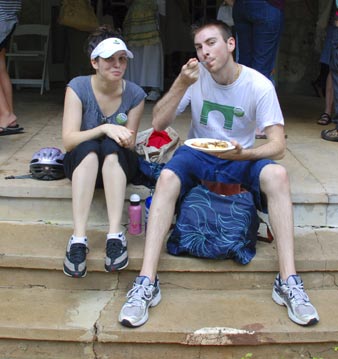
Foodies Naomi Ross and Brian Lemmerman enjoying pie bliss on the porch. They bicycled over from UM in the rain to taste something good to eat.

If you missed the pies, you can still visit Merrick House. It’s a lovely place, and one of the few structures that still remain from an earlier era. I’m glad I was able to visit it briefly, and want to come back another time to tour the house and grounds.

Merrick House
907 Coral Way
Coral Gables, FL 33134
305-460-5361, 305-460-5095

Kara Kautz, Historic Preservation Officer

Read Full Post »

« Newer Posts - Older Posts »