If you missed seeing FRESH the Movie at last month’s screening up in Broward, you have another chance. The good folks at the Urban Oasis Project are showing FRESH at their September meeting. Also on the agenda is a potluck dinner and a garden tour. The screening/meeting is on Saturday, September 12th. For more details — including how to RSVP — go to the Urban Oasis project website.
Archive for the ‘location’ Category
Potluck and FRESH the Movie
Posted in food, location, media, tagged joel Salatin, Melissa Contreras, Michael Pollan, movie, Urban Oasis Project, Will Allen on September 9, 2009|
Help save Extension Services
Posted in farm, food, location, politics, Uncategorized, tagged county budget, county commissioners, Extension, Margie Pikarsky, Redland Organics on September 9, 2009|
<nag> Have you written to your county commissioner about the proposed budget cut that would close the doors to the Miami-Dade Cooperative Extension Service? No? Still thinking about it? Maybe it’s just not that important or relevant? I mean, how could it possibly tie in with the tasty, fresh, local and organic veggies you’re going to eat from Redland Organics in a few months? Extension has a LOT to do with it! </nag>
Farmer Margie wouldn’t be where she is if it weren’t for the training that she got from Extension over the years. In her own words:
I started contacting Extension way back in the 70’s when I was in college. I got information on vegetable gardening for Florida, castrating & butchering a pig, raising and butchering chickens, canning, pickling and preserving information, how to take care of my fruit trees, and put it all to good use. In the early 80’s, I took the Master Gardener training, and received in-depth information about growing plants.
In the mid 90’s, when we started the farm, I looked to Extension to get advice on establishing my avocado grove. Later, when we expanded to vegetables, I consulted with them on variety selection, growing techniques, pest control, fertilizing. I’ve attended numerous workshops providing training on irrigation, growing, pests, diseases, etc etc etc.
Extension has been very responsive in helping develop training programs for folks interested in converting to organic productions. I always find good workshops and field days that I can bring my farm interns and apprentices to learn about growing in this tropical climate.
So… what are you waiting for? The list of commissioners is right here. Start writing!
The hemp is high
Posted in farm, location, photo, tagged cover crop, sunn hemp on August 30, 2009| 5 Comments »
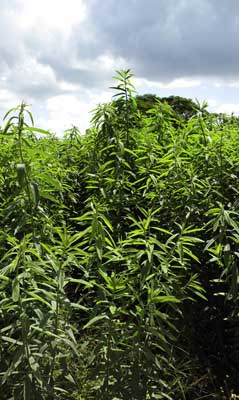
Sunn hemp cover crop
Summertime
And the livin’ is easy
Fish are jumpin’
And the hemp is high
(apologies to George Gershwin)
Hold on, bucko! Before you go jump in the van to load up — it’s sunn hemp — the non-smoking variety. No, CSA members will not have to eat it, either (Farmer Margie does love to grow lots of greens for us to eat, but this one is not for us.) Sunn hemp (crotolaria juncea) is grown as a cover crop on Bee Heaven Farm during the summer off season. It’s actually a legume that fixes nitrogen in the soil, suppresses nematodes and weeds, and provides organic matter for soil building.
Sunn hemp grows thick and straight and tall. When the wind blows, the hemp rustles and sighs and sounds like rain. Margie and I stepped into the moving green maze of swaying hemp plants, and headed across to the other side of the patch. The plants were almost above my head, and I lost sight of Margie within a short distance. The soil was thick and spongy with organic matter below my feet. When I emerged on the other side, I felt like I swam the full length of the field underwater.
Margie will mow the sunn hemp later this week. Then it will get disked and tilled under to add organic matter to the soil. The hemp will break down and feed the crops that will get planted next month. There’s a lot of prep work involved when you’re farming organically. Having good soil is the most important part. If you feed the soil, the soil will feed you.

Farmer Margie swimming in the sea of sunn hemp
Green Needs to Be Seen and Heard
Posted in csa, farm, farmer/grower, location, locavore, politics, tagged avocado, county budget, county commissioners, Extension, laurel wilt on August 20, 2009| 2 Comments »
Did you go to the county commissioner budget meetings to state your case? No? You have several more chances. There are Budget Conference Committee (BCC) meetings on Aug 24, 25, 26 and 27 at commission chambers downtown.
The commission will hold final budget hearings on Thursday Sept 3rd at 5:01 pm and Thursday Sept. 17th at 5:01 pm . Currently the location of the hearings will be at the county commission chambers, but that might change as commissioners are expecting an overflow crowd. (The meeting location is not changing, but they are expecting a crowd. Marian, 8/21/09)
When you go, be sure to wear green. Green needs to be seen! And heard! Read and bring copies of these two documents Ivory Sheet and Green Sheet with you. They have facts and figures about the Extension program.
According to Cindy Dwyer, Master Gardener, “Remember that this is a game of numbers. If nobody shows up to protest, the result is a big zero. Organize a group of Master Gardeners and get your friends and neighbors who care about this issue to go to the meetings with you!”
If you can’t attend meetings, write letters to the commissioners. Find out how you can contact your commissioner here.
So why should CSA members and other locavores care? According to the Extension Ivory Sheet, “Miami-Dade County is considered as ground zero for new plant pests and diseases entering the United States. Many are first found in residential neighborhoods and quickly spread to agricultural areas. Cooperative Extension horticultural professionals are first responders for these invasive threats to agriculture, home horticulture, urban landscapes and the natural environment.”
Remember laurel wilt? It’s still here, and it’s not going away. Do you have an avocado tree in your yard? Cooperative Extension is the place to turn to if you want to learn how to keep your tree alive. If you’ve been enjoying Farmer Margie’s ginormous avocados this summer, and want to eat them again next summer, speak out in favor of Cooperative Extension at the commission meetings. Margie learned how to grow avocados and keep them healthy through training from Extension.
If the budget that Mayor Carlos Alvarez proposes is approved, the Extension office will close its doors forever on September 30. Everyone from the Master Gardener coordinator to the clerical staff will lose their jobs. Everyone from growers to locavores will feel the impact.
Solar Power Systems at Bee Heaven Farm
Posted in farm, location, photo, tagged Bee Heaven Farm, Margie Pikarsky, Nick Pikarsky, solar power on August 12, 2009| 2 Comments »
At the Small Farms Conference, Nick and Margie Pikarsky of Bee Heaven Farm were part of a panel on solar power.
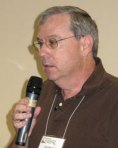
Nick Pikarsky
They gave a presentation on the two solar systems they have installed at their farm. One is a passive hot water collector, and the other system powers a water pump and freezer.
Water pump and freezer system
This system is used to pump water from the well for the bar, with extra power for the freezer. The pump provides water for everyday farm water uses. The system also does minor irrigation in a small area, consisting of a small mist house and a garden size drip system.

Solar panels mounted on roof of pump house
Two solar panels are mounted on top of the freezer shed, and were set at a compromise angle between summer and winter positions. Since the farm is so close to the equator in South Florida, the angle of the sun doesn’t change much through the seasons. They learned quickly that you can’t have anything obscuring the panels. A crawling vine once covered part of one panel and reduced the power output considerably. When nearby branches and a flowering bush grow too tall, they get cut back. After hurricanes Katrina and Wilma, the farm was without power two weeks and one week accordingly. The house didn’t have water, but the barn did, and the system was hooked up to supply for the house as well.
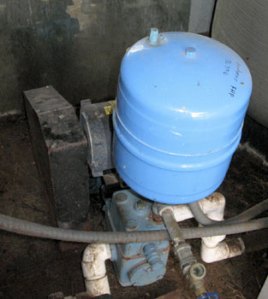
24V Dankoff Solar Force irrigation pump
Nick researched the literature, spoke with suppliers and decided on a 24 volt DC system as a compromise between efficiency and economy. 12V systems are cheaper but more inefficient, and 48V systems were a bit too expensive. Choose the type of pump based on your needs — depth of water table, amount of water needed, and duty cycle — then size the solar system accordingly, Margie advised. The irrigation pump is a 24V Dankoff Solar Force (now sold under the Conergy brand). The pump system runs off 2 deep-cycle batteries charged by a small controller unit. It also powers a Sundanzer 8 cu. ft. 24V freezer chest, and a couple of emergency lights in the barn and pump house.

Inverter and breaker panel mounted on wall. Batteries, pump and freezer on the floor of the pump house.
Passive water heater
Bee Heaven participated in Florida Keys GLEE a few years ago and learned about TCT Solar, which makes passive solar hot water collectors. This particular model is 50 gallons, and was mounted to serve as the roof of an outdoor shower stall. It provides plenty of scalding hot water for the shower, a washing machine, and the big sink in the barn. The passive system heats water only when there is sun, but the water stays hot! It requires no electricity and works really well.
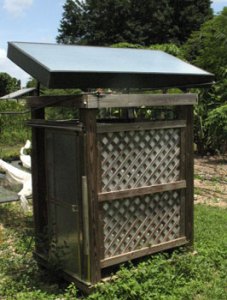
Passive collector mounted on top of outdoors shower.
Barn system
There is a third system at Bee Heaven Farm that has not yet been fully implemented. It will someday serve all the power needs in the barn. The barn
has a Solar 5K 48V inverter which is designed to power the walk-in cooler, tools, lighting and standard 120V AC appliances. Nick and Margie calculate they need a total of 20 PV panels to power the barn, along with a complement of 40 batteries. It’s too expensive to do that all at once, so they’re hoping to implement in stages, and are excited about new government incentives to help with the purchases. There’s an A-B switch in the barn to go on or off the grid. Margie said their goal is to be completely free of the grid.
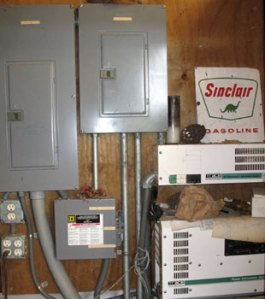
Barn breaker panels, A-B switch and inverter.
FPL has a net metering policy, but there’s a catch, Margie cautioned. They require you to be down when they are down, and you have to buy power from FPL at retail, yet they buy power from you at wholesale, and that’s a significant difference. FPL will give you credit if you generate more power
than you use, but at the end of the year, you lose any credit you’ve accumulated. Other speakers on the panel cautioned users to try to negotiate a contract with their utility that’s equitable.
Costs
These are the prices when the systems were built 5-7 years ago. Some things are now cheaper, and some things are more expensive.
Solar collector for hot water $1400 (copper piping and stand not included)
Pump and freezer system:
Batteries 400 x 2
Sharp modules (solar panels) 550 x 2
Rack for modules 200
Charge controller 140
Dankoff pump 2500
Pressure tank 200
Sundanzer freezer 1200
Total: 6200 + labor & shed
Download system diagrams for the solar water heater and for the solar pump.
Thanks to Margie for collaborating in the writing of this article, and Nick for the systems diagrams.

-
Recent Posts
- Remembering Hani Khouri
- 5th Annual Redland GrowFest!
- Chefs’ Local Cookoff Challenge
- Sea of seedlings
- Jim Ewing presents at GrowFest!
- Adventures of a Farm Apprentice
- GrowFest! demos and presentations
- OFF vs. BHF CSA
- How does the Oriental Fruit Fly Quarantine affect us?
- GrowFest! is a go!
- Oriental Fruit Flies in Redland Trigger Quarantine
- Lychees in the morning
- Ugly veggie love (NSFW)
- Plethora of peppers
- Saucy Kohlrabi
Archives
Frequent Tags
Art Friedrich Arturo Gonzalez avocado avocados Bee Heaven Farm bees black sapote brunch Brunch in Paradise Charles LaPradd chickens county budget county commissioners csa Dan Howard Dinner in Paradise Earth Dinner Earth Learning edible South Florida Extension Fairchild Tropical Botanic Gardens Farm Day Farmer Margie Pikarsky farmers market Fruit and Spice Park fundraiser Gabriele Marewski greenhouse GrowFest! Hani's Mediterranean Organics Hani Khouri heirloom tomatoes holiday Katie Edwards laurel wilt Little River Market Garden Local Links lychee mango Margie Pikarsky Marty Mesh Melissa Contreras Miami Herald Miguel Bode movie Muriel Olivares Nick Pikarsky Paradise Farms Paradise Farms Organic Pinecrest Gardens Farmers Market Possum Trot Nursery redbay ambrosia beetle Redland GrowFest! Redland Mediterranean Organic Redland Organics Robert Barnum Roots in the City share Slow Food Miami small farms conference Sous Chef 2 Go Steven Green Teena's Pride Farm Teena Borek Three Sisters Farm Tim Rowan UDB UF/IFAS UF/IFAS Cooperative Extension Upper East Side Farmers Market Urban Oasis Project Whole Foods Will Allen Worden Farm zoning-
Join 626 other subscribers
Copyright©2009-2015 Marian Wertalka
 Redland Rambles