|
|||
|
|||
|
|
|||
|
Archive for the ‘locavore’ Category
End of Summer Brunch
Posted in agritourism, chef, farm, food, locavore, tagged Bee Heaven Farm, brunch, Possum Trot Nursery, Redland Organics on September 9, 2009| 2 Comments »

Possum Trot Nursery
Posted in agritourism, chef, farmer/grower, food, fruits, location, locavore, photo, vegetables, tagged brunch, jakfruit, passion fruit, Possum Trot Nursery, Robert Barnum, star fruit on September 9, 2009|
If you bought smoked eggs or fruit this summer, the jakfruit, starfruit and passion fruit (among others) came from Possum Trot Nursery. Later this month owner Robert Barnum will host a brunch outdoors on his property. You’ll get a tour, then eat a sumptuous meal — The Possum Trot Experience — prepared by Robert himself. He calls himself The Cantankerous Chef and invents all kinds of tasty dishes that use his fruits. This month’s brunch should be an easy challenge for Robert — use only local ingredients except for salt, pepper, sugar and the like.
Possum Trot is completely unlike any plant nursery you have ever seen before. It’s a cross between a grove and a primeval jungle, 40 acres of Old Florida wildness that makes Fairchild Tropical Gardens look like a manicured rosebush. Robert has collected all kinds of trees that have useful purposes, whether it be fruits, herbs or wood for smoking food. The property also has a sinkhole — or is it a spring? — and a bomb shelter right in the ground.
Here are pictures of my first visit to the nursery in September 2007.
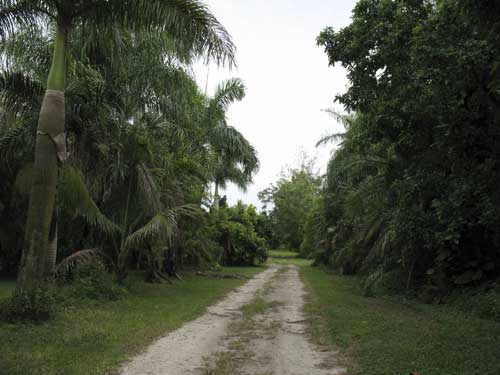
Entering Possum Trot Nursery
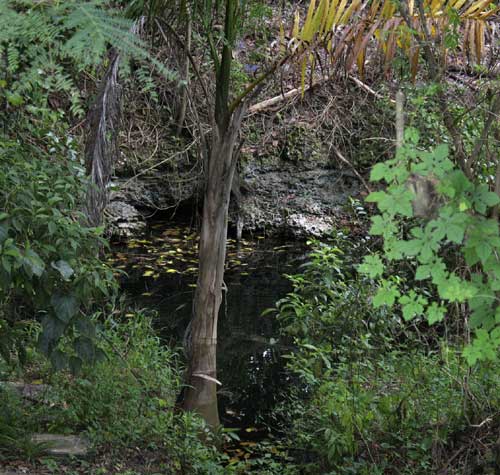
Ye olde swimming hole
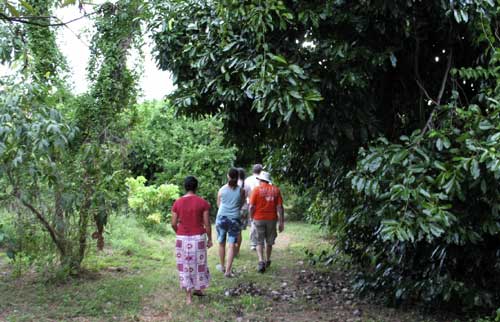
Strolling through 40 acres of tropical trees
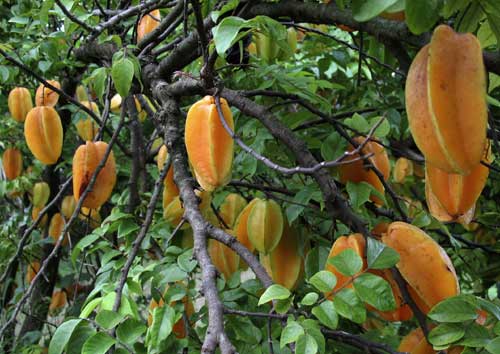
Star fruit hang like golden lanterns
Green Needs to Be Seen and Heard
Posted in csa, farm, farmer/grower, location, locavore, politics, tagged avocado, county budget, county commissioners, Extension, laurel wilt on August 20, 2009| 2 Comments »
Did you go to the county commissioner budget meetings to state your case? No? You have several more chances. There are Budget Conference Committee (BCC) meetings on Aug 24, 25, 26 and 27 at commission chambers downtown.
The commission will hold final budget hearings on Thursday Sept 3rd at 5:01 pm and Thursday Sept. 17th at 5:01 pm . Currently the location of the hearings will be at the county commission chambers, but that might change as commissioners are expecting an overflow crowd. (The meeting location is not changing, but they are expecting a crowd. Marian, 8/21/09)
When you go, be sure to wear green. Green needs to be seen! And heard! Read and bring copies of these two documents Ivory Sheet and Green Sheet with you. They have facts and figures about the Extension program.
According to Cindy Dwyer, Master Gardener, “Remember that this is a game of numbers. If nobody shows up to protest, the result is a big zero. Organize a group of Master Gardeners and get your friends and neighbors who care about this issue to go to the meetings with you!”
If you can’t attend meetings, write letters to the commissioners. Find out how you can contact your commissioner here.
So why should CSA members and other locavores care? According to the Extension Ivory Sheet, “Miami-Dade County is considered as ground zero for new plant pests and diseases entering the United States. Many are first found in residential neighborhoods and quickly spread to agricultural areas. Cooperative Extension horticultural professionals are first responders for these invasive threats to agriculture, home horticulture, urban landscapes and the natural environment.”
Remember laurel wilt? It’s still here, and it’s not going away. Do you have an avocado tree in your yard? Cooperative Extension is the place to turn to if you want to learn how to keep your tree alive. If you’ve been enjoying Farmer Margie’s ginormous avocados this summer, and want to eat them again next summer, speak out in favor of Cooperative Extension at the commission meetings. Margie learned how to grow avocados and keep them healthy through training from Extension.
If the budget that Mayor Carlos Alvarez proposes is approved, the Extension office will close its doors forever on September 30. Everyone from the Master Gardener coordinator to the clerical staff will lose their jobs. Everyone from growers to locavores will feel the impact.
Diversify! Marketing for Small Farmers
Posted in agritourism, chef, csa, farm, farmer/grower, food, locavore, tagged Bee Heaven Farm, Margie Pikarsky, Mise en Place, Redland Organics on August 17, 2009|
Still have a few more posts about the Small Farms Conference. There was a lot going on, but I focused on attending sessions where members of Redland Organics were presenting (or if there was a focus on local food systems). Here’s notes from Margie Pikarsky’s presentation on marketing.
Diversify! was Margie’s main theme, as in don’t put all your eggs in one basket. She raises various fruits and vegetables and animals (eggs) and also sells merchandise (tote bags and cookbooks).
Providers. Redland Organics CSA got started because of diversifying. Margie told the story of how Gabriele Marewski of Paradise Farms originally started the CSA. She was growing only a few things, and Margie was growing a few other things, and combined they were a good variety for their customers. From there, Redland Organics grew as other organic or non-spray/natural growers were included. Currently there are eight providers within a 160 mile radius. Membership in the CSA grew from 40 in the first season (2002-2003) and topped at 450 shares this past season.
Crops. Margie started with avocados and greens, but now gets more money per square foot from vegetables. She recommends growing something unique that would appeal to the public. For her it’s heirloom tomatoes, and usually she raises around 30 different varieties. Diversify also means to interplant crops, such as tomatoes with mustard greens, or a short crop with a second crop.
Seasonal offerings. In summer there are eggs and fruit for sale — mangos, avocados, passion fruit, jakfruit — depending on whatever is available from various local sources. Emails are sent out to customers and payments are made online. Customers pick up at the farm or one other site in the city. Margie doesn’t grow vegetables in summer but plants a cover crop instead, such as black eyed peas. During the winter CSA season, her crew picks to order on Thursday, and additional deliveries start coming in. The CSA boxes are packed on Friday. Saturday morning the shares go out by truck to various drop off points in town for customer pick up.
Labor. Bee Heaven Farm relies on volunteers from WWOOF and occasional interns. Margie tries to get seasonal people who will stay for at least a couple months. The work crew is small, about 6 to 8 people, and is intensely managed. Everything is handwork, only Margie uses the tractor and other machinery. She pays somebody local year round to pull weeds and gather eggs.
Various sources of income. The CSA brings in 75 percent, and farmers market 15 percent. The other 10 percent comes from avocados, honey, tomato starts, greens, workshops, eggs, value added products, and other products (totes, cookbooks).
Direct marketing. Redland Organics has space at the South Florida Farmers Market in Pinecrest, and at the peak of the season added a large table devoted to heirloom tomatoes. Last two seasons Margie sold avocados to Whole Foods. Participating in select events and festivals is also a good way to get exposure.
Agritourism. Bee Heaven Farm is open to the public twice a year. Farm Day is in winter and started as a small potluck. Last season it grew to 200 people attending. A small market is offered on the side. There’s also the end-of-season Gleaning Day, also a potluck, then customers go through the rows to pick the last of the season. Mothers Day brunch with tables set under the trees was a new event, featuring local food prepared by the chefs of Mise en Place.
Workshops. A series of four cooking workshops were offered last winter. Margie teamed up with chefs Adri Garcia and Rachel O’Kaine of Mise en Place, who used all local ingredients except for flour, sugar, salt and oil. The tamale workshop was hands on, and participants picked and shucked corn, and shaped their own tamals. When Margie needed to cull roosters she held a chicken processing workshop. Participants watched her process the first bird, then did their own and got to take it home. Margie said that people do want to know more and connect with their food, and these interactive workshops help them connect.
Value added. Other diversity is through dried fruits (mango, banana etc.) and tomatoes. Tip: Margie uses a venison dryer from Cabela’s. She also makes various spice rubs that include her herbs.
Currently Margie and a couple other growers in RO are working with their local county commissioner to allow on-farm food processing and commercial kitchens. The state laws allows this, but county zoning ordinances do not. A change in zoning would also allow for B&Bs, which would have to be located on an active farm (unless it was a historically designated building), and would have to follow certain restaurant kitchen requirements. Language for this change in zoning is being drafted now and will come up for a vote in fall.
Download the Powerpoint slide show and the handout from this session.

This avocado weighs 2 3/4 pounds
It’s coming toward the end of the season for summer avocados. The Donnie variety growing at Bee Heaven Farm is getting big and plump. Very big. Last Saturday at the fruit sale, Farmer Margie was weighing the monster green fruit, claiming that there was a three-pounder lurking in the bin somewhere among the two-and-a-half pounders.
No matter, this one will do. Look carefully at the scale. It says 2 and 3/4 pounds. No, the image has not been altered in any way. The fruit is really that huge.
When I brought this one to a friend, he exclaimed, “Oh my god! That’s a big avocado!” His eyes were shining with happiness. “I love avocados! I’m going to eat this all at one time.” Ok, Luis, go for it! Let me know if you really did it. (I can manage about half at one sitting.) Skanaus!
If you want to get your own, there will be another fruit sale this Saturday August 15th. Here’s the link where you can place your online order.
http://www.redlandorganics.com/CSASS09eggsNhoney.htm
Keep in mind the Donnies will be growing on the tree for one more week. So there might actually be a fruit that could weigh in at 3 pounds — or more!

-
Recent Posts
- Remembering Hani Khouri
- 5th Annual Redland GrowFest!
- Chefs’ Local Cookoff Challenge
- Sea of seedlings
- Jim Ewing presents at GrowFest!
- Adventures of a Farm Apprentice
- GrowFest! demos and presentations
- OFF vs. BHF CSA
- How does the Oriental Fruit Fly Quarantine affect us?
- GrowFest! is a go!
- Oriental Fruit Flies in Redland Trigger Quarantine
- Lychees in the morning
- Ugly veggie love (NSFW)
- Plethora of peppers
- Saucy Kohlrabi
Archives
Frequent Tags
Art Friedrich Arturo Gonzalez avocado avocados Bee Heaven Farm bees black sapote brunch Brunch in Paradise Charles LaPradd chickens county budget county commissioners csa Dan Howard Dinner in Paradise Earth Dinner Earth Learning edible South Florida Extension Fairchild Tropical Botanic Gardens Farm Day Farmer Margie Pikarsky farmers market Fruit and Spice Park fundraiser Gabriele Marewski greenhouse GrowFest! Hani's Mediterranean Organics Hani Khouri heirloom tomatoes holiday Katie Edwards laurel wilt Little River Market Garden Local Links lychee mango Margie Pikarsky Marty Mesh Melissa Contreras Miami Herald Miguel Bode movie Muriel Olivares Nick Pikarsky Paradise Farms Paradise Farms Organic Pinecrest Gardens Farmers Market Possum Trot Nursery redbay ambrosia beetle Redland GrowFest! Redland Mediterranean Organic Redland Organics Robert Barnum Roots in the City share Slow Food Miami small farms conference Sous Chef 2 Go Steven Green Teena's Pride Farm Teena Borek Three Sisters Farm Tim Rowan UDB UF/IFAS UF/IFAS Cooperative Extension Upper East Side Farmers Market Urban Oasis Project Whole Foods Will Allen Worden Farm zoning-
Join 626 other subscribers
Copyright©2009-2015 Marian Wertalka
 Redland Rambles