Feeds:
Posts
Comments

Archive for the ‘locavore’ Category

artisanal fair

Saturday, September 28, 2013
12 noon to 4:00 pm
Free admission

The Wolfsonian Museum is teaming up with local farms and makers of food products for this all-about-the-local-food-you eat event.

Artisanal Fair @ The Wolf and CSA Sign-Up is a fantastic opportunity to meet your local farmers. Come find out more about local food grown by Margie Pikarsky of Bee Heaven Farm and sign up for one of her Community Supported Agriculture (CSA) farm shares.

Teena Borek from Teena’s Pride CSA and Muriel Olivares from Little River Market Garden CSA (sold out for this season!) will also be there. Buying from a CSA a great way to support a local farmer, and get fresh produce every week during our harvest season.

Participating local food vendors include: Cao Chocolates, The Cheesecake Gallery, Dauphin Kaffee artisanal coffees, Freakin’ Flamingo jams and jellies, Pop Nature popsicles and paletas, Proper Sausages, and Simply Sharon’s “treats that heal.”

At 2:00 pm, take a special guided tour of the current Modern Meals exhibit. It will be led by museum staff and Teena Borek.

This event is co-presented by The Village Stand gourmet shop and Slow Food Miami.

Read Full Post »

Margie Pikarsky and Charles LaPradd with the new Local Flavors cookbook.

Margie Pikarsky and Charles LaPradd with the new Local Flavors cookbook.

Recently, Charles LaPradd, the county agriculture manager, stopped by Bee Heaven Farm with a special delivery. He unloaded several boxes of Redland’s latest crop — “Local Flavor: Recipes Raised in the Florida Redland” — a very special cookbook two and a half years in the making.

It’s filled with recipes for local produce gathered from growers and cooks. The list of contributors is a who’s who of area growers and cooks. Farmer Margie Pikarsky has three of her own recipes: Avocado Salad (or Chunky Guacamole), Calabaza & Watercress Salad, and Strawberry Black Satin Pudding. “Veronique,” a Sea Grape Martini, was originally concocted with Margie’s sea grapes for a Slow Food Miami event.

If it grows in Redland, there’s a mouthwatering recipe for it, and almost all look quick and easy to make. Carambola is coming into season now, and Star Fruit Chicken Salad caught my eye. A useful chart in the back lists what’s growing when. This is a great book for CSA members to have in their kitchen.
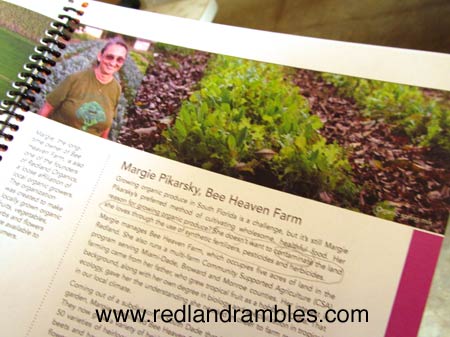
Bios of various farmers were originally included in the  cookbook, but unfortunately didn't make the cut for the final version.

Bios of various farmers were originally included in the cookbook, but unfortunately didn’t make the cut for the final version.

The book is beautifully produced, with luscious pictures of produce and and lovely countryside. Yes, that’s what Miami-Dade County’s back yard looks like! If there is one disappointment, there are no pictures of the finished dishes. The book is thoughtfully designed to be used in a kitchen, with glossy, heavy pages to stand up to drips and spills, and a spiral binding that lets pages lay flat. There’s plenty of white space to scribble comments.

Charles delivered 100 copies, which Margie is selling on her summer web store for $16 each (including tax). You can also buy it from the Dade County Farm Bureau. The book will also be available at the Homestead Book Fair on October 5th. Three thousand copies have been printed. “There’s no room to move in my office,” LaPradd said, laughing. Help him free up some floor space and buy a book!

redland-raised-logo-smallThe cookbook was published so that people can learn about the area, and how to use its products, LaPradd explained. Proceeds from its sales will go toward raising money to pay for colorful produce stickers with the Redland Raised logo.

Starting this October, those stickers plus in-store displays should be in Publix stores so shoppers can clearly identify what’s locally grown. Some of the local produce to look for (as it comes into season) is green beans, yellow squash, zucchini, boniato, okra and avocados. And if you don’t find those displays, or if they’re on produce that clearly isn’t from here, complain to the store’s produce manager. This is information that LaPradd’s office provides free to stores.

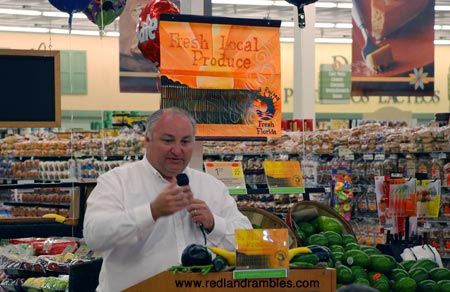
If Redland Raised sounds vaguely familiar, the brand was launched with great hope and promise on October 29, 2009. Various dignitaries including LaPradd, county mayor Carlos Alvarez, several commissioners, a bunch of Redland growers, and store execs gathered in the produce department of a Publix near Tropical Park for the kickoff. But a cold winter freeze that damaged a lot of crops caused a setback, and both local veggies and signage disappeared from stores. Now the program is rallying a comeback, and hopefully sales of the new “eat local” cookbook will revive interest from both cooks and retailers.

The Redland Raised brand was LaPradd’s brainchild, and it was designed to be used in conjunction with the state ag department’s Fresh From Florida brand. Only Redland growers who are members of the Florida Agricultural Promotional Campaign (FAPC) can use the Redland Raised logo to promote their produce as grown in Redland.

Surrounded by a bounty of local, Redland produce, Charles LaPradd speaks at the launch in 2009.

Surrounded by a bounty of local, Redland produce, Charles LaPradd speaks at the launch in 2009.

Read Full Post »

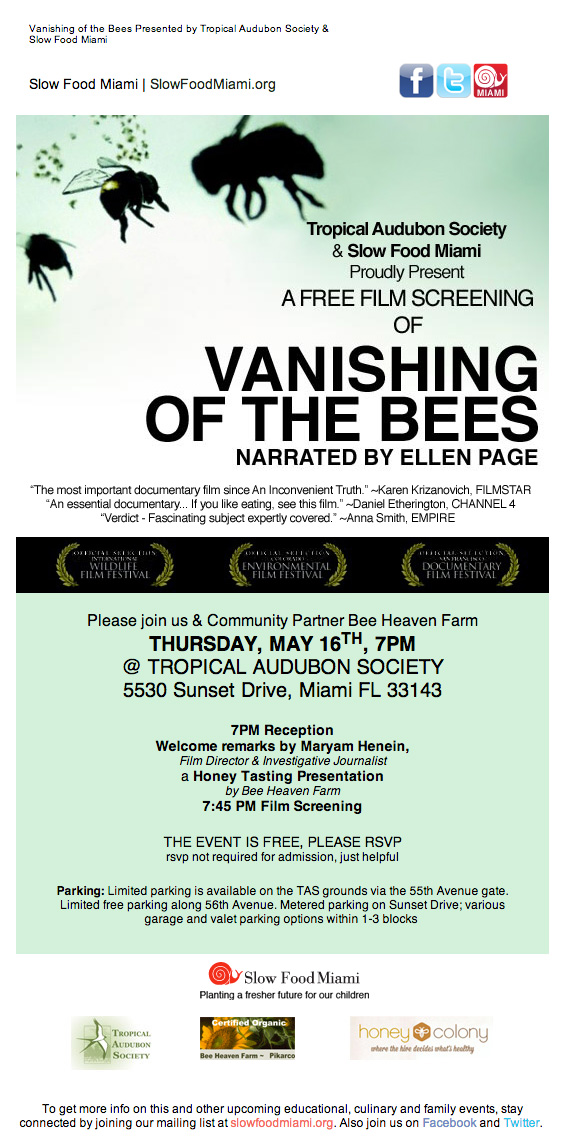
Indie filmmaker Maryam Henein is back in town with a free screening of her documentary Vanishing of the Bees, co-sponsored by Tropical Audubon Society and Slow Food Miami. Come see an award winning, informative, provocative, beautifully filmed documentary about the ongoing honeybee crisis.

To sweeten the deal, farmer Margie Pikarsky of Bee Heaven Farm will present a honey tasting. True to the name of her farm, there are vibrant and healthy bees living on her property, and the hives are maintained and honey gathered by beekeeper Miguel Bode. (You may have met him at various events at Fairchild Tropical Botanic Garden.) At least two different kinds of honey — wildflower, and lychee and longan — are produced by the bees that call Bee Heaven their earthly home.

Admission is free, but you have to RSVP to Tropical Audubon Society at events@tropicalaudubon.org. Bee there!

A review of a previous screening back in May 2011 can be found here.

Can’t make it to the screening? You can watch online pay per view, or purchase a copy of the DVD at the film’s web site.

vanishing2013

Read Full Post »

Three vendors at the Brownsville Farmers Market offer Argentinean empanadas, fresh local and organic produce from Urban Oasis Project, and Tommie's Gourmet Comfort Food.

Three vendors at the Brownsville Farmers Market offer Argentine empanadas, fresh local and organic produce from Urban Oasis Project, and Tommie’s Gourmet Comfort Food.

Brownsville Farmers Market is small, a clutch of three tents set up in the entrance plaza of the Jesse Trice Community Health Center. But this is where Melissa Contreras of the Urban Oasis Project non-profit, and her assistants, set up shop this season, selling fresh, local and organic fruits and vegetables to the underserved community nearby.

The market is a welcome patch of green in an area not known for healthy eats. The afternoon I came to visit, the place was bustling with staffers and clients of the health center. I had just missed the lunch rush, but got swept up in the cheerful chaos of a group of women leaving a wellness class. They sampled bits of fruit and grabbed up cauliflower picked just 24 hours earlier. Melissa greeted many people by name and cheerfully answered questions. The market accepts EBT and offers matching funds up to $20. One man had a $10 matching token burning a hole in his pocket, which he had received from the center for reaching a health milestone. He carefully chose two golden papayas, bunches of fresh herbs, and a bag of Shawnee’s Green Thumb spirulina popcorn as a treat.

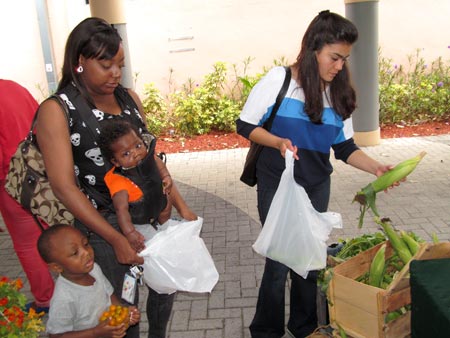
Diverse families come to shop for fresh produce they can't get anywhere else in the neighborhood.

Diverse families come to shop for fresh produce they can’t get anywhere else in the neighborhood.

A woman who comes every week to shop for her family of eight children left with three large boxes of vegetables and a potted African Basil plant the size of a shrub. “This is the only place in Brownsville where she can get vegetables to feed her family,” Melissa said. “This is a food desert.” She explained that a food desert is an area where its residents do not have access to fresh produce and other healthy foods. The residents have to shop at small neighborhood markets that don’t stock much by way of fresh produce.

The Brownsville market moved around and changed names a bit. Originally it was known as the Liberty City market located at the TACOLCY Center. Because of permit issues, it moved to the African Heritage Cultural Arts Center, then moved again to this current location and changed names. Last year, the market was funded by grants from the Communities Putting Prevention to Work (CPPW) initiative, a federal grant administered by the county’s Consortium for a Healthier Miami-Dade. “This year, we are purely self-funded,” Melissa explained,”Our SNAP matching funds, which are a separate program, are from Wholesome Wave, as they are for all of our markets.”

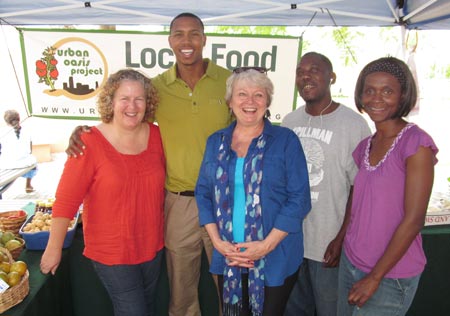
Melissa Contreras, John Lewis (Sistrunk and PATCH market), Sharon Yeago (consultant), Brett Johnson and Rachelle Lawson-Norwood from PATCH market.

Left to right: Melissa Contreras, John Lewis (Sistrunk and PATCH markets), Sharon Yeago (market consultant), Brett Johnson and Rachelle Lawson-Norwood from PATCH market.

As luck would have it, I got to meet Sharon Yeago, a local food activist and farmers market consultant, who was visiting that afternoon. She was accompanied by representatives of two new farmers markets in Dania Beach (PATCH) and Sistrunk, and stopped to chat for a moment. Sharon was instrumental in helping Urban Oasis get grants for the Brownsville market, and had helped get funding for four other new farmers markets in Miami-Dade. For the past year, Sharon’s been working in Broward to develop new markets through TOUCH (Transforming Our Community’s Health) Broward, a program of the Broward Regional Health Planning Council that also helps underserved residents get access to healthy food.

The Brownsville market is seasonal and will close in two weeks on April 17, following the winter growing season here. It will reopen sometime in fall. After the market closes, the mother of eight and other regulars will have to travel quite a bit further to shop at the next nearest local-grower-supported market. (That would be the Upper Eastside Farmers Market on 66 St. and Biscayne Blvd. It’s also run by Urban Oasis, and is open year round.) But at least there is another market that she can go to.

It took a lot of hard work and determination on the part of Brownsville market organizers to navigate their way through permit and zoning challenges, and to gather funding to get started. But the people of Urban Oasis have proved that it can be done, again and again, despite the odds. Hopefully Miami-Dade County can streamline the process to allow more farmers markets with less governmental difficulties. There aren’t that many sources of fresh produce in the food desert, yet the need is so great.

Brownsville Farmers Market at Jesse Trice Community Health Center
5361 NW 22nd Ave.
Miami FL 33142
Wednesdays from 11 am -2 pm
Seasonal, open through April 17, 2013 (resumes in Fall)

Read Full Post »

paradise-signThe first Dinner in Paradise event on Sunday, December 9th, will be a special treat as the chefs have gone all out to present a menu almost entirely from the farm.

This year’s opening dinner introduces Philippe Reynaud and Jason Stocks from Ocean Reef Club in Key Largo, Fla. A native of Cannes, France, Reynaud oversees 12 restaurants, as well as catering and culinary events, at the world-class, all-inclusive residential community. A big proponent of local and natural ingredients, he believes customers want to know where their food comes from more than ever these days.

Perennial and popular favorites Frederic Delaire and Jason Prevatt from Loews Miami Beach hotel return with yet more creative approaches to local ingredients, keeping diners coming back year after year.

Together these teams will be producing a tantalizing five-course menu that features produce harvested fresh from Paradise Farms, as well as seafood and grains provided by sponsor Whole Foods.  Sommelier Shari Gherman offers a select array of red and white wine pairings for each dish.

Guests arrive at 5 pm to enjoy a cocktail reception in the cotton candy tree grove before taking a farm tour that ends in an open-air gazebo strewn with linen clad tables and edible centerpieces.

Dinner is served at 6 pm, at communal tables of 10, so strangers are often making plans by the end of the night and the party continues with a bonfire and stargazing.

Tickets are $165 per person plus tax and processing fees. Reservations are required. All reservations must be made by Friday noon, so that the farm crew can harvest accordingly. For more information and to make reservations, please visit Paradise Farms Organic web site.

Proceeds from this dinner benefit Miami’s Project HEAT’s Healthy Eating for Active Teens.

Read Full Post »

« Newer Posts - Older Posts »