Feeds:
Posts
Comments

Archive for the ‘market’ Category

The two best farmers markets on the weekend — and you can feel free to debate this with me — are the Pinecrest Gardens Green Market on Sundays from 9 am to 2 pm, and the Coral Gables Farmers Market on Saturdays from 8 am to 1 pm.

Coral Gables Farmers Market
405 Biltmore Way
(in front of City Hall, at Biltmore Way and LeJeune Ave.)

Hurry over to the Gables Market because this Saturday March 27 is the last day. Several members of Redland Organics are selling their wares there.

Jad, Jessie, Leah and Mary Lee at Hani's Mediterranean Organics

One recent weekend I stopped by to chat with the crew at Hani’s Mediterranean Organics. Everybody who walked up to the tent asked if cheese was available. “The goat cheese is in limited production and sells out fast. You got to get here early,” Hani’s wife Mary Lee patiently explained. She offered mussels cooked in white wine sauce with garlic, or maybe some lupini beans to snack on. Their son Jad was making falafel, and volunteers Jessie and Leah from Ohio State University helped out. (Hani is also at the Pinecrest Market.)
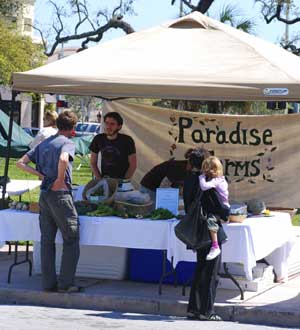
Paradise Farms, the only certified organic farmer at Gables market.

Across the street you’ll find Paradise Farms selling various fruits, vegetables and herbs. Paradise is certified organic, unlike other growers at the market. You have to get there early for their famous oyster mushrooms. The recent cool, dry weather slowed down mushroom growth, so there have been some weeks where they have been in short supply. (Paradise is not at Pinecrest Market, but you might find the mushrooms at Redland Organics.)

You’ll find Miguel Bode selling honey and pollen at his tent set up at the end of Biltmore Way right by LeJeune. Miguel’s wife was there last Saturday while Miguel was down in Redland checking his hives. He keeps bees at Bee Heaven Farm and at Paradise Farms. His wildflower honey is my favorite, and is a real taste of the local area.
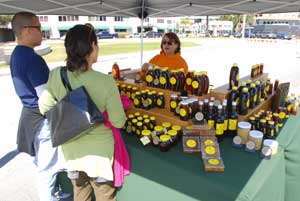
Miguel Bode's local honey and bee pollen

Pinecrest Gardens Green Market
5855 S.W. 111th Street
(in parking lot in front of Pinecrest Gardens)

If you want Miguel’s honey but missed the Gables Market, you can also find it here, sold by Redland Organics. Everything is local, either grown on Bee Heaven Farm or sourced from organic growers within 150 miles of Miami. No telling what interesting things you’ll discover under the sprawling tent. In addition to honey, you can find certified organic fruits, vegetables and herbs, along with bunches of flowers and dried fruits, and Paradise Farms oyster mushrooms (subject to availability).

Word up to CSA members — the produce in your Saturday box is also available at market, so if you want more of something but didn’t find it in the extras box, go to Pinecrest. You can also find things at market which never make it into your CSA box, particularly fruit and herbs. On one recent Sunday, I saw rangpur limes, which look like small oranges but are not quite as tart as the familiar green limes.

The Pinecrest Market will run through April.

An assortment of familiar and unusual fruit at Redland Organics.

Read Full Post »

Roots in the City Farmers Market in Overtown

Just west of new luxury high rises on Biscayne, a row of white tents sprang up on the corner of NW 2nd Ave. and 10 St., smack dab against a patch of young collard greens. Underneath the tents, farm fresh fruits and vegetables were arranged on tables. The newest farmers market was launched on Wednesday in Historic Overtown, one of the oldest and underserved neighborhoods in Miami. If people couldn’t come to market to get much needed produce, well, the market was going to come to them. There hasn’t been an actual farmers market in downtown for decades.

Locals checking out and buying from Redland Organics.

Two local growers were at the Roots in the City Farmers Market. Farmer Margie from Redland Organics put out a colorful display of radishes and white Asian salad turnips, carrots and celery, Asian greens, loquats, canistel and black sapote. Under the next tent, farmers Teena Borek and her son Michael from Teena’s Pride Farm brought tomatoes, red bell peppers, white eggplant that looked like bowling pins, and bunches of greens.

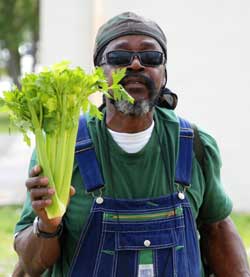
John Lealand Laundry likes celery.

The market was open from 1 to 4, and there was a fairly steady trickle of curious neighbors wandering over. A lot of looking, a bit of curious sniffing and tasting, but mostly people were excited that a farmers market suddenly appeared on their street. People bought a few things, choosing carefully. One resident told me that there are several groceries in the neighborhood, including a Winn Dixie on the other side of I-95, but produce is very expensive.

Market tokens

Some neighbors paid with cash and some were happy to find out they could use food stamps. That was the best part, the most amazing thing. The Roots market is set up to accept food stamps (also known as Supplemental Nutrition Assistance Program or SNAP). Even better, the Roots market has implemented a Double Value Coupon Program that would double the value of a person’s food stamp purchases. For example, if somebody bought five dollars worth of veggies, they would get that equal amount in tokens they can then use to buy more food at the market.

This bit of shopping ingenuity and the Roots market came about from the collaboration of many entities. The Wholesome Wave Foundation has set up similar “Nourishing Neighborhoods” programs at over 80 farmers markets around the country, and provided leadership, training and seed money. Health Services Coalition handled the actual SNAP transactions, acting as a go-between the farmers and the buyers, and is putting the word out in the community. Michael’s Genuine Food and Drink enlisted Margie and Teena, the first two local family farmers to participate, and helped with fundraising and promotions. And the Roots in the City community garden (which is raising nearby collards, and has two acres of garden in the immediate area) offered space for the market, and added its produce to sell.

People from HSC on hand to handle SNAP sales and manage tokens.

The Roots market will have a dedication ceremony in two weeks, on Wednesday April 7. Miami Mayor Tomas Regalado has been invited, and there will most likely be other dignitaries attending. The market will run for four weeks, with maybe an extension for four more, and is scheduled to resume in fall.

Listen to Low-cost produce comes to Miami’s Overtown, the WLRN report by Joshua Johnson, here. The Genuine Kitchen has posted the press release (with lots of good information) here. And Mango & Lime posted her report on the market opening here.

Miss Sarah tells it like it is to the media.

Read Full Post »

While I was in the barn on Friday setting up to photograph this week’s share, in strolled Annie Gascoyne, co-owner of Help Yourself!, an organic restaurant located in Key West. Annie made the three-and-a-half hour drive up with her boyfriend to pick up boxes of veggies for her restaurant, and for the farmer’s market that she and her business partner run on Sundays from 9 am to 1 pm.

The market is “getting quite a little following,” Annie told me as she took a minute from packing produce into the car. In addition to herbs, fruits and vegetables from Redland Organics, “there’s a fellow who cuts fresh coconuts, and live music from a local band that comes without fail.” Co-owner and chef Charlie Wilson gives cooking demos. The market is in its second season, paralleling the CSA season, and it’s starting to take off. A loyal group of locals comes by every week to shop, and this season Annie has noticed an increasing number of tourists dropping by.

Annie explained that she started the market because not everybody may want to, or afford to, eat at her restaurant every day. “There was such a lack,” she said. “I wanted to bring that [market] experience to support local farmers. It’s so nice knowing what you’re supporting.” And her customers are delighted for the opportunity to get fresh, healthy local food. “All say thank you so much for being here,” Annie said.

Help Yourself! is a rare bird as far as restaurants go in this area. Annie and Charlie source local food as much as possible, and all ingredients are natural and organic. “We’re all about food as it should be,” Annie explained. She had visited restaurants with similar concepts in London and New York, and Charlie had been a chef at a top-notch vegan restaurant in New York — so why not Key West? “Knowing that this exists in other places, and feeling a real lack, combined with a desire to support local business doing great things” inspired the two women to launch their restaurant.

Today and tomorrow Help Yourself! is participating in the Gardenfest, a weekend festival to benefit the Key West Tropical Forest and Botanical Garden, located on Stock Island. The festival will feature a plant sale, and various speakers on gardening, plus a green market, various artisan crafts and live music.

Help Yourself! organic restaurant
829 Fleming Street
Key West, Fl 33040
305-296-776
www.helpyourselffoods.com

Read Full Post »

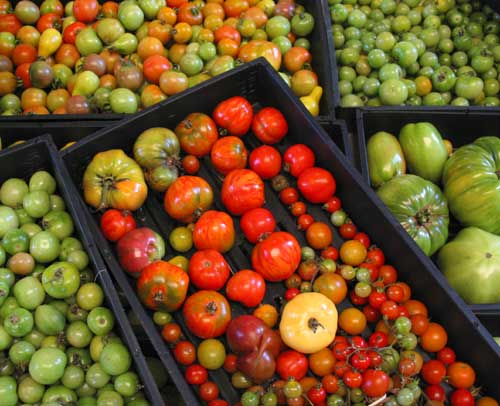
Heirloom tomatoes of all sizes, color and flavors.

Margie’s crew has been picking tomatoes as they ripen, and it looks like there will be some at market this Sunday. Don’t know how much the poor little beat up plants will bear or for how long. Some heirloom tomatoes are hanging on by a thread, but other varieties still look fairly healthy. If you want to get your tomato fix, now is your chance. Also, a lot of green tomatoes that dropped off the plants will be available. I hear there’s all kinds of ways to prepare green tomatoes — dipped in batter and fried, baked in a pie, or made into jam or relish.

Read Full Post »

Freeze’s toll

The Miami Herald
Posted on Sat, Jan. 16, 2010

Freeze takes huge toll on Florida agriculture

http://www.miamiherald.com/business/story/1428216.html

BY ELAINE WALKER
ewalker@MiamiHerald.com

Although the freezing weather is finally gone, consumers in South Florida and across the country will soon feel the impact at the grocery store.From green beans and yellow corn in Homestead to tomatoes in Immokalee, the freeze had a devastating effect on the vegetable industry. In some cases, entire fields were destroyed, with statewide losses expected to stretch into the hundreds of millions of dollars.

While some farmers have managed to salvage part of their crops and others are already replanting, supply is going to be a problem for at least a month or two, depending on the crop. That in turn translates into higher prices for consumers.

“Tomatoes that were trading for $14 for a 25-pound box, now they are up at $24 a box,” said Gene McAvoy, a vegetable expert with the University of Florida. “Consumers can probably expect to see prices go up about $1 a pound. But at a certain point, the consumer is going to balk and people will start to back away from certain items.”

The timing of the freeze couldn’t have been worse for Florida’s vegetable farmers, who were in the midst of the peak growing season. During the winter months, Florida growers are the largest U.S. supplier of vegetables.

Florida Agriculture and Consumer Services Commissioner Charles Bronson told state legislators earlier this week he believes that about 30 percent of the state’s agricultural crops were damaged or destroyed. With losses expected to reach into the hundreds of millions of dollars, that’s another blow to the state’s already fragile economy.

Florida growers typically generate about $8 billion a year in annual agricultural revenue, said Florida Agriculture spokesman Terence McElroy.

“The industry is going to be hit hard,” McElroy said, “but farmers are a pretty resilient group.”

In Miami-Dade County alone, the losses are estimated at just over $250 million, which is about 40 percent of the more than $600 million in revenue agriculture generates each year, said Charles LaPradd, agriculture manager for Miami-Dade County.

Hardest hit in Miami-Dade were the row crops like green beans, squash and corn, said Katie Edwards, executive director of the Dade County Farm Bureau. About 30 percent of the county’s tomato crop took a hit, Edwards said, but growers are still trying to assess the damage.

“We got some stuff that got hurt and some stuff that made it,” said Freddy Strano, a Homestead tomato grower, who estimates his losses could range between 20 percent and 50 percent of his 250 acres. “It’s hard to tell. Anything on the outside of the plant got exposed and is no good. We’re trying to salvage what we can.”

In the Immokalee area, which is one of the major areas for tomato production, produce losses are estimated at over $100 million, McAvoy said. Tomatoes in Immokalee were nearly wiped out for the winter season.

Bob Spencer of West Coast Tomato says about 95 percent of the tomatoes that he would be picking over the next 45 days in Immokalee are gone. He estimates he lost close to 250 acres of crops, worth hundreds of thousands of dollars.

“We haven’t experienced a freeze like this in 20 years,” Spencer said. “It reminds the ego what can happen. Farming is a tough sport. It’s not flag football. It’s tackle football.”

The last freeze of this magnitude Florida experienced was in 1989. But this recent cold spell potentially was more devastating for farmers because the freezing temperatures lingered for a week — 10 days in some places. Many crops can withstand one or two days of freezing temperatures, but with prolonged exposure there is no escape.

“Typically if you water the crops ahead of the cold period, it will help,” said John Alger of Alger Farms in South Miami-Dade. “A bulletproof vest works only to a certain size gun. If you keep getting shot in the same place, eventually it’s going to get through.”

Alger, who grows sweet corn and landscape trees, estimates he lost “way over a million” dollars from the freeze, which destroyed about 75 percent of his 1,250 acres of sweet corn.

“It’s not only the farmer, but everyone in related businesses from the truck drivers to the crop dusters, the harvesting crew and the packing houses are going to be impacted,” he said. “The multiplier effect on the economy is devastating.”

Florida tomato growers are already worrying about how to avoid panic over the tomato shortages and make the current supply last as long as possible until the spring crop is ready for harvest in late March.

“The tomatoes we have are going to be metered out to try to meet our customer demand,” said Reggie Brown, executive vice president of the Florida Tomato Growers Exchange.

“It’s going to be an opportunity for Mexico to make inroads, and that’s never a good thing.”

© 2010 Miami Herald Media Company. All Rights Reserved.
http://www.miamiherald.com

Read Full Post »

« Newer Posts - Older Posts »