Feeds:
Posts
Comments

Archive for the ‘people’ Category

Thursday, May 10, 2012
7:30 p.m.
Free and open to the public

Pioneering urban farmer and MacArthur “Genius Award” winner Will Allen had no intention of ever becoming a farmer. But after years in professional basketball and as an executive for Kentucky Fried Chicken and Procter & Gamble, Allen cashed in his retirement fund for a two-acre plot a half mile away from Milwaukee’s largest public housing project. The area was a food desert with only convenience stores and fast-food restaurants to serve the needs of local residents. In the face of financial challenges and daunting odds, Allen built the country’s preeminent urban farm – a food and educational center that now produces enough vegetables and fish year-round to feed thousands of people. Employing young people from the neighboring housing project and community, Growing Power has sought to prove that local food systems can help troubled youths, dismantle racism, create jobs, bring urban and rural communities closer together, and improve public health. Today, Allen’s organization helps develop community food systems across the country. An eco-classic in the making, The Good Food Revolution (Gotham, $26) is the story of Will’s personal journey, the lives he has touched, and a grassroots movement that is changing the way our nation eats. Presented by Books & Books in collaboration with Slow Food Miami. 

Location:

Coral Gables Congregational Church
3010 De Soto Boulevard
Coral Gables, Florida 33134
(located across from the Biltmore Hotel)
phone: 305-448-7421

Read Full Post »

Read Full Post »

Got the following message from Antonio Guadamuz and thought I’d pass it along to all who want to put their money where their mouth is. Below is a checklist of many ways that you can help support Urban Oasis Project with their various efforts to get fresh, local and organic food to under-served neighborhoods. This organization is behind the emergence of two new grower supported markets (in Liberty City and Upper Eastside), and has created dozens of edible gardens for families in need. Now they’re growing in many new directions. Don’t have time to volunteer? UOP is a 501 (c) 3 charity and your donations are tax deductible.


It’s never been a better time to get involved!

Urban Oasis Project has been driven over the past two years mainly by the volunteer efforts of Melissa Contreras, Art Friedrich and Antonio Guadamuz — and they couldn’t even begin to count the number of hours they’ve planted gardens, organized events, networked with people, written grants, coordinated farmers markets, driven vegetables from farm to market, and so much more.

We’re moving into a new phase of the project! Melissa, Antonio and Art will have nearly full-time positions working in our partnership with Earth Learning to create a new sustainable farm and market in East Homestead at Verde Gardens — and it’s going to be impossible to keep up all the other aspects of UOP without a broader group of of members actively taking on responsibilities.

[Urban Oasis Project is no longer affiliated with Verde Gardens!]

Here’s a list of some things that we’re doing that you can help with:

Farmers Markets
Market Assistance —  Helping set-up the market, making the displays pretty, selling veggies, and breaking down. Thursdays and Saturdays.
Market Expansion — Making educational displays, cooking demos, recruiting new vendors, recruiting musicians, etc. Be creative!
Market Outreach —  Promoting the market through flyers, directly to passerby at markets as well as at neighborhood events, homes, stores etc.

Garden Building
GIVE Garden management — Contacting interested recipients, setting up dates to plant, organizing volunteers and materials, follow-up contacts and visits.  Creating handouts for distribution.

Potlucks and Workshops
Organize Workshops — Recruit folks who want to teach, promote the workshops. We’d love to be able to expand this program to reach more low-income people as well! Host a potluck and/ or workshop yourself.

Other Initiatives
Food Truck Project — If we have committed project leaders, we’d like to have our own Food Truck with a permanent garden in the bed, to travel around and give educational presentations.

Homestead-Verde Gardens Farm and Market — Looking for volunteers and workers for the new Verde Gardens project in Homestead! A 22 acre organic, permaculture designed farm we’re building from scratch! Daily work being done so you can come almost anytime!

[Please contact Art Friedrich at 786-548-3733 if you wish to volunteer for Urban Oasis Project activities and events.]

These are a few of the things we do. Do you see a way to tap in? Every little bit counts! The most important thing to us at this point is consistency. You must be able to do what you commit to, otherwise it doesn’t help anybody!

Please call us or email with any questions and to get started! We can do lots to help out, you will be supported!

Thanks,
Antonio Guadamuz
Vice Treasurer
Urban Oasis Project

Read Full Post »

The choice is not local or organic but how, through your organic food purchases, you can incorporate supporting local agriculture, local communities and and local economies into an organic lifestyle. The more you were into local culture, the more important it is to support organics in your region.
– George Siemon, Organic Valley

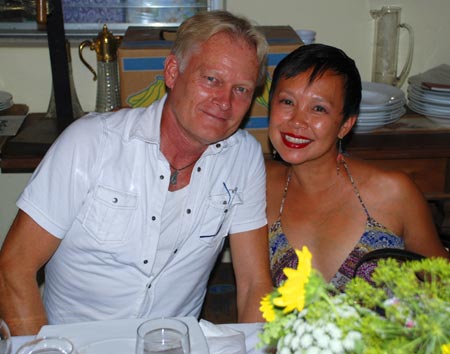
Carolann and Ted Baldyga, Hani Khouri

As the locavore dinner unfolded I couldn’t help thinking that maybe this was the way previous generations ate in this area. Crab, wild pig, cobia, coconut for sure, and other foods were later introduced. Many tropical things, whether native or  introduced, don’t grow in more northern latitudes. Jaboticaba, bignay, betel leaf, callaloo, Red Ceylon peach, rangpur lime, Mysore raspberries  — you’re not going to find most of those at a supermarket in Miami — or New Jersey! (But you can find some things at farmers markets, or grow others in your back yard.)

James and Donna Patrick, Laura Veitia

Earth Dinner calls for us to honor the earth, the very dirt we stand on, by honoring our food. And by so doing, we honor our farmers — a stubborn, determined, independent tribe — who work very hard to feed us. In fact most of the growers who provided the ingredients for our dinner were present — Robert Barnum, Margie Pikarsky, Hani Khouri, George Figueroa, Teena Borek, and guests Thi and Bill Squire representing our local Slow Food Miami chapter.

Bill and Thi Squire

Robert and Margie’s Earth Dinner was only one of two in the entire state of Florida. I’m a bit surprised there weren’t more. A wide range of food grows in the spaces outside urban development, and agriculture is the state’s second largest source of revenue. City dwellers are quick to forget that they live among farmers, even as farmers are pushed back by relentless waves of development.

Robin and Carol Faber

Margie stood up and spoke at the close of dinner. “This dinner is about the importance of the local farmer. It’s important that we support the local foodshed and the richness of the local food here. This is the way to keep our country strong and our food safe. By keeping food regional, it’s easier to control food safety.”

Anthony Rodriguez, George Figueroa, Tina Trescone

Know where your food comes from, or how it was grown and processed. Connect the food with the place where you live, and you will be healthier and stronger for it. At last month’s Earth Dinner, the taste of this place was in the food and drink. It was unlike any dinner I’d eaten anywhere else. And it sure made for good experience and good memories! If I were to savor a perfectly ripe Mysore raspberry or take a sip of bignay wine, blindfolded, years from now, I would remember in a heartbeat this dinner and this particular abundant land — thanks to our local farmers!

Read Full Post »

The dinner table is perhaps the most powerful and delicious place to plant the seeds of change; the return to simple truths, change, and wisdom all go hand in hand. Our first step toward change can be to pause when we take our first bite and think about our connections with food. Aha! Understanding this connection is the essence of the Earth Dinner.
– Theresa Marquez, founder of Earth Dinner

Earth Dinner is a new holiday tradition meant to celebrate Earth Day. It was started four seven years ago by Organic Valley and Chefs Collaborative as a way to gather friends and loved ones around the table for a fresh, seasonal meal made of local ingredients. The focus of the Dinner is to have a meaningful conversation about the food — where it came from, how it was grown or harvested, and who grew it. So it was only natural that farmer Margie Pikarsky and grower/chef Robert Barnum would organize their own Earth Dinner,  held the weekend after Earth Day.

Earth Dinner at Possum Trot Tropical Fruit Nursery.

Call it extreme locavore. The challenge was to source all ingredients — except for flour and olive oil — from what was available locally. And so the hunting and foraging began. Chef Michael Schwartz  donated wild boar he had hunted himself together with local fisherman George Figueroa of Trigger Seafood, who donated cobia. Hani Khouri provided cheese and milk from his goats. Large beautiful heirloom tomatoes came from grower Teena Borek. Callaloo came from Three Sisters Farm, and a variety of herbs and vegetables from Bee Heaven Farm. Winemaker Peter Schnebly donated two kinds of local fruit wine. And a plethora of fruit came from Robert’s own grove.

At the wood smoker, Weber bastes wild boar and Sadie checks multi-color potatoes.

Margie and her crew volunteered to help clean and cook, and Robert’s friends pitched in. Preparations took days and went up to the last minute. When I arrived an hour before dinner, a plume of blue smoke chugged from the wood smoker outside the house, as wild boar and multi-color potatoes cooked inside. Both kitchens were humming with activity as helpers chopped, stirred, snipped and tossed. In the dining room, two long tables were covered with white linen and glittered with fine china, glassware and silver. Centerpieces of mixed flowers — food for local bees — from Bee Heaven Farm graced the tables. Glass goblets were stocked with braided breadsticks that had been baked in the wood oven and looked like branches plucked from the grove. Even the sea salt was local, produced by a small company in the Florida Keys.

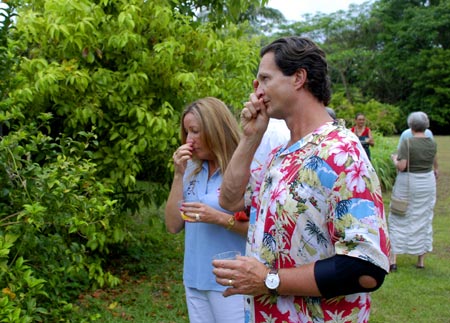
Donna and James Patrick smell crushed bay rum leaves.

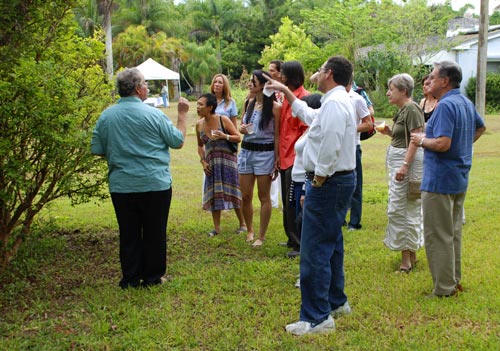
While there was still daylight before dinner, Robert offered guests a short tour of his 40 acre property. Everything he grows is useful in some way. He pointed out bay rum, lemon bay and citronella outside the house, and invited guests to crush leaves and smell different scents. Jaboticaba was nearby, with small, unripe berries growing on its trunk. It bears fruit three or four times a year. Robert harvests the berries for wine, of which we got a taste later in the dinner. Guests strolled through the grove and saw macadamia, mango, and lychee trees (to name just a few of the edibles that I recognized).

<< to be continued >>

Robert Barnum holds up a jaboticaba fruit.


Read Full Post »

« Newer Posts - Older Posts »