Feeds:
Posts
Comments

Archive for the ‘people’ Category

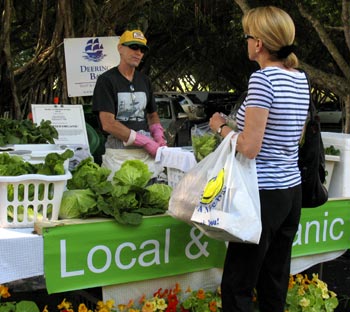
Lettuce Farmer Tim Rowan at the Pinecrest Gardens Green Market.

While most of us are still asleep, farmer Tim Rowan gets up on market days in the middle of the night, turns on the floodlight in his 3/4 acre field, and starts harvesting lettuce and cabbage by 4:30 a.m. The greens are only a few hours old by the time market opens. “That to me is creative,” Tim said. “Growing lettuce is creative. Getting it to customers within hours is creative. Anybody can load it in a box and ship it in. What I have growing that day is what I have at market.”

By 8 a.m. on a recent Sunday morning, Tim was set up underneath a large banyan tree at the Pinecrest Gardens Green Market. A poster size copy of his organic certification hung from the tree, and a big green and white Local & Organic sign was at the front of the table. It was heaped with cabbages and lettuces grown at The Lettuce Farm, Tim’s small certified organic farm located deep in Redland.

Last Sunday, a steady stream of customers and friends appeared at Tim’s table, and he greeted each person, remembering quite a few regulars by name. (He has been selling at this particular market since it started in 1996 in front of Gardner’s Market.) He chatted with them about their kids and families as he briskly bagged up their purchases of salad mix, butterhead lettuce, tatsoi, formosa cabbage and bok choy. A man came up asking for arugula. “All sold out,” Tim told him. “Come early for selection, come late for bargains.” The arugula was gone by 10 am, and almost everything else was gone an hour before the market closed.
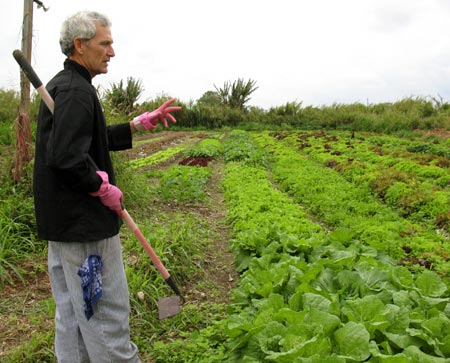
Farmer Tim getting ready to weed his lettuce field.

Before farming, Tim was a chef at Mark’s Place. “Inspiration struck” when he saw all kinds of tropical fruit that came in to the kitchen from Ellenby Groves. His first taste of acidity of a Green Zebra heirloom tomato from Teena’s Pride made him realize that “this is real, fresh food. Growing heirloom tomatoes is something real,” he said. So he planted a backyard garden in 1990, expanded to growing heirloom tomatoes on a Kendall farm in 1992, and hasn’t stopped farming. “I saw the restaurant business as a dead end, and thought this was a way out,” he said.

But Tim is still a chef, working 50 to 55 hours a week at Deering Bay Yacht and Country Club. And he is still farming on a small scale. He bought his current place about seven years ago, and switched to growing several varieties of lettuces and cabbages that don’t require as much work to spray and fertilize. He plants late to avoid bugs. “Caterpillars are the biggest problem,” he explained. The greens are fairly sturdy and didn’t seem to be harmed too much by the recent cold. “Everything had a white coating of frost. I still don’t understand how this stuff can freeze for 12 hours and survive,” Tim said with amazement.

Farmer Tim and a very large cabbage.

His farm finally got certified by QCS (the Florida organic certifier) in 2003, a fact which Tim is proud of. “I got tired of explaining that I don’t spray. Having the certification makes a big difference,” he said. As an organic grower, Tim doesn’t use fertilizer, and instead relies on lots of compost to build up the marl soil of his farm.

Tim got into farming 15 years ago thinking he would stop being a chef, but he still has one foot in the kitchen. Instead, farming is what gives his life balance, feeds his soul and keeps him strong. “The farming part turns work more into a virtue,” he said at the end of a long day. “I go out in the morning and enjoy every part of it. It makes you feel great. There’s no drug that can give you the buzz like that. Clean living is good for your body, and mentally too. The older I get the easier it is to work. You realize how grateful you are to work and reap the benefits.”

Find The Lettuce Farm at these farmers markets: Pinecrest Gardens on Sunday, Key Biscayne on Saturday and Jackson Memorial on Thursday. His lettuces are also available at Norman Brothers Market in Kendall.
Follow The Lettuce Farm on Facebook

Read Full Post »

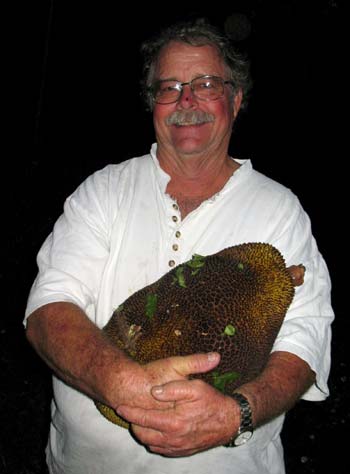
Robert just loves some jakfruit.

Last week was the start of a new CSA season, and to kick things off, The Cantankerous Chef AKA Robert Barnum invited Farmer Margie and her crew of interns, apprentices and volunteers to come over for dinner at his Possum Trot Tropical Fruit Nursery. Every CSA season, Margie has a different group of people picking and packing all the goodies you get in your share box. This year’s helpers are Jane, Liberty, Helene, Tomas, Eric and Lauren. They have come from as near as Florida and as far as Michigan and Europe to work at Bee Heaven for the season.

The group arrived at Possum Trot just as the sun was starting to set. Robert offered an abbreviated tour of his 40-acre grove before dinner. We strolled down a grassy path and paused from time to time as he pointed out various trees. (This is by no means a complete list of what grows at Possum Trot.) He has: osceola tangerine, macadamia (squirrels pillage the nuts), grumichama (which has a cherry-like fruit), jaboticaba, pithacyillobium (its sawdust will stain your skin blue, really!), a giant brassus palm killed by last winter’s freeze and still standing, mamoncillo, Central American walnut, several jakfruit loaded with fruit, sugar palm, oil palm, and Orinoco banana. Over in the lychee section, golden orb weaver spiders had spun their webs overhead, and appeared to float against the darkening sky. As we walked and listened to Robert’s spiel about his trees, the twilight grew deeper and an almost-full moon rose over the tree tops. It was getting too dark to see, so we headed back to the farm house where we were greeted by the mouthwatering aroma of bread baking.

The Crunchy Bunch: Liberty, Helene, Robert, David, Eric, Lauren, Jane, Tomas. Not seen: Margie, Marian.

The menu was curried pork with local organic green beans (which were still crisp and crunchy), white rice, avocado salad, a mixed organic greens salad made by Margie’s crew, and bread still warm from the oven. We had a lively discussion on how we liked our beans cooked. It was determined that that there are two kinds of people when it comes to beans — those who like them crunchy, and those who prefer them soft. Everyone at the table agreed that they preferred crunchy green beans, then somebody suggested that we were the Crunchy Bunch…

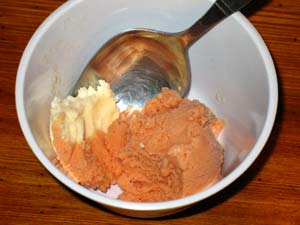
Mamey-pineapple-banana ice cream, with a dab of cas guava ice cream at the bottom.

I didn’t realize how hungry I was until I started eating, and forgot to photograph my plate before it was devoured. I guess that means it was good! Robert scooped up homemade mamey-pineapple-banana ice cream, which was outrageously smooth and creamy. Banana mellowed mamey, but pineapple was a bit shy.

After dinner, we broke out the wine. Robert’s friend David Weingast, who had joined us for dinner, brought a California organic petite sirah. (David’s Organic Company ships Robert’s fruit.) Robert produced two bottles of his home brewed bignay wine. One tasted much like a merlot, and the other was a sweet dessert wine made with champagne yeast. The Crunchy Bunch sipped and sampled and picked their favorites. The dessert bignay got a lot of votes. It was a pleasant end to a delicious meal, and the Bunch enjoyed their last easy night before the frenzy of the CSA season began.

For lunch or dinner reservations, trees, fruit and/or a tour of Possum Trot, contact Robert Barnum at 305-235-1768 or possumplentious@yahoo.com.

Read Full Post »

Ten students from the Ecology Club at Miami Southridge Senior High School put in a day’s work at Bee Heaven Farm. This was not just any kind of work day but an Environmental Immersion Day, as part of the Fairchild Challenge, sponsored by Fairchild Tropical Botanic Garden.

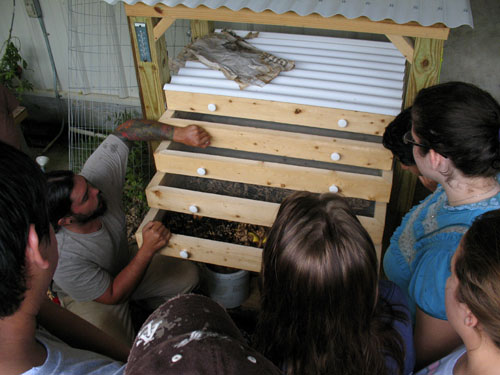
On Thursday, November 3rd, ten students, their Ecology Club advisor, and the Challenge coordinator arrived bright and early in the morning. Farmer Margie gave them a tour of the farm, along with a explanation of organic farming practices that she follows. The kids were introduced to the vermicomposting setup by intern Eric Morales, and learned how to grow worms to make worm castings and worm tea, which are then used as fertilizer.

Farm intern Eric Morales teaches the ins and outs of the Worm Manor.

But the must important part of the day lay ahead. The students’ mission was to get rid of invasive, non-native plant species that had taken root in a buffer section planted with native plants. On the non-native hit list were long pesky

Non-native jasmine vine

vines of a sweet smelling but totally invasive variety of jasmine, a variety of morning glory, and wild petunia with purple flowers. Although these plants look pretty when they bloom, they can quickly overwhelm the natives by competing for light and space.

The non-natives had put down long runners that threaded through and on top of cabbage palm, coontie and and other native plants in the buffer area. Those vines are tough to remove. You can’t just grab and pull on it, and expect it to come up. You have to grab one end and start working your way back to the root, then dig a bit to pull it out, or the whole plant will grow back.

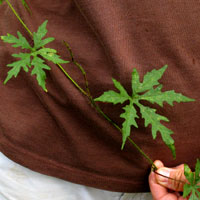
Non-native morning glory

Margie carefully pointed out the difference between the non-native jasmine leaves which had a pointed tip, and a very similar native plant which had smaller leaves with a rounded tip. An albizia, or woman’s tongue, tree was attacked by students with loppers and a pruning saw. They hacked it into chunks, loaded them into a wheelbarrow, and wheeled it to the compost heap. Part of a shrubby Brazilian pepper suffered a similar fate.

Farmer Margie shows how to attack Brazilian pepper.

The students were accompanied by the Ecology Club mentor, Jennifer DeHart, who teaches AP environmental science at Southridge. She picked students who were the most active in the club to participate in this day’s Challenge. Her ten

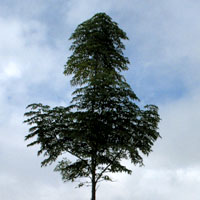
Non-native albizia or woman's tongue tree

students worked hard, sometimes in a drizzling rain, and cleared out a good bit of “bad” plants by the end of their day. Most importantly, they learned a bit more about plants, worms and organic farming — and what to do about a wasp sting.

Non-native wild petunias

Also on hand was Challenge coordinator Marion Litzinger, from Fairchild Tropical Botanic Garden. She explained that the Fairchild Challenge is a free school program to get kids involved in hands-on activities alongside scientists or growers. The goal is to reconnect kids with nature and the environment, Marion explained. Students win points based on doing different Challenges throughout the school year, and all the points add up to winning varying amounts of money for their school, as much as $1000, meant for improving the environmental situation at the school.

For more information about the Fairchild Challenge, contact Marion Litzinger at 305-667-1651 ext. 3356 or mlitzinger@fairchildgarden.org.

Read Full Post »

Katie Edwards

MW: How to keep the land in agriculture? The farmer thinks that the land was your bank, that’s your retirement fund.

KE: I’d rather see us focus, before we start looking out, start looking in and focus more on reinvestment. Even in the city of Homestead there are things that we can be doing for energized growth. I think, you take the lazy approach and say Ok you know what, I don’t like what I drew on that piece of paper, scratch, give me a new one. That’s the mentality. It’s so much easier.

MW: So you’re saying the urban sprawl is not economically viable any more?

KE: I don’t think it ever was. I don’t think it ever was. I don’t think it makes sense to build up out of there. I don’t think we should vilify farmers for the predicament that they’re in. I don’t think that they created it That’s the plot in life God gave them, is they’ve got land that has to be planted, and they’ve got to be able to take out money to sell their crops, to buy their seed, their inputs, their fuel at the beginning of the season, and what do they do, they go to the bank. Pre-NAFTA they were making money and they didn’t have these issues. And all of sudden, it’s like everything happened. We convert row crop land to nurseries, and we end up that there are 1200 nurseries in Miami-Dade County, that’s too many. And then what happens? We’ve got water restrictions and people aren’t buying plants. And then we have a recession and housing market, there’s nothing to landscape. People would rather pay off bills rather than landscape or re-sod their homes. Most of the nurseries are on small parcels. They can’t put a subdivision in there. So what do the growers do? They are abandoning, they’re walking away from their properties saying I can’t make it, sorry. That’s the problem. Drive around Redland and see how many nurseries there are with for sale signs up, vacant ground covering those lands there. They can’t afford to maintain them. That’s the problem I’ve encountered.

MW: How does Farm Bureau speak for the small guy? Or is Farm Bureau only for the big guys?

KE: I’ve got quite a lot of small growers [as members]. A lot of these guys are new farmers, some are generational growers, but some are completely new to the business. We’re just trying to find ways trying to make everyone happy, because in my industry the people that I represent are so diverse, ethnically, gender-wise, age, income and what they grow. You’re going to have some issues that collectively we all agree on, but everyone needs a different type of help and assistance. What my big farmers need help with are immigration issues, so most of their issues are federal. With the smaller farmers need mostly are county, they want help with their certificate of occupancy at farmers markets, they want help with ag assessment, they want help marketing, they want help making inroads talking with chefs.

MW: In other communities you have farmers communicating with chefs. Food writers are writing about eating local food. Would be great if more restaurants sourced locally.

KE: Absolutely! You help promote, you do incentives, you provide more awareness and recognition like for programs like Redland Raised. And the farmers have the chance to be entrepreneurs, to adapt and to be creative. Because if we’re going to be adaptive in the industry and keep looking for new and emerging markets, we can’t have the state, or most oftentimes the county saying, no you can’t do this. With the winery for example, I helped Peter Schnebly with the winery ordinance. Originally, that was illegal. And all the residents in the Redland were fighting against it saying it will be disruptive, it’s not going to do anything for us, and now they all love it. And that was the whole thing, trying to find a way to get creative. You have to have common sense. You have to give growers enough flexibility to be able to be entrepreneurs, to be creative and to stay in business.

MW: What issues come up at fundraisers?

KE: Each population has its issues. The issues in Sweetwater aren’t the same as the issues in Homestead or the Redland. And you talk and you learn. Part of what I do is try to bring people together, find commonalities, and then figure, where we can compromise and where can we get stuff done.

One of the biggest issues in West Kendall is dealing with the homeowners associations. With the huge rate of foreclosures and trying to strike a balance between the rights of the condo association, the rights of the homeowner, the rights of the bank that actually has title when someone has to walk away from the mortgage. How do you look at it as a human being, but what does the law say? You can’t keep asking private citizens to bear more of the brunt of the economic crisis when it comes to the HOAs and the foreclosures.

The other issue that’s important to me is property tax reform. It’s very expensive to be a homeowner in Miami-Dade County. When I began doing comparisons online, looking at the Miami-Dade Property Appraisers website, I saw the complete inequities in what we’re paying but we’re all sharing the same services. Let’s say I pay 2 thousand dollars a year in property taxes, my neighbor next door pays less because they bought their home in 1998, that to me is not fair. We’ve got to figure out something holistically that provides people an opportunity to share in government services that’s not based on some fictitious value, which is to me all these fair market values are, it’s just whatever the market is. I’m willing to put it out there and tell people we’ve got to have a serious conversation on how to fix this and make it at least equitable and fair for all of Floridians.

When I come back from Tallahassee I’m still going to go in to the Royal Palm Diner, and I’m still gonna have to face these people who are going to grill me and say, why did you sell out, why did you do this? I want to be able to still be Katie and still be a member of this community and have my name in good standing. I don’t understand how anybody could ever lose sight of the fact that they are going up there not for themselves but for other people. And these people, they’re giving you their vote, which is the most powerful thing they could ever give you. If someone says, I can’t give you a donation, I say that’s fine, what I really need is your vote. The money is great but it can only go so far, though. When people come to you and they say, when you get elected I want you to help me work on these projects, I’m like, absolutely. You have to give them an open door, you have to be accessible.

Read Full Post »

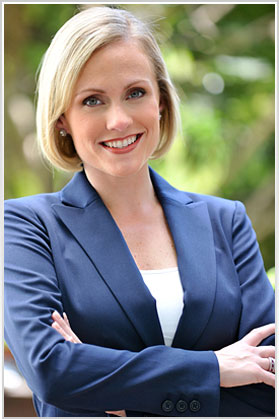
Several months ago, I had the chance to interview Katie Edwards. She is running for State Representative, District 119, and is currently the executive director of Farm Bureau. Katie is quite familiar with issues that affect growers in South Dade; and since I blog about growers, our interview focused on agricultural issues.

I have not contacted or interviewed her opponents Frank Artiles, Nestor A. Iglesias, and Graziella Renee Denny. I did  look at their web sites to see where they stand on the issues. Iglesias doesn’t have one. Denny’s web site is completely blank. And Artiles is concerned about the economy, jobs, property tax issues, education, healthcare — everything under the sun except local ag! Do any of these candidates know where their food comes from? Do they care about who grows their food? It appears that only Katie does.

Don’t forget to vote on Tuesday November 2nd!

MW: What does Farm Bureau do?

KE: Farm Bureau is a membership organization. We have about 4 thousand members,  about 2100 who are actively engaged in farm production. All of the vegetable farmers are FB members. About 80 percent of the nursery growers are Farm Bureau members. Most of the tropical fruit growers I represent, apiaries or beekeepers, and aquaculture. That would be everything from koi and Everglades ciclid to the Everglades alligator farms. So what we do represent in terms of membership is incredibly diverse. Most of our membership lives here in South Miami-Dade County.

MW: Tell me about your job with Farm Bureau.

KE: I’ve worked with Farm Bureau  for about seven years now, and I reach out to politicians and like to get them down here so that they can fully appreciate the impact of their decisions. I want them to remember the nursery growers and farmers down in Homestead, and to think about those family farmers when they vote on a bill.

One thing very important to Farm Bureau and to me is helping educate policy makers so that there is an appreciation for agriculture, the state’s leading industry, and also for them to recognize that within their own county we’re the ones producing the food. So you have to look at it very holistically and reach out to the people outside of our borders.

MW: There’s been a lot in the local media about the freeze. How have you been putting a face to the farmer, and what kind of feedback have you gotten?

Katie Edwards

KE: When people think about a freeze and agriculture, people think, how is this going to impact the price of orange juice? Consumers don’t realize the amount of capital that the grower already has in the ground from the very moment that seed is sown. You’ve got your land rent, you’ve got your labor expenses, so when a freeze comes and wipes out and devastates your crop, you still have expenses that you can’t recover and pass along.

Sometimes it’s a race against time because every season you’re getting essentially a four-month window to make make enough money to cover your expenses, and then maybe offset money that you lost last year. And the last couple of seasons we’ve had a very difficult time trying to keep up with fertilizer and fuel expenses.

The other thing is going forward, this freeze helps us remember how important American agriculture is. If we don’t have a safe domestic food supply that can produce for all of us during the winter months, then we’re dependent on foreign countries.

MW: Are there any subsidies for growers here in Florida?

KE: The subsidies are for primarily commodities. Just so you understand, the stuff we grow here is not subsidized. So 97 percent of what Florida produces is not subsidized, maybe some peanuts and a little bit of tobacco and some cotton in the Panhandle, which accounts for 3 percent. But everything that we grow down here are not commodities. Like the old saying, we’re price takers not price makers.

MW: What’s your position on the UDB?

KE: When I go downtown and speak [before the county commission], I choose my battles carefully and I choose them wisely, because if I’m always going downtown against something, you lose credibility very quickly. I’ve seen that happen to people in this area. But with the UDB, we’re not one of the organizations that’s out there in bed with the developers saying we want to have more projects. I mean the Parkland project scares us, because if I lose 900 acres of agricultural land, that’s the chink in the chain. It’s like, you can get one, it can go right after that. And what about the property rights of the guy — we all have property rights — what about the property rights of the guy next to him? Doesn’t he have the right to keep farming without being a nuisance to homeowners and all the ancillary issues that goes along with that? He made an investment, he wants to continue farming. I have to protect his rights too.

I think we can all agree that we want to have agriculture in Southwest Miami-Dade County. I don’t think there’s anybody that says, I don’t want agriculture here. And if they do, I’d be very surprised. But I think a common goal — and I like to look at the commonalities — we all want to have agriculture here in Miami-Dade. So I look at it and say ok, take the UDB issue off the table, and let’s spend our time, our resources, our capital, talking about what we can all do to help make sure that farmers aren’t forced to make the difficult decision to then have to sell to the developer. That’s the whole crux of the problem.

Tell me what you’re doing to help the local farmers. I want to do my own reality TV show and call it Do You Want To Be A Farmer, and invite all these people to come down here. I’m going to say to them, you go to the bank, you go to farm credit, take out a loan for 10 million dollars, I want to see you make a buck. They wouldn’t know what end was up and even how to turn a damn tractor! I’ve said that for years, that’s what I’m up against. I’m losing farmers to foreign competition and you guys aren’t helping the farmers out.

(To be continued)

Read Full Post »

« Newer Posts - Older Posts »