Feeds:
Posts
Comments

Archive for the ‘photo’ Category

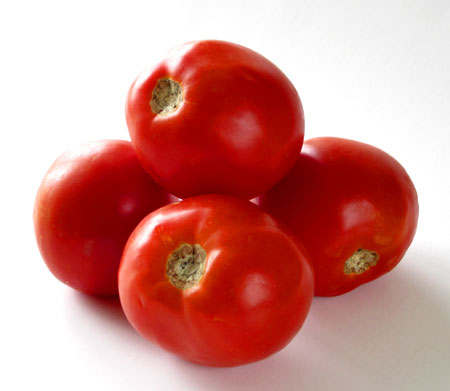
Locally grown round red slicers.

Round and red, and kind of ordinary looking, the slicing tomatoes in your CSA share box a few weeks ago didn’t seem very special, did they? But they are, and what made this year’s crop different is the way it was grown — in pots of soil, not directly in the ground. (The variety itself, Florida 47, is a commercial hybrid that’s been around for a long time, and is known as a good producing plant.)

Dan’s field of tomatoes in pots.

Farmer Dan raised the Florida 47s one plant per container, dozens of rows marching across a field blanketed with shiny black landscaping cloth, hundreds of staked tomatoes filling up three and a half acres. Why grow in pots? Because the land Dan had to use for growing, across from the Keys Gate Market Garden, was former swampland filled in with rock and even chunks of concrete, thin soil supporting only weeds. “Seven, eight, ten feet of fill instead of soil, and it was absolutely impossible to grow anything there,” Dan explained. Thus hundreds of pots, growing plant nursery style — a quick solution to the no-soil problem. (Plus, it was also the quickest way to get the operation certified organic.)

Read the fine print. This tomato came from Mexico. And people bought it because it’s cheap.

The tomatoes were delicious and beautiful, but financially the crop was a disaster. Startup costs were much higher than if he had planted directly into a fertile field. The potted plants required a lot of input — fertilizer and insect control sprays — plus you have to take into account the cost of soil, pots, landscaping cloth, irrigation and labor. “It cost me seventeen thousand dollars gross to set up, and my net was damn near nothing,” Dan grumbled.

Just as Dan was starting to harvest a few weeks ago, round red organic tomatoes from Mexico flooded the local market. (You might have seen them at area stores.) Thanks to NAFTA, the dollar-peso exchange rate, and low labor costs, organic tomatoes from Mexico were wholesaling for a lot less than what Dan was asking for.

No way he could make a profit. And he was stuck with bushels of tomatoes he had to unload. So he sold them at cost to farmer Margie of Bee Heaven Farm, and everybody in her CSA, large and small shares alike, got round red tomatoes. And, there’s Florida 47s to be had at the Keys Gate Farmer’s Market on Saturdays, and Pinecrest Gardens Farmers Market on Sundays, while they last.
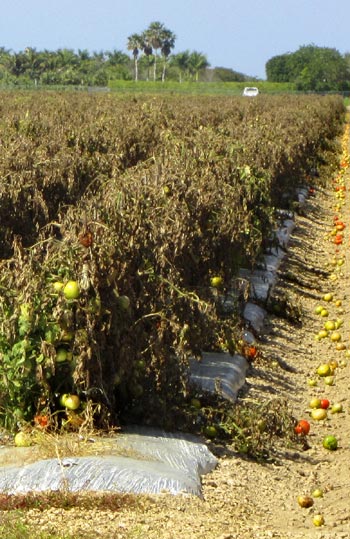
Tomatoes left to rot.

It’s not just organic growers who gambled and lost hard this season. I saw a field off Krome Ave. and SW 168 St. where the grower didn’t even bother harvesting his tomatoes. He left his crop to rot on the vines. Half the field was brown and dead, like it went through the worst freeze — and in the absence of recent cold weather, a sign it had been doused with herbicide. Why bother to spend more for labor to pick the crop when he was already in the hole raising it? (Food activists may want to chime in about holding off on chemicals, and allowing people to come glean fields to salvage food.)

Mexican produce aside, growing organic tomatoes in pots was an interesting experiment, but not one Dan cares to repeat any time soon. “It’s not sustainable,” he said. He is sticking with growing slightly more profitable green beans grown in a field of real dirt. It’s a gamble he knows how to win a bit better, providing there’s no hard winter freezes. “You want to know how to make a little money in farming?” Dan asked. “Start with a LOT of money.” And he laughed long and hard at his familiar joke.
Read Full Post »

A hen lays an egg every day.
True. Hens generally lay around the same time of day, usually in the morning. To get more technical, it takes about 25 hours for an egg to form and travel through the oviduct, causing the hen to lay her egg a little later each day. As the cycle progresses, she will skip a day (hens don’t lay eggs in the evening) and start a new cycle. A group of eggs laid during one cycle is called a “clutch.”

A hen will lay eggs all its life.
Maybe. A young hen, called a pullet, will start laying eggs at 6 months until its first moult. It will then resume laying eggs in the second year at 80% of its previous rate, then 60% of that year’s rate in the year after that. After 3 years, laying drops off. But a hen can keep laying eggs for several years after, just not every day. Older hens usually stop laying eggs, but some might keep laying an occasional egg.

A very big hen lays the big double yolk eggs.
False. A pullet, or young hen, that doesn’t have a regular laying cycle can occasionally lay double yolk eggs. That happens when ovulation happens inconsistently, and one yolk joins the next as the egg develops. (Some breeds will regularly lay double yolk eggs.) Of course, a double yolk egg is much larger than a normal sized egg. Sound painful? Not really. The egg comes out soft and its shell hardens in contact with air.

An old egg will float in water, but a fresh egg will sink.
True! A fresh egg will sink in a bowl of water, but as it gets older, it will start to stand up. A very old egg will float. Don’t eat that one! Inside the egg is a small air pocket at the blunt end. Eggshell is porous to air, and as the egg ages, more air will slowly seep in, and make the air pocket bigger.

The best place to store eggs in the refrigerator is on the door.
False! Keeping eggs in the refrigerator door is bad, because every time you open the door it changes temperature — hot, cold, hot, cold. Always store eggs in the carton with the pointy end down. To keep eggs fresh longer, find a spot for them on the shelf where the temperature is cool and consistent.

Read Full Post »

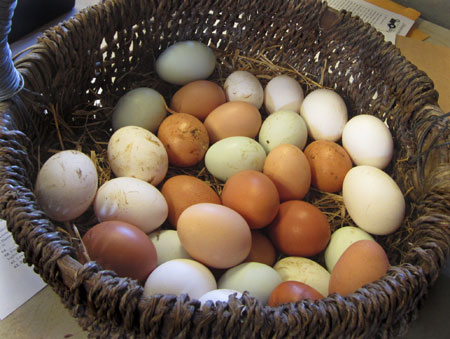
White chickens lay white eggs, and brown chickens lay brown eggs.
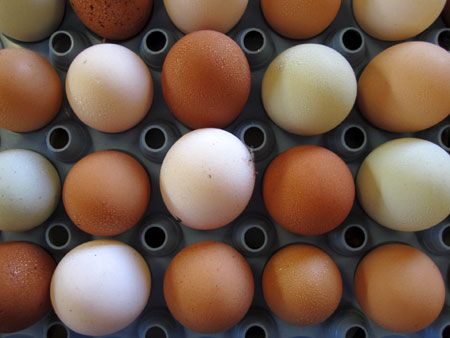
Not true! The color of the egg is determined by the color of the hen’s ear lobe. White ear lobes indicate white eggs, and red or pink earlobes indicate brown, blue or green eggs, depending on the breed. Some brown breeds, like Rhode Island Red, will lay brown eggs, but other varieties of brown hens don’t. Cuckoo maran hens, which have black and white speckled feathers, lay dark brown eggs, with shells so dark in color they are called “chocolate” eggs.

So does that mean that green chickens lay green eggs?
Sort of. Araucana hens will lay green, blue, and pinkish beige eggs. They do not have green, blue or pink feathers. Look at their feet! Instead of white, yellow or gray, their feet are blue or green, ranging from pale to deep in color.

Speckled eggshells mean the hen was stressed.
Maybe. Certain breeds consistently lay speckled eggs. Or the dark brown speckles could be tiny flecks of blood that were deposited on the egg as it traveled through the oviduct. It just happens sometimes, no worries. The hen is ok and the egg is good to eat. If a hen is stressed, such as when she is moulting (seasonally shedding feathers) or getting henpecked (ever hear of pecking order? it’s real), she will stop laying eggs for a while.

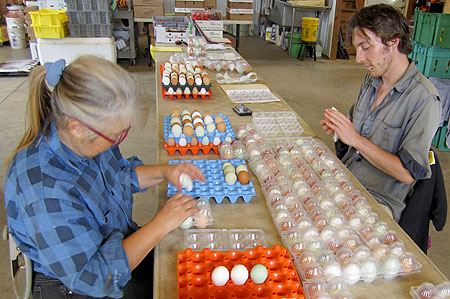
Farm interns Donna and Jon pack eggs.

A blood speck next to the yolk of an egg means that the egg is fertilized.
Not true! It means that a little bit of blood got inside the shell as the yolk was developing. You can tell if an egg is fertilized only if you hold up the egg to light (candling) to see if an embryo is forming. The egg needs to be incubated in warmth (under the hen in a nest, or in an incubator) for the embryo to develop.

An orange yolk is more nutritious than a yellow yolk.
Mostly true. But, some breeds, like the araucana, lay eggs with a light colored yolk. A deep yellow or orange yolk egg generally comes from a pastured or free range hen, which has a chance to eat a variety of nutritious things, including plants and bugs. Marigolds have carotenoids which make egg yolk color darker. An orange yolked egg is not necessarily fresher than a lighter yolked egg.

Read Full Post »

Cleopatra tang’y’rines

Cleopatra tangerines

Tangy indeed! Pop one of the little segments into your mouth and you’re in for a sweet-sour surprise. The Cleopatra variety of tangerine is not shy about expressing its citrusy flavor, but it’s downright sour if you pick it too early. The best fruits are the ones that have just fallen off the tree, their tartness mixing with sun-ripened sweetness.

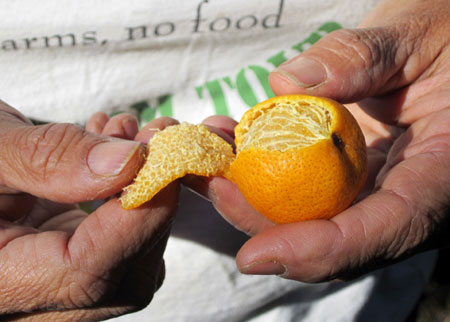
Farmer Margie peels a tangerine.

Cleopatras are a mandarin orange characterized by loose skin and small segments. (This is a variety that’s usually canned, not sold fresh, because of its tartness.) The fruit itself is small, no more than two inches across. The skin is edible, and has a high oil content, making it very aromatic and quite tasty. You can eat the skin fresh, or use it in cooking, like for for orange beef, to flavor oil for the dish.

The Cleopatra tree is usually used as rootstock, to graft another variety of citrus onto it, because it can tolerate cold and resists most diseases. It has been around for a long time, introduced from Jamaica to Florida before 1888.

During the winter season (January and February), the tree will be loaded down with fruit. The season for Cleopatras is starting to wind down, so get them while you can!

Read Full Post »

Cooking with fire!

Saturday, Feb 4, 2012
9:30 am – 3:00 pm

Possum Trot Tropical Fruit Nursery
14955 SW 214th St.
Miami, FL 33187-4602
305-235-1768

Convert your gas grill to burn wood. That’s the first of a series of survival workshops that grower/chef Robert Barnum is teaching. “I teach long lost trades, arts, and skills that can be quite useful if the situation becomes less than what it is today,” he said. Robert has teamed up with Jason Long, who started the Re-skill Florida school “where anyone can teach and learn honorable useful skills,” according to their web site.

Bring your gas grill to the workshop and Robert will show you how to safely modify it. Instead of expensive gas, burn wood, and use your own. Being able to cook with wood can save money, and teach you how to be more frugal and self-reliant. Robert has plenty of experience when it comes to being self-reliant. Over the years, he has experimented with which woods are better for cooking, and which are to be avoided. “Don’t use Brazilian pepper, oleander or mango,” he suggested, “as the smoke can be irritating to some people.” He should know — he has 40 acres of trees on his Possum Trot Tropical Fruit Nursery.

There’s room for 35 people, but hurry as the class is selling out. The cost if the workshop is $50. It includes the registration fee, instructor fee, grill modification fee, and lunch. You could try to register online at the Re-skill Florida web site, but when I checked on Wednesday night, the registration button was still not working.

Instead, call Robert at 305-235-1768 to let him know you’re coming, and bring cash to pay at the door. If you haven’t been to Possum Trot before, you will need directions, as the entrance is a bit tricky to find, and the address doesn’t show up on some GPSs.

The gas-to-wood grill workshop is the first of a series of Saturday classes. Coming up:

Feb. 11th — Rope making with Agave
How to make rope from agave plants. Optional: Learn preparation, and camp out the night before.

Feb. 18th — Introduction to economic botany
Learn which trees and plants to grow in your yard for food and other useful purposes.

Feb. 25th — Kitchen frugality
What to do with all the food in your CSA box, and how to shop in bulk and store food.

Read Full Post »

« Newer Posts - Older Posts »