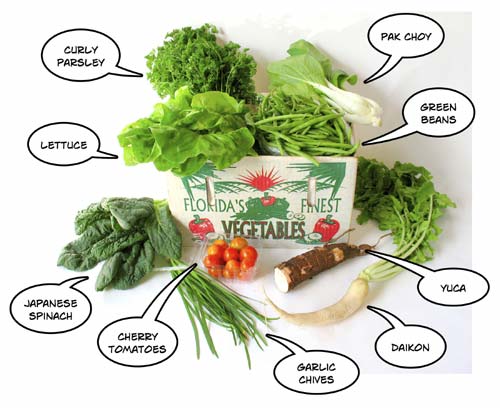
CSA share: week 1
Posted in comic, csa, food, photo, tagged csa, share on November 19, 2010| 1 Comment »
CSA share: week 1
Posted in events, food, location, locavore, market, photo, tagged farmers market, Pinecrest Gardens Farmers Market, Redland Organics on November 15, 2010| 6 Comments »
The Pinecrest Gardens Green Market opened for the season two Sundays ago, and you couldn’t ask for a better day, sunny and cool, and not too humid. It was a great day to take the kids and dogs outside and stroll among the tents, shop for farm fresh produce and grab a bite to eat.
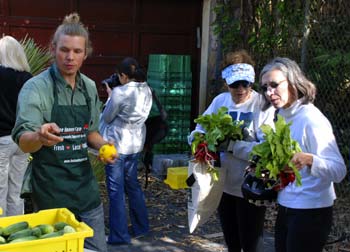
Farm intern helping shoppers with their purchases.
The big Redland Organics tent dominated the west entrance of the market, and its tables were loaded with a variety of fresh, organic fruits and vegetables. It’s one of many sellers returning this year, and plenty more new ones were added to the mix. There are 50 vendors this year, according to Alana Perez, the Director of Pinecrest Gardens. I caught her prowling the market snapping pictures with her iPhone. She was delighted about the turnout on the first morning of the season. “This has really taken off, it’s huge!” she exclaimed. “The market has community support and it has a loyal following.” And the hungry community was there shopping up a storm. They lined up eight and ten deep to pay at the Redland Organics tent. By noon, Farmer Margie had sold out of grape tomatoes, all greens, and most fruit and vegetables. Only a few green peppers, zucchini, thai basil and some mamey remained.

Eggplants with schnozzles, proboscis, protruberances, and curlicues.
This year the market setup was a bit different. The tents were moved back to a row of banyan trees behind the main parking lot for the Gardens. It was hard to see tents from the road when I drove up. Then I spotted two small signs pointing me to the parking lot. Some vendors would have preferred to be visible from the street, like last year. But Alana Perez explained the move freed up more parking spaces. And Farmer Margie pointed out that the trees provide shade that helps keep produce from wilting in the heat.
Of the 50 vendors, there were more selling non-food items, like stoneware and solar systems. One produce seller groused, “It becomes more like bargaintown.” Bud and Linda, two shoppers who stopped to chat with me, love the market but had mixed feelings about its new incarnation. Bud told me, “I don’t want it to be like a flea market. There shouldn’t be anything that’s not edible.” Linda liked the old location by the street, and found the narrow aisles a bit claustrophobic. Both shop at the market to support local growers. “The people who are local are proud to be local,” Bud pointed out. “As for people who are not, it should be compulsory to say where the food came from.” (If they don’t have a sign, peek under the table at the produce boxes to discover where things came from.)
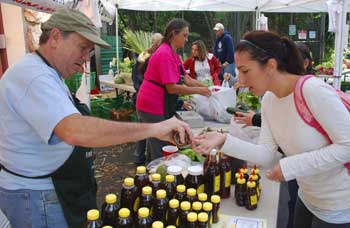
Farmer Nick offers a taste of local honey.
Most produce was local, and customers who want something that’s not ready for harvest right now will just have to wait a little longer. Overheard at the Redland Organics tent:
Customer: I want kale. Why don’t you have kale?
Farmer: Because it’s not ready yet. It’s not in season.
Customer: How come Whole Foods has kale?
Farmer: Because they get it from California!
Farmers markets are about eating in season, celebrating local food, and enjoying freshness you won’t find in any supermarket. Support your local farmers and you’ll support local families too.

Local food bloggers Laura Lafata of La Diva Cucina, Trina Sargalski of Miami Dish, and Paula Nino of Mango & Lime.
Posted in agritourism, chef, events, farmer/grower, food, locavore, photo, tagged Possum Trot Nursery, Robert Barnum on November 12, 2010|
Robert Barnum AKA the Cantankerous Chef sent me an email about a recent event at his place, Possum Trot Tropical Fruit Nursery. Text and photos by Robert.
Possum Trot hosted 16 Brazilian farmers for lunch and a tour on October 28th. They were on a South Florida farm tour after attending the PMA (Produce Marketing Association) meeting in Orlando. The farmers first visited Burr’s Berry Farm, and owner Charles Burr and his wife accompanied them for lunch here. Stuffed jackfruit pouches and boiled jackfruit seeds, with pumpkin sauerkraut soup, and wood oven fired bread sticks started out the meal. Wood oven roasted betel potato and carrots, and carambola glazed wood roasted chicken followed as the main course. Carambola pie with cas guava ice cream finished the meal. Homemade jaboticaba and bignay tropical fruit wines accompanied the meal. A tour of the plantings finished my portion of their farm tour day of South Florida.
The Cantankerous Chef would be delighted to host your next event. Lunch or dinner includes a tour of his 40 acre grove of tropical fruit trees. For information and reservations, call Robert Barnum at 305-235-1768 or email possumplentious(at)yahoo.com.
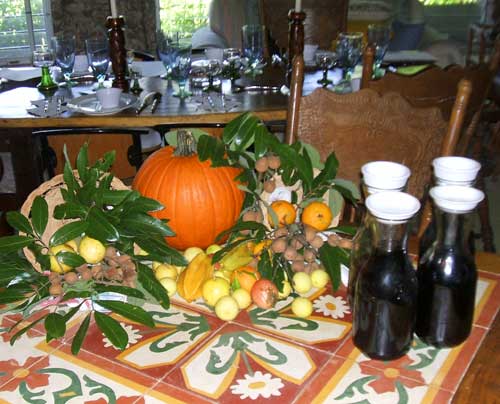
Tropical table setting of cas guava, star fruit, longans and rangpur limes, all grown at Possum Trot. Carafes contain jaboticaba and bignay fruit wines. Only the pumpkin isn't local!
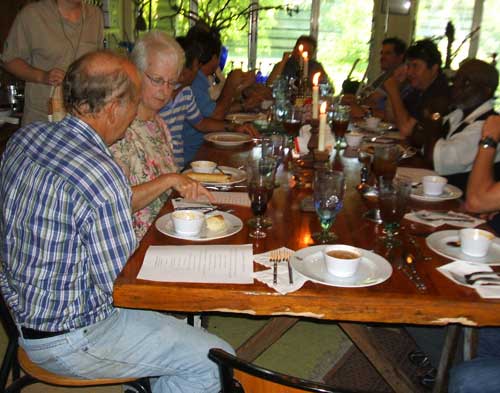
Brazilian framers and the Burrs seated at the rustic table in Robert Barnum's home.

Bread that had been baked in the outdoors wood oven.
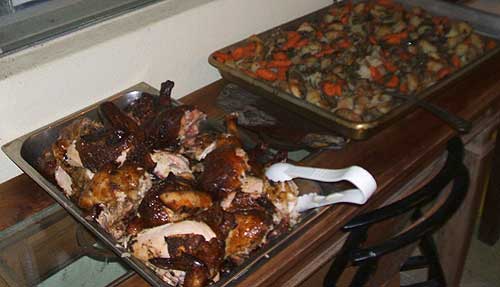
Wood oven roasted chicken, and betel-seasoned potatos and carrots.

Brazilian farmers with Robert Barnum (back row, third from right).
Posted in events, farm, people, photo, tagged Fairchild Tropical Botanic Gardens, Miami Southridge Senior High School on November 8, 2010| 1 Comment »
Ten students from the Ecology Club at Miami Southridge Senior High School put in a day’s work at Bee Heaven Farm. This was not just any kind of work day but an Environmental Immersion Day, as part of the Fairchild Challenge, sponsored by Fairchild Tropical Botanic Garden.
On Thursday, November 3rd, ten students, their Ecology Club advisor, and the Challenge coordinator arrived bright and early in the morning. Farmer Margie gave them a tour of the farm, along with a explanation of organic farming practices that she follows. The kids were introduced to the vermicomposting setup by intern Eric Morales, and learned how to grow worms to make worm castings and worm tea, which are then used as fertilizer.
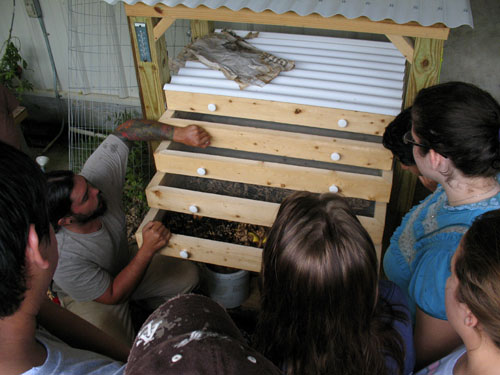
Farm intern Eric Morales teaches the ins and outs of the Worm Manor.
But the must important part of the day lay ahead. The students’ mission was to get rid of invasive, non-native plant species that had taken root in a buffer section planted with native plants. On the non-native hit list were long pesky

Non-native jasmine vine
vines of a sweet smelling but totally invasive variety of jasmine, a variety of morning glory, and wild petunia with purple flowers. Although these plants look pretty when they bloom, they can quickly overwhelm the natives by competing for light and space.
The non-natives had put down long runners that threaded through and on top of cabbage palm, coontie and and other native plants in the buffer area. Those vines are tough to remove. You can’t just grab and pull on it, and expect it to come up. You have to grab one end and start working your way back to the root, then dig a bit to pull it out, or the whole plant will grow back.
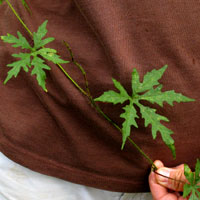
Non-native morning glory
Margie carefully pointed out the difference between the non-native jasmine leaves which had a pointed tip, and a very similar native plant which had smaller leaves with a rounded tip. An albizia, or woman’s tongue, tree was attacked by students with loppers and a pruning saw. They hacked it into chunks, loaded them into a wheelbarrow, and wheeled it to the compost heap. Part of a shrubby Brazilian pepper suffered a similar fate.

Farmer Margie shows how to attack Brazilian pepper.
The students were accompanied by the Ecology Club mentor, Jennifer DeHart, who teaches AP environmental science at Southridge. She picked students who were the most active in the club to participate in this day’s Challenge. Her ten
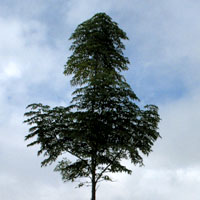
Non-native albizia or woman's tongue tree
students worked hard, sometimes in a drizzling rain, and cleared out a good bit of “bad” plants by the end of their day. Most importantly, they learned a bit more about plants, worms and organic farming — and what to do about a wasp sting.

Non-native wild petunias
Also on hand was Challenge coordinator Marion Litzinger, from Fairchild Tropical Botanic Garden. She explained that the Fairchild Challenge is a free school program to get kids involved in hands-on activities alongside scientists or growers. The goal is to reconnect kids with nature and the environment, Marion explained. Students win points based on doing different Challenges throughout the school year, and all the points add up to winning varying amounts of money for their school, as much as $1000, meant for improving the environmental situation at the school.
For more information about the Fairchild Challenge, contact Marion Litzinger at 305-667-1651 ext. 3356 or mlitzinger@fairchildgarden.org.
Posted in farm, farmer/grower, location, photo, vegetables, tagged Bee Heaven Farm, Jane Cameron, Margie Pikarsky on October 21, 2010|
You haven’t heard much from me these last few months because I’ve been feeling de-pleated by condo board responsibilities. Small problems were looking big, and bigger problems looked overwhelming. Time to hit the reset button, so I headed down to Bee Heaven a couple weeks ago to get some much needed farm therapy.
Fall is planting time down in Redland. Summer is just too hot, too buggy and too rainy to grow much of anything. Planting starts in the fall near the start of the dry season, and harvest is in the spring. The growing seasons here are completely upside down compared to the temperate climate Up North.
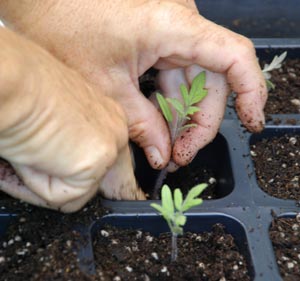
Jane transplanted starts into their first pot.
It was a sunny, breezy Saturday afternoon when I visited Bee Heaven. Margie and her manager Jane Cameron were puttering in the potting shed, transplanting starts, or baby vegetable plants, from the seed beds to small pots. A bit of soil went into the bottom of each pot. Then, one by one, Jane carefully lifted each start out of its bed and placed it into its new home. She set the plant down with one hand, put more soil around it with her other hand, and pressed the soil down gently. The work had a gentle rhythm. Repeat it a hundred more times or so, and that was the afternoon’s task.
Growers will tell you there’s something hopeful about working with baby plants. “It’s so exciting to see them grow from seed,” Jane said. “It’s empowering. It feels exciting to see the plant first poking out of the ground, to see the energy. You don’t get that with a plant already started that you buy from the store.”
You’re not thinking of bugs, or disease or freeze — although those risks are there, even at that stage. Some starts’ leaves had evidence of bugs munching along the edges. Another start revealed a small black caterpillar near its roots, as it was gently lifted out of the seed bed. The caterpillar would grow up to be a butterfly of some kind, Margie explained, but in the meantime, it was chomping on little roots. A note was made in the input log, and the plants and seed tray would be treated with BT for the caterpillars.
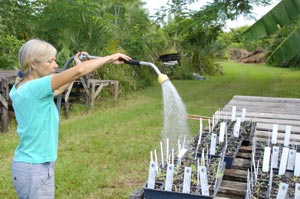
Jane watered the starts after transplanting.
Labels were placed into the pots, so you knew what kind of plant it was. Trays of pots were taken to an outside table made from old wooden pallets, where the starts soaked up sunshine and would grow and grow. Jane watered them lightly, holding the spray nozzle high above, so water fell gently like rain. Smaller starts were waiting on other outside tables nearby, still too young for transplant, maybe in a few more days. “They aren’t finished sprouting,” Margie said. When the little plants show four true leaves, then they are ready to pot up.
Most of the starts I saw that day were heirloom tomatoes with exotic names like Black From Tula, Red Calabash, and Zapotec Pleated. “ZAP-otec. That sounds like the name of a pharmaceutical,” Jane remarked. “Feeling de-pleated? Try Zapotec,” Margie chimed in. “It will pleat you back in no time!” Now there’s an idea — plant (and eat) heirloom tomatoes to be re-plete with energy.
Work done, I ambled around Bee Heaven to see how other things were going. Bright sunshine and clear blue sky were good medicine in itself, and soon I was feeling less de-pleated. A light breeze ruffled leaves, and mockingbirds twittered background music from a nearby big tree and from the hedges further over. Roosters living in nearby chicken tractors got a call and response chorus going. “Ur-ur-ER-ah,” one rooster called, and another responded an similar way, and another, and suddenly I was in the midst of poultry opera. “Here I am, how are you,” they seemed to be calling. “I am here,” I told them. (Yes, I talk to chickens.) I am here, I am fine, pleated and replete. Farm therapy works!

 Redland Rambles