Feeds:
Posts
Comments

Archive for the ‘photo’ Category

Sunday, October 17th Rain or Shine
From 10am-3pm
at the Little River Market Garden
8290 NE 4th Ave.
Street parking all along our block


Heirloom tomato seedling ready for transplanting into your garden. Photo by Muriel Olivares.


We’ve prepared a really nice selection of our favorite varieties, mostly heirloom, grown in 65% homemade compost and 35% sphagnum peat moss. NO chemicals, NO pesticides.

All plants are in 4″ re-used plastic pots.

$4.00 each, every 5 get one free!

All seed packets are $3.00 each.

CASH ONLY PLEASE!

Bring boxes, carts or bags to carry your seedlings home.

SEEDLINGS:

CHERRY TOMATOES: Sungold, Black Cherry, Amish Red, Ghost Cherry
SAUCE TOMATOES: Amish Paste, Federele
SLICING TOMATOES: Cherokee Purple, Gold Medal, Lime Green Salad, Florida Pink, Black Prince, Green Zebra
PEPPERS: Golden Hot, Early Jalapeno, Biscayne Cubanelle, Antohi Romanian
EGGPLANTS: Orient Charm, Black Coral, Long Italian Purple, Raveena
BASIL: Genovese Basil
ARUGULA: Rocket

SEEDS:
*Luffa Gourd, *Mustard, *Gandules a.k.a Pigeon Peas, Sunhemp, Buckwheat, Cow Peas

*There will also be a small selection of seeds for sale.  These are plants that grow very well in our climate and most of them make good cover crops.

For more information:

web site: Little River Market Garden
phone: 786-991-4329

Read Full Post »

Pie…. ah, who doesn’t love pie. Fruit pie, custard pie, pie with whipped cream on top, pie with ice cream, pie with a light flaky crust. Pie! As much as I love eating pie, I haven’t had much luck making it. Have been thwarted by the most important step — making a crust that is light and flaky, not tough and rubbery.
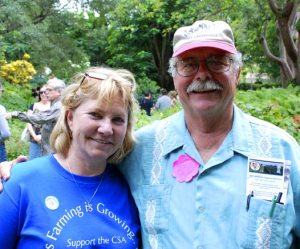
Growers Teena Borek and Robert Barnum

The Cantankerous Chef aka Robert Barnum spent his summer vacation patiently working on pie crust. He was passionately in pursuit of the perfect light, flaky crust to use in his tropical fruit pies. He told me that I could get a taste of that perfection in his homegrown longan-walnut-‘bola raisin pie at the Slow Food Miami “Pie on the Porch” competition this past Saturday.

It was a great afternoon to hang out on the wide wraparound porch at the historic Merrick House while sipping lemonade. Kids ran around on the lush green lawn under the shade of huge live oak trees. A vegetable garden had been set up on a side lawn. It was round, with coral rock borders, and looked very much like a pie cut into four slices. Boy Scouts from

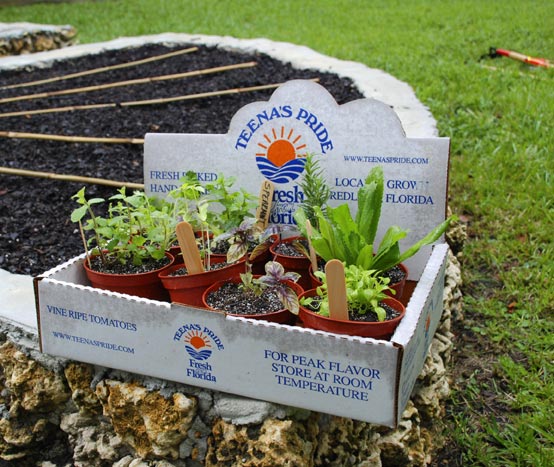
Little plants ready to grow.

Troop 4 tilled the soil, and starter plants provided by Teena’s Pride Farm were waiting to get planted into the beds. Slow Food Miami director Donna Reno explained this would be a historically accurate kitchen garden, growing foods much like the ones the Merrick family ate. The garden and pie competition are two of several events to  commemorate the 100th anniversary of the Merrick House.

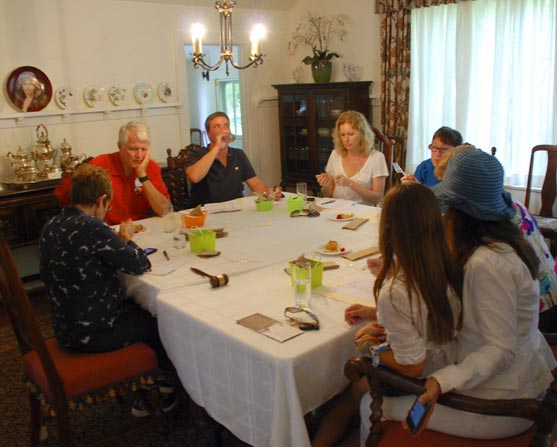
By the time I arrived, the porch was packed with eager, hungry people. Serving tables were set up, but where were the pies? They were inside the house getting judged. The seven judges aka the Supreme Court of Pie, led by Chief Justice of Pie Hedy Goldsmith herself, were ensconced in the dining room of the Merrick House. They were seated around a large table, armed with scorecards, plastic forks and glasses of water.
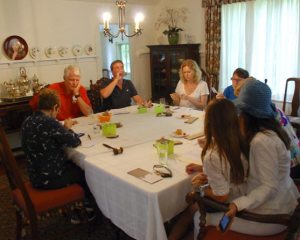
The Supreme Court of Pie

In the adjoining kitchen, 23 pies were arrayed on the counter. The pies were judged one by one. Three thin slices were cut and brought out to the table. The judges sampled and passed around the slices, discussed them briefly, and made their marks on score sheets. The judges evaluated pies on overall appearance, taste, overall impression, creativity, regional ingredients, and name. It was serious, intense work.
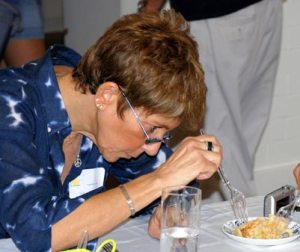
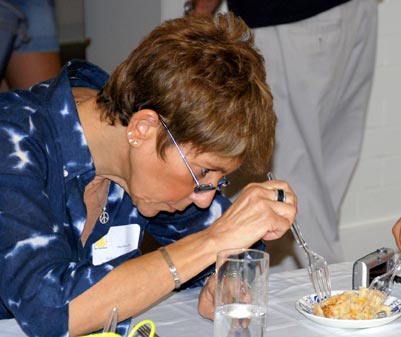
Pastry chef Hedy Goldsmith goes eyeball to eyeball with coconut pie.

According to the competition rules, “All pies must be made with a fruit or main ingredient that grows locally.” The pies had to be homemade, using home grown or local, and non-artificial ingredients. The pies had small cards describing what they were, but contestants were not identified.

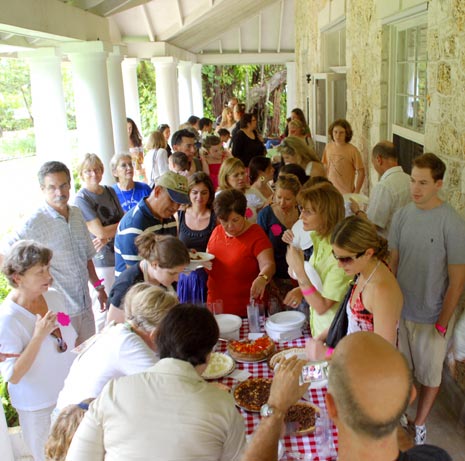
Once the pie was judged, a runner brought it out to the porch, where hungry guests were waiting for a taste. As a Slow Foodie began slicing and doling out pieces, people immediately mobbed the table. You’d think they hadn’t eaten pie in ages. “It’s a feeding frenzy out there,” the runner commented when she returned to the kitchen. I was intrigued by a green avocado pie and a salmon-colored mamey pie, but those vanished before I made it to the table.
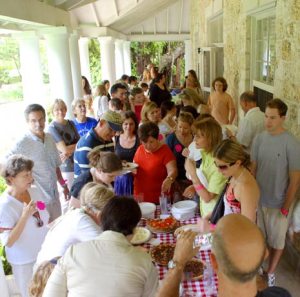
The first pies to emerge from judging got mobbed.

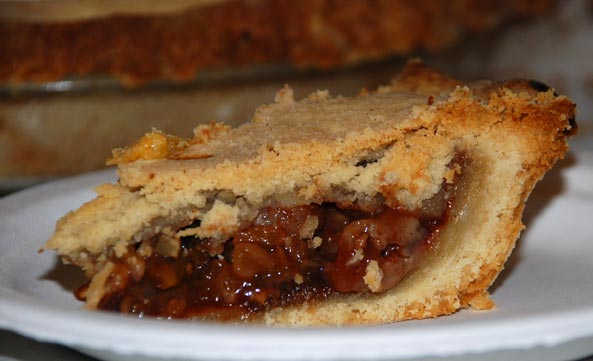
Tracked down Robert’s longan-walnut-‘bola raisin pie and dug in. It was a pie of complex flavors and unusual textures. Am not a fan of fresh longan, but baking mellowed and sweetened its flavor, and it tasted more like lychee. Encountered chewy bits of ‘bola raisins made from dried carambola, and crunchy bits of walnut. The texture reminded me of mincemeat pie, but count on Robert to push a recipe and turn the familiar into something different. As for the perfect crust, yes, it was light and crumbly, as promised. (If you want The Cantankerous Chef to make you a pie, and maybe dinner to go with it, give him a call at 305-235-1768.)

Most of the pies that I tasted (but I didn’t taste them all) followed the competition rule that the predominant ingredient must be local — mango, avocado, mamey, passion fruit, guava, coconut and longan to name the ones I saw. Some were nowhere near local — apple, apricot, pecan, chocolate — but they sneaked into the competition anyway.

The official winners were blueberry (could be local, blues grow in Florida), chocolate pecan (not local), and papaya (could be local). Details are posted on the Slow Food Miami web site.
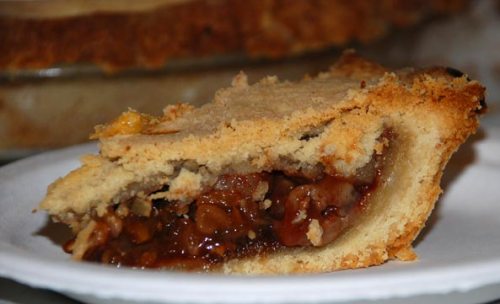
Robert Barnum's longan-walnut-bola raisin pie.

Robert’s longan-walnut-‘bola raisin pie won an Honorable Mention. His cantankerousness vanished for a few moments. “Yippee!” he cried out happily. “I’m in fourth place,” he kept telling me. Yes, indeed. Good to see his work receive public recognition on its merits alone. Good to see SFM inching closer to recognizing local food.

In the past, SFM was chided about using (or not using) local food at its locavore events. With this pie competition, the group came one step closer to walking the walk. If the Holy Grail of a locavore event is that the ingredients (all, most, or as much as reasonably possible) are sourced locally, this event came a bit closer. However, pies made from non-local ingredients (for example apple, chocolate, pecan, apricot) should have been kept out of competition.
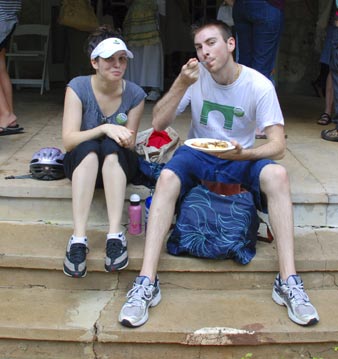
Foodies Naomi Ross and Brian Lemmerman enjoying pie bliss on the porch. They bicycled over from UM in the rain to taste something good to eat.

If you missed the pies, you can still visit Merrick House. It’s a lovely place, and one of the few structures that still remain from an earlier era. I’m glad I was able to visit it briefly, and want to come back another time to tour the house and grounds.

Merrick House
907 Coral Way
Coral Gables, FL 33134
305-460-5361, 305-460-5095

Kara Kautz, Historic Preservation Officer

Read Full Post »

Hello Redland Ramblers!


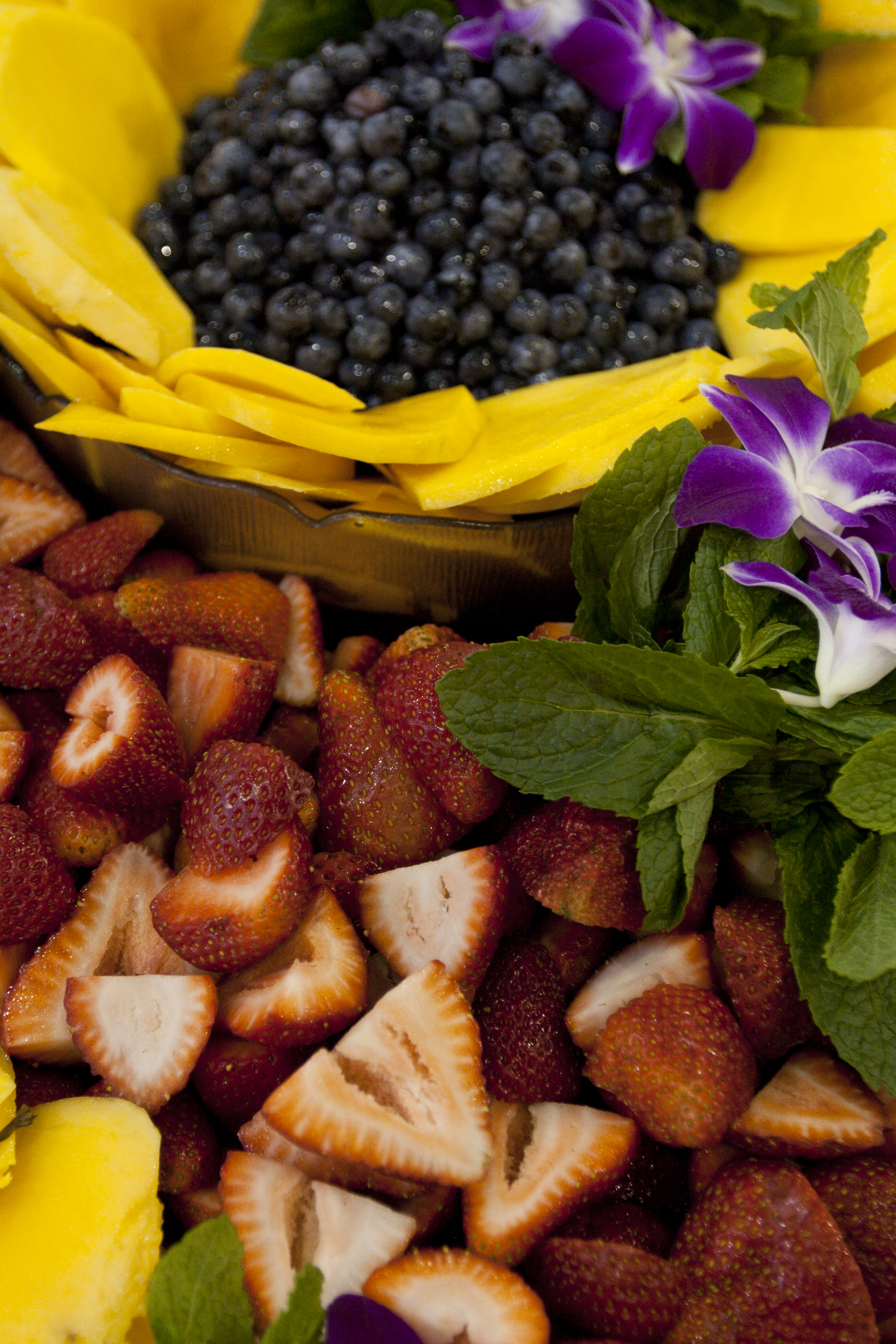
Mangos from Dr. Jonathan Crane at TREC, blueberries from Gail & Mike Waldron in Marion County.

Guest blogger Melissa Contreras here again. It’s been several weeks since the last post, and I apologize for that. Most of that time was spent waiting for photos from the official IFAS photographer, my one reliable source of photos from the conference. The poor overworked guy was traveling with several assignments to keep up with, and apologizes for not getting them out in a timely manner. We forgive him. Life’s too short. As promised, this post details the fabulous Florida local food lunches and the Conference workshops. If it’s not enough, well then I guess you’ll just have to attend next year’s conference!

There are omnivore and vegan options at every year’s conference, and both are amazing, featuring Florida food, real food: meat from pastured animals, vegetables and fruits from our fair state’s wide repertoire, milk from small herds of grass-roaming and grass-eating cows, and eggs from hens which get to freely scratch the soil  and eat a smorgasbord of bugs and assorted plants, expressing their “chicken-ness” under the Sunshine State’s skies.

Omnivores loved the delicious Gilchrist Brand Sausage from Jonnie Thompson of Ocala, who emphasizes humane animal treatment.

The fabulous  selections from this year’s menu:

Menu

These delicious dishes were made with food provided from small farms all over Florida. Our Redland farmers provided ‘Donnie’ avocado (Bee Heaven Farm), mangos (Dr. Jonathan Crane of TREC), and longans from Guara Ki farm. Summer in the Redlands  means tropical fruit, so we gave the rest of Florida a taste of the tropics.

Breakout sessions followed several tracks of interest: alternative energy, business and marketing, livestock, horticulture, organic and sustainable farming, policy and regulations. This conference is geared toward small farmers, and there were lots of them present looking for ways to make their farms better, branch out into new enterprises, market their products, and more. This year’s  included urban farmers and local food enthusiasts and activists, in addition to farmers.

Yummy Florida okra and blackeye peas from William Moore at Bluefield Organic Farm in Okeechobee.

The different tracks of interest included valuable lectures and workshops. Here’s a sampling of the workshops: Earth Wind and Fire: Renewable Energy Options; Agritourism; Aquaculture and Aquaponics; Minor Fruit Crops; The Excitement about Social Marketing – How it Can Help Your Operation; Pasture Management; Grass Fed Beef: How Do We Get There?; Poultry Management; Expanding Your Fruit Portfolio: Stone Fruit & Muscadine Grapes; Healthy Schools, Healthy Kids – Florida Farm to School Programs; High-Quality Compost for Organic and Conventional Farms; Advanced Disease Management for Organic Vegetables; Small Farm Friendly Approaches to Food Safety; Diversifying the Income Portfolio for Organic Products; and Direct Marketing Regulations (How to Get Products to Market Legally).  Next year’s workshops will be scheduled according to feedback from this year’s conference.

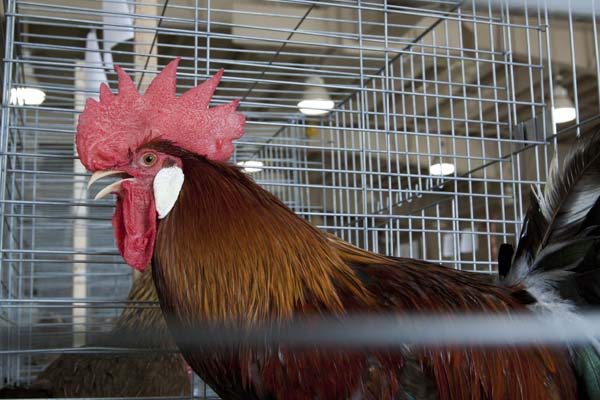
I am the handsomest rooster at the Small Farms Conference and I approve this message.

It was an information-packed weekend, with plenty of fun and networking.  Vendors in the exhibition hall sold everything from organic t-shirts with organic slogans on them, to fish emulsion fertilizer, to packaging for tomatoes and strawberries, to complete aquaponics systems, to worm poop fertilizer, to hydroponic growing systems, to Florida grass-fed beef, to info about becoming certified organic, and so much more.

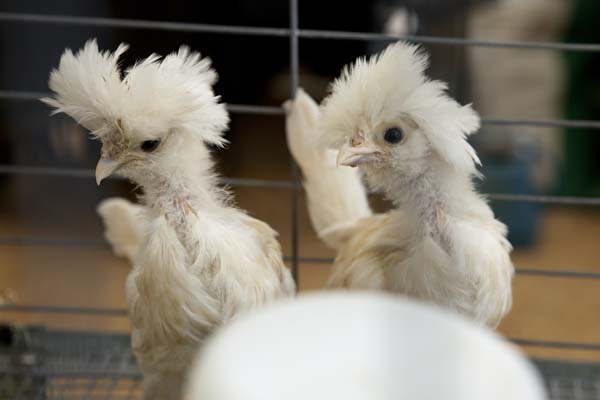
And who doesn’t love seeing the animals at the livestock exhibit? I spent an hour in there looking at and sometimes petting cows, llamas and alpacas with babies (below), and lots of interesting and unusual poultry breeds.

We love the local, organic hay at the Small Farms Conference--mmm...

Did I mention that this conference was next door to the national convention of Jehovah’s Witnesses? This made for heavy traffic on Sunday morning, with the JWs in their Sunday best. This explains why they did not come knocking on your door that weekend….(I stand corrected- it was a regional conference, thanks for finding that out Margie. There sure were lots of them… )

So, Marian will be back soon. I have to stop or someone might think I have taken her blog over. A coup de blogue, golpe de blogo, or other messy affair could be suspected, but no worries, she will be back to tell you more of the Redlands and its farmers. Thanks for letting me share…

Gratuitous cuteness.

Read Full Post »

Avocado bliss

Seen at the the Pinecrest Whole Foods on Friday.

The time has come to pick avocados. Last week Farmer Margie mustered her crew of mostly volunteers and they went through the grove to gather the first of the season. Thirty bushels of certified organic Donnie avocados went straight to the area Whole Foods warehouse, and I’m told that the fruit just flew out of the stores. This week Margie’s crew picked again, and she took 30 more bushels to the WF warehouse on Thursday. I found her Donnie avocados at the Pinecrest Market on Friday afternoon. They are selling for $3.49 each, ouch! But even at that price, there may not be many left today.

But all is not lost. I’ve learned about Number Two fruit. Those are avocados that have scuff marks on their skins, superficial blemishes that that are bigger than a certain allowed size.  The fruit rubbed against a branch while it was maturing and it made for a dark mark. Stores don’t like blemished fruit, but they are just as good.

Last week I bought a half bushel of Number Twos to re-sell to friends and co-workers for $2.50 each. Like their pristine brethren that went to WF, these avocados sold very fast. This week I sprang for a full bushel of Twos. People wanted more, or saw they missed out and were calling me with orders.

This dramatic scuff mark is cosmetic, doesn't affect the flesh inside. Whole Foods doesn't want this fruit, but I do!

Local fruit makes people happy! Case in point, I took a half bushel of avocados to my doctor’s office. She is a holistic practitioner, and she and her hard working staff and patients know that avocados are good for you. I staggered in with the heavy box of fruit, set it on the floor, and everybody pounced. My doctor did the most interesting thing — she cradled a large green avocado to herself, stroked it with her hand, and giggled with delight. Other staffers were smiling as they sorted through the box. One woman picked out a fruit, then another, then went off with three avocados clutched to her chest. Altogether a dozen avocados found new homes so quickly I felt almost giddy.

I saw that grin, heard that giggle, and watched people pet and stroke the smooth, green shiny skinned avocados over and over on Thursday and Friday as I made my deliveries. And once you’ve actually eaten a Donnie from Bee Heaven, that’s it, you’re hooked on the creamy, nutty flavor. Last week a friend got one avocado, then ask me for four more this week. “Are you sure,” I asked. “Oh yes,” was her answer, said with a smile and sigh of bliss. “I want them. They’re buttery.”

Another thing I heard often is, “I’m going to eat the whole avocado for lunch.” Easy to say now, when the fruit is only about a pound and a half in size. Wait a few weeks when they have increased to three pounds — or more. Last summer a friend claimed that he could eat a whole three pound avocado by himself in one sitting. “That’s a pretty big avocado. I can only eat half or less at one time,” I cautioned. My friend boasted, “I’m a big guy, and I have a big stomach. I can eat it.” He took the avocado home and that was the last I heard of it. It’s quite possible that a three pound avocado defeated a 200 pound man.

So, I get a little crazed this time of year, phoning people — “Hey, I got some green crack*, let me know how many you want” — and driving around town with a bushel of avocados in my car. I do it because Margie’s fruit makes people happy, and I’m glad I can bring them a bit of joy. That’s the power of local food. Once you’ve tasted it, you know.

*That’s a Margie joke.

Nutrition facts and analysis for Florida avocados

Read Full Post »

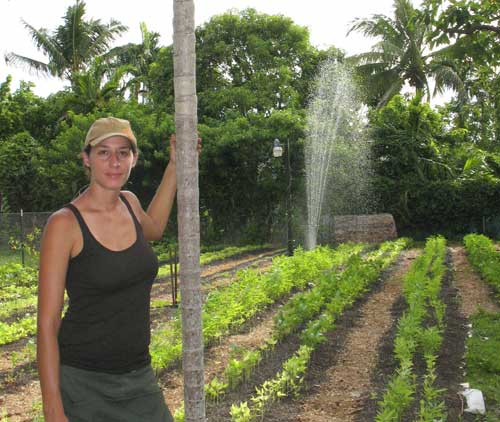
Cover crops growing at Little River Market Garden.

Tucked away in an obscure corner of northeast Miami, a new vegetable garden is starting to take shape in what was an empty city lot. Long straight rows of cover crops — Sunn hemp, cow peas and velvet bean — raise their young leaves to the late afternoon sun. In between rows of cover crop, peanuts are just starting to show pretty little yellow flowers. Loofa vines race to the top of the chain link fence at the front of the property, and a row of cassava flourishes alongside a stepping stone path. Over on one side is a trellis for a muscadine grapevine already forming a miniature cluster of fruit, and sweet potatoes grow beneath. Sage and other herbs are planted in a well-mulched S-shaped bed edged by palm tree logs. In the shade of an ancient mango tree loaded with fruit, a teepee shaped chicken coop holds several brown hens.

Welcome to the Little River Market Garden. This is the handiwork of Muriel Olivares, last year’s farm manager at Bee Heaven Farm. She created this garden from scratch a mere six weeks ago, planting on land leased from friends. Only grass and several trees were growing in what was once part of a citrus grove many decades ago. Now, weathered cardboard peeks out from the edges of some vegetable rows, and Muriel explained that it was set down right over the grass, with compost piled on top. The cardboard is already breaking down, and vegetable roots will easily push through it. In between planted rows, mulch neatly covers grass. The cover crops will get cut down and as they decompose, will add more nutrients to the compost.

This technique of piling on compost and mulch is called no-till because the soil is not tilled or disturbed by a tractor. Tilth builds up naturally without getting disrupted by tilling, and weeds are less likely to grow because they are smothered by compost and mulch. “No-till improves the soil by building soil structure and adding nutrients with compost,” Muriel explained. “It’s a very old technique. No matter the scale of farming, the concept is the same — never disturb the soil and always keep it covered.”

Muriel Olivares

The Garden will provide food for 11 people who have already signed up for CSA shares and flower shares. She says she might be able to squeeze in a couple more members, so if you’re interested, let her know. Her season runs for 21 weeks from November to April. Muriel wants to sell extra veggies and cut flowers at farmers markets, and is already inquiring about getting in to a few in the area. Check out her blog, Little River Market Garden, for news about the garden and updates about markets (once the season starts).

Muriel is confident that her crops and market garden will flourish. She took what she learned working as an intern for a season at a no-till organic farm in upstate New York, and combined that with skills learned at Bee Heaven helping run the CSA and selling at farmers market. Now she is is gambling that she can make a living as a market gardener. “This is my full time job, eight hours a day.” She doesn’t have a “day job” to tide her over. This is it!

So why do this crazy, risky thing? “I really like to be outdoors,” Muriel explained, “and to do what I want to do.” She paused and thought for a moment. “It sounds really weird but I have this connection to plants. I’m absorbed by them. I’m interested in them. Working with plants gives me mental energy.” She chose the urban location because she likes the city and found Redland too isolated. “This is a nice, happy medium. It’s very peaceful, but you’re in the city.” Here she is close to home, her friends, and her customers. When market season starts in winter, look for Little River and say hi to Muriel, the new generation of urban farmer.

Little River Market Garden
8290 NE 4th Ave.
Miami, FL 33138

mail@littlerivercsa.com

Read Full Post »

« Newer Posts - Older Posts »