Feeds:
Posts
Comments

Archive for the ‘photo’ Category

Arazá the "Amazonian pear"

Arazá the "Amazonian pear"

A box of arazá (eugenia spititouta stipitata) showed up in Farmer Margie’s barn last week. Robert Barnum had dropped it off. The fruit is round and yellow, with soft velvety skin like a peach but smoother — “smooth as a baby’s behind,” as Robert described. Arazá is very soft when ripe, smells sweet and perfumey but tastes incredibly tart.

Farmer Gabriele stopped by and tried to eat a whole fruit but failed at the attempt. “It got me in the glands in my neck,” she said as she pointed to the sides of her throat. Each fruit has twice as much vitamin C as one orange, so it is said on the Internet.

Because of the fruit’s tartness, you don’t eat it fresh out of hand, Robert cautioned, and suggested that it might be better used to make a bebida (drink), daiquiris or ice cream. Here’s a recipe from The Cantankerous Chef himself:

Arazá Bebida

Cut up fruit, removing seeds and calyx. The skin is thin and can remain. Put fruit in blender and puree. You can freeze some in ice cube trays if you aren’t going to use it all at once. Add banana (to thicken it), sugar (or honey or agave) to taste, ice, and water and blend thoroughly.

For sorbet, leave out the banana and freeze the mixture. For daiquiris, add rum. For ice cream, add heavy cream and freeze.

Robert has been growing arazá at Possum Trot Nursery for the last 30-40 years. He learned about it on a trip to Costa Rica visiting friends who have a grove and run the Tiskita Lodge. (The fruit originally comes from the Ecuadorean rainforest.) Robert brought back seeds and planted them among the avocados in his grove, where the shrubby understory trees tolerate partial shade. They bear three or four crops a year. The trees are blooming now and will bear fruit again in about four months. If you want to buy arazá fruit, you can give Robert a call at 305-235-1768.
Read Full Post »

Go make your beds

A lot of behind the scenes prep work goes on at Bee Heaven Farm before the first seeds are planted. The cover crop, which fixes nitrogen and other nutrients, has been mowed and tilled under to also add organic matter to the soil. The next step is to create rows of raised beds, where the vegetables will get planted.

Making beds

Making beds

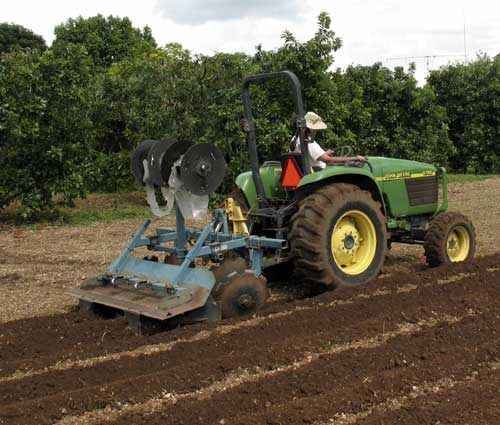
The bedding attachment behind the tractor cuts into the soil and shapes it into a bed with channels on either side (where tractor tires pass). Native soil is not very deep in Redland. It averages about 1/4 inch over limestone rock. At Bee Heaven Farm — after rock-plowing, years of building up organic matter, and mounding up the beds — soil is maybe 4-6 inches deep, and very rocky. That’s it! That’s what your food grows in! The beds then need to be shaped and leveled by hand with a hoe. Rows of plants will then get planted by hand or with a seeder in each bed, either as transplanted starts or directly seeded. Tomatoes are planted in one row, beets in 4 rows, greens in 8 rows, or anything in between.

Bedding attachment

Bedding attachment in action

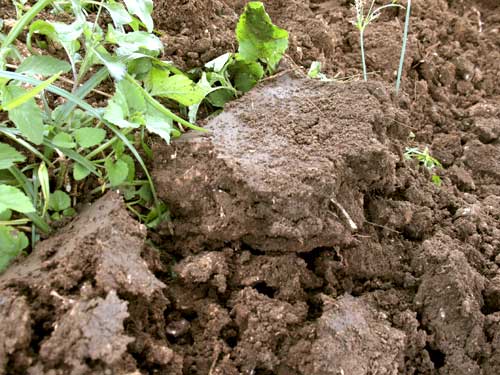
This past Saturday when I arrived, Farmer Margie was driving the tractor with the bedding attachment on the back, making passes up and down the main planting area. The bedding process wasn’t going very well. I saw one row wasn’t straight, kind of tapered into the next row. As she climbed down from the tractor, Margie explained that was where the tractor had actually slipped in the ground. The soil was wet from scattered rain showers blowing through because of a cold front. The wet soil was also getting compacting into clay-ey clumps, losing aeration and fluffiness that had been created by tilling. (For a detailed explanation of soil compaction and air spaces, read Margie’s post on tilth at Bee Heaven Farm’s Blog.)

Wet soil clumps

Wet soil clumps

Margie grumbled that she would have to wait until the weather cleared and the soil dried out, then till all over again to erase the curving beds of compacted soil, and attempt bedding again. Clearly every step of the growing process is affected by weather, in ways both subtle and obvious. Too much rain, not enough rain, too hot, too cold, too windy — the farmer is almost always at the mercy of the weather.

Read Full Post »

Heirloom tomato starts

Heirloom tomato starts

The Edible Garden Festival is coming up this weekend Oct. 24-25 at Fairchild Garden. Farmer Margie and her crew will be there, selling starts of heirloom tomatoes, basil, arugula, garlic chives, lemongrass and chard so you can plant them in your garden. (She promises to have an even bigger selection at Ramble next month.)

Heirloom varieties available for this month’s event are mostly small and plum-fruited types. The larger, beefsteak types won’t be ready for another three weeks. I’ve met heirloom tomato fans who explain they buy starts year after year from Redland Organics because there are certain varieties (like black tomatoes, such a deep dark red it looks almost black) that only Margie sells.

You can also get fruits that are in season now: avocados, carambolas, perhaps bananas, cas guava, and antidesma (bignay). Also available are the usual offerings of organic eggs in lovely shades of browns — and even light green ones from auracana hens — and wildflower honey from hives kept on the farm.

====================================

Events presented by growers or members of Redland Organics CSA:

LECTURES
Saturday, October 24
12:00 p.m. Growing Organic Heirloom Tomatoes, Margie Pikarsky
1:00 p.m. Edible Landscaping in Paradise, Gabriele Marewski

Sunday, October 25
4:00 p.m. Extreme Edible Landscaping: Urban Homesteading!, Melissa Contreras

GARDENING DEMONSTRATIONS

Sunday, October 25
10:00 a.m. Slow Food School Gardens, Hunter Reno
1:30 p.m. Square Foot Gardening with Kids, Hunter Reno

Read Full Post »

Thyme for tilapia and lime

Sleeps wit' da fishes

Sleeps wit' da fishes

The other Saturday I rambled down to Bee Heaven to pick up a tilapia and some callaloo for dinner. If you’ve never done that, you’re missing out on some good eating. The fish are ridiculously fresh. They were swimming early that same morning just before getting put on ice. You won’t eat anything fresher unless you catch it yourself. When you order a tilapia, you get the whole fish. It’s your job to scale, gut and clean it before cooking, but that isn’t too difficult to do. The average weight per fish is about 1.5 pounds, maybe a bit more.

The tilapia is farm raised by Wayne and Carmen of American Viking Aqua Farms, a mom-n-pop operation right around the corner from Bee Heaven. Although the fish is a bit more expensive than what you can get at at the grocery store, it has been raised without chemicals. Technically they are not organic because the fish food isn’t, though Wayne and Carmen want to move in that direction. They also use a biofilter to clean their water, and have a natural filtration system which lets them use the nutrients to grow native mangroves for use in bioremediation projects.

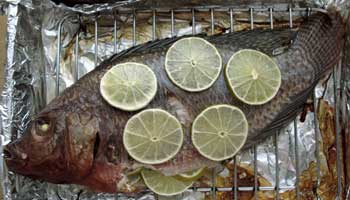
Plans for Mr. Fish were to roast it whole. It was scaled, gutted and cleaned, then its cavity stuffed with slices of lime and branches of fresh thyme, and more lime slices on top. Was baked it in the oven at 350 for about 20 minutes (more or less), until the flesh flaked when stuck with a knife.

Mr. Fish meets his demise

Mr. Fish meets his demise

Mmmmmm good eating! The flesh was tender, moist and delicate. Limes on top kept it moist, and the flavors of lime and thyme permeated. Well, maybe a bit too much lime… will try with lemon next time, and use a bit less, and add garlic or onion. I don’t pretend to be a chef, or even a halfway good cook, but I have my moments and this was one of them. Your meal is only as good as the ingredients!

If you got a tilapia how did you prepare it? Feel free to share your recipe in the comments section below!

Read Full Post »

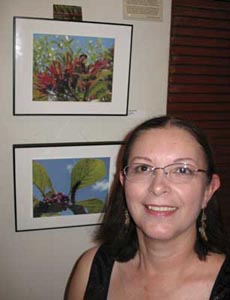
The photographer and her work

The photographer and her work. Photo by Margie Pikarsky.

As I entered the Miami Beach Botanical Gardens, the sweet, intoxicating scent of jasmine greeted me. Friends were waiting for me at the exhibit, and I was glad they came out to see the art and to show support. Farmer Margie and her husband Nick took turns taking pictures of me with my pictures, and it felt like paparazzi. Now I know what it’s like on the other side of the lens! Margie pointed out that the picture Firebush was hanging right below the sign that said FIRE extinguisher. Hmmm, seems like the people who were hanging the art have a sense of humor, I like that. Robert the Cantankerous Chef also came, and was discussing what kind of caterpillar that was. He thinks it’s a zebra Gulf Fritillary butterfly, and Margie thinks it might be a brown orange julia. [Both caterpillars are quite similar in appearance and both are natives, according to Margie, who looked these things up. Thanks for the fact checking!]

Claire Tomlin of The Market Company (whom I’ve met at the South Florida Farmers Market) provided veggie snacks, and Schnebleys brought a variety of fruit wines. I sampled the avocado wine, and it’s similar to pinot grigio with a whiff of avocado, and it’s actually pretty good. Heard the lychee wine (my favorite) ran out fairly quickly. Hung out till the very end with my friend photographer Mark Diamond, waiting to hear the announcements of the winning artists, including audience choice, but neither us of won anything. Thanks for your votes, it’s all good. I’m glad to be in the show, and hope that more shows are to come.

The pictures look a lot better in person, so if you haven’t seen them and you’re in the area, stop in and take a look for yourself. The show is up for only this week. I’m coming by on Saturday afternoon to pick them up — unless you want to take them home with you…? Let me know…

Botanist Steven Woodmansee wrote about the plants depicted in the art works. Here’s what he wrote about my pieces, which was posted on a card next to them.

1.  Beautyberry  – This photograph depicts one of our showier native flowering plants. American beautyberry (Callicarpa americana) is a member of the mint family (Lamiaceae), and its leaves are aromatic when crushed, although it is not recommended for culinary practices.

However, the clusters of purple fruit do attract birds, especially mockingbirds, who will defend “their” plant from other encroaching birds. It is native to upland habitats including pinelands and hammocks, and prefers full sun.  Branches may be clipped, and used in flower arrangements, as they last several days.  In cultivation, it is best to cutback the plant to one third its size at least once a year.  It is native throughout Florida and portions of the southeastern United States.

2.  Firebush – (Hamelia patens) is a member of the coffee plant family (Rubiaceae).  The showy tubular red flowers attract a plethora of butterflies and hummingbirds (and in this photo, a honey bee).  A favorite for the butterfly garden, firebush flowers year ’round, and grows well in partial shade.

Its fruits are devoured by birds.  It is recommended that for a bushy appearance and longevity, plants be cut back to one third its size at least once per year.  This species is a must for any Florida yard.  It is native across most of peninsular Florida where it can be found in swamps and hammocks.

Read Full Post »

« Newer Posts - Older Posts »