Feeds:
Posts
Comments

Archive for the ‘photo’ Category

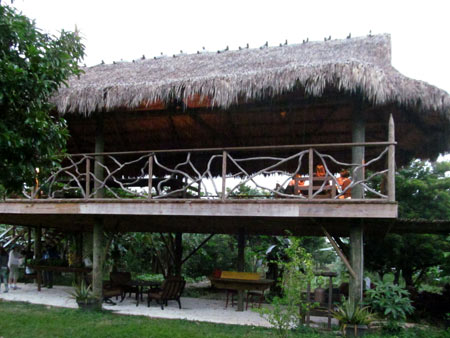
The Tiki Hut at Three Sisters Farm.

The Tiki Hut at Three Sisters Farm.

Farm Meal
Saturdays 5:00 to 8:00 pm, October through March
Reservations required / cancel 24 hours in advance
Adults $85 per person. No children.
Accepts credit cards

This is the second season for Farm Meals, as they are called, elegantly rustic five course dinners prepared with ingredients grown at Three Sisters Farm, which is located across the street from the Fruit and Spice Park. The Meals are owner Chef Jon Gambino’s love song to many different things growing on his farm, expressed with menus that change with the season. (If you attended GrowFest! back in October, you might have sampled Chef Jon’s wood oven pizza, or tasted his sorrel drink or lemongrass tea.)

The Meals are held in the upper level of a large two story Tiki Hut, which stands at the end of a grassy drive. Rachael Middleton, one of the farmers, greeted guests as they arrived. (If they come early, she will give them a tour of the farm.) She served each person a bright red drink called sorrel. It was both tart and sweet, made from the fleshy thick calyxes of the red sorrel or roselle plant.

She directed us to narrow wooden steps leading to the upper floor of the hut. We entered a large open area with a vaulted thatched roof, and railings made of gnarly tree branches. Being in that space felt like riding in an ark over the shadowy seas of treetops. The room held a grouping of different sized tables that can seat 20. A fresh cool breeze made candles flicker. Jazz softly played from a modern record player designed to look like an old fashioned gramophone. A stack of records were nearby, and guests were encouraged to pick something to listen to (or bring their own from home).

Dining upstairs in the Tiki Hut.

Dining upstairs in the Tiki Hut.

On the night I came to visit, two families were dining. A large, lively group sat at a big table, celebrating a family event. This was the second visit for most of them, who drove down from Broward. At a previous meal, they had dined on fresh pizza topped with arugula and papaya, baked in the wood burning oven, accompanied by yuca fries.

I was invited to join the small group, three visitors from New York. They spent their day exploring the area and it was their first dinner at Three Sisters. They brought a bottle of white wine, which was quickly set to chill on ice.

Tostones with chunky guacamole and black bean spread.

Crispy tostones with chunky guacamole and black bean spread.

As we settled in at table, Eddie the server brought thin crispy tostones the size of small tortillas, which were arranged on wooden planks, accompanied by small pots filled with cilantro-laden chunky guacamole and a garlicky, spicy black bean spread. The tostone was as thin as a cracker, and I dabbed it with the different spreads.

Next came tropical sushi rolls that were very vegetarian, without a hint of seafood. I identified jackfruit, cucumber, mamey, and rice but was baffled by something crispy which turned out to be fried yuca. It was accompanied by two dipping sauces — deep sea kelp infused black sapote, and pickled umobeoshi mamey sapote — plus another plate with thin strips of pickled half-ripe papaya, and thin slices of vinegary cucumber pickles. A dab and a slice on a roll made for sweet bumping against sour with two kinds of crunch.

Tropical vegetarian sushi.

Tropical vegetarian sushi.

Service slowed down a bit, but no matter, this is not a meal to rush through but to savor and discuss. Part of the pacing could be due to the small staff. Chef Jon and sous chef Michael Bayramian prepare food in a small kitchen shed nearby, and the different courses are carried up the narrow Tiki Hut steps by Rachael and Eddie.

The third course was strawberry hibiscus coconut soup with chunks of green banana. The pale mauve broth was both sweet and sour, and starchy chunks of banana lurked at the bottom of the bowl. Their taste and texture were more like a root vegetable than the familiar sweet fruit.

The main course was plantain pappardelle with Jamaican style kale, and for those who requested fish, broiled local grouper. The fish was fresh and lightly seasoned. Wide pasta ribbons were made fresh and had a mild sweetness of plantain that was a nice bed for stronger flavored greens seasoned with tomato and lots of garlic. Rachael explained they grow lots of greens on the farm, kale being available now, and callaloo later in the season. The pasta was filling and satisfied even the pickiest eaters at the table.
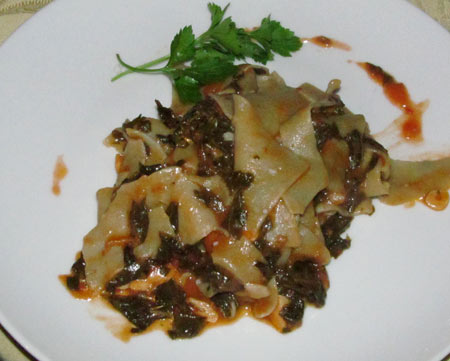
Pappardelle with Jamaican style kale.

Pappardelle with Jamaican style kale.

Lucky for us, we were regaled with two desserts that night — and there’s always room for dessert! The first was banana sorbet with jaboticaba sauce. Jon has a good hand with sorbets, and the banana came through with a rich, almost earthy, flavor. It was a solid base for tart, grape-like jaboticaba sauce, and the combination sang from the first bite. Jon has a passion for this fruit, and has become familiar with its nuances, such as how many days it needs to ripen before its skin sweetens and mellows.

The second dessert was pumpkin pie made from calabaza with a chocolate cookie crumb crust. Its flavor was rich and its color was darker than regular pumpkin. It was served with a pot of whipped cream. Coffee arrived, strong and rich, and each guest got their own french press of brew. (Lemongrass tea was available too.)
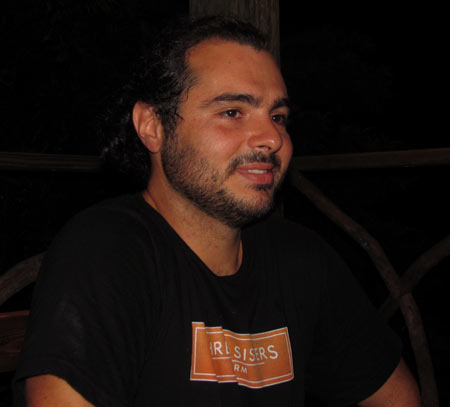
Chef Jon Gambino

Chef Jon Gambino

The Farm Meal dining experience is unique because the menu changes with the seasons, based on what is available on the farm. Guests have to be adventurous and willing to try anything. From this Meal I could see that Jon likes to take a familiar dish and play with the ingredients, making substitutions or changes, until something new breaks forth. He has a light touch with seasonings, allowing the fresh flavors of the ingredients to shine.

Almost every ingredient (except for coffee, cream, chocolate, beans and rice) was either grown there or procured locally. Jon considers his farm as a large, living pantry, where he can step out and gather what he wants to eat that day. His eyes light up when he talks about what he will plant and cook next. He admits he still has a lot more to learn about farming, but doesn’t mind getting his hands dirty and working hard. He is living his dream.

Location:
Three Sisters Farm
18401 SW 248th St

Homestead, FL 33031
305-209-8335
Read Full Post »

What do I do with the fennel?

The start of the CSA season couldn’t come soon enough! This summer, even though I tried to shop for local produce at nearby farmers markets, it was all too easy to backslide, and to gradually eat less and less fresh food (other than mangoes, avocados, and salads). Don’t get me wrong, I love vegetables. But there’s something about opening up a packed-full box of produce and just diving in.

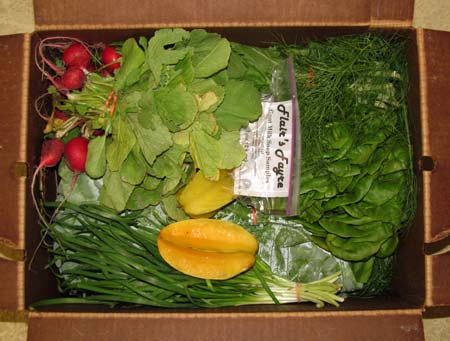
This Friday, as I set up to take photographs of the shares, I felt that familiar thrill as I opened the first boxes of the season. Oooh, what’s in here? Star fruit, yum! Followed closely by, what am I going to do with fennel? Will I even like it? No matter, I’ll try anything once. And there’s a recipe for caramelized fennel in the CSA newsletter. But still, what do I do with the tops??

If anything, belonging to the CSA has introduced me to new things that I never saw or tasted before. If they weren’t in the box, I would never have tried them or known about them. I remember feeling really adventurous eating black sapote and canistel,  and took to saying, “You won’t find that in a grocery store!” Belonging to a CSA delightfully stretched me out of my comfort zone of eating.

Photographing the shares is a great privilege. I get to see in advance what’s in the box, and share it with you on this blog and in the farm newsletter. It amazes me every week how farmer Margie and her crew manage to cram all that goodness into one box. Easy enough to dismantle it all, but don’t ask me to repack it the same way!

Opening the first box of the season.

Opening the first box of the season.

Arranging different items for the photograph can be tricky. This week the challenge was — what do I do with the fennel? Its fluffy fronds take up so much space. Does it go in the front? Off to one side? In the back? There’s a lot of tweaking things, and stepping back to peer through the viewfinder. Once it looks right, click click click! What you see is what you’ll get, no faking. The most I’ll do is use some hidden props to hold things in place. No matter what’s in the box, the recurring challenge is, how do I place each item so you can clearly see what it is. The picture has to be distinct in black and white for the printed newsletter, too.

Once a farm volunteer asked me, “Do the veggies speak to you?” Always the smart aleck, I shot back, “Yeah, they say eat me!” She looked disappointed. Truth is, they do speak in a gentle whisper, beseeching like any divalicious model, “Make me look good. I want people to love me.” And I do want them to look attractive, vibrant and three dimensional. It’s my weekly zen practice, as it were.

And then I get to cook and eat my subjects. Fun! Dinner’s ready!


Read Full Post »

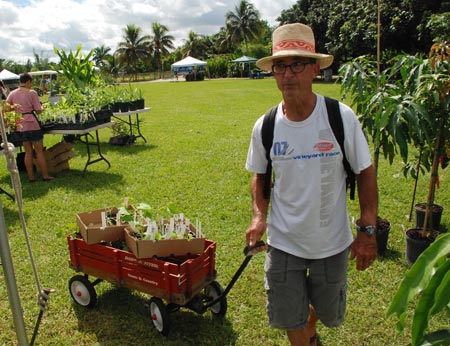
Browsing for organic seedlings at the Bee Heaven Farm tent.

Browsing for organic seedlings at the Bee Heaven Farm tent.

(part 1 of 2)

Back for its second year this October, GrowFest! was the event for gardeners and locavores. Despite rain on Saturday afternoon and a slow start on Sunday morning, well over 1300 adults and kids came to the Fruit and Spice Park to browse for plants and nosh on good eats. Farmer Margie Pikarsky of Bee Heaven Farm, who organized the event (along with a group of fantastic volunteers), was delighted that the event is growing.

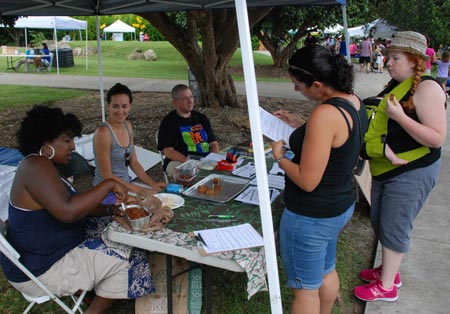
This year there was a mix of familiar and new vendors and exhibitors, a few less than last year, but each was worth checking out. Gardeners had plenty of plants to look at and buy, locavores found delicious things to taste, and there were plenty of interesting and knowledgeable people to talk to, with a wide variety of demos to attend.

GF-wagon

The best way to carry mass quantities of seedlings!

Bee Heaven Farm had its usual sea of organic seedlings. Along with dozens of varieties of heirloom tomatoes, you could also choose from a selection of vegetables, herbs and greens that grow well in our climate and are regularly raised at the farm. In response to customer demand, there were several varieties of eggplant, sweet and hot peppers, Asian greens, and intriguing herbs like lemongrass, curryleaf, turmeric (new this year).

Farm intern Nicole Fiori helps a customer choose heirloom tomato seedlings.

Farm intern Nicole Fiori (right)helps a customer choose heirloom tomato seedlings.

A big thanks to farm employee Luz, intern Nicole, and volunteers Dhilini, Alhen and Holly who were on hand all weekend!

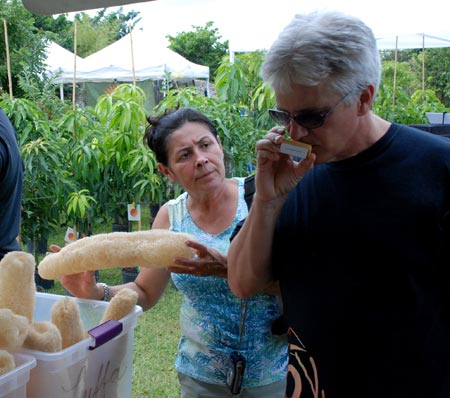
Selecting loofahs and goat's milk soap.

Selecting loofahs and goat’s milk soap.

New this year was the addition of Flair’s Fayre line of goat milk products. The husband and wife team of Pat Houle and Dan McGillicuddy, along with their assistant Christine, were on hand with offerings of raw goat milk and cheeses (for pet consumption only), and an assortment of deliciously aromatic soaps that were very popular. All products are made with milk from their small herd of goats.

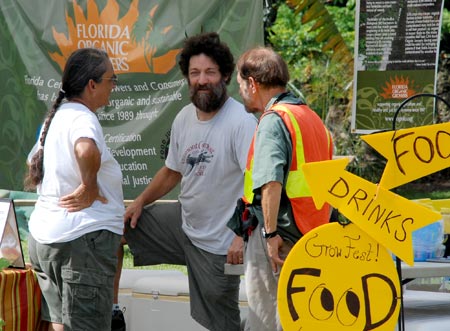
Margie Pikarsky, Marty Mesh and Steven Green discuss matters at the FOG tent.

Margie Pikarsky, Marty Mesh and Steven Green discuss matters at the FOG tent.

At the Florida Organic Growers and Consumers Inc. (FOG) tent, folks were selling chilled Uncle Matt’s organic citrus juices and sharing information on organic certification. Marty Mesh, the executive director, returned this year along with several staffers who were thrilled to introduce their newest statewide program, Fresh Access Bucks (FAB).

Staffer Carmen Franz explained that FAB doubles value, up to $20, that SNAP recipients can use to buy Florida grown fruits and vegetables at participating farmers markets. So far, FABs are accepted at Urban Oasis Project farmers markets and Bee Heaven Farm (in this area). This new program is funded by a grant from the state agriculture department, and Wholesome Wave, a non-profit which pioneered matching funds. Become a member to help FOG support “a sustainable and just food and farm system for all.”

Two Innovative Farmers of the Year! Margie Pikarsky (2013) and Gabriele Marewski (2012).

Two Innovative Farmers of the Year! Margie Pikarsky (2013) and Gabriele Marewski (2012).

Farmer Gabriele Marewski of Paradise Farms Organic brought two kinds of salads: cactus salad made with nopalitos, and her signature Baby Brassica Blend which includes a colorful sprinkling of edible flowers. The farm is known for its elegant, gourmet Dinner in Paradise and Brunch in Paradise series, season starting soon.

Alfredo Anez, Katie Sullivan and Gretchen Schmidt are the key people who produce Edible South Florida.

Alfredo Anez, Katie Sullivan and Gretchen Schmidt are the key people who produce Edible South Florida.

Edible South Florida magazine debuted their latest issue, which is all about local food. Many local growers and artisans are featured, and if you haunt farmers markets and locavore restaurants and cafes, they may be familiar to you too — Helen Cole’s jerky, Hani’s falafel, and Zak’s bread to name a few. I spotted a picture of farmer Margie on page 23. (Next to it is a brief essay I wrote about Farm Day.) You can pick up a copy for free at Whole Foods, Joanna’s Marketplace and other locations around town.

Giant African Land Snails (GALS) in carious stages of growth. A sample of their eggs is in the upper right corner.

Giant African Land Snails (GALS) in various stages of growth. A sample of their eggs is in the upper right corner.

And the villain of GrowFest! was back for an encore — the Giant African Land Snail (GALS). It’s an invasive species that devours over 500 kinds of plants and is capable of munching stucco off your house. Fully grown, the snail is as big as your hand, and has unique vertical jagged stripes on its shell. If you see a GALS in your yard, absolutely do NOT touch it! Call the state Division of Plant Industry at 888-397-1517 to come get it. These snails can harbor a microscopic nematode that can infect your brain and kill you. Over 131,000 GALS have been located and captured in South Florida in the past two years.

Grower Arturo Gonzalez, of Margarita's Fruits & Vegetables brought a forest of mango and avocado saplings.

Grower Arturo Gonzalez, of Margarita’s Fruit Trees, brought a forest of mango and avocado saplings.

GF-bananas

Bananas and plantains at Going Bananas

GF-bees

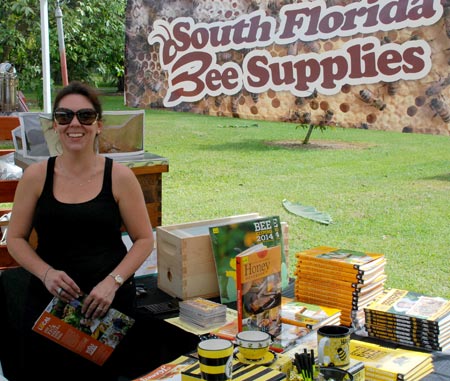
Beekeeping books and supplies from South Florida Bee Supplies.

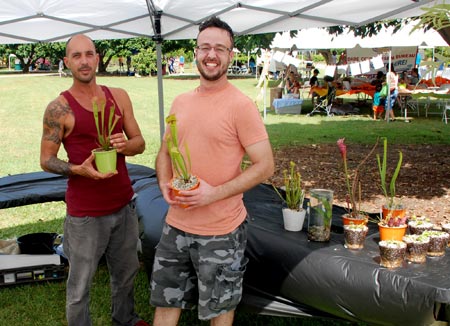
Carnivorous plants from Envy Botanicals

Carnivorous plants from Envy Botanicals

Landscaping plants at Casey's Corner Nursery

Landscaping plants at Casey’s Corner Nursery.

Fresh potted herbs from Teena's Pride Farm

Fresh potted herbs from Teena’s Pride Farm.

Learn how to compost with worms, from the Fertile Earth Foundation.

Learn how to compost with worms, from the Fertile Earth Foundation.

Kamala Fletcher, Christiana Serlé, and Mike Moskos of the South Florida Food Policy Council

Kamala Fletcher, Christiana Serlé, and Mike Moskos of the South Florida Food Policy Council discuss the community’s food issues.

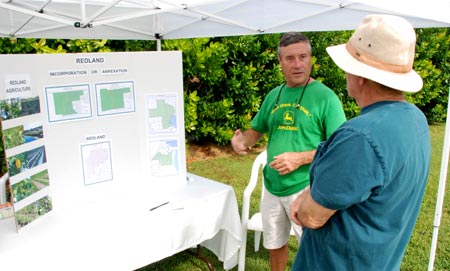
Ken Holden advocates incorporating Redland

Ken Holden advocates incorporating Redland.

Buy native plants from the Urban Paradise Guild

Buy native plants from the Urban Paradise Guild

(To be continued…)

Read Full Post »

Ripe allspice berries

Ripe fresh allspice berries, half pint.

Ripe allspice berries, half pint.

Allspice! The name alone conjures up a blend, but it is actually one spice with the aromas and flavors of cinnamon, cloves and nutmeg. The mellow brown powder from the grocery is made from unripe allspice berries harvested which are dried and ground.

Fresh, ripe berries are hard to find, unless you are lucky enough to have a tree growing in your yard. The flavor from fresh is completely different than from dried berries. “Allspice berries, allowed to ripen, ascend to a whole other level,” farmer Margie Pikarsky told me. “I call them ‘Nature’s Altoids (TM)’ because they’re sweet and yet surprisingly strong.”

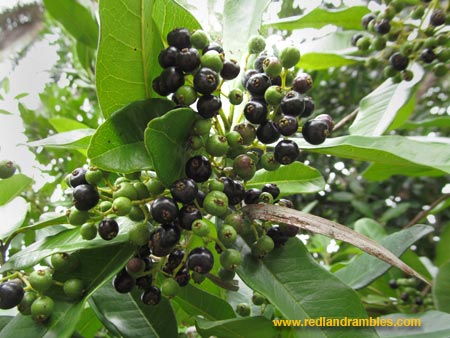
The fresh berries are about the size of a large peppercorn, and ripen to a dark bluish-purple color. When you pop one into your mouth, it gives a rich and resonant burst of flavor. Suddenly the dried version pales by comparison.

“The berries are great in spice breads, muffins, or drinks. Substitute them in any baked goods recipe calling for blueberries. Frozen berries will keep a long time in the freezer. Maintained below 0 F, they successfully keep for over one year,”  Margie recommends.

The fresh leaves also have a spicy aroma, but not as strong. “Fresh allspice leaves are used like bay leaves for flavoring. Use them fresh, though. Dried ones lose their oomph.” The glossy green leaves can be steeped in hot water to make a refreshing spice tea, good hot or cold, and sweetened lightly with local honey.

Allspice was one of the very first plants Margie put in on her farm, probably back in 1996. She planted two, and they have since grown to shrubby looking trees about eight or nine feet tall. The plants are dioecious (male and female). The female is the one that bears the edible berries but needs a male tree nearby.

Ripe allspice berries

Ripe and unripe allspice berries and leaves.

Read Full Post »

avos-cluster

In August and early September, the stars of Bee Heaven Farm are the shiny green Donnie avocados grown to almost football size. Stroll through the grove even this late in summer and you’ll see many, both on the branches and littering the ground below.

Summertime is a good time to visit fruit growers in Redland, because as you tour their groves, they’ll pick a fruit and let you taste it. So when the newest member of the Extension office, Tropical Fruit Agent Jeff Wasielewski, came to visit, that’s exactly what farmer Margie Pikarsky did. She took him for a walk around her farm, where they paused at different fruit trees, tasted a couple things along the way, and shared stories about the trees’ health and growth. “Visiting smart, forward-thinking growers like Margie is important for me as a learning tool and not just a social visit,” he said. (The UF/Miami-Dade County Extension office shares the latest agriculture information from University of Florida’s researchers with farmers and gardeners in the county. Some of the ways are through workshops, educational materials, field consulatations, and their web site.)

Tropical Fruit Agent Jeff Wasielewski and Margie Pikarsky open up an avocado.

Tropical Fruit Agent Jeff Wasielewski and Margie Pikarsky open up an avocado.

Margie’s pride and joy is the grove of over 90 avocado trees, which she herself planted back in 1996. She and Wasielewski stopped at one tree where she picked up a windfall avocado and handed it to him. It looked ready to eat, so he pulled pruning snips from a case on his belt, and cut open the fruit.

He’s a tall, easy going man with a ready smile and 18 years of tropical fruit experience, and 21 years of horticulture in South Florida. You might already know him from lectures, articles and videos he made for Fairchild Tropical Botanic Garden, where he was the Educational Outreach Specialist. He’s developed keen senses and loads of experience when it comes to tropical fruit and plants. All it took was one taste and he said the avocado was a day away from being perfectly ripe.

Further down the row of trees, he noticed a dead branch, which Margie snapped off. “Be careful,” he warned. “A dead branch like that can attract other beetles now suspected of carrying laurel wilt.” Margie explained that she removes dead branches from the trees as soon as she finds them, and trims the trees every year. So far her grove looks healthy, but laurel wilt disease remains a lurking concern.

Laurel wilt is a dangerous avocado disease that appeared in Miami-Dade County a few years ago. It is spread by the red bay ambrosia beetle, which is tinier than a grain of rice. Wasielewski  explained that the beetle burrows into healthy avocados and other trees in the laurel family. “It cultivates a fungus that eventually kills the tree branch by branch by disrupting its vascular system. Signs of the disease are quick branch dieback or tiny holes and sawdust towers where the beetles enter the tree. The tree will die very quickly if infected. Commercial growers are advised to quickly and completely remove the tree and its roots. The removed tree should be burned in place, out of fear of spreading infested wood to other groves and trees. Root removal is necessary because the disease may spread from tree to tree through root grafts,” he told me in an email.

So far there have been over 2000 trees removed due to laurel wilt in commercial groves in Redland, and  growers are worried, and anxious for a cure. When the first tree in a large commercial grove was suspected of having the disease, Extension held a standing room only meeting for growers, informing them of the threat. They continue to provide updated information on their website and with occasional meetings. (Yes, backyard trees in town are also at risk. Find info for homeowners at Save The Guac web site.)

Jeff and Margie

Jeff and Margie

As Tropical Fruit Agent, one of Wasielewski’s goals is to inform avocado growers of new research on combating laurel wilt. “It’s important that I am on the cutting edge of what is going on in the tropical fruit world,” he said. University of Florida has done tests, and complied a list of pesticides that will kill the ambrosia beetle. Unfortunately, none of them can be used in an organic grove. Local organic growers are pressuring the scientists to test substances approved for use in organic production.

Margie expressed her frustration to Wasielewski at the current lack of effective organic options. He said he would keep her informed as to new research into alternative treatments. “I want growers to have options as far as doing things in an environmentally friendly way. I let them know their options and the value of each option. Growers are then free to make a choice on how they want to proceed, but only if they are armed with new knowledge and multiple options,” he told me in an email.

For now, it’s wait and see how bad laurel wilt gets in Redland, and how quickly research can come up with solutions that all growers can use. Wasielewski is an important addition to the Extension office during a critical time for tropical fruit growers.

As for Bee Heaven Farm, over the years Margie has accumulated a wide variety of other tropical fruit trees, tucked away here and there among the vegetable beds. Sapodilla, carambola, longan, mango, and bananas are planted in various spots on her five acre farm. If her avocado trees have to go, she’ll plant different fruit trees and more vegetables, she once told me. But until then, she and other growers will put up a fight to save their groves.

Got a question about tropical fruit? Contact Jeff Wasielewski at 305-248-3311, ext. 227 or email at jwasielewski@ufl.edu .

Read Full Post »

« Newer Posts - Older Posts »