Feeds:
Posts
Comments

Archive for the ‘photo’ Category

Margie Pikarsky and Charles LaPradd with the new Local Flavors cookbook.

Margie Pikarsky and Charles LaPradd with the new Local Flavors cookbook.

Recently, Charles LaPradd, the county agriculture manager, stopped by Bee Heaven Farm with a special delivery. He unloaded several boxes of Redland’s latest crop — “Local Flavor: Recipes Raised in the Florida Redland” — a very special cookbook two and a half years in the making.

It’s filled with recipes for local produce gathered from growers and cooks. The list of contributors is a who’s who of area growers and cooks. Farmer Margie Pikarsky has three of her own recipes: Avocado Salad (or Chunky Guacamole), Calabaza & Watercress Salad, and Strawberry Black Satin Pudding. “Veronique,” a Sea Grape Martini, was originally concocted with Margie’s sea grapes for a Slow Food Miami event.

If it grows in Redland, there’s a mouthwatering recipe for it, and almost all look quick and easy to make. Carambola is coming into season now, and Star Fruit Chicken Salad caught my eye. A useful chart in the back lists what’s growing when. This is a great book for CSA members to have in their kitchen.
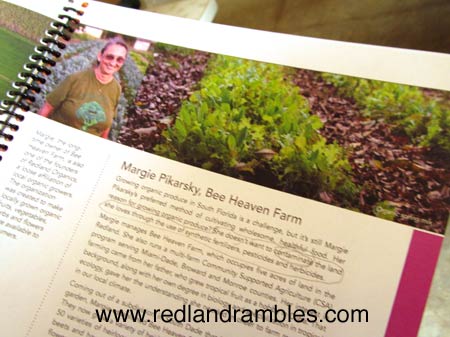
Bios of various farmers were originally included in the  cookbook, but unfortunately didn't make the cut for the final version.

Bios of various farmers were originally included in the cookbook, but unfortunately didn’t make the cut for the final version.

The book is beautifully produced, with luscious pictures of produce and and lovely countryside. Yes, that’s what Miami-Dade County’s back yard looks like! If there is one disappointment, there are no pictures of the finished dishes. The book is thoughtfully designed to be used in a kitchen, with glossy, heavy pages to stand up to drips and spills, and a spiral binding that lets pages lay flat. There’s plenty of white space to scribble comments.

Charles delivered 100 copies, which Margie is selling on her summer web store for $16 each (including tax). You can also buy it from the Dade County Farm Bureau. The book will also be available at the Homestead Book Fair on October 5th. Three thousand copies have been printed. “There’s no room to move in my office,” LaPradd said, laughing. Help him free up some floor space and buy a book!

redland-raised-logo-smallThe cookbook was published so that people can learn about the area, and how to use its products, LaPradd explained. Proceeds from its sales will go toward raising money to pay for colorful produce stickers with the Redland Raised logo.

Starting this October, those stickers plus in-store displays should be in Publix stores so shoppers can clearly identify what’s locally grown. Some of the local produce to look for (as it comes into season) is green beans, yellow squash, zucchini, boniato, okra and avocados. And if you don’t find those displays, or if they’re on produce that clearly isn’t from here, complain to the store’s produce manager. This is information that LaPradd’s office provides free to stores.

If Redland Raised sounds vaguely familiar, the brand was launched with great hope and promise on October 29, 2009. Various dignitaries including LaPradd, county mayor Carlos Alvarez, several commissioners, a bunch of Redland growers, and store execs gathered in the produce department of a Publix near Tropical Park for the kickoff. But a cold winter freeze that damaged a lot of crops caused a setback, and both local veggies and signage disappeared from stores. Now the program is rallying a comeback, and hopefully sales of the new “eat local” cookbook will revive interest from both cooks and retailers.

The Redland Raised brand was LaPradd’s brainchild, and it was designed to be used in conjunction with the state ag department’s Fresh From Florida brand. Only Redland growers who are members of the Florida Agricultural Promotional Campaign (FAPC) can use the Redland Raised logo to promote their produce as grown in Redland.
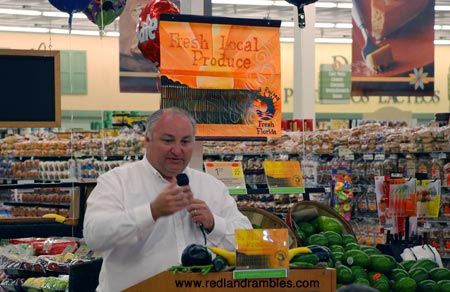
Surrounded by a bounty of local, Redland produce, Charles LaPradd speaks at the launch in 2009.
Surrounded by a bounty of local, Redland produce, Charles LaPradd speaks at the launch in 2009.

Read Full Post »

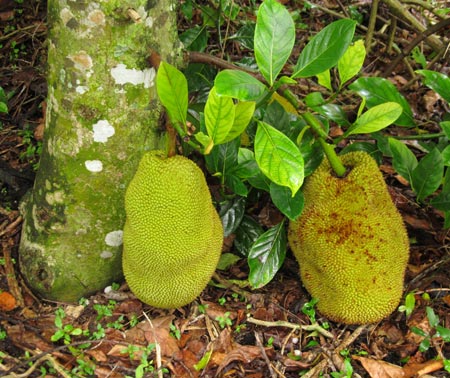
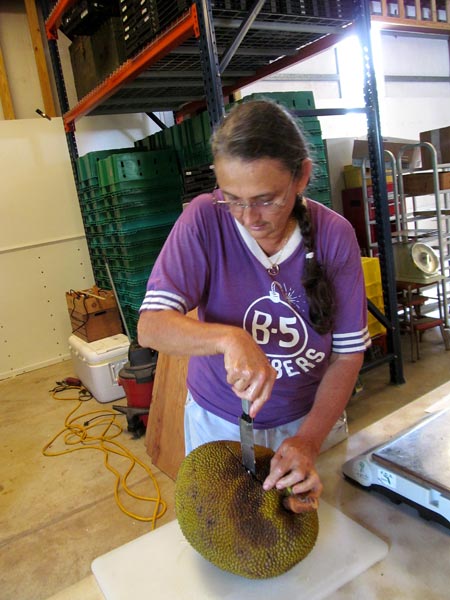
One of the weirdest looking fruits of summer is jackfruit. It has a thick green knobby skin, could pass for some kind of alien pod. A full-grown fruit may easily weigh 30 to 40 pounds.

Farmer Margie Pikarsky starts opening up a jackfruit.

Farmer Margie Pikarsky starts opening up a jackfruit.

Farmer Margie sells whole fruits of varying sizes on her summertime online store. She also cuts 3 pound chunks to order.

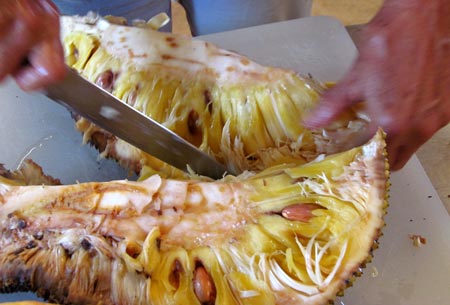
The yellow pouches are edible, but the white membranes are not.

The yellow pouches are edible, but the white membranes are not.

Opening one of these fruits is not for the weak of hand or faint of heart. You’ll need a big, sharp knife to pierce the thick skin, and the blade, your hands and the cutting board all need to be thoroughly oiled so the latex sap doesn’t stick.

You can’t just cut open the fruit, peel it and pop it in your mouth. Its white/gray “rags” or connective membranes are inedible in most varieties and need to be removed. The edible part of the fruit looks like a firm yellow pouch, which contains a large oval seed. You can blanch and roast seeds, or boil in brine, to make a snack that has a taste and texture of chestnuts.

Jackfruit seeds can be cooked and eaten.

Jackfruit seeds can be cooked and eaten.

When it’s ripe, jackfruit has a strong sweet, distinctive aroma, and gives off a good bit of ethylene gas (which can ripen other things in your refrigerator if you’re not careful.) It tastes like a blend of banana, pineapple and vanilla, and has a chewy texture. You can also eat the fruit green or unripe (but be extra careful with the sticky sap, which is greatly reduced when the fruit is fully ripe), and season it like you would curry or chili, or cook it in coconut milk. It said to make for a convincing meat substitute.

Read about Robert Barnum of Possum Trot Tropical Fruit Nursery growing jackfruit.

jackfruit-tree

Jackfruit ripening on the tree.

Read Full Post »

The big barn in the back of Bee Heaven Farm is where a lot of things happen. In the winter, a packing line for CSA shares is set up in its large open space.  Then in summer a slightly different packing line is set up to sort and box organic  avocados from the Bee Heaven grove.

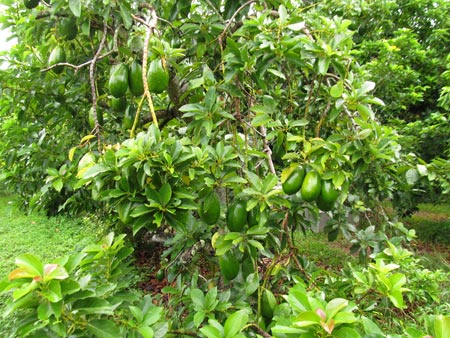
Trees in the Bee Heaven grove are loaded with fruit.

Trees in the Bee Heaven grove are loaded with fruit.

Periodically through the summer, Farmer Margie delivers pallets of freshly-harvested large green Donnies and red-skinned Hardees directly to the Whole Foods Market Florida warehouse in Pompano Beach, where they are distributed to area stores the very next day.

Cleaning and grading avocados.

Cleaning and grading avocados.

Because the barn is a certified organic packing house, from summer through fall, local grower Murray Bass backs in trailer loads of his organic avocados to pack there. His crew cleans, sorts and boxes avocados all day long.

Filling boxes to be sold under Uncle Matt's brand.

Filling boxes to be sold under Uncle Matt’s brand.

Then pallet loads of his avocados are taken over to the Florida City State Farmers Market Facility, where they are kept in a large drive-up cooler. Big rigs from Publix and Whole Foods can back in easily to the loading docks to pick up their orders. Look for Murray’s avocados sold under the Uncle Matt’s brand!

Unloading pallets of Uncle Matt's avocados at the Florida City market.

Unloading pallets of Uncle Matt’s avocados at the Florida City market.

Read Full Post »

Summertime is down time

summer-moon

Rising almost-full moon on Summer Solstice Eve.

It’s officially summer time! The solstice was last Friday, followed by a supermoon (when the moon is at the very closest to Earth all year). But it sure felt like summer months before. Summer is a hot, humid, sweaty, weedy time at Bee Heaven Farm. The CSA season ended in late April. The last of the carrots got found and pulled up at Gleaning Day in early May. And now the vegetable beds take a well-deserved rest until planting season in fall. Yes, fall — not spring.

If you are from anywhere north of Florida, you’ll quickly discover that farming seasons are upside down here, compared to what you may be used to in, say, North Carolina. There, the growing season is in full swing. Here, farmers let the fields rest and go on vacation. When the fall harvest winds down Up North, the planting season begins down here.

Lost in the weeds. (Can you find the bee?)

Lost in the weeds. (Can you find the bee?)

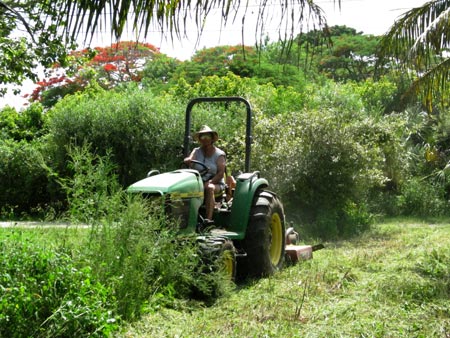
In the last two months, weeds sprang up to waist and shoulder height in the vegetable beds. They flourished because of days of torrential rain. Finally, on a dry day, Farmer Margie attached the brush hog to the green John Deere tractor and mowed them all down.

summer-mow

Weeds have met their match.

Summer is time for fruit. Lychees made their brief appearance for a couple weeks in May. Margie’s creamy Donnie avocados can get as big as footballs. Mangoes in all their varieties are definitely the queen of the summer fruit. Much coveted mamey, with its sweet salmon-colored flesh, is coming in. Massive jackfruit looks primordial with its thick, spiky hide. Sapodilla and longans are ripening. Summer is definitely a good time to become a fruitarian!

summer-avos

Donnie avocados ripening.

Read Full Post »

onions-table-1

Red and yellow onions drying in the front stall.

A sea of organic onions has washed up at the horse barn at Bee Heaven Farm. The onions  are laid out in two double rows on either side of the walkway, and one layer deep on tables in two of the stalls. The red spring onions still have their tops attached, and the big round yellow ones are topless. They are drying out so they can be kept longer in storage.

onions-arturo

Farmer Arturo dropping off a million onions. Farm worker Luz in background. Photo by Margie Pikarsky.

onions-table-2

Yellow onions drying in the back stall.

Farmer Arturo Gonzalez of Sunshine Organic Farm grew all these onions for the CSA. “So many onions, I don’t know what to do with them!” he told me. “I’ve been eating onions every day — onions with breakfast, lunch, and dinner and I still have too many onions!”

You can help Margie with her onion problem by grabbing some at the next summer offering. Just think — onion soup, caramelized onions (my favorite), dried onions, onions in omelets with fresh herbs — I could go on and on…

If you aren’t already, get on Farmer Margie’s mailing list so you don’t miss out on a single deal during the off season!

onions-red

Sea of red spring onions.

Read Full Post »

« Newer Posts - Older Posts »