Feeds:
Posts
Comments

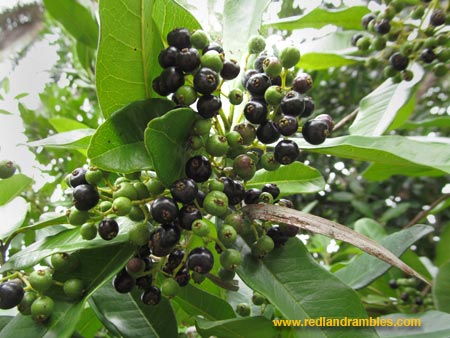
Ripe allspice berries

Ripe fresh allspice berries, half pint.

Ripe allspice berries, half pint.

Allspice! The name alone conjures up a blend, but it is actually one spice with the aromas and flavors of cinnamon, cloves and nutmeg. The mellow brown powder from the grocery is made from unripe allspice berries harvested which are dried and ground.

Fresh, ripe berries are hard to find, unless you are lucky enough to have a tree growing in your yard. The flavor from fresh is completely different than from dried berries. “Allspice berries, allowed to ripen, ascend to a whole other level,” farmer Margie Pikarsky told me. “I call them ‘Nature’s Altoids (TM)’ because they’re sweet and yet surprisingly strong.”

The fresh berries are about the size of a large peppercorn, and ripen to a dark bluish-purple color. When you pop one into your mouth, it gives a rich and resonant burst of flavor. Suddenly the dried version pales by comparison.

“The berries are great in spice breads, muffins, or drinks. Substitute them in any baked goods recipe calling for blueberries. Frozen berries will keep a long time in the freezer. Maintained below 0 F, they successfully keep for over one year,”  Margie recommends.

The fresh leaves also have a spicy aroma, but not as strong. “Fresh allspice leaves are used like bay leaves for flavoring. Use them fresh, though. Dried ones lose their oomph.” The glossy green leaves can be steeped in hot water to make a refreshing spice tea, good hot or cold, and sweetened lightly with local honey.

Allspice was one of the very first plants Margie put in on her farm, probably back in 1996. She planted two, and they have since grown to shrubby looking trees about eight or nine feet tall. The plants are dioecious (male and female). The female is the one that bears the edible berries but needs a male tree nearby.

Ripe allspice berries

Ripe and unripe allspice berries and leaves.

artisanal fair

Saturday, September 28, 2013
12 noon to 4:00 pm
Free admission

The Wolfsonian Museum is teaming up with local farms and makers of food products for this all-about-the-local-food-you eat event.

Artisanal Fair @ The Wolf and CSA Sign-Up is a fantastic opportunity to meet your local farmers. Come find out more about local food grown by Margie Pikarsky of Bee Heaven Farm and sign up for one of her Community Supported Agriculture (CSA) farm shares.

Teena Borek from Teena’s Pride CSA and Muriel Olivares from Little River Market Garden CSA (sold out for this season!) will also be there. Buying from a CSA a great way to support a local farmer, and get fresh produce every week during our harvest season.

Participating local food vendors include: Cao Chocolates, The Cheesecake Gallery, Dauphin Kaffee artisanal coffees, Freakin’ Flamingo jams and jellies, Pop Nature popsicles and paletas, Proper Sausages, and Simply Sharon’s “treats that heal.”

At 2:00 pm, take a special guided tour of the current Modern Meals exhibit. It will be led by museum staff and Teena Borek.

This event is co-presented by The Village Stand gourmet shop and Slow Food Miami.

Start your gardens!

GrowFest-logo-2

Saturday October 19 and Sunday October 20, 2013 
10:00 a.m. – 5:00 p.m.

GrowFest! 2013 is right around the corner, and it’s a tremendous opportunity to get your seedlings, companion plants and fruit trees for your fall garden. Farmer Margie Pikarsky and her staff have been hard at work growing heirloom tomato starts and other baby plants for the event.

Bee Heaven Farm will offer over 80 varieties of heirloom tomato seedlings, several varieties of eggplant, hot peppers, basil, arugula, chard, kale, Asian greens and perennial herbs like garlic chives, curryleaf, and lemongrass. Other vendors will have fruit trees, native and companion plants to promote beneficial insect habitat, and gardening supplies. SNAP/EBT dollars can be used for buying veggie seeds and seedlings. And those dollars will stretch twice as far, courtesy of Urban Oasis Project/Wholesome Wave Foundation’s double-value program, to get those gardens growing!

Browsing through a sea of seedlings in the heirloom tomato section. (GrowFest! 2012)

Browsing through a sea of seedlings in the heirloom tomato section. (GrowFest! 2012)

Questions about growing? Answers here for backyard growers, urban farmers, small and big farms. The UF/Miami- Dade County Extension Office is our local source for growing information tailored to our subtropical South Florida climate. Check out their presentations and demos. There will be special emphasis on organic and environmentally friendly practices, and establishing building blocks for healthy eating.

Want to learn how to prepare healthy food and kid-friendly snacks? See local chefs use fresh local ingredients to create fun and tasty dishes, school lunches, and snacks. Pick up copies of three awesome books all about local foods — Local Flavor: Recipes Raised in the Florida Redland — Field to Feast: Recipes Celebrating Florida Farmers, Chefs and Artisans — Organic Methods for Vegetable Gardening in Florida.

Melissa Contreras, author of Organic Methods for Vegetable Gardening.

Melissa Contreras, author of Organic Methods for Vegetable Gardening.

Enjoy fresh, great food!  Tired of that same old fair food? We’ll have a great selection of healthy foods showcasing locally-grown Fresh From Florida and Redland Raised ingredients. Local cottage food and artisanal producers will share their stories and sell their goods.

Explore the park!  The only tropical botanical garden and public park of its kind in the U.S., the Redland Fruit & Spice Park hosts over 500 varieties of tropical fruits, vegetables, spices, herbs, nuts and edible plants. If you’ve ever been to the park, you know what a nice place it is to visit and learn about the amazing variety of edible plants you can grow in South Florida.

For sponsorship opportunities, contact Margie at GrowFest@beeheavenfarm.com

Want to be a vendor or exhibitor?
Click here for GrowFest! 2013 vendor application.

Location:
Redland Fruit & Spice Park 
24801 SW 187th Avenue, Redland, FL 
(corner of Coconut Palm Drive & Redland Road)

Admission:
$8 advance purchase 
$10 at the gate 
children under 12 free
Includes raffle tickets for a chance at some great door prizes!

The heart of the matter was found at the Bee Heaven Farm tents.

The heart of the matter was found at the Bee Heaven Farm tents. (GrowFest! 2012)

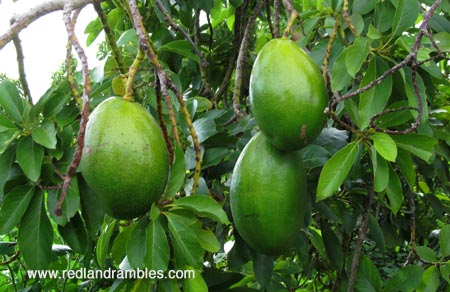
avos-cluster

In August and early September, the stars of Bee Heaven Farm are the shiny green Donnie avocados grown to almost football size. Stroll through the grove even this late in summer and you’ll see many, both on the branches and littering the ground below.

Summertime is a good time to visit fruit growers in Redland, because as you tour their groves, they’ll pick a fruit and let you taste it. So when the newest member of the Extension office, Tropical Fruit Agent Jeff Wasielewski, came to visit, that’s exactly what farmer Margie Pikarsky did. She took him for a walk around her farm, where they paused at different fruit trees, tasted a couple things along the way, and shared stories about the trees’ health and growth. “Visiting smart, forward-thinking growers like Margie is important for me as a learning tool and not just a social visit,” he said. (The UF/Miami-Dade County Extension office shares the latest agriculture information from University of Florida’s researchers with farmers and gardeners in the county. Some of the ways are through workshops, educational materials, field consulatations, and their web site.)

Tropical Fruit Agent Jeff Wasielewski and Margie Pikarsky open up an avocado.

Tropical Fruit Agent Jeff Wasielewski and Margie Pikarsky open up an avocado.

Margie’s pride and joy is the grove of over 90 avocado trees, which she herself planted back in 1996. She and Wasielewski stopped at one tree where she picked up a windfall avocado and handed it to him. It looked ready to eat, so he pulled pruning snips from a case on his belt, and cut open the fruit.

He’s a tall, easy going man with a ready smile and 18 years of tropical fruit experience, and 21 years of horticulture in South Florida. You might already know him from lectures, articles and videos he made for Fairchild Tropical Botanic Garden, where he was the Educational Outreach Specialist. He’s developed keen senses and loads of experience when it comes to tropical fruit and plants. All it took was one taste and he said the avocado was a day away from being perfectly ripe.

Further down the row of trees, he noticed a dead branch, which Margie snapped off. “Be careful,” he warned. “A dead branch like that can attract other beetles now suspected of carrying laurel wilt.” Margie explained that she removes dead branches from the trees as soon as she finds them, and trims the trees every year. So far her grove looks healthy, but laurel wilt disease remains a lurking concern.

Laurel wilt is a dangerous avocado disease that appeared in Miami-Dade County a few years ago. It is spread by the red bay ambrosia beetle, which is tinier than a grain of rice. Wasielewski  explained that the beetle burrows into healthy avocados and other trees in the laurel family. “It cultivates a fungus that eventually kills the tree branch by branch by disrupting its vascular system. Signs of the disease are quick branch dieback or tiny holes and sawdust towers where the beetles enter the tree. The tree will die very quickly if infected. Commercial growers are advised to quickly and completely remove the tree and its roots. The removed tree should be burned in place, out of fear of spreading infested wood to other groves and trees. Root removal is necessary because the disease may spread from tree to tree through root grafts,” he told me in an email.

So far there have been over 2000 trees removed due to laurel wilt in commercial groves in Redland, and  growers are worried, and anxious for a cure. When the first tree in a large commercial grove was suspected of having the disease, Extension held a standing room only meeting for growers, informing them of the threat. They continue to provide updated information on their website and with occasional meetings. (Yes, backyard trees in town are also at risk. Find info for homeowners at Save The Guac web site.)

Jeff and Margie

Jeff and Margie

As Tropical Fruit Agent, one of Wasielewski’s goals is to inform avocado growers of new research on combating laurel wilt. “It’s important that I am on the cutting edge of what is going on in the tropical fruit world,” he said. University of Florida has done tests, and complied a list of pesticides that will kill the ambrosia beetle. Unfortunately, none of them can be used in an organic grove. Local organic growers are pressuring the scientists to test substances approved for use in organic production.

Margie expressed her frustration to Wasielewski at the current lack of effective organic options. He said he would keep her informed as to new research into alternative treatments. “I want growers to have options as far as doing things in an environmentally friendly way. I let them know their options and the value of each option. Growers are then free to make a choice on how they want to proceed, but only if they are armed with new knowledge and multiple options,” he told me in an email.

For now, it’s wait and see how bad laurel wilt gets in Redland, and how quickly research can come up with solutions that all growers can use. Wasielewski is an important addition to the Extension office during a critical time for tropical fruit growers.

As for Bee Heaven Farm, over the years Margie has accumulated a wide variety of other tropical fruit trees, tucked away here and there among the vegetable beds. Sapodilla, carambola, longan, mango, and bananas are planted in various spots on her five acre farm. If her avocado trees have to go, she’ll plant different fruit trees and more vegetables, she once told me. But until then, she and other growers will put up a fight to save their groves.

Got a question about tropical fruit? Contact Jeff Wasielewski at 305-248-3311, ext. 227 or email at jwasielewski@ufl.edu .

Hot off the press

Margie Pikarsky and Charles LaPradd with the new Local Flavors cookbook.

Margie Pikarsky and Charles LaPradd with the new Local Flavors cookbook.

Recently, Charles LaPradd, the county agriculture manager, stopped by Bee Heaven Farm with a special delivery. He unloaded several boxes of Redland’s latest crop — “Local Flavor: Recipes Raised in the Florida Redland” — a very special cookbook two and a half years in the making.

It’s filled with recipes for local produce gathered from growers and cooks. The list of contributors is a who’s who of area growers and cooks. Farmer Margie Pikarsky has three of her own recipes: Avocado Salad (or Chunky Guacamole), Calabaza & Watercress Salad, and Strawberry Black Satin Pudding. “Veronique,” a Sea Grape Martini, was originally concocted with Margie’s sea grapes for a Slow Food Miami event.

If it grows in Redland, there’s a mouthwatering recipe for it, and almost all look quick and easy to make. Carambola is coming into season now, and Star Fruit Chicken Salad caught my eye. A useful chart in the back lists what’s growing when. This is a great book for CSA members to have in their kitchen.

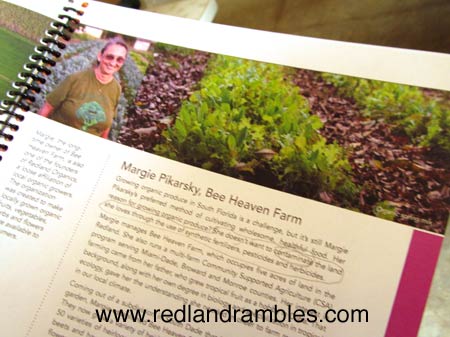
Bios of various farmers were originally included in the  cookbook, but unfortunately didn't make the cut for the final version.

Bios of various farmers were originally included in the cookbook, but unfortunately didn’t make the cut for the final version.

The book is beautifully produced, with luscious pictures of produce and and lovely countryside. Yes, that’s what Miami-Dade County’s back yard looks like! If there is one disappointment, there are no pictures of the finished dishes. The book is thoughtfully designed to be used in a kitchen, with glossy, heavy pages to stand up to drips and spills, and a spiral binding that lets pages lay flat. There’s plenty of white space to scribble comments.

Charles delivered 100 copies, which Margie is selling on her summer web store for $16 each (including tax). You can also buy it from the Dade County Farm Bureau. The book will also be available at the Homestead Book Fair on October 5th. Three thousand copies have been printed. “There’s no room to move in my office,” LaPradd said, laughing. Help him free up some floor space and buy a book!

redland-raised-logo-smallThe cookbook was published so that people can learn about the area, and how to use its products, LaPradd explained. Proceeds from its sales will go toward raising money to pay for colorful produce stickers with the Redland Raised logo.

Starting this October, those stickers plus in-store displays should be in Publix stores so shoppers can clearly identify what’s locally grown. Some of the local produce to look for (as it comes into season) is green beans, yellow squash, zucchini, boniato, okra and avocados. And if you don’t find those displays, or if they’re on produce that clearly isn’t from here, complain to the store’s produce manager. This is information that LaPradd’s office provides free to stores.

If Redland Raised sounds vaguely familiar, the brand was launched with great hope and promise on October 29, 2009. Various dignitaries including LaPradd, county mayor Carlos Alvarez, several commissioners, a bunch of Redland growers, and store execs gathered in the produce department of a Publix near Tropical Park for the kickoff. But a cold winter freeze that damaged a lot of crops caused a setback, and both local veggies and signage disappeared from stores. Now the program is rallying a comeback, and hopefully sales of the new “eat local” cookbook will revive interest from both cooks and retailers.

The Redland Raised brand was LaPradd’s brainchild, and it was designed to be used in conjunction with the state ag department’s Fresh From Florida brand. Only Redland growers who are members of the Florida Agricultural Promotional Campaign (FAPC) can use the Redland Raised logo to promote their produce as grown in Redland.

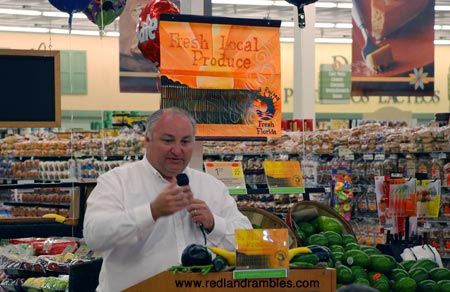
Surrounded by a bounty of local, Redland produce, Charles LaPradd speaks at the launch in 2009.

Surrounded by a bounty of local, Redland produce, Charles LaPradd speaks at the launch in 2009.