Feeds:
Posts
Comments
The Firework Flower

The Incendiary Blooms of the Guiana Chestnut are hard to miss. Combining arches of vibrant yellow with electric red and white hairs…you could almost call this The Firework Flower.

[Welcome to guest blogger Alex Norelli, contributor to the Organic Gardening blog. Alex is a blogger, poet, and photographer. Here is his view of a month’s visit to Redland. – marian33031]

My first introduction to the Redland was through the Fruit and Spice Park, a great place to see the potentials of this land and climate. When I arrived in the Redlands I expected to see an intense iron-colored soil like the almost inhuman Mars-red fields in La Mancha I remember driving through while in Spain. But I didn’t see it in the soil as much as I found it in the air, in a host of blooms and fruit, some edible, others strictly for the eye.
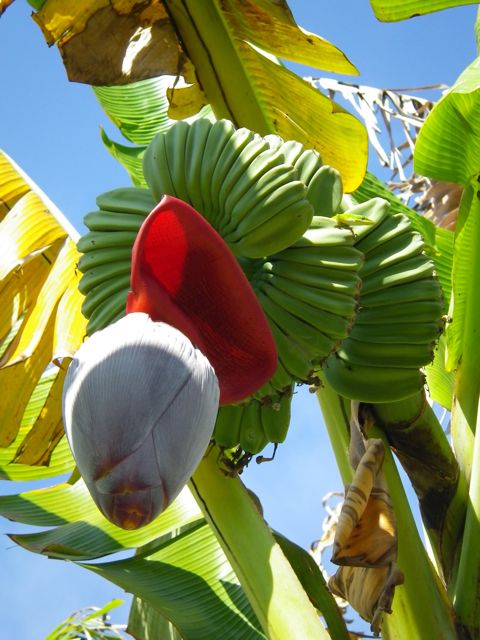
Such Mainifold color, with red at the center.

Such manifold color and form…the red of the flower’s petals contrasting with the green of unripe bananas is an eye-catching combination. The size of this fruit has no equal where I come from, and perhaps only a rose, or cardinal flower, has a comparably red.

Coming from the north and spending nearly my entire life in zone 6, with short forays into other zones, I was in for a wealth of newness. For one thing, fruits and flowers in zone 6 are usually quite reserved, petite and constrained, nonetheless beautiful, but of a different scale. In the sub-tropics, without a winter to hold back growth, there is never a thought for conservation, or preserving energy to make it through a many-month winter. And so things just grow; wildly, gaudily, loudly, abundantly, fruiting multiples times a year. That simple fact allows for a startlingly different display of color than I am used to, and it’s been an eye-opening pleasure encountering it in the last two months.
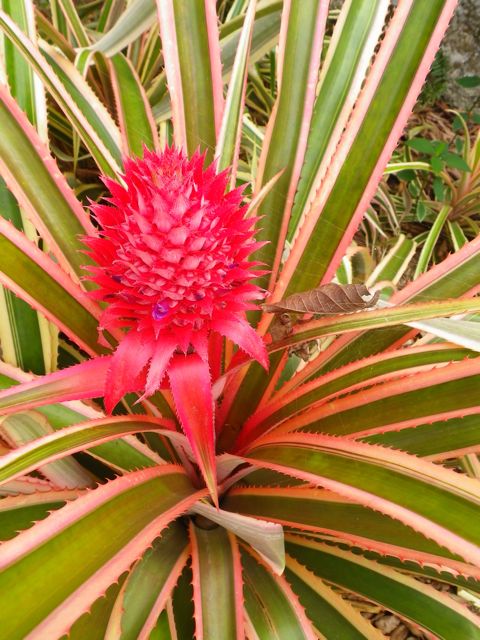
This Red is otherworldly…This neon red is too bright for my camera to capture in detail, the luminosity of the color is so great it becomes a iridescent smudge of wild color.
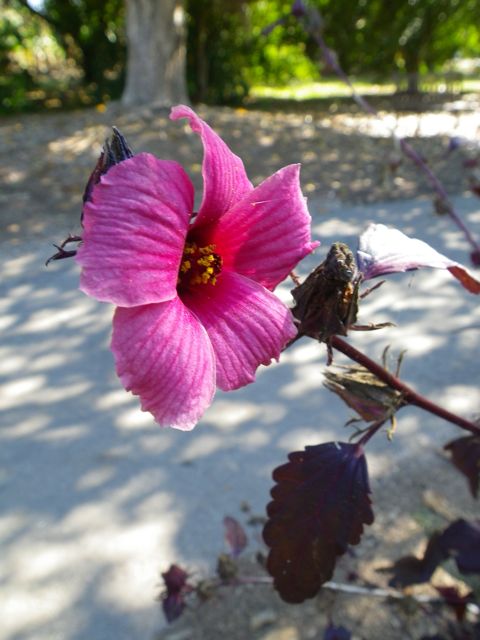
Cranberry Hibiscus, An edible red…its leaves can be steeped to make a tart tea high in Vitamin C

A row of edible red/orange marigolds among an impressive selection from Paradise Farms
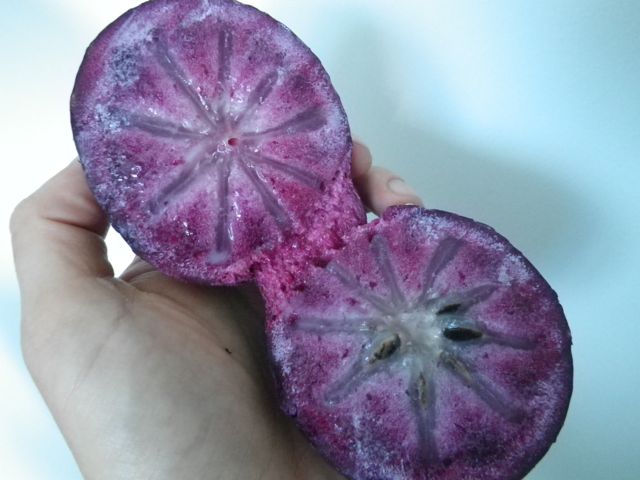
This purple star apple shows a bit of the red and blue that make up its color

The Strawberry Tree with its Cotton Candy flavored fruit

I am sure the examples of red are more numerous than I have experienced in only one season. I didn’t even hit on the tomatoes, of which the Cherokee has always caught my eye, not to mention they are one of the tastiest you’ll find. I’ve heard the nearly 150 varieties of mango are truly something to taste and see, and I have not spoke of the orchids. The one red I wish I captured was the rosy blush of a ripe mango, but I was too busy eating them to pause to take a photograph, and anyway, the interior is more delicious to the tongue than the exterior to the eye.

Alex Norelli spends his time between Pennsylvania and New York City where he works as a Roof-top gardener and writes poetry and paints. Recently he found himself in South Florida for a time and has set out to see its many wonders with his own brown eyes. You can see some of his works at www.AlexNorelliArt.com

Tomato madness!

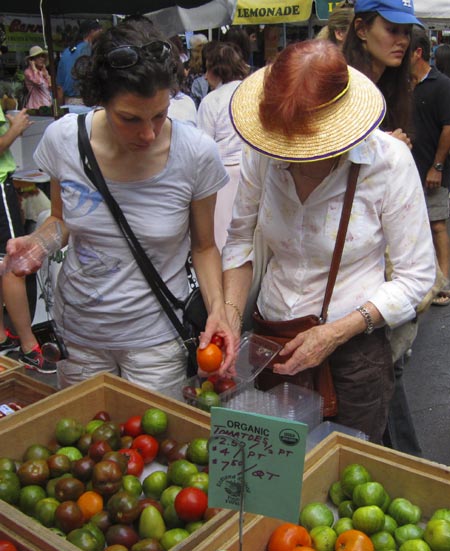
It’s that time of year when heirloom tomatoes are coming in thick and fast. You’ll find them in all shapes and sizes and colors at the Redland Organics tent at Pinecrest Gardens Farmers Market on Sundays.

Big ones, small ones, green, red, yellow, even orange, looking like jewels, enticing you to gather them from their wooden trays.

Eat one and you’ll know why people are crazy about heirlooms. Not only are they beautiful, but they’re just bursting with real flavor, their seed saved for generations.

Green ones tend to be a bit more tart, yellow and orange are sweet, and “black” ones have the richest flavor of all.

To serve, slice and add a little bit of good olive oil and sea salt and you’ve got locavore heaven on your plate and in your mouth.

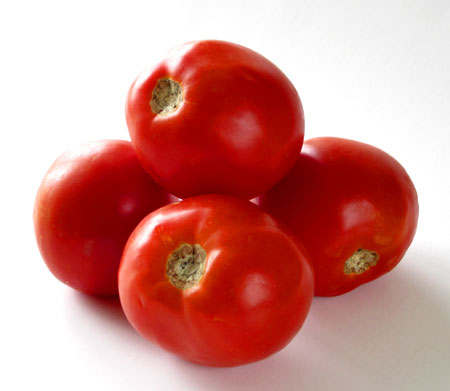
Locally grown round red slicers.

Round and red, and kind of ordinary looking, the slicing tomatoes in your CSA share box a few weeks ago didn’t seem very special, did they? But they are, and what made this year’s crop different is the way it was grown — in pots of soil, not directly in the ground. (The variety itself, Florida 47, is a commercial hybrid that’s been around for a long time, and is known as a good producing plant.)

Dan’s field of tomatoes in pots.

Farmer Dan raised the Florida 47s one plant per container, dozens of rows marching across a field blanketed with shiny black landscaping cloth, hundreds of staked tomatoes filling up three and a half acres. Why grow in pots? Because the land Dan had to use for growing, across from the Keys Gate Market Garden, was former swampland filled in with rock and even chunks of concrete, thin soil supporting only weeds. “Seven, eight, ten feet of fill instead of soil, and it was absolutely impossible to grow anything there,” Dan explained. Thus hundreds of pots, growing plant nursery style — a quick solution to the no-soil problem. (Plus, it was also the quickest way to get the operation certified organic.)

Read the fine print. This tomato came from Mexico. And people bought it because it’s cheap.

The tomatoes were delicious and beautiful, but financially the crop was a disaster. Startup costs were much higher than if he had planted directly into a fertile field. The potted plants required a lot of input — fertilizer and insect control sprays — plus you have to take into account the cost of soil, pots, landscaping cloth, irrigation and labor. “It cost me seventeen thousand dollars gross to set up, and my net was damn near nothing,” Dan grumbled.

Just as Dan was starting to harvest a few weeks ago, round red organic tomatoes from Mexico flooded the local market. (You might have seen them at area stores.) Thanks to NAFTA, the dollar-peso exchange rate, and low labor costs, organic tomatoes from Mexico were wholesaling for a lot less than what Dan was asking for.

No way he could make a profit. And he was stuck with bushels of tomatoes he had to unload. So he sold them at cost to farmer Margie of Bee Heaven Farm, and everybody in her CSA, large and small shares alike, got round red tomatoes. And, there’s Florida 47s to be had at the Keys Gate Farmer’s Market on Saturdays, and Pinecrest Gardens Farmers Market on Sundays, while they last.

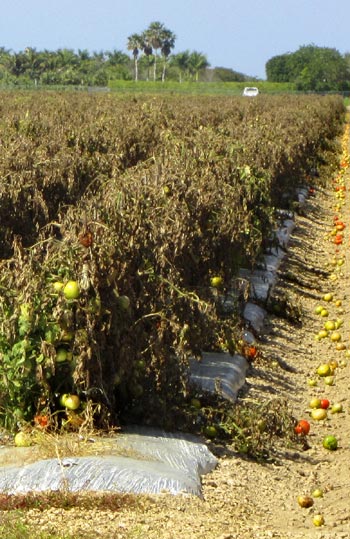
Tomatoes left to rot.

It’s not just organic growers who gambled and lost hard this season. I saw a field off Krome Ave. and SW 168 St. where the grower didn’t even bother harvesting his tomatoes. He left his crop to rot on the vines. Half the field was brown and dead, like it went through the worst freeze — and in the absence of recent cold weather, a sign it had been doused with herbicide. Why bother to spend more for labor to pick the crop when he was already in the hole raising it? (Food activists may want to chime in about holding off on chemicals, and allowing people to come glean fields to salvage food.)

Mexican produce aside, growing organic tomatoes in pots was an interesting experiment, but not one Dan cares to repeat any time soon. “It’s not sustainable,” he said. He is sticking with growing slightly more profitable green beans grown in a field of real dirt. It’s a gamble he knows how to win a bit better, providing there’s no hard winter freezes. “You want to know how to make a little money in farming?” Dan asked. “Start with a LOT of money.” And he laughed long and hard at his familiar joke.

Extension Open House

Saturday, February 25, 2012
10:00 a.m. to 2:30 p.m.

John D. Campbell Ag Center
18710 SW 288 Street
Homestead FL

This year’s free event at the Miami-Dade County Cooperative Extension Office will feature interactive demonstrations including grafting (in English and Spanish) and making a rain barrel. There will be educational displays on gardening, tree pruning, healthy eating, new pests and plant problems, plant diagnostic clinic, and much more.  In addition, there will be fun and educational activities designed for the entire family, including a “Fun and Learn 4-H Zone” for kids. There will also be seminars about vegetable gardening and landscaping. Participants will be able to purchase fresh, locally grown vegetables and orchids and other plants for their gardens.

Schedule of Events:

Demonstrations (outside):
10:30 – 11:00 – How to Graft (English)
noon – 12:30 – How to Graft (Spanish)
1:00 – 1:30 – How to Make a Rain Barrel (after the demo, you can stay and have help making your own rain barrel)

Lectures (inside):
10:30 – 11:00 – Vegetable Gardening Made Easy
12:30 – 1:00 – Colorful Landscape Plants for Water-wise Yards
1:30 – 2:00 – Florida-friendly Plants for Your Landscape

Raffle drawings will be every 30 minutes starting at 10:45 and ending at 1:45. Winners must be present at the raffle drawing to win. Participants will be able to purchase fresh, locally grown vegetables and orchids and other plants for their gardens.

A hen lays an egg every day.
True. Hens generally lay around the same time of day, usually in the morning. To get more technical, it takes about 25 hours for an egg to form and travel through the oviduct, causing the hen to lay her egg a little later each day. As the cycle progresses, she will skip a day (hens don’t lay eggs in the evening) and start a new cycle. A group of eggs laid during one cycle is called a “clutch.”

A hen will lay eggs all its life.
Maybe. A young hen, called a pullet, will start laying eggs at 6 months until its first moult. It will then resume laying eggs in the second year at 80% of its previous rate, then 60% of that year’s rate in the year after that. After 3 years, laying drops off. But a hen can keep laying eggs for several years after, just not every day. Older hens usually stop laying eggs, but some might keep laying an occasional egg.

A very big hen lays the big double yolk eggs.
False. A pullet, or young hen, that doesn’t have a regular laying cycle can occasionally lay double yolk eggs. That happens when ovulation happens inconsistently, and one yolk joins the next as the egg develops. (Some breeds will regularly lay double yolk eggs.) Of course, a double yolk egg is much larger than a normal sized egg. Sound painful? Not really. The egg comes out soft and its shell hardens in contact with air.

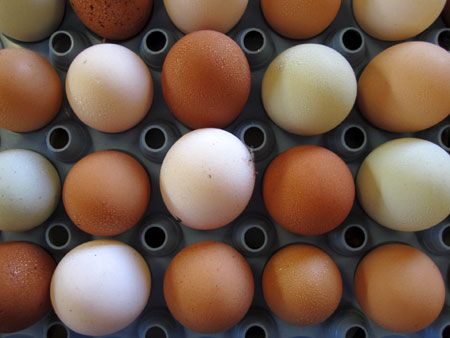
An old egg will float in water, but a fresh egg will sink.
True! A fresh egg will sink in a bowl of water, but as it gets older, it will start to stand up. A very old egg will float. Don’t eat that one! Inside the egg is a small air pocket at the blunt end. Eggshell is porous to air, and as the egg ages, more air will slowly seep in, and make the air pocket bigger.

The best place to store eggs in the refrigerator is on the door.
False! Keeping eggs in the refrigerator door is bad, because every time you open the door it changes temperature — hot, cold, hot, cold. Always store eggs in the carton with the pointy end down. To keep eggs fresh longer, find a spot for them on the shelf where the temperature is cool and consistent.