Feeds:
Posts
Comments

Regenerate at a farm

Have you signed up for any of the sessions scheduled before the Community Food Summit? There’s plenty to choose from. The one that caught my eye is the Regenerative Farm Tour on Sunday Oct. 2. Regenerating is a good thing to do on a weekend, to clear out big city craziness at various farms, big and small, both urban and rural.

Tour guide Corinna Moebius will visit The Farm at Verde Gardens, Frank Macaluso’s Edible Yard, Yve Rose’s Backyard Food Forest, and Muriel’s Little River Market Garden. The tour runs from 9 am to 3 pm and costs $45.

Included is a stop at Possum Trot Tropical Fruit Nursery, where Robert Barnum, the Cantankerous Chef, will prepare a delicious vegetarian lunch. He’s using as much farm raised and local food as possible. The menu includes:

  • drink made with cas guava
  • vegetable casserole with okra, cabbage, squash, zucchini, tomato sauce (made from Teena’s Pride heirloom tomatoes), betel leaf, topped with Hani’s organic goat cheese
  • fresh fruit platter including monstera, jakfruit and carambola
  • Sem Chi organic rice (grown in Belle Glade FL)
  • carambola pie
  • homemade tropical fruit wine (optional)

Register here for the tour and lunch.

Path to the Summit

Earth Learning is presenting a series of workshops and seminars that lead up to the Second Community Food Summit. These events will bring in recognized activists and skilled practitioners to work with our community leaders as well as engage public audiences.

The Path to the Summit will be organized around six perspectives : Healthy People, Resilient Communities, Justice and Fairness, Sustainable Ecosystems, Vibrant Farms, and Thriving Local Economies.

Thursday, September 29th
8:00 am to Noon: “Local Plus” Food Access for All (Healthy People)
1:00 – 4:00 pm: Enabling Local Food (Resilient Communities)
6:30 – 9:30 pm: Re-Setting the Table, Toward Food Justice (Justice and Fairness)

Friday, September 30th
8:00 am – Noon: Sustainable Agriculture for All (Justice and Fairness)
6:00 – 9:30 PM: Carbon Farming: An Appetizing Strategy for Ecosystem Restoration and Climate Change (Sustainable Ecosystems)

Saturday, October 1st
3:00 – 7:00 PM: The New Agrarians: Growing Food Everywhere (Vibrant Farms)
7:00 – 10:00 PM: Greenhorns Film Screening & Potluck

Sunday, October 2nd
9:00 AM – 3:00 PM: Regenerative Farm Tour
4:00 – 8:00 PM: Miami’s Local Food Scene: Dine-Around Midtown

Monday, October 3rd
8 am – Noon: Slow Money Workshop
1:00 – 4:00 PM: Leading the Transition to a Local Food Economy

For detailed information on the pre-Summit workshops, along with registration and locations, go to the Earth Learning web site.

Join Earth Learning at the Second Greater Everglades Community Food Summit to envision and design a local food system in southern Florida that is vibrant, healthy, just, sustainable and resilient.

This Summit will include a who’s who of local food professionals, activists and enthusiasts from southern Florida, providing an unprecedented networking and partnership-building opportunity for all seeking to advance the passion for South Florida’s year round bounty of local foods. Be an active participant!

Keynote speakers are Woody Tasch of Slow Money, and Michael Brownlee of Transition Colorado.

Participants will:
* Interact with presenters on the leading-edge of the local food movement
* Share the State of the Foodshed report, highlighting our progress to date and highlighting local success stories
* Develop a shared vision and an Action Plan to move forward this vision
* Identify opportunities to enhance the production, processing, storage, distribution, marketing, and consumption of foods sustainably grown in the Greater Everglades bioregion
* Network and build relationships

When:
Tuesday, October 4 2011, 8 am – 6:00 pm
through Wednesday, October 5, 2011 8 am – 4:30 pm

Registration:
Early Pricing $80 ends Sept. 23rd — Regular price $95
(including breakfast and lunch both days)
Register at the Earth Learning web site

Location:
Miami Dade College, Wolfson Campus
300 NE 2nd Avenue, Building 3, Room 3210
Miami, FL 33132

If you have any questions about the event or how to register please feel free to contact Cat McLean, events@earth-learning.org , 786-233-2784

Mystery pears

Pineapple pear

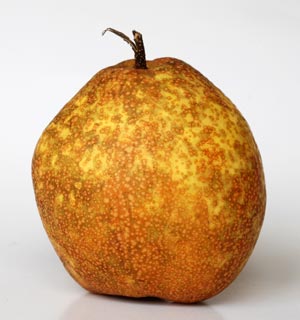
Nothing says autumn like a fresh, crisp, juicy pear — from Florida. Yes, pears grow in the northern part of our state! Farmer Ara Morenberg recently delivered five bushels of two different varieties of heritage pears from 3 Rivers Farm. Her fruit is available at several local farmers markets this week, and online from Bee Heaven Farm.

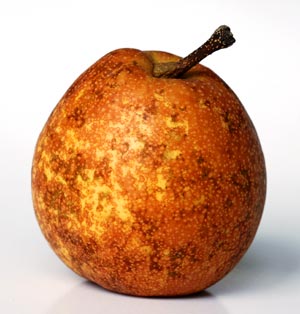
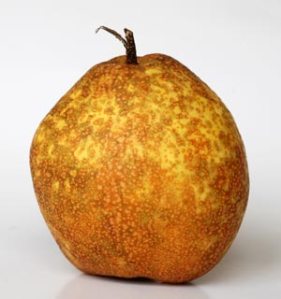
These Florida pears don’t look like your typical grocery store pear. They are shaped much like an apple, and their skin is spotted similar to an Asian pear. They stay hard when ripe, with only the slightest give. Their flesh is crisp and juicy and only slightly sweet, not meltingly soft and sugary like a Bartlett pear. In fact, these old Florida varieties are a hybrid of Asian and European pears, bred for disease resistance.

Ara recently purchased a five-acre property in Lake City, which came with an abandoned grove of heritage pear trees which hadn’t been sprayed or cared for in years. The parcel was originally part of a 100-acre orchard, and she thinks there are several varieties of pears growing on it. “I am guessing that we have Flordahome, Hood and Pineapple right now. The previous property owner said we had five to six varieties but did not know the names,” Ara wrote in an email. “The extension agent said that they could be even older than the above named varieties, and that we may never know the specific varieties other than calling them Florida pears, because the property has had pears on it for a minimum of 50 years.”
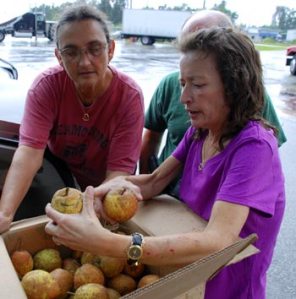
Ara (right) explains the differences between two kinds of pears to Margie (left).

Of the two varieties that came this week from Ara’s farm, Hood might not be one of them. A quick internet search revealed that Hoods are light green, do have the typical long neck, but don’t have reddish-brown spots. However they could very likely be Pineapple pears, which match having a short-necked shape and spotted color, and have a bit of tartness to their flavor. They are huge for pears, about the size of a softball.

And… they could be sand pears, or at least that’s what Farmer Margie Pikarsky was told when she was selling them at the Pies & Thighs pie contest on Saturday. She told me that “a couple of people, upon seeing them, immediately exclaimed ‘Sand pears! I grew up with these!’ ” They are called that for their gritty, hard texture. Sand pears (pyrus pyrifolia) could be any of several varieties commonly grown over 100 years ago in the old South.
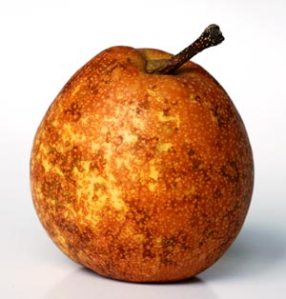
Sand pear

Whatever the names and cultivars, Lake City folk call them canning pears. “What they mean by that is that they can be cooked with,” Ara explained, “and they don’t eat them fresh, but instead baked, relishes, chutneys, canned, etc.” I found an easy recipe for apple tart that could be used with sand pears instead. Or you can skip the formalities and eat them raw, and enjoy their mildly sweet flavor as is. I cut up a sand pear and put it in chicken salad, instead of using apple or celery, and it added crunch without any obvious, strong flavor.

Delicious, nameless, ancient pears of mystery and delight! You can order online no later than 3 pm on Thursday Sept 15 from Bee Heaven Farm’s Summer Store. (Pickup in person at the farm or another location.) Or, look for them at the FIU, Verde Gardens and Upper Eastside farmers markets this week and taste a bit of old Florida history for yourself.

FIU Farmers Market, Maidique Campus, 11200 SW 8th Street, Miami. Wednesdays, noon to 3pm.

Homestead Harvest Market at Verde Gardens, 28000 SW 127th Ave., Homestead. Fridays 4 – 8 pm.

Upper Eastside Market, NE 79th St. and Biscayne Blvd., Miami. Saturdays 9-2 pm.

North Florida pears at Upper Eastside Farmers Market last Saturday.
Stopped by Margarita’s farm stand on Krome Avenue a couple weeks ago to get some bananas, and saw some potted rue plants off to the side. One had a handsome caterpillar on it, with bright green and yellow stripes, but I put that plant aside. Didn’t want any hitchhikers…

Sneaky giant swallowtail caterpillar browsing in rue.

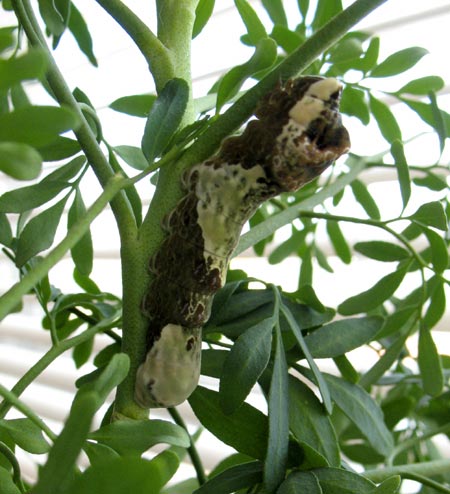
Discovered the next morning that the rue plant I brought home also had a caterpillar! It was big and had black and white blotches. I knew right away that it was a giant swallowtail caterpillar, much like the one I saw back in May at Possum Trot Tropical Fruit Nursery.

The caterpillar begins its transformation into a chrysalis.

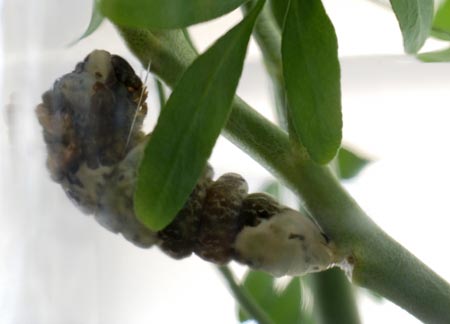
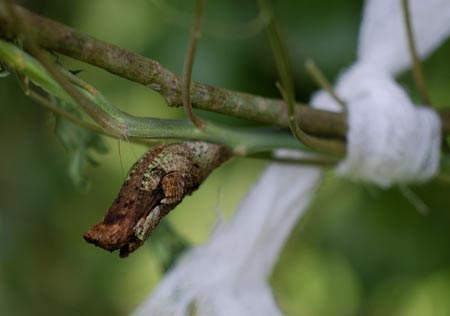
The caterpillar had a good appetite and devoured several branches of rue leaves for the next few days. (Giant swallowtail caterpillars feed only on citrus and rue leaves, so if you want them in your yard, grow rue.) Several days later the caterpillar looked different. It was hanging from a branch with what looked like two strands of monofilament connected to just below its head area, and its tail was firmly wedged against a stem. It had begun its transformation into a chrysalis! The following day the transformation was complete. Its skin had turned dark brown and rough. The chrysalis looked like a bit of a brown tree branch — protective camouflage.

Chrysalis, day 5. That knob of old wood doesn’t look like it would have anything to do with a butterfly.

I carefully clipped the branch it was attached to and put it into a large jar, and with a piece of cheesecloth on top so air could get in. The plan was to take it to a good place with lots of flowers. The giant swallowtail butterfly that would emerge would need sustenance in the form of nectar. In my neighborhood, there aren’t that many things blooming this time of year, and come to think of it, I haven’t seen any butterflies around.

Chrysalis, day 7. Released into the wild. It has acquired subtle green markings.

Farmer Margie offered to host the chrysalis, and I brought it to Bee Heaven Farm. We scouted for a good spot. It couldn’t be near the ground, where something might eat it, and it had to be close to the farm house, where it would be easy to check. Finally we picked a shrubby tree near the kitchen door, and tied the chrysalis to a branch with the cheesecloth from the jar. The butterfly is supposed to emerge after 10 to 12 days. Margie promised she would check the chrysalis twice a day. Hopefully she’ll be there with a camera when the butterfly emerges.