Feeds:
Posts
Comments

Seems like gourmet cheesemaker and Mediterranean chef Hani Khouri is all over the place these days. Busy man! Does he ever take a moment to just relax, chill out for a moment, stop and smell the… shisha? Sure he does!

There’s a groovy, laid-back event coming up soon at the Everglades Hostel way down in Florida City. Don’t groan, it’s worth the drive down. Where else would you get a chance to sprawl out on cushions and carpet in the hostel’s gazebo, smoke a hookah and get your hands and feet decorated with traditional henna designs?

And speaking of Hani, he’s bringing the vegetarian feast of: hommos asli (asli means authentic), baba ghanouj asli, tabbouleh asli, felafel asli, tahini sauce, traditional condiments, fresh baked pita bread and fresh goat milk ice cream in various tropical fruit flavors. If you miss buying his ice cream at the farmers market, here’s your chance to enjoy the treat in real Mediterranean style.

For more details and to purchase tickets, click here.

Henna Hookah and Hani
June 12 8 pm – 1 am
Everglades Hostel
20 SW 2 Avenue
Florida City, FL 33034

Call/text Kristin Jayd for more info 305-342-5844 or send her an email at kristinjayd(at)gmail.com .

A lot was going on at the Fairchild Farm & Garden Festival. Here’s another post from the Festival, about growing your own oyster mushrooms.

On Saturday April 24th, Gabriele Marewski and Drake Kurlander of Paradise Farms were set up for a talk on her oyster mushroom operation. “Growing mushrooms is an art and a science,” Gabriele said as she introduced Drake, an FIU student with a passion for mushrooms. He works closely with Benjamin Masope, the mushroom expert from Ghana who is responsible for successfully starting Gabriele’s mushroom production. (You can read more about his story in the April issue of edible South Florida.) Here are my notes from Drake’s presentation.
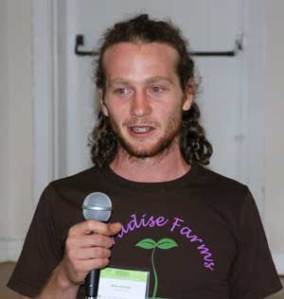
Drake Kurlander

“Anyone can grow mushrooms once the process is understood,” Drake said. He went on to explain the life cycle of mushrooms. You start with spores, which germinate, grow in substrate and result in the fruit body, or edible part of the mushroom. Spores are in the air everywhere. Spores are both male and female, and once they germinate, they make a simple structure called hypha that replicates itself, combines, and creates a network called mycelium. This network colonizes, and two and a half to three months later, produces pin or baby mushrooms. From that stage, it takes only two to three days for a pin mushroom to grow to full size. A full grown fruit body (as the edible part of the mushroom is called) has a hollow structure full of spores, and it can reach out and put spores in the atmosphere. A fruit body will also grow by cloning. You can sever it and put it in substrate (special growing medium) and it will expand.

The production process on the farm follows a specific process. The growers start the spore culture in a petri dish. Next, they sterilize grain (they use organic chicken feed at Paradise) under high heat and crush it. The grain, or primary substrate, is inoculated with spores and incubated in jars. While it’s growing, Drake and Benjamin mix up the secondary substrate — a top secret formula! — and put it into bags. Those go in the pasteurizer which cooks the substrate at a high heat to kill any wild spores which might dominate the mushroom spores. The spawn is then inoculated into the sterilized substrate and left to grow in a chamber which circulates humidified air. “The challenge is to maintain sterility in the grow room,” Drake explained. “Air has fungi and contaminants floating in it.” Currently they are harvesting 200 to 300 pounds a week, and want to increase production to 800 pounds a week.
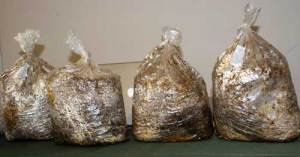
Oyster mushroom starter kits. Each bag of substrate is inoculated with mycelium. Just add water and light, and wait for signs of growth!

If you’re adventurous and want to grow your own oyster mushrooms, Gabriele has starter kits available. The kits consist of a large bag of secondary substrate inoculated with mycelium, and a larger bag with perlite. Drake explained the home growing process with the starter kits. Soak the perlite with water, strain, then set the bag of colonized material in it. The water provides humidity that the mycelium needs to grow and set fruit. “Open it up and air it out every day and mist with water. After a week or two, you will see the mushrooms start growing.” The best place to grow is on a windowsill or near a source of light. “The mycelium need light to trigger pin set,” Drake explained. He recommended that you harvest all the mushrooms at one time, or it will shut down growth and start to rot. Once picked, the fruit body growth will start again, and you can re-harvest several times. Click here for a copy of Paradise Farms’ mushroom growing instructions. (If you want to learn more, Drake recommended this book — The Mushroom Cultivator: A Practical Guide to Growing Mushrooms At Home by Paul Stamets.)

The starter kits are available for $40. Each bag or inoculated substrate will last for about four to six months of growing, and you can harvest six to twelve pounds of mushrooms from it. Gabriele pointed out this is a pretty good deal, since mushrooms retail for $10-12 per pound. You can order a mushroom growing kit from Paradise Farms, and pick it up from Benjamin where he works at the Crackerman booth at the Coconut Grove Farmers Market on Saturdays.

Paradise Farms
305.248.4181
Info(at)paradisefarms.net

Cooking with Hani

Sous Chef 2 Go is offering their series of cooking classes again. Local chefs will teach you how to prepare foods from a variety of cuisines. First up is Hani Khouri, who will teach various Mediterranean dishes this Saturday, May 22, beginning at noon. For more information and to register, email Sous Chef 2 Go at info (at) souschef2go.com. An individual class costs $150, and a 5-class series discount is offered.

Class:

  • Features a different seasonal menu that you will learn to prepare
  • Includes a 2-serving take-home Recipe Bag and chef’s instructions
  • Showcases unique wines and include a wine tasting courtesy of Sous Chef 2 Go

Discover:

  • Taste the benefits of cooking with seasonal, local produce
  • Explore a variety of cooking styles and recipes using produce at its peak taste
  • Treat your loved ones to the very same meal you just learned to prepare
  • Enjoy a variety of sweet, tender vegetables that are in their prime

Learn:

  • Culinary skills and easy-to-master cooking techniques
  • Specially designed 2-hour classes will demonstrate a variety of recipes featuring different preparation and cooking techniques
  • Experienced instructors will demonstrate how to prepare gourmet meals
  • Take your cooking skills and general culinary knowledge up a notch

Sous Chef 2 Go
7758 SW 88 St. Miami, FL 33156
305.595.8010

Celebrity kids

If you have been reading the local food blogs, then you knew goatherd-cheesemaker-chef Hani Khouri’s kids started arriving in March. No, not his children home for spring break. His kids, as in baby goats.

These kids have been been the focus of a small media frenzy. They must be the most famous goats in the area. Hani is very excited about it. Celebrity kids, imagine that!

Laurie Jennings introduces The Goat Herder.

Most recently, Jonathan Vigliotti did a story on Hani’s transition from businessman to goatherd, which aired on Local 10 WPLG on May 11. If you missed it, the story and video are posted online here.

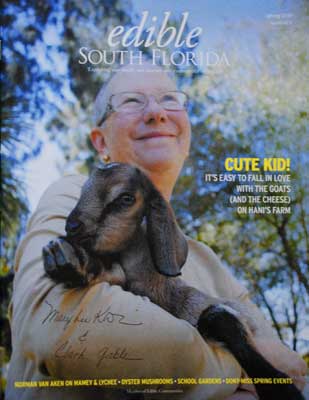
Mary Lee Khouri and Clark Gable

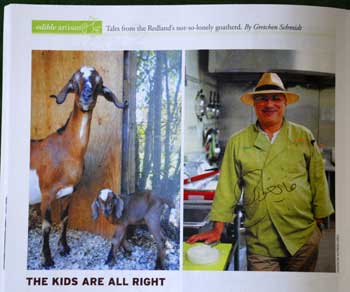
In their latest issue, Edible South Florida has a great cover picture of Hani’s wife Mary Lee, holding one of the kids, accompanying a nice article. The article is by Gretchen Schmidt and photos by Alfredo Añez. Look for the magazine this month at Whole Foods and other locations.

If you look carefully, Mary Lee and Hani autographed their pictures. Want my copy? Be the fifth (5th) person to comment on this post as to which is your favorite flavor of HANI’S ice cream and why, and the autographed magazine is yours! Only one comment per person allowed. Offer expires Thursday May 20 Saturday May 22 at midnight.

Back in March, two local food blogs have also posted about the goats. Genuine Kitchen featured the pregnant does, including the very huge Cleopatra.

Shortly after, Mango & Lime came out and took pictures of Cleo’s kids, including the very pregnant doe Maria. Paula’s post about the goats and Hani was featured as Blog Post of the Week on the South Florida Daily Blog.

The kids are growing up. They are cute and friendly, and better yet, they are weaned. That means that Hani is back in full production with goat cheese and goat milk ice cream, and it’s as good as you remember. You can get some from Hani’s Mediterranean Organics at the Pinecrest Gardens Green Market this Sunday. Yes, it’s still going strong through the end of this month.

5855 S.W. 111th Street, Pinecrest, 33156
Open Sundays, 9 a.m. to 2 p.m.

Hani signed his name in Arabic.

In a pickle

Speaking of Gleaning Day, guests had an additional treat in store. Over at a table to one side of the barn, CSA member Lolyklara Palmahuergo set up samples of her lacto-fermented foods. They were all made following recipes from the cookbook Nourishing Traditions, written by Sally Fallon. It is chock full of ways to preserve all kinds of foods using natural fermentation, based on principles of the Weston A. Price Foundation.

I sampled a bok choy salsa which was packed with flavor, tangy pickled cucumbers, a zippy kimchi and milder pickled okra. There were pickled green beans, sweet potato, malanga, and sauerkraut. The foods were lacto-fermented, not made with vinegar or brine. She also makes two kinds of kombucha, chicken liver pate and pesto. All of the vegetables are organic.

Sample platter of pickled foods, sauerkraut on far left, beets in the middle, green beans bottom left, and a few things I didn't taste.

Lacto-fermented foods are made by using whey and sea salt. The whey is a by-product from making yogurt from raw milk, which is obtained from “free pastured animals from North Florida,” Lolyklara explained. She uses different cultures to also make pima milk, kefir, and buttermilk.

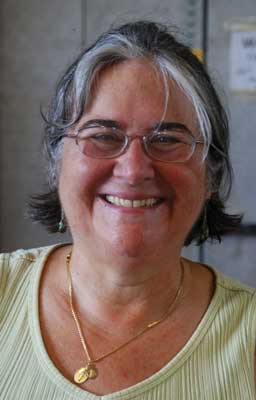
Lolyklara Palmahuergo

Eating fermented foods really helped Lolyklara overcome problems with fatigue. She had been exhausted the last few years, so she started reading a lot, trying to find solutions. “I’m a biologist originally and and this made sense,” she said, holding up her well-used copy of Nourishing Traditions. Not only does Lolyklara feel better, as an added bonus, her skin became clear and soft. Excitement about her recovery and a love of cooking propelled her to start making extra pickles to sell. “It’s about feeling useful and working, which I haven’t felt in the last four years since I got laid off from teaching German,” she explained.

All of the above mentioned fermented foods are available for purchase. Email Lolyklara at lolyklara(at)gmail.com to get on her mailing list or call 305-720-7766 to request a product price list and information on how to order. In addition, she is a healer working toward getting certified in the Healing Touch Program, and is looking for volunteers who would like free healings.