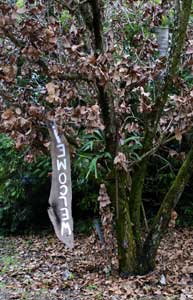
Even the Welcome sign is a bit quirky!
The big day finally arrived. Farmer Margie and her intern Andrew went over early to Possum Trot to help Robert Barnum with the last minute preps for the Potato Pandemonium dinner. His sous chefs Bob and Lindsay were slicing, dicing, frying and stirring.
Robert calls his dinners the Possum Trot Experience, and they are rightfully so, as there is a bit of adventure involved just to find the place. Six thirty rolled around and the guests trickled in, flustered that their GPS or Google map gave them cryptic directions. It would appear that Possum Trot is not on the map. It’s Terra Incognita. If you missed the front gate and sign and solely relied on your GPS, it stubbornly led you down a deeply potholed back road to a different entrance, and then a muddy driveway leading you through a jungle of trees and vines back to the farmhouse. Ah, the mysteries of navigation!

Kitchen prep Lindsay Tidwell brings out the potato salad.
As the guests arrived, they were treated to a sampling of various homemade wines that Robert had made from fruit growing on his property. Two that I sampled were a sweet, full bodied lychee wine (no comparison to Schnebly’s), and a dry red wine that tasted a bit like merlot, which was made from bignay (or antidesma) berries, which quickly became a favorite at my end of the table. The wine bottles were recycled and still with their original labels, so it was a bit of an adventure as to what you were going to get.

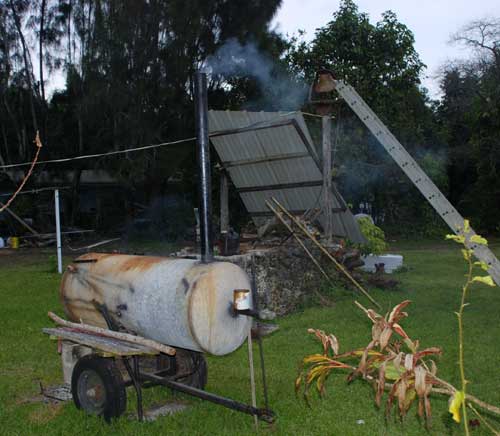
Wood smoker (foreground) and wood fired grill.
The next part of the Experience was a brief tour of the property in the waning twilight. (Usually the tour starts earlier, and Robert will take you on a 30 minute stroll through a section of his 40 acre grove. You get to see a variety of trees including macadamia and carambola, and a natural swimming hole surrounded by ferns, among other things.)
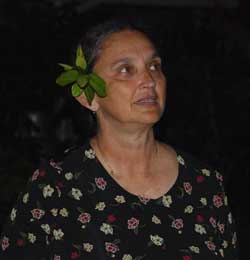
Farmer Margie Pikarsky wears two kinds of bay laurel.
Despite the light sprinkling rain, we ambled around the house, looking at and smelling various things that Robert handed us — bay laurel, lemon bay, and bay rum (lemon form). Nearby was a rippling lake of citronella grass studded with diamond-like raindrops. Robert picked and passed around a perfumey cas guava, the size of a yellow ping ping ball, for us to smell. The wood fired smoker was puffing merrily as we approached. Robert opened a door on its side and revealed cut up potatoes smoking in a pan, and handed out chunks to taste.

Bill Dickhaus, Randall Rakestraw and Cindy Dwyer seated at the guanacaste table.
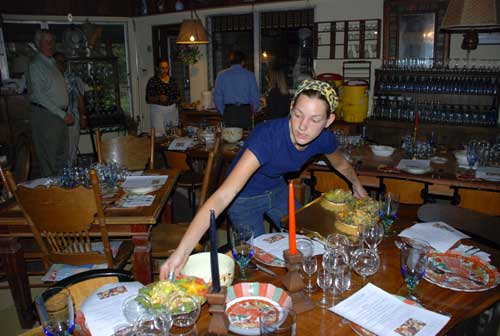
The dining room had high open beam ceiling and was lit softly with pendant lamps and a Waterford crystal chandelier. Guests had the choice of sitting at three tables, one which had its tabletop made from a single solid plank of guanacaste wood from Brazil. (It takes several very strong people to lift and move that table.) Around the room, china cabinets sparkled with glassware and plates. As we dined, a light rain pattered on the roof, adding to the cosy feeling. The house is authentic Old Florida, built in the 40s and 50s, and features a fireplace, two kitchens, a book-lined study, and a small winery in the back.
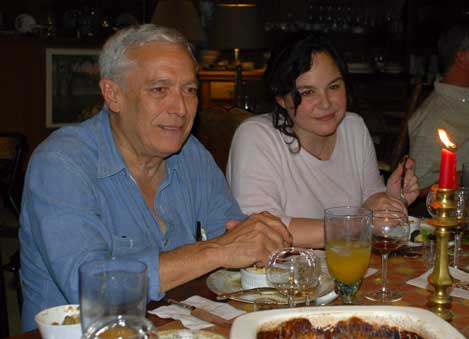
Hector Ugalde and daughter Aileen Ugalde
(I’m going to mention just a few of the dishes that night, having discussed others in an earlier post about the preview dinner. For a clear-eyed critique and photos of most of the dishes, click over to Bill Jacobs’ Tinkering with Dinner blog.)
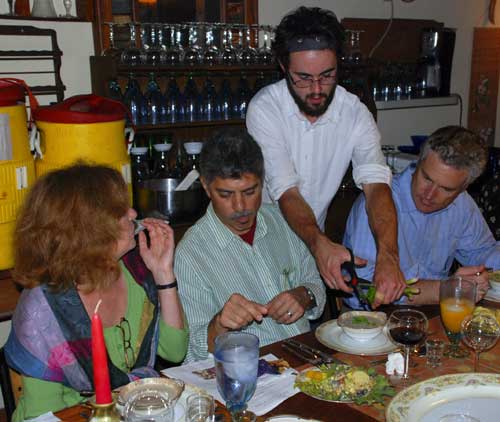
Leisha John and Greg Hamra crunch chips while Andrew Clinard snips scallions, and Frank DuMond looks on.
Once guests were seated, Robert’s hard-working crew had food flying out of the kitchen. First came the lavender vichyssoise, which was garnished with snipped scallions. It was as good as I remembered, smooth and creamy with a delicate potato flavor. The colorful, crispy potato chips added crunch and a much-needed bit of salt. The chips quickly disappeared and became everyone’s favorite.
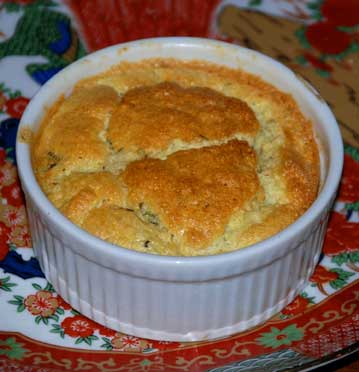
The souffle has risen!
The drab-looking souffle that had fallen last week was transformed. It had a golden brown top, and a light and fluffy texture that tasted a bit more of egg and a bit less of potato. One guest remarked, as she scraped the last morsels out of her ramekin, that the souffle would be good for breakfast with a sweet fruit sauce.
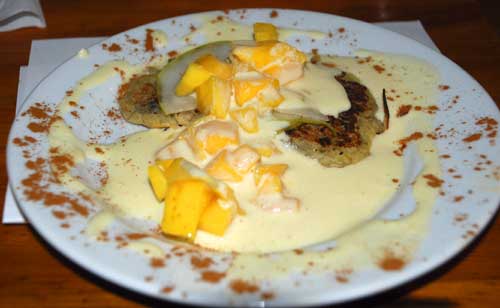
Dessert pancakes topped with the insanely delicious cas guava-passion fruit sauce.
The dessert pancakes with cas guava and passion fruit sauce were more potato-y and heavier than at the testing dinner. Maybe if the edges had been a bit crispy, one guest murmured. The sauce, though, is exceptional, and I can see it on the souffle, or perhaps with breakfast crepes as another guest suggested. The pancakes were accompanied by araza wine, light in color, dry, with a bit of the tartness and flavor of the fruit coming through. (Araza is a tropical fruit that Robert brought back from Amazonian Ecuador. The fruit first appeared for sale this summer, although Robert has been growing it for 30 years. Hani Khouri had used it to whip up a fine batch of araza ice cream.)

Mike Rimland
The dinner was a locavore’s dream come true. Many of the ingredients were grown right at Possum Trot – cas guava, carambola, betel leaf, Rangpur lime, passion fruit, eggs from free range chickens, and wood burning in the smoker. All the fruits for the wines — lychee, bignay and araza — came from the grove. Farmer Margie contributed red kale, carrots, scallions, garlic chives, rosemary, parsley and thyme from her Bee Heaven Farm. Purple, blue, red, yellow, white, small, fingerling and round potatoes were gleaned from a field nearby. And the USDA certified grassfed beef came from 4 Arrows Ranch in Citra, Florida. (If you want to buy some, contact Farmer Margie. She has a few cuts left from the last order.)
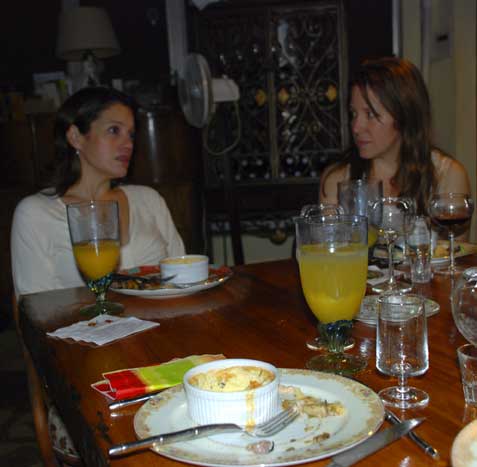
Sandra Torres and Marlen Caudron
If you are what you eat, them I’m looking quite like a potato these days, having happily devoured what seems to be my weight in spuds between the two dinners. It was tasty and unusual, and worth the extra miles on the treadmill (or so I’m telling my creaky knees).
But if you missed out on the dinner, or potatoes aren’t quite your thing, Robert is planning different meals soon — the Possum Trot Experience, he calls them. He’s also available for private dinners. You can contact him at 305-235-1768 for more information.
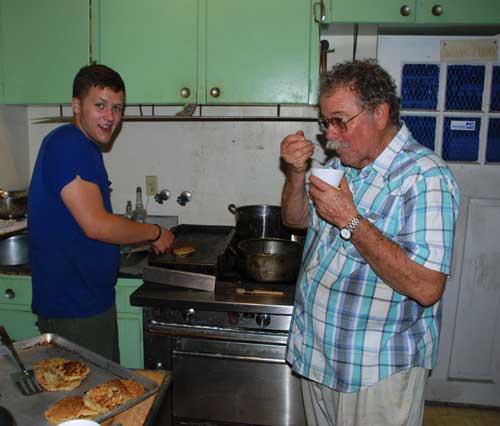
Sous chef Bob Fisher and the Cantankerous Chef Robert Barnum in the klitchen.





 Redland Rambles