Add family, friends, and sharing stories about this connection with one another, and you have the recipe for change. Each element is of equal importance to an Earth Dinner and to the food culture — spinning yarns, savoring food, learning to truly listen. We have much to connect here, and we need each other’s wisdom to do it.
– Theresa Marquez

Guests settled in at table.
With the sun setting and appetites provoked by wood smoke, guests made their way back to the house and took their seats at table in the high ceilinged, open beamed dining room. Even Robert’s unassuming house has a story. It’s positioned on the property to make the best use of the prevailing breezes and stays cool with cross ventilation (something that contemporary house builders have forgotten to do). High ceilings, large windows and wide overhangs are part of the design to stay cool in tropical heat. Only two fans supplemented the evening breeze to keep guests comfortable.
Each dish that was served came with its own story about where the food came from. Margie and Robert took turns telling those stories, and fisherman George “Trigger” Figueroa also chimed in with his own tales of adventure. The foods were accompanied with wines from Schnebly and some of Robert’s best vintages.
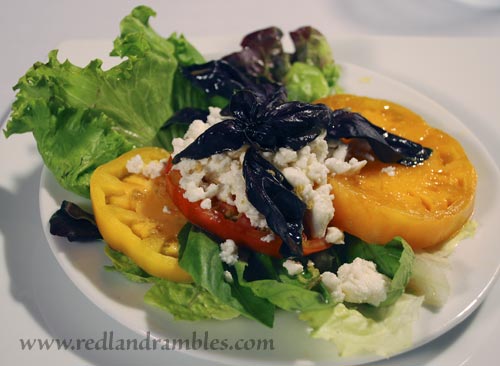
Heirloom tomatoes topped with goat cheese and purple basil.
And so the dinner began, and grew to a torrent of local abundance and deliciousness. Salad featured Teena’s heirloom tomatoes, and right away I fell in love with the orange one called appropriately enough, Tangerine. It has a bright, citrusy flavor, thus the name, and is said to be loaded with lycopene. Other varieties in the salad were Pink Brandywine and Cherokee Purple. Tangy and rich tomato flavors were balanced by crumbles of mild goat cheese. The salad was paired with Schnebly’s avocado wine, which tastes surprisingly crisp and clean, similar to a pinot grigio, and not one whiff of avocado. Teena said she has been growing tomatoes and vegetables in a sustainable way for over 35 years in Redland.

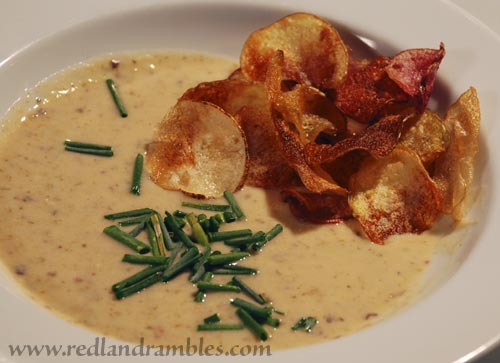
Vichysoisse with multicolor potato chips.
If you attended the Potato Pandemonium dinner last year, you’ll remember the vichyssoise. The soup was light and delicate in flavor and texture, but this time was more orange than lavender in color. (The color is determined by the mix of potatoes in a particular batch.) A handful of crispy potato chips topped the soup and gave it a salty crunch. The creamy half and half used to thicken the soup came from Dakin Dairy in Myakka City. Robert explained the potatoes came from a nearby field where the State of Maine tests their seed crop of spuds every year. Many different kinds in all different colors — red, blue, golden, white — are grown. Robert has permission to forage after they plow the crop under. Potatoes were a popular crop in Redland, grown in clay-like marl soil. But in the last decade, potato fields have given way to fields of houses and paved roads.
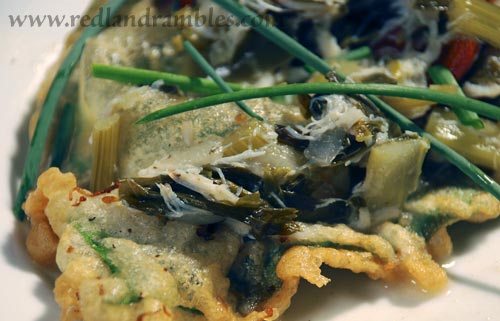
Tempura battered betel leaf and blue crab rangoon.
Tempura battered betel leaf with crab rangoon had also gone through its evolution into a lighter dish. Robert got several pounds of local blue crabs from Card Sound Crabs Company located not too far away on rustic Card Sound Road. The crabs had been swimming just the day before. It took three people about three hours to pick out all the crab meat. (Talk about slow food!) The crab sauce was less creamy than I remembered, and that was a good thing, allowing the delicate crab flavor to come through. The crunchy fried leaf served as a deconstructed fried wonton wrapper and added smoky flavor. This dish was served with Schnebly’s coconut wine, which had a slight coconut flavor that became more pronounced as it warmed.

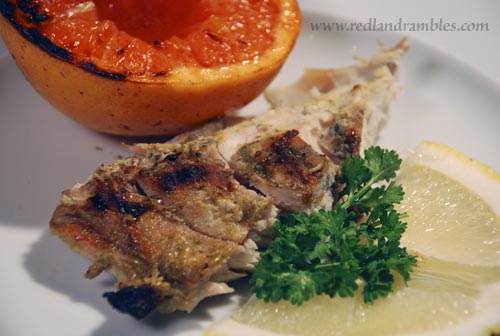
Wild caught cobia with broiled red grapefruit and Ponderosa lemon.
Crab rangoon was followed by another seafood dish, wild caught cobia. It’s a gamefish that migrates from the Gulf, around the coast of Florida and into the Carolinas. When this particular fish was swimming, it was about 38 inches long. Local fisherman George Figueroa speared it while free diving in about 25 feet of water off the coast of Jacksonville, and was present at the dinner to tell the tale.
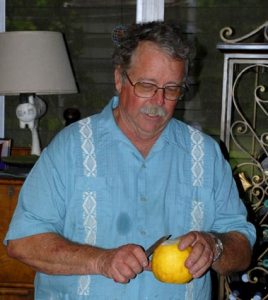
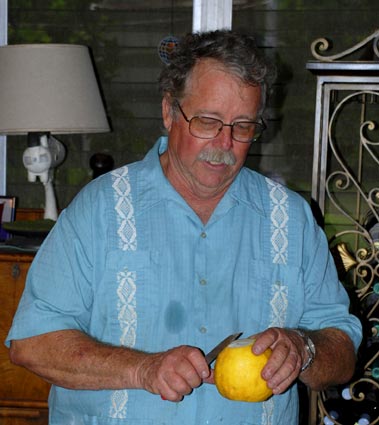
Robert Barnum opens up a Ponderosa lemon.
The carambola glazed, wood grilled fillet was thick and meaty, much like cod, and its flavor reminded me of mackerel. It was served with broiled red grapefruit from David’s Organics and a huge slice of Ponderosa lemon which Robert grows. He passed one around to examine. It was bigger than a softball and had thick bumpy skin. Its taste was mildly acid (similar to Bahamas lemon which Margie grows at Bee Heaven). The dish was accompanied by one of Robert’s wines made from araça, a tart yellow fruit that also makes great ice cream, but is too sour to eat on its own. The araça wine was light in color and a bit fruity, but not quite as complex as chardonnay.

Wood smoked wild boar with tamarind-peach chutney and callaloo.
Smoked wild boar came with its own story too. The meat had been donated by chef Michael Schwartz, who shot it on a hunt in the woods near Lake Okeechobee. (Read about the hunt on Michael’s blog.) George explained to dinner guests that feral pigs roam all over Florida, and can cause a considerable amount of damage as they root for food. But this particular pig was a menace no more. Robert smoked the pork for eight hours in his outside wood fired smoker, using Florida mahogany wood. It was glazed with a tamarind-peach chutney sauce, and served with more of the same on the side. The lightly smoked roast pork was lean and had a slightly chewy texture, to be expected from an animal that got lots of exercise. Fruit for the chutney came from Robert’s grove. Red Ceylon peach has a light colored flesh with red around the pit, and its light peachy flavor makes for a good ice cream (which made an appearance at the ice cream social last summer). Robert explained that this peach is one of very few varieties that had been grown commercially in South Florida over 50 years ago but no longer, because it is susceptible to fruit fly infestation. The wild boar was served with two large dollops of callaloo (also known as Jamaican spinach) grown at Three Sisters Farm. The greens were cooked with scallions and garlic chives from Bee Heaven Farm. The dish was served with Robert’s jaboticaba wine, which was purplish, tasted a bit sweet and grape-like, and went quite well with the chutney. It seemed to be one one of the more popular wines of the night.

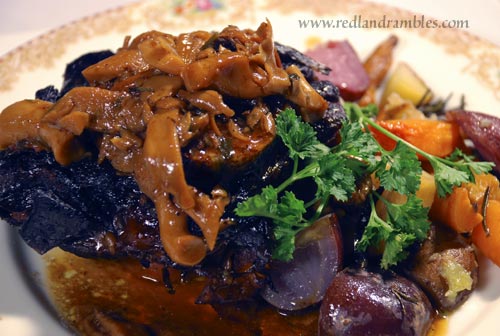
Grassfed beef with oyster muchrooms and roasted multicolor potatoes.
The third entree was grassfed beef raised at Deep Creek Ranch located in DeLand. (According to their web site, the cattle are raised on pasture according to organic practices but are not actually certified organic.) On my plate was a large chunk of meat with a marrow bone that appeared even larger because it was draped with sauteed oyster mushrooms from Happy Shrooms, and was accompanied by a side of smoked multicolor potatoes from the Maine testing fields, carrots and onions from Worden Farm, and parsnips and rosemary grown at Bee Heaven. Robert said the shank meat had been browned and oven braised in a blend of his homemade tropical fruit wines for about eight hours until it was tender. I was starting to get full when the beef arrived, but after one bite, couldn’t set it aside untouched. It had a rich taste and the wine reduction added to the depth of the flavor. The meat was falling off the bone, and a dollop of marrow was worth pursuing with the tip of a knife. The beef was served along with Robert’s bignay wine, which has a dark red color and tastes similar to cabernet. Some people think it’s too astringent, but it held up well to the richness of the beef.

Carambola pie with rangpur lime/sapodilla gelato and fresh Mysore raspberries.
Dessert — as if anyone could eat another bite — was Robert’s familiar square slab of carambola pie made with a whole wheat crust, accompanied by two scoops of rangpur lime/sapodilla gelato made with goat’s milk. The carambola, rangpur lime and sapodilla came from Robert’s grove, and milk from Hani’s goat herd just down the street. The pie tasted like a tangy peach pie, and the gelato was a light dance of sweet and sour. Both were topped with a sprinkling of freshly picked Mysore raspberries from Bee Heaven. The dessert was paired with a sweet bignay wine that was as thick and strong as an elixir, almost too strong and sweet for me. Robert said he made it with twice the fruit and twice the sugar.
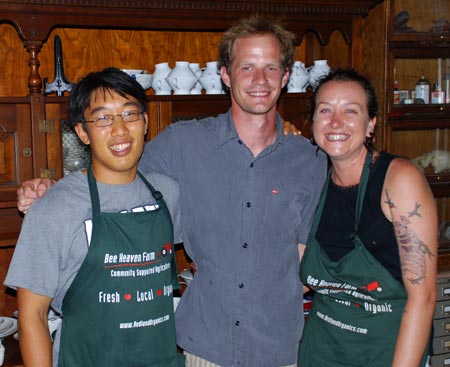
Weber, Mike and Sadie from Bee Heaven Farm helped with prep.
I’ve been to several dinner events at Robert’s and with this one he had outdone himself. His cooking and presentation gets better and better with each event, and it doesn’t hurt that he had excellent fresh local ingredients to work with and lots of willing helpers. Yes, there were a few minor glitches — the appetizer and soup courses didn’t come out of the kitchen in order, others weren’t paced evenly, and a few stray cobwebs lingered in a chandelier. But for the most part, the event went smoothly. Food presentation was professional and the service (by volunteers!) was very, very good. Kudos to Kathy, Karen, Sadie, Mike and Weber!
<< to be continued >>
Read Full Post »









 Redland Rambles