Feeds:
Posts
Comments

Posts Tagged ‘Bee Heaven Farm’

Farm Day at Bee Heaven Farm

Come to the country! Fun for the whole family!

Sunday, December 19th * 11:30am – 3:30pm

Activities:

*Make your own scarecrow (and take it home)
* Hay Rides
* Farm Market featuring locally-grown seasonal organic produce, dried fruit, raw farm honey, heirloom tomato plants, veggie & flower plants for sale
* Live Music with local singer/songwriter Grant Livingston

*Food Sakaya Kitchen‘s Dim Ssäm à Gogo Food Truck
Chef Richard Hales will be preparing dishes using local ingredients. Bring $$ for this amazing food!

Your $5 donation helps support our farm internship program, and includes a chance to win a Smith & Hawken BioStack Composter – a $129 value

Directions:

From southbound on US1, turn west (right) on Bauer Drive (SW 264th St), & go approx 5 miles. The farm is about 1/3mile past Redland Road (SW 187th Ave). Look for the farm sign & flags.

Bee Heaven Farm accepts credit/debit and EBT cards.

Read Full Post »

You haven’t heard much from me these last few months because I’ve been feeling de-pleated by condo board responsibilities. Small problems were looking big, and bigger problems looked overwhelming. Time to hit the reset button, so I headed down to Bee Heaven a couple weeks ago to get some much needed farm therapy.

Fall is planting time down in Redland. Summer is just too hot, too buggy and too rainy to grow much of anything. Planting starts in the fall near the start of the dry season, and harvest is in the spring. The growing seasons here are completely upside down compared to the temperate climate Up North.

Jane transplanted starts into their first pot.

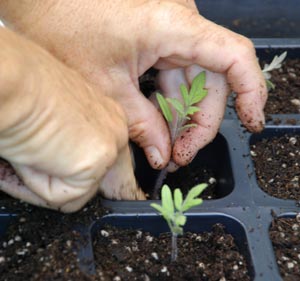
It was a sunny, breezy Saturday afternoon when I visited Bee Heaven. Margie and her manager Jane Cameron were puttering in the potting shed, transplanting starts, or baby vegetable plants, from the seed beds to small pots. A bit of soil went into the bottom of each pot. Then, one by one, Jane carefully lifted each start out of its bed and placed it into its new home. She set the plant down with one hand, put more soil around it with her other hand, and pressed the soil down gently. The work had a gentle rhythm. Repeat it a hundred more times or so, and that was the afternoon’s task.

Growers will tell you there’s something hopeful about working with baby plants. “It’s so exciting to see them grow from seed,” Jane said. “It’s empowering. It feels exciting to see the plant first poking out of the ground, to see the energy. You don’t get that with a plant already started that you buy from the store.”

You’re not thinking of bugs, or disease or freeze — although those risks are there, even at that stage. Some starts’ leaves had evidence of bugs munching along the edges. Another start revealed a small black caterpillar near its roots, as it was gently lifted out of the seed bed. The caterpillar would grow up to be a butterfly of some kind, Margie explained, but in the meantime, it was chomping on little roots. A note was made in the input log, and the plants and seed tray would be treated with BT for the caterpillars.

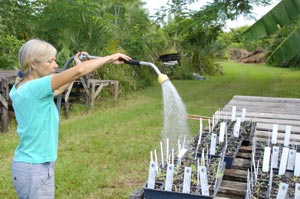
Jane watered the starts after transplanting.

Labels were placed into the pots, so you knew what kind of plant it was. Trays of pots were taken to an outside table made from old wooden pallets, where the starts soaked up sunshine and would grow and grow. Jane watered them lightly, holding the spray nozzle high above, so water fell gently like rain. Smaller starts were waiting on other outside tables nearby, still too young for transplant, maybe in a few more days. “They aren’t finished sprouting,” Margie said. When the little plants show four true leaves, then they are ready to pot up.

Most of the starts I saw that day were heirloom tomatoes with exotic names like Black From Tula, Red Calabash, and Zapotec Pleated. “ZAP-otec. That sounds like the name of a pharmaceutical,” Jane remarked. “Feeling de-pleated? Try Zapotec,” Margie chimed in. “It will pleat you back in no time!” Now there’s an idea — plant (and eat) heirloom tomatoes to be re-plete with energy.

Work done, I ambled around Bee Heaven to see how other things were going. Bright sunshine and clear blue sky were good medicine in itself, and soon I was feeling less de-pleated. A light breeze ruffled leaves, and mockingbirds twittered background music from a nearby big tree and from the hedges further over. Roosters living in nearby chicken tractors got a call and response chorus going. “Ur-ur-ER-ah,” one rooster called, and another responded an similar way, and another, and suddenly I was in the midst of poultry opera. “Here I am, how are you,” they seemed to be calling. “I am here,” I told them. (Yes, I talk to chickens.) I am here, I am fine, pleated and replete. Farm therapy works!

Read Full Post »

Hey there Redland Ramblers! This is guest blogger Melissa Contreras, founder of Urban Oasis Project. Last night, a group of Redland and Miami farmers and I returned home after a weekend at the 2nd Small Farms/Alternative Enterprises Conference in Kissimmee.  I have always been a farmer wannabe, and as such, I grow food for my family, my pet bunnies,  and a few friends on my 1/4 acre “urban homestead” in Kendall.  I was happy to learn at the conference that this small scale of growing is now being officially considered as part of our local food system, as it should be! The University of Florida/IFAS Extension isn’t just for big farmers and agribusiness, we little people count too!

Cast of characters on this road trip included Bee Heaven Farmer Margie, husband Nick, their new farm manager Jane;  Muriel of Little River Market Garden, Mario of Guara Ki Farm, and me.  Meeting up at Bee Heaven Farm, we shared a ride in Margie’s van, and took the scenic route around the shores of Lake Okeechobee on US 27. It was beautiful! Cows and egrets mingled in green pastures, Nick spotted a sandhill crane, and tri-color herons searched for underwater snacks near the water’s edge. Along the way, through what was once a river of grass, we saw fields of sugarcane (some organic), and picturesque views which reminded me that while South Florida is often thought of as a metropolitan built environment,  it still belongs to Mother Nature, though altered. Hopefully Everglades restoration will return the river of grass to its rightful owner.

After 4 hours on the road, we arrived  and checked into our hotel, the posh and sophisticated Super 8. Hey, we’re on a budget, OK?  I shared a suite with Margie, Nick, and Jane.  After repeated promises to Jane that I would not confuse her with my husband in the middle of the night, she decided to sleep on the couch.  But, I digress.  We had a nice lunch in restored historic downtown Kissimmee, an old cowboy town with a lovely lakefront, unique and colorful wooden homes with gingerbread mill work, unusual eateries and watering holes like ” The Wicked Stepsister,” a nice antique shop,  and so much more. Next time you’re in the neighborhood, take a break from the Orlando area tourist traps and visit this authentic town.

After lunch, we proceeded to the Osceola Heritage Center, site of the next day’s convention, for meetings of the Greater Everglades Foodshed Alliance, the Florida Food Policy Council, and a pre-conference pow-wow with Extension agents from all over Florida. The Greater Everglades Foodshed Alliance meeting was a recap of the Food Summit for interested parties.  The Florida Food Policy Council will “bring together stakeholders from diverse food-related sectors to examine how the food system is operating and to develop recommendations on how to improve it. FPCs may take many forms, but are typically either commissioned by state or local government, or predominately a grassroots effort. Food policy councils have been successful at educating officials and the public, shaping public policy, improving coordination between existing programs, and starting new programs.” (definition from foodsecurity.org). We are forming a soon-to-be Miami food policy council. (Contact Mario if you have a stake in our local food system and want to participate in this new effort.)

Those who attended the informal Friday meetings were also invited to sit in on the pre-conference event for UF/IFAS Extension agents, in which  Dr. Danielle Treadwell, Dr. Mickey Swisher, and Sarasota Extension’s new Director and doctoral candidate Evangeline “Van” Linkous  talked about our changing food system from their different points of view and varying expertise.  Dr. Treadwell champions UF research in organic and sustainable farming, and feels that “educating consumers is an important part of what we do.”  Dr. Swisher said she was surprised to discover the “30 mile problem” in which  “disadvantaged communities in Florida’s urban areas often live 30-40 miles from areas where fresh produce is grown.”  Van’s background is in planning and she was a member of the Delaware Valley Regional Planning Council before coming back to Florida from Philadelphia and the University of Pennsylvania. She feels that much urban zoning could be converted to mixed-use, which could mean urban farms and farm stands could be located within high-density urban populations, giving urbanites more access to local, fresh food. A kindred spirit! We are quite lucky to have these three women in Extension.

So, if you’re catching on to a theme here, the conference tagline was “Sustaining Small Farms…Strengthening Florida’s Communities.”  There was much excitement among attendees on that Friday before the conference, seeing our major research institutions catching onto interests of so many people in local food,  and food justice as a paradigm shift from our current system. Further illustrating this point is the choice of keynote speaker for the conference: my personal hero, Will Allen, founder of  Growing Power, Inc.

I will write more about Saturday of the conference in the next post:  keynote speaker Will Allen, the three Florida Innovative Farmer Award winners, conference workshops, amazing local foods lunch and more! Come back  for more, including pictures!

Read Full Post »

Avocado bliss

Seen at the the Pinecrest Whole Foods on Friday.

The time has come to pick avocados. Last week Farmer Margie mustered her crew of mostly volunteers and they went through the grove to gather the first of the season. Thirty bushels of certified organic Donnie avocados went straight to the area Whole Foods warehouse, and I’m told that the fruit just flew out of the stores. This week Margie’s crew picked again, and she took 30 more bushels to the WF warehouse on Thursday. I found her Donnie avocados at the Pinecrest Market on Friday afternoon. They are selling for $3.49 each, ouch! But even at that price, there may not be many left today.

But all is not lost. I’ve learned about Number Two fruit. Those are avocados that have scuff marks on their skins, superficial blemishes that that are bigger than a certain allowed size.  The fruit rubbed against a branch while it was maturing and it made for a dark mark. Stores don’t like blemished fruit, but they are just as good.

Last week I bought a half bushel of Number Twos to re-sell to friends and co-workers for $2.50 each. Like their pristine brethren that went to WF, these avocados sold very fast. This week I sprang for a full bushel of Twos. People wanted more, or saw they missed out and were calling me with orders.

This dramatic scuff mark is cosmetic, doesn't affect the flesh inside. Whole Foods doesn't want this fruit, but I do!

Local fruit makes people happy! Case in point, I took a half bushel of avocados to my doctor’s office. She is a holistic practitioner, and she and her hard working staff and patients know that avocados are good for you. I staggered in with the heavy box of fruit, set it on the floor, and everybody pounced. My doctor did the most interesting thing — she cradled a large green avocado to herself, stroked it with her hand, and giggled with delight. Other staffers were smiling as they sorted through the box. One woman picked out a fruit, then another, then went off with three avocados clutched to her chest. Altogether a dozen avocados found new homes so quickly I felt almost giddy.

I saw that grin, heard that giggle, and watched people pet and stroke the smooth, green shiny skinned avocados over and over on Thursday and Friday as I made my deliveries. And once you’ve actually eaten a Donnie from Bee Heaven, that’s it, you’re hooked on the creamy, nutty flavor. Last week a friend got one avocado, then ask me for four more this week. “Are you sure,” I asked. “Oh yes,” was her answer, said with a smile and sigh of bliss. “I want them. They’re buttery.”

Another thing I heard often is, “I’m going to eat the whole avocado for lunch.” Easy to say now, when the fruit is only about a pound and a half in size. Wait a few weeks when they have increased to three pounds — or more. Last summer a friend claimed that he could eat a whole three pound avocado by himself in one sitting. “That’s a pretty big avocado. I can only eat half or less at one time,” I cautioned. My friend boasted, “I’m a big guy, and I have a big stomach. I can eat it.” He took the avocado home and that was the last I heard of it. It’s quite possible that a three pound avocado defeated a 200 pound man.

So, I get a little crazed this time of year, phoning people — “Hey, I got some green crack*, let me know how many you want” — and driving around town with a bushel of avocados in my car. I do it because Margie’s fruit makes people happy, and I’m glad I can bring them a bit of joy. That’s the power of local food. Once you’ve tasted it, you know.

*That’s a Margie joke.

Nutrition facts and analysis for Florida avocados

Read Full Post »

Three very local ice cream makers presented their frozen creations at the Ice Cream Social at Bee Heaven Farm on the Fourth of July. All of the flavors were made from local, tropical fruit. Two fruits — lychee or mamey — were common to all three ice cream makers, and each brought at least one more flavor. Guests got a ballot when they checked in, and voted on their favorite flavors. (For official results, go see the Bee Heaven Farm blog.) Altogether, a person could indulge in more than 10 different flavors of ice cream and sorbet — a locavore ice cream eater’s heaven!
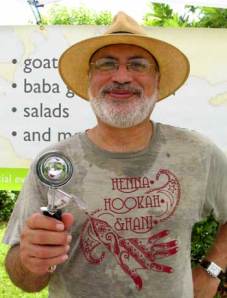
Hani Khouri and his ice cream scooper ready to go!

Hani Khouri, of Hani’s Mediterranean Organics, has been making ice cream with fresh goat milk for about two years now. He was definitely the artisan of the group. All ingredients were super local — goat milk from his herd of Nubian goats, fruit from Redland groves, and even local sugar. Hani bought guarapo, or sugar cane juice squeezed from locally grown cane, and evaporated it slowly over a low heat to molasses, then cooked it longer to get a brown sugar similar to panela. That process alone took several days.

His mamey ice cream tasted mellow and fruity. Lychee was sweet but not too sweet. Lime was most unusual, bright yellow from turmeric, more on the savory side with ginger, cinnamon and other spices added for flavoring. It wasn’t obviously lime-y, and seemed to change flavor with every spoonful. Very interesting, because I hadn’t considered savory as a possible direction for ice cream (or sorbet). Hani also brought a pale yellow, sweet-tart cas guava ice cream with a light refreshing flavor. Saw passion fruit ice cream circulating, but didn’t get a chance to taste it. Overall, Hani’s ice cream was very light and refreshing, and the fruit flavors of lychee and mamey were bright and clear. The home made sugar gave a slightly gritty texture, and the lime ice cream also had little bits of lemon zest in its texture. Goat milk has a slightly tangy after taste that seems to work best with tart flavors. This summer I like cas guava very much (my new favorite?), and last summer I liked arazá, another sour tropical fruit that is impossible to eat by itself but was terrific in ice cream.

You can order ice cream online at Hani’s Mediterranean Organics. There are two pick up locations. In Dade, pick up at Sous Chef 2 Go, and in Broward, pick up your order at BM Organics.

Enid and Albert Harum

Gabrielle Berryer of Gaby’s Farm ice cream is the queen of the local ice cream scene. She has been making her frozen goodies from local fruits for 15 years and retailing for the last 5 years. Black sapote was the first flavor that she introduced to the public at the Fruit and Spice Park, and since then her line has expanded to 30 flavors, which are locally produced. All fruit is locally grown, and most comes from her two-and-a-half acre farm.

Lev and Liz discovering Gaby's mamey ice cream.

Gaby brought mamey, guava and canistel ice creams, and lychee sorbet. Her ice cream flavors taste more creamy than fruity, and the texture is silky smooth. Overall, her ice cream tastes and feels a lot like store bought. Dark pink mamey tasted much like a milk shake. Light pink guava was incredible combined with a slice of mango pie. (Yes, there was pie — and cookies too.) Canistel was egg yolk yellow (that’s why it’s also called egg fruit) and likeable with the addition of cream and sugar, but I’m still not a big fan. It could be more exciting if pumpkin pie spices were blended in. Lychee sorbet had a clear fruit flavor and was quite refreshing, but just a tad sweet.

Find Gaby’s Farm ice cream at area Whole Foods, Fruit and Spice Park, Schnebly’s Winery and various local hotels.

Katie Edwards with ballot in hand and one of the candidates.

Robert Barnum was the jack of all trades of the bunch. He brought the above-mentioned mango pie — and pie lovers, this one was for you! It was very tasty, especially with guava ice cream. Two Pie Are Squared, as he called it, was baked in two large sheet pans. He joked that he used “rectangular mangoes” for the pie filling. “I never do anything normal,” he explained. Rectangular or not, the mangoes were his very own Yellow Bellied Possum variety. Robert also brought lychee and peach ice creams and white sapote sorbet.

Mmmmmmmm mango pie!

Most intriguing was his Florida peach ice cream. Yes, peaches do grow here, and don’t let those Georgia folks tell you otherwise. Robert has several Red Ceylon trees, a wild naturalized variety that was cultivated in his grove since the 1950’s. The fruit has white flesh, red at the seed, with a pale green skin that never turns peachy yellow. The ice cream made with those peaches was rosy pink with little flecks of darker red skin and tasted sweet-sour, peachy-ish, a bit like strawberry but not quite. Robert explained that he picked early to keep fruit flies from infesting the peaches, “to keep the protein content down,” he chuckled. The fruit hadn’t completely ripened by the time it was mixed into ice cream. Would love to taste the ice cream made with a more ripe fruit, but it was pretty good the way it was.

Robert also brought lychee ice cream, which tasted pretty good, having a nice balance between fruit and cream, and wasn’t outrageously sweet. The daring experiment of the bunch was white sapote sorbet, sweetened with local honey instead of palm sugar. To my tongue, which was already addled by sugar from the other two ice cream makers, this combination of fruit and sweetener had a slightly bitter bite. Robert describes the fruit as having an “astringent” flavor. Am not sure about this one, but then, I don’t remember if I’ve even tasted white sapote fruit. But I saw other people enjoying the sorbet’s unusual qualities, so it could just be me, spoiled by sweetness.

Head over to Possum Trot, Robert’s place,  for dinner and a tour of his 40 acre grove, one of the last bits of Old Florida left in the area. And best of all, you can ask him to make ice cream and pie for dessert! If you want to grow your own Red Ceylon peaches, seedlings will be available next spring.

Possum Trot Tropical Fruit Nursery
14955 SW 214th St
Miami, FL 33187-4602
305-235-1768

Read Full Post »
« Newer Posts - Older Posts »