Feeds:
Posts
Comments

Posts Tagged ‘Bee Heaven Farm’

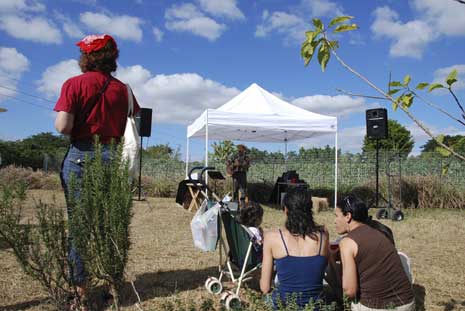
Hanging out at Farm Day 2008. (Grant Livingston was the musician last year.)

Farm Day

Come to the country!
Fun for the whole family!

Sunday, December 20
11:30 am – 3:30 pm

* Food * Activities * Hay Rides *
* Farm Market *
Locally-grown seasonal organic produce, dried fruit, heirloom tomato plants for sale.
* Live Music *
With Jennings & Keller: Fusion Folk Americana

Your optional $10 donation helps support our internship and student artist programs
and includes a chance to win a Smith & Hawken BioStack Composter ($129 value).

Directions:
From southbound US1, turn right (west) onto Bauer Drive (SW 264 St.) and go approx. 5 miles. The farm is about 1/3 mile past Redland Road (SW 187 Ave.) Look for the farm sign and flags.

This is Bee Heaven Farm’s annual open house. Every year more and more people show up. Last year over 200 folks participated in the event. Here’s some tips so you can have more fun: Get there early! Bring your kids, but leave the dogs at home. Bring a covered dish to share in the potluck. Bring money to buy veggies, honey, fresh herbs and flowers, and other farm goodies. Bring old clothes to make scarecrows.

Most of the local farmers who have been growing food for the CSA will be at the party. Confirmed rsvp’s: Robert Barnum of Possum Trot Nursery who will cook local foods and roast corn. Hani Khouri of Redland Mediterranean Organics will have goat milk ice cream, goat cheese and authentic Lebanese dishes, and will bring his fryer to make falafel. Still waiting on rsvp’s: Cliff Middleton and the other Clifton of Three Sisters Farm (callaloo and yuca); Gabriele Marewski of Paradise Farms (oyster mushrooms), Dan Howard of Homestead Organics (green beans, yellow squash, zucchini) and Murray Bass of Wyndham Organics (avocados).

The donations collected will go toward two very worthy causes. Farm Day overlaps during Art Loves Farms, an art students residency at Bee Heaven. Eight students from DASH will be living on the farm for four days making art, which will be exhibited at a later date. The donations will be split between an honorarium for a guest artist who will give a workshop with the students, and farm internship expenses. Almost all the farm workers are interns or volunteers who have come from all over the United States, sharpening their farming skills learning how to grow new crops. Some of the volunteers/interns have gone on to run farms of their own. (Oh, and if you see a videographer roaming around, that would be me documenting both events.)

Here are some pictures from last year’s Farm Day.

Sylvia, CSA member and site host, shopping at the mini market.

Kids of all ages get up close with a real tractor.
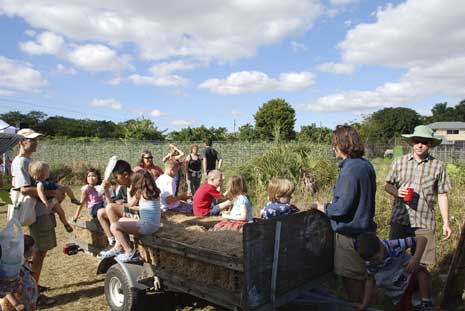
All aboard for a hayride.

When was the last time you made a scarecrow?
Read Full Post »

Go make your beds

A lot of behind the scenes prep work goes on at Bee Heaven Farm before the first seeds are planted. The cover crop, which fixes nitrogen and other nutrients, has been mowed and tilled under to also add organic matter to the soil. The next step is to create rows of raised beds, where the vegetables will get planted.

Making beds

Making beds

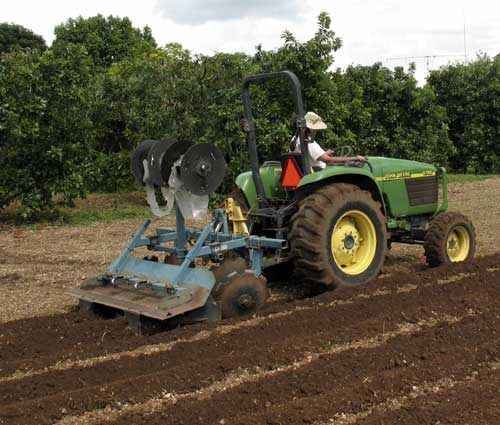
The bedding attachment behind the tractor cuts into the soil and shapes it into a bed with channels on either side (where tractor tires pass). Native soil is not very deep in Redland. It averages about 1/4 inch over limestone rock. At Bee Heaven Farm — after rock-plowing, years of building up organic matter, and mounding up the beds — soil is maybe 4-6 inches deep, and very rocky. That’s it! That’s what your food grows in! The beds then need to be shaped and leveled by hand with a hoe. Rows of plants will then get planted by hand or with a seeder in each bed, either as transplanted starts or directly seeded. Tomatoes are planted in one row, beets in 4 rows, greens in 8 rows, or anything in between.

Bedding attachment

Bedding attachment in action

This past Saturday when I arrived, Farmer Margie was driving the tractor with the bedding attachment on the back, making passes up and down the main planting area. The bedding process wasn’t going very well. I saw one row wasn’t straight, kind of tapered into the next row. As she climbed down from the tractor, Margie explained that was where the tractor had actually slipped in the ground. The soil was wet from scattered rain showers blowing through because of a cold front. The wet soil was also getting compacting into clay-ey clumps, losing aeration and fluffiness that had been created by tilling. (For a detailed explanation of soil compaction and air spaces, read Margie’s post on tilth at Bee Heaven Farm’s Blog.)

Wet soil clumps

Wet soil clumps

Margie grumbled that she would have to wait until the weather cleared and the soil dried out, then till all over again to erase the curving beds of compacted soil, and attempt bedding again. Clearly every step of the growing process is affected by weather, in ways both subtle and obvious. Too much rain, not enough rain, too hot, too cold, too windy — the farmer is almost always at the mercy of the weather.

Read Full Post »

Farmer Margie's blog!

Farmer Margie's blog!

Farmer Margie has posted on this blog, and now she’s got the blog fever and started her own, Bee Heaven Farm’s blog. The news and details will be a lot more specific to daily operations at the farm. Meanwhile, Redland Rambles will keep rambling about Bee Heaven, the CSA and its members, other growers in Redland Organics, and whatever’s going on in Redland that’s relevant and that I find out about in a timely manner. Am cutting back on the politics, though…

Read Full Post »

Bee Heaven Farm ~ Redland Organics

 End of Summer Brunch 


Join us down on the farm for a Locavore’s dream!

End of Summer Brunch at Possum Trot 
Sunday, September 27th, 2009 at 10:30am
 
in an informal Old Florida homestead 40-acre garden setting
featuring 100% locally-grown*
organic produce from Bee Heaven Farm and our Redland Organics farm partners. (Some items are not certified organic, but are pesticide-free.)
*except-oil, flour, salt, baking powder/soda
 
Passionately prepared by
Robert, The Cantankerous Chef
~~~ MENU ~~~
 
Broiled Avocado halves stuffed with Betel-leaf Farm Egg Scramble
and Nubian Goat Cheese Topping
 
Bee Heaven Farm Smoked Eggs
 
Boiled Salted Jakfruit Seeds
 
Roasted Rosemary-scented Roots Medley
 
Sautéed Vegetable Amaranth (Callaloo) with scallions
 
Allspice Muffins with Nubian Goat Honey Labneh
 
Honeyed Seasonal Farm Fruits 
 
Minted Passion Fruit Ice
 
Tropical Juice selection ~ Cas, Passionfruit & Carambola
 
Fresh Lemongrass Iced Tea
~~~ * ~~~

 Cost: Adults $28; Children 6-12 $14; Children 3-5 $5; 2 and under free

Please reserve early – Attendance limited to 60
 
Proceeds help support our farm internship program and local family farms


We hope you and your family join us for this amazing locavore feast!
Online reservations and payment required by September 22nd. Click here to RSVP & pay now, or type the following into your browser:  http://www.redlandorganics.com/EOSbrunch.htm
 
 Possum Trot is located next door to Monkey Jungle. Directions to the farm will be provided with your confirmation, so please be sure to print it out!
 
Sincerely,
 Margie's signature

Bee Heaven Farm ~ Redland Organics

Read Full Post »

Still have a few more posts about the Small Farms Conference. There was a lot going on, but I focused on attending sessions where members of Redland Organics were presenting (or if there was a focus on local food systems). Here’s notes from Margie Pikarsky’s presentation on marketing.

Diversify! was Margie’s main theme, as in don’t put all your eggs in one basket. She raises various fruits and vegetables and animals (eggs) and also sells merchandise (tote bags and cookbooks).

Providers. Redland Organics CSA got started because of diversifying. Margie told the story of how Gabriele Marewski of Paradise Farms originally started the CSA. She was growing only a few things, and Margie was growing a few other things, and combined they were a good variety for their customers. From there, Redland Organics grew as other organic or non-spray/natural growers were included. Currently there are eight providers within a 160 mile radius. Membership in the CSA grew from 40 in the first season (2002-2003) and topped at 450 shares this past season.

Crops. Margie started with avocados and greens, but now gets more money per square foot from vegetables. She recommends growing something unique that would appeal to the public. For her it’s heirloom tomatoes, and usually she raises around 30 different varieties. Diversify also means to interplant crops, such as tomatoes with mustard greens, or a short crop with a second crop.

Seasonal offerings. In summer there are eggs and fruit for sale — mangos, avocados, passion fruit, jakfruit — depending on whatever is available from various local sources. Emails are sent out to customers and payments are made online. Customers pick up at the farm or one other site in the city. Margie doesn’t grow vegetables in summer but plants a cover crop instead, such as black eyed peas. During the winter CSA season, her crew picks to order on Thursday, and additional deliveries start coming in. The CSA boxes are packed on Friday. Saturday morning the shares go out by truck to various drop off points in town for customer pick up.

Labor. Bee Heaven Farm relies on volunteers from WWOOF and occasional interns. Margie tries to get seasonal people who will stay for at least a couple months. The work crew is small, about 6 to 8 people, and is intensely managed. Everything is handwork, only Margie uses the tractor and other machinery. She pays somebody local year round to pull weeds and gather eggs.

Various sources of income.
The CSA brings in 75 percent, and farmers market 15 percent. The other 10 percent comes from avocados, honey, tomato starts, greens, workshops, eggs, value added products, and other products (totes, cookbooks).

Direct marketing. Redland Organics has space at the South Florida Farmers Market in Pinecrest, and at the peak of the season added a large table devoted to heirloom tomatoes. Last two seasons Margie sold avocados to Whole Foods. Participating in select events and festivals is also a good way to get exposure.

Agritourism. Bee Heaven Farm is open to the public twice a year. Farm Day is in winter and started as a small potluck. Last season it grew to 200 people attending. A small market is offered on the side. There’s also the end-of-season Gleaning Day, also a potluck, then customers go through the rows to pick the last of the season. Mothers Day brunch with tables set under the trees was a new event, featuring local food prepared by the chefs of Mise en Place.

Workshops. A series of four cooking workshops were offered last winter. Margie teamed up with chefs Adri Garcia and Rachel O’Kaine of Mise en Place, who used all local ingredients except for flour, sugar, salt and oil. The tamale workshop was hands on, and participants picked and shucked corn, and shaped their own tamals. When Margie needed to cull roosters she held a chicken processing workshop. Participants watched her process the first bird, then did their own and got to take it home. Margie said that people do want to know more and connect with their food, and these interactive workshops help them connect.

Value added. Other diversity is through dried fruits (mango, banana etc.) and tomatoes. Tip: Margie uses a venison dryer from Cabela’s. She also makes various spice rubs that include her herbs.

Currently Margie and a couple other growers in RO are working with their local county commissioner to allow on-farm food processing and commercial kitchens. The state laws allows this, but county zoning ordinances do not. A change in zoning would also allow for B&Bs, which would have to be located on an active farm (unless it was a historically designated building), and would have to follow certain restaurant kitchen requirements. Language for this change in zoning is being drafted now and will come up for a vote in fall.

Download the Powerpoint slide show and the handout from this session.

Read Full Post »

« Newer Posts - Older Posts »