Feeds:
Posts
Comments

Posts Tagged ‘Bee Heaven Farm’

Browsing for organic seedlings at the Bee Heaven Farm tent.

Browsing for organic seedlings at the Bee Heaven Farm tent.

(part 1 of 2)

Back for its second year this October, GrowFest! was the event for gardeners and locavores. Despite rain on Saturday afternoon and a slow start on Sunday morning, well over 1300 adults and kids came to the Fruit and Spice Park to browse for plants and nosh on good eats. Farmer Margie Pikarsky of Bee Heaven Farm, who organized the event (along with a group of fantastic volunteers), was delighted that the event is growing.

This year there was a mix of familiar and new vendors and exhibitors, a few less than last year, but each was worth checking out. Gardeners had plenty of plants to look at and buy, locavores found delicious things to taste, and there were plenty of interesting and knowledgeable people to talk to, with a wide variety of demos to attend.
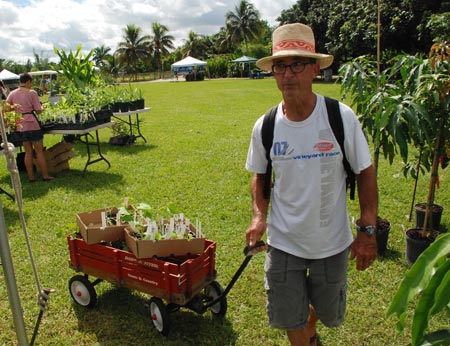
GF-wagon

The best way to carry mass quantities of seedlings!

Bee Heaven Farm had its usual sea of organic seedlings. Along with dozens of varieties of heirloom tomatoes, you could also choose from a selection of vegetables, herbs and greens that grow well in our climate and are regularly raised at the farm. In response to customer demand, there were several varieties of eggplant, sweet and hot peppers, Asian greens, and intriguing herbs like lemongrass, curryleaf, turmeric (new this year).

Farm intern Nicole Fiori helps a customer choose heirloom tomato seedlings.

Farm intern Nicole Fiori (right)helps a customer choose heirloom tomato seedlings.

A big thanks to farm employee Luz, intern Nicole, and volunteers Dhilini, Alhen and Holly who were on hand all weekend!
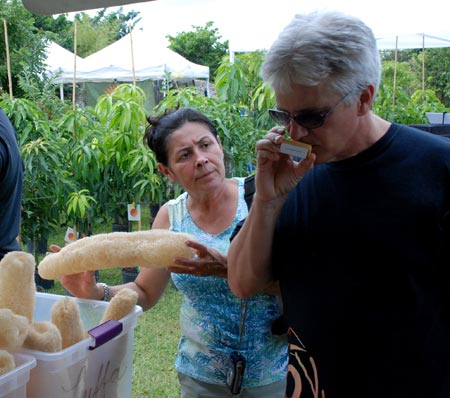
Selecting loofahs and goat's milk soap.

Selecting loofahs and goat’s milk soap.

New this year was the addition of Flair’s Fayre line of goat milk products. The husband and wife team of Pat Houle and Dan McGillicuddy, along with their assistant Christine, were on hand with offerings of raw goat milk and cheeses (for pet consumption only), and an assortment of deliciously aromatic soaps that were very popular. All products are made with milk from their small herd of goats.
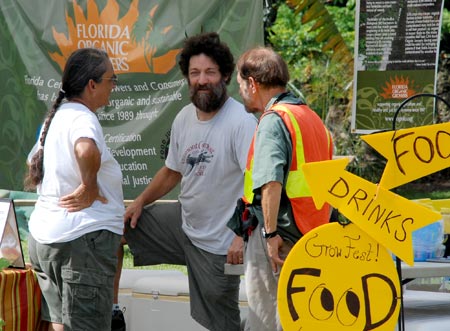
Margie Pikarsky, Marty Mesh and Steven Green discuss matters at the FOG tent.

Margie Pikarsky, Marty Mesh and Steven Green discuss matters at the FOG tent.

At the Florida Organic Growers and Consumers Inc. (FOG) tent, folks were selling chilled Uncle Matt’s organic citrus juices and sharing information on organic certification. Marty Mesh, the executive director, returned this year along with several staffers who were thrilled to introduce their newest statewide program, Fresh Access Bucks (FAB).

Staffer Carmen Franz explained that FAB doubles value, up to $20, that SNAP recipients can use to buy Florida grown fruits and vegetables at participating farmers markets. So far, FABs are accepted at Urban Oasis Project farmers markets and Bee Heaven Farm (in this area). This new program is funded by a grant from the state agriculture department, and Wholesome Wave, a non-profit which pioneered matching funds. Become a member to help FOG support “a sustainable and just food and farm system for all.”

Two Innovative Farmers of the Year! Margie Pikarsky (2013) and Gabriele Marewski (2012).

Two Innovative Farmers of the Year! Margie Pikarsky (2013) and Gabriele Marewski (2012).

Farmer Gabriele Marewski of Paradise Farms Organic brought two kinds of salads: cactus salad made with nopalitos, and her signature Baby Brassica Blend which includes a colorful sprinkling of edible flowers. The farm is known for its elegant, gourmet Dinner in Paradise and Brunch in Paradise series, season starting soon.

Alfredo Anez, Katie Sullivan and Gretchen Schmidt are the key people who produce Edible South Florida.

Alfredo Anez, Katie Sullivan and Gretchen Schmidt are the key people who produce Edible South Florida.

Edible South Florida magazine debuted their latest issue, which is all about local food. Many local growers and artisans are featured, and if you haunt farmers markets and locavore restaurants and cafes, they may be familiar to you too — Helen Cole’s jerky, Hani’s falafel, and Zak’s bread to name a few. I spotted a picture of farmer Margie on page 23. (Next to it is a brief essay I wrote about Farm Day.) You can pick up a copy for free at Whole Foods, Joanna’s Marketplace and other locations around town.

Giant African Land Snails (GALS) in carious stages of growth. A sample of their eggs is in the upper right corner.

Giant African Land Snails (GALS) in various stages of growth. A sample of their eggs is in the upper right corner.

And the villain of GrowFest! was back for an encore — the Giant African Land Snail (GALS). It’s an invasive species that devours over 500 kinds of plants and is capable of munching stucco off your house. Fully grown, the snail is as big as your hand, and has unique vertical jagged stripes on its shell. If you see a GALS in your yard, absolutely do NOT touch it! Call the state Division of Plant Industry at 888-397-1517 to come get it. These snails can harbor a microscopic nematode that can infect your brain and kill you. Over 131,000 GALS have been located and captured in South Florida in the past two years.

Grower Arturo Gonzalez, of Margarita's Fruits & Vegetables brought a forest of mango and avocado saplings.

Grower Arturo Gonzalez, of Margarita’s Fruit Trees, brought a forest of mango and avocado saplings.

GF-bananas

Bananas and plantains at Going Bananas
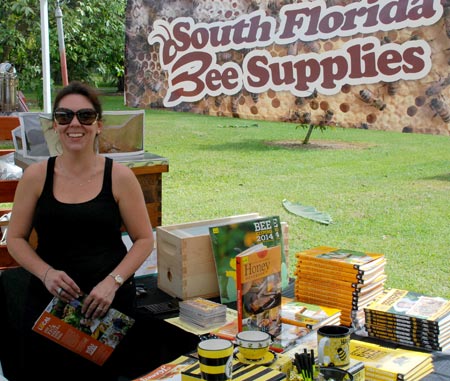
GF-bees

Beekeeping books and supplies from South Florida Bee Supplies.
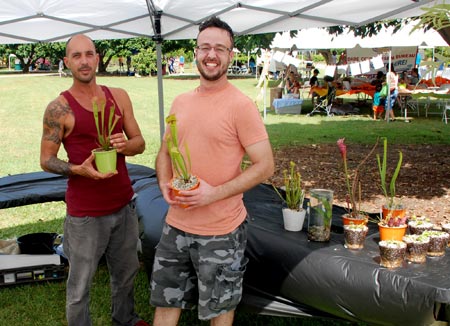
Carnivorous plants from Envy Botanicals

Carnivorous plants from Envy Botanicals

Landscaping plants at Casey's Corner Nursery

Landscaping plants at Casey’s Corner Nursery.

Fresh potted herbs from Teena's Pride Farm

Fresh potted herbs from Teena’s Pride Farm.

Learn how to compost with worms, from the Fertile Earth Foundation.
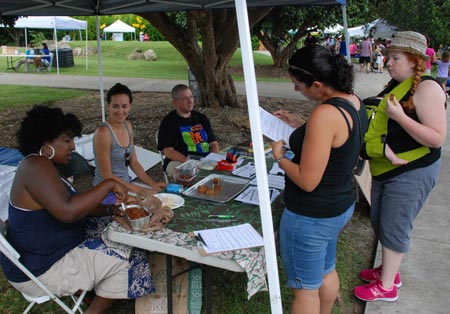
Learn how to compost with worms, from the Fertile Earth Foundation.

Kamala Fletcher, Christiana Serlé, and Mike Moskos of the South Florida Food Policy Council

Kamala Fletcher, Christiana SerlĂ©, and Mike Moskos of the South Florida Food Policy Council discuss the community’s food issues.
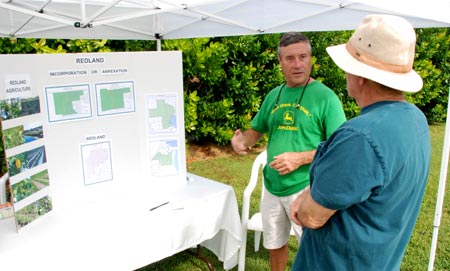
Ken Holden advocates incorporating Redland

Ken Holden advocates incorporating Redland.

Buy native plants from the Urban Paradise Guild

Buy native plants from the Urban Paradise Guild

(To be continued…)

Read Full Post »

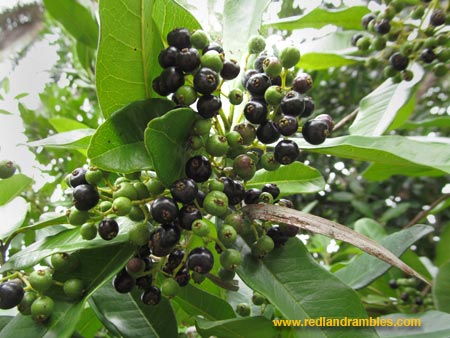
Ripe allspice berries

Ripe fresh allspice berries, half pint.

Ripe allspice berries, half pint.

Allspice! The name alone conjures up a blend, but it is actually one spice with the aromas and flavors of cinnamon, cloves and nutmeg. The mellow brown powder from the grocery is made from unripe allspice berries harvested which are dried and ground.

Fresh, ripe berries are hard to find, unless you are lucky enough to have a tree growing in your yard. The flavor from fresh is completely different than from dried berries. “Allspice berries, allowed to ripen, ascend to a whole other level,” farmer Margie Pikarsky told me. “I call them ‘Nature’s Altoids (TM)’ because they’re sweet and yet surprisingly strong.”

The fresh berries are about the size of a large peppercorn, and ripen to a dark bluish-purple color. When you pop one into your mouth, it gives a rich and resonant burst of flavor. Suddenly the dried version pales by comparison.

“The berries are great in spice breads, muffins, or drinks. Substitute them in any baked goods recipe calling for blueberries. Frozen berries will keep a long time in the freezer. Maintained below 0 F, they successfully keep for over one year,”  Margie recommends.

The fresh leaves also have a spicy aroma, but not as strong. “Fresh allspice leaves are used like bay leaves for flavoring. Use them fresh, though. Dried ones lose their oomph.” The glossy green leaves can be steeped in hot water to make a refreshing spice tea, good hot or cold, and sweetened lightly with local honey.

Allspice was one of the very first plants Margie put in on her farm, probably back in 1996. She planted two, and they have since grown to shrubby looking trees about eight or nine feet tall. The plants are dioecious (male and female). The female is the one that bears the edible berries but needs a male tree nearby.

Ripe allspice berries

Ripe and unripe allspice berries and leaves.

Read Full Post »

artisanal fair

Saturday, September 28, 2013
12 noon to 4:00 pm
Free admission

The Wolfsonian Museum is teaming up with local farms and makers of food products for this all-about-the-local-food-you eat event.

Artisanal Fair @ The Wolf and CSA Sign-Up is a fantastic opportunity to meet your local farmers. Come find out more about local food grown by Margie Pikarsky of Bee Heaven Farm and sign up for one of her Community Supported Agriculture (CSA) farm shares.

Teena Borek from Teena’s Pride CSA and Muriel Olivares from Little River Market Garden CSA (sold out for this season!) will also be there. Buying from a CSA a great way to support a local farmer, and get fresh produce every week during our harvest season.

Participating local food vendors include: Cao Chocolates, The Cheesecake Gallery, Dauphin Kaffee artisanal coffees, Freakin’ Flamingo jams and jellies, Pop Nature popsicles and paletas, Proper Sausages, and Simply Sharon’s “treats that heal.”

At 2:00 pm, take a special guided tour of the current Modern Meals exhibit. It will be led by museum staff and Teena Borek.

This event is co-presented by The Village Stand gourmet shop and Slow Food Miami.

Read Full Post »

The big barn in the back of Bee Heaven Farm is where a lot of things happen. In the winter, a packing line for CSA shares is set up in its large open space.  Then in summer a slightly different packing line is set up to sort and box organic  avocados from the Bee Heaven grove.

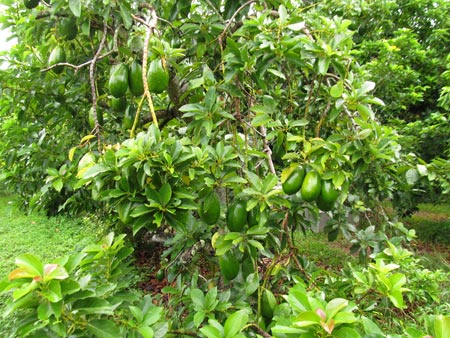
Trees in the Bee Heaven grove are loaded with fruit.

Trees in the Bee Heaven grove are loaded with fruit.

Periodically through the summer, Farmer Margie delivers pallets of freshly-harvested large green Donnies and red-skinned Hardees directly to the Whole Foods Market Florida warehouse in Pompano Beach, where they are distributed to area stores the very next day.

Cleaning and grading avocados.

Cleaning and grading avocados.

Because the barn is a certified organic packing house, from summer through fall, local grower Murray Bass backs in trailer loads of his organic avocados to pack there. His crew cleans, sorts and boxes avocados all day long.

Filling boxes to be sold under Uncle Matt's brand.

Filling boxes to be sold under Uncle Matt’s brand.

Then pallet loads of his avocados are taken over to the Florida City State Farmers Market Facility, where they are kept in a large drive-up cooler. Big rigs from Publix and Whole Foods can back in easily to the loading docks to pick up their orders. Look for Murray’s avocados sold under the Uncle Matt’s brand!

Unloading pallets of Uncle Matt's avocados at the Florida City market.

Unloading pallets of Uncle Matt’s avocados at the Florida City market.

Read Full Post »

Summertime is down time

summer-moon

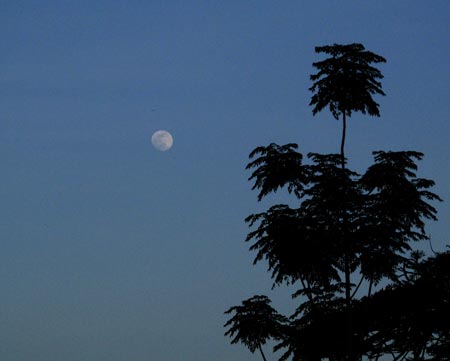
Rising almost-full moon on Summer Solstice Eve.

It’s officially summer time! The solstice was last Friday, followed by a supermoon (when the moon is at the very closest to Earth all year). But it sure felt like summer months before. Summer is a hot, humid, sweaty, weedy time at Bee Heaven Farm. The CSA season ended in late April. The last of the carrots got found and pulled up at Gleaning Day in early May. And now the vegetable beds take a well-deserved rest until planting season in fall. Yes, fall — not spring.

If you are from anywhere north of Florida, you’ll quickly discover that farming seasons are upside down here, compared to what you may be used to in, say, North Carolina. There, the growing season is in full swing. Here, farmers let the fields rest and go on vacation. When the fall harvest winds down Up North, the planting season begins down here.

Lost in the weeds. (Can you find the bee?)

Lost in the weeds. (Can you find the bee?)

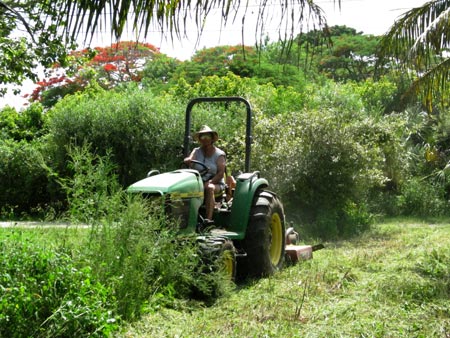
In the last two months, weeds sprang up to waist and shoulder height in the vegetable beds. They flourished because of days of torrential rain. Finally, on a dry day, Farmer Margie attached the brush hog to the green John Deere tractor and mowed them all down.

summer-mow

Weeds have met their match.

Summer is time for fruit. Lychees made their brief appearance for a couple weeks in May. Margie’s creamy Donnie avocados can get as big as footballs. Mangoes in all their varieties are definitely the queen of the summer fruit. Much coveted mamey, with its sweet salmon-colored flesh, is coming in. Massive jackfruit looks primordial with its thick, spiky hide. Sapodilla and longans are ripening. Summer is definitely a good time to become a fruitarian!

summer-avos

Donnie avocados ripening.

Read Full Post »

« Newer Posts - Older Posts »