Two films about food rolled into town last weekend. Both FRESH and Food, Inc. (which played all around town earlier this summer) cover the same ground of factory farming versus sustainable organic family farming. Both will hopefully make you think twice about what you eat and where it comes from. But the two films differ like night and day in tone and approach toward current food production systems, and their discussion of alternatives.
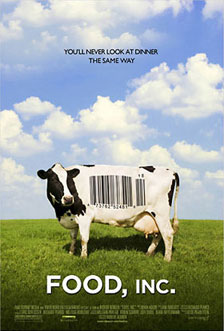
Food, Inc. was definitely the big budget production with slick graphics, aerials, and an emotion-wringing score. The film focused on the dark side of corporate, mass-produced products which we all know packaged and processed foods in the supermarket. Chickens and sides of beef hanging on large hooks passed on conveyors that filled huge buildings. One could almost smell the footage of in-your-face scenes of feedlots and slaughterhouses. Food, Inc. mentioned a lumber of lawsuits that Monsanto had filed against farmers for saving seeds, or getting their fields infected by GMO pollen (familiar ground if you have already seen The Future of Food). Monsanto took a drubbing in this film for suing farmers. Author Michael Pollan explained all processed foods are based in some ways from mass produced corn or soybeans. (If you’ve read The Omnivore’s Dilemma, you’re familiar with this information.) As the credits rolled, I felt I had been beaten by a gloomy sci-fi stick, only the future is now. Alternative organic farming was mentioned as a solution, but Joel Salatin’s enthusiasm seemed insufficient to overcome the horrors of factory farming and corporate foods.
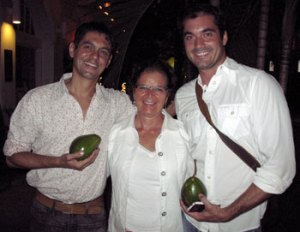
Luiz Rodrigues, ECOMB; Gabriele Marewski, Paradise Farms; Michael Laas, ECOMB
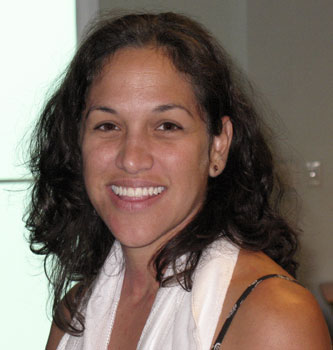
After the showing of Food Inc., organic farmer Gabriele Marewski of
Paradise Farms fielded questions. She bought an optimistic attitude (along with a big bowl of longans, avocados and mamey) that provided an antidote to the movie’s gloom. “The biggest revenge is to grow our own food,” she said. “Grow whatever you possibly can. It’s a movement and they can’t stop us.” She mentioned her new business venture, Miami Victory Gardens, a potting and growing system that anybody can put into their yard to raise their own herbs and vegetables. Gabriele described gardening as a spiritual exercise which allows you to “develop a relationship with food and your place in the world.”
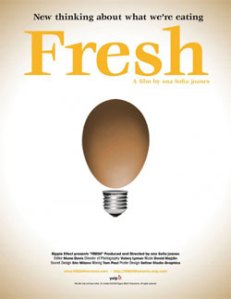
The next day I went to see FRESH, hesitantly thinking I would get more of the same. There are some overlaps between the two films. Both interviewed organic farmer Joel Salatin and author Michael Pollan. In Food, Inc., they were cast as voices criticizing the corporate food system, but in FRESH the conversations with them and other farmers are more thoughtful and optimistic, and the film’s slower pace allowed interviews to go deeper.
FRESH the movie
Salatin was beautifully photographed working on his farm herding cows to greener pastures, towing eggmobiles full of chickens in early morning mist, and hanging out with happy tail-wagging hogs. He spoke about growing a superior product on his own terms that people clamor for, and described his chickens as “fellow workers that you honor and respect and fully allow them to express their chickenness.” He is “committed to healing the land,” and he said that “part of the responsibility of being stewards of the earth is to respect the design of nature.”
Michael Pollan pointed out that cheap food is an illusion because ultimately it’s paid for by the environment, by subsidies, or by your declining health. “Local and organic costs more but it’s worth more,” he said. Conventional food may be cheaper, but its nutritional values are also cheaper, down by 40 percent. The big challenge remains in the “food deserts” of inner cities, where people want fresh food but can’t get it in their neighborhood stores.
One possible solution (as farmer Gabriele suggested) is to grow it yourself. FRESH interviewed Will Allen, urban farmer in Milwaukee and 2008 MacArthur Fellowship recipient, who teaches people how to raise their own food. (CSA member Melissa Contreras attended his workshop earlier this year.) “It is important that everybody has access to healthy, sustainable food,” Allen said. And what better way to do it than grow hanging pots of microgreens, build a tank and stock it with tilapia, and compost with lots and lots of squirmy worms? Urban farming, according to Allen, is a “social justice movement, based on how people live and how we treat each other.”
FRESH ended on a hopeful note. Every decision made in the supermarket creates the future for land, diversity, farmers and our own bodies, all by voting with our dollars, explained agricultural economist John Ikerd. “It’s a new vision for the future that we don’t have to wait for,” he said. “We can transform the whole system one person at a time by choosing what we buy and what we eat right now.”

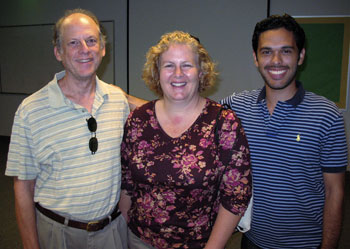
Scott Lewis, Melissa Contreras, Antonio Guadamuz, of Urban Oasis Project
Food, Inc. might scare you a bit, and FRESH will inspire you to plant some seeds. They both will certainly make you think. Hopefully those of us who do vote with our forks can help those who are stuck in food deserts or seas of nutritional ignorance. Over 400 people belong to the Redland Organics CSA. Hopefully our changes will ripple out to others, like our kids learning to make healthy choices, or friends who are willing to try something other than “foodlike substances” (to quote Michael Pollan).
As for the corporate food system, I suspect it won’t completely change until the growers change. This summer I was visiting relatives in southwest Wisconsin, in an area full of corn, wheat and soybean farms. They are family operations, and average about 100 acres. But since my last visit a few years ago, I saw more clusters of houses and less farms. The land gets sold because the farmer just can’t make a profit much longer, or the children don’t want to continue. Why don’t they switch to vegetable farming, I asked naively. Because that takes too much labor, I was told. Where are the farmer’s markets, I asked. Was told Hmong refugees who settled in the area grow their own kinds of vegetables and sell to each other, but that’s about it for local markets. Hmmm, maybe commodity farmers in Wisconsin need to see FRESH or talk to Salatin… I’m just sayin…
ana Sofia joanes article about making FRESH
http://www.huffingtonpost.com/ana-joanes/ifreshi—-new-thinking-a_b_201822.html

Alexandra Duffy, urban farmer
Thanks to Alexandra Duffy, urban farmer, who obtained the DVD of FRESH and organized the screening. Get your own copy from the movie web site.
Food, Inc. will be available on DVD in November. Watch the trailer here.
Resources mentioned in audience discussions are veggieswap.com, squarefootgardening.com, veggietrader.com, localfoodmiami.ning.com, and eatwild.com.
Read Full Post »




 Redland Rambles